
Most Probable Number (MPN) Test: Principle, Procedure, MPN Table, and Results

On this page
In August 2014, an outbreak of acute watery diarrhea affected over 6,000 residents in Kathmandu following monsoon flooding that contaminated municipal water supplies. The public health response required rapid assessment of microbial water quality across dozens of collection points.
For many of these samples (turbid, sediment-laden floodwater) the standard spread plate and pour plate methods were unreliable because suspended particles interfered with colony counting. The method that could handle these samples was the Most Probable Number (MPN) test.
MPN does not count individual colonies. Instead, it uses the statistical pattern of which dilution tubes turn positive to calculate the most probable number of viable organisms per 100 mL of sample. It is the method of choice for turbid water, sediments, sludge, and any sample where colony counts are not feasible.
MPN is used to estimate the concentration of viable microorganisms in a sample by means of replicating liquid broth growth in ten-fold dilutions. It is commonly used in estimating microbial populations in soils, waters, and agricultural products. MPN test is particularly useful with samples that contain particulate material that interferes with plate count enumeration methods.
MPN is most commonly applied for quality testing of water i.e. to ensure whether the water is safe or not in terms of bacteria present in it. A group of bacteria commonly referred to as fecal coliforms act as an indicator of fecal contamination of water. The presence of very few fecal coliform bacteria would indicate that water probably contains no disease‑causing organisms, while the presence of large numbers of fecal coliform bacteria would indicate a very high probability that the water could contain disease‑producing organisms making the water unsafe for consumption.
Principle
The MPN test is a statistical method for estimating viable bacterial concentration. It does not count individual bacteria directly, instead, it exploits the mathematics of serial dilution to estimate how many organisms were probably present in the original sample based on the pattern of positive and negative tubes.
The core concept, most probable number:
When a sample containing bacteria is serially diluted and inoculated into multiple tubes at each dilution, whether a given tube turns positive depends on how many organisms were present in that specific aliquot. At high concentrations, nearly all tubes will be positive. At very high dilutions, most tubes will be negative. The dilution at which tubes change from all-positive to all-negative contains the critical information about the original concentration.
The MPN value is defined as the concentration of viable organisms that, in the statistical sense, is most likely to have given the observed pattern of positive and negative tubes. It is not an exact count but a probability-based estimate, which is why results are reported with a confidence interval (usually 95%).
Why coliforms are indicator organisms?
MPN is most commonly used to detect and count coliforms: Gram-negative, non-spore-forming, facultatively anaerobic bacilli that ferment lactose with acid and gas production within 48 hours at 37°C. Total coliforms include organisms from the genera Escherichia, Klebsiella, Citrobacter, and Enterobacter. Thermotolerant (fecal) coliforms, primarily E. coli, grow at 44.5°C.
Coliforms are used as indicator organisms because their presence in water indicates likely fecal contamination and the potential presence of pathogens such as Salmonella, Vibrio cholerae, and hepatitis A virus. The absence of coliforms does not guarantee safety, but their presence is a reliable signal of unacceptable contamination.
The lactose fermentation signal:
Coliforms ferment lactose in the MPN tubes to produce:
- Acid: detected by a color change in the pH indicator (bromocresol purple or phenol red) in the medium
- Gas: detected as a bubble in the inverted Durham tube submerged in the medium
Gas production is the endpoint you read to call a presumptive tube positive: it appears as a bubble trapped in the inverted Durham tube. Acid production usually accompanies gas and shifts the pH indicator, but because many non-coliforms can produce acid without gas, gas in the Durham tube (not color change alone) is what marks the tube positive.
Why three steps: presumptive, confirmatory, and completed?
MPN uses a three-step approach because lactose fermentation is not exclusive to coliforms. Some non-coliform organisms (Aeromonas, certain Clostridium species, some yeasts) can also produce acid and gas from lactose, generating false positives in the presumptive test. The confirmatory and completed tests progressively eliminate these non-coliforms, improving specificity.
Procedure of the MPN Test
The MPN test is carried out in three sequential steps: presumptive, confirmatory, and completed, each narrowing the result toward confirmed coliforms.
Presumptive test
The presumptive test is a screening test to sample water for the presence of coliform organisms.
If the presumptive test is negative, no further testing is performed, and the water source is considered microbiologically safe.
If the presumptive test is negative, no further testing is performed, and the water source is considered microbiologically safe. If, however, any tube in the series shows acid and gas, the water is considered unsafe and the confirmed test is performed on the tube displaying a positive reaction.
The method of the presumptive test varies for treated and untreated water.
Requirements
- Medium: Lactose broth or MacConkey broth or Lauryl tryptose (lactose) broth
- Glassware: Test tubes of various capacities (20ml, 10ml, 5ml), Durham tube
- Others: Sterile pipettes
Preparation of the Medium
- Prepare medium (either MacConkey broth or lactose broth) in single and double strength concentrations.
- For untreated or polluted water :
Dispense double strength medium into 5 tubes (10 mL in each) and single strength medium into 10 tubes (10 mL in each), and add an inverted Durham tube to every tube. The 5 double-strength tubes receive the largest sample volume (10 mL); the 10 single-strength tubes are split into two sets of 5 for the 1 mL and 0.1 mL volumes.
- For treated water:
Dispense the double strength medium in 5 tubes (10mL in each tube) and 50 mL single strength medium in 1 bottle and add a Durham tube in an inverted position.
- Examine the tubes to make sure that the inner vial is full of liquid with no air bubbles.
- Sterilize by autoclaving at 15 lbs pressure (121°C) for 15 minutes.
Procedure of MPN test
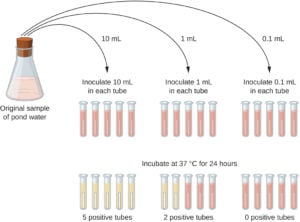 A. For untreated (polluted) water
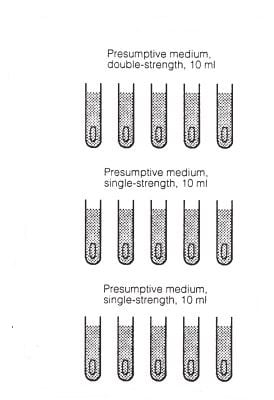 Figure: MPN Water Testing
- Take 5 tubes of double strength and 10 tubes of single strength for each water sample to be tested.
- Using a sterile pipette add 10 mL of water to 5 tubes containing 10 mL double strength medium.
- Similarly, add 1 mL of water to 5 tubes containing 10 mL single strength medium and 0.1 mL water to the remaining 5 tubes containing 10 mL single strength medium.
- Incubate all the tubes at 37°C for 24 hrs. If no tubes appear positive re-incubate up to 48 hrs.
- Compare the number of tubes giving a positive reaction to a standard chart and record the number of bacteria present in it. For example, a water sample tested shows a result of 3–2–1 (3 × 10 mL positive, 2 × 1 mL positive, 1 × 0.1 mL positive) gives an MPN value of 17, i.e. the water sample contains an estimated 17 coliforms per 100 ml.
NOTE: To view the full table download the PDF file from WHO Link (first reference)
B. For treated (unpolluted) water
- Take 1 tube of single strength (50mL) and 5 tubes of double strength (10mL) for each water sample to be tested.
- Using a sterile pipette add 50 mL of water to the tubes containing 50 mL single strength medium.
- Similarly, add 10 mL of water to 5 tubes containing 10 ml double strength medium.
- Incubate the tubes at 37°C for 24 hrs. If no tubes appear positive re-incubate up to 48 hrs.
- Compare the number of tubes giving a positive reaction to a standard chart and record the number of bacteria present in it.
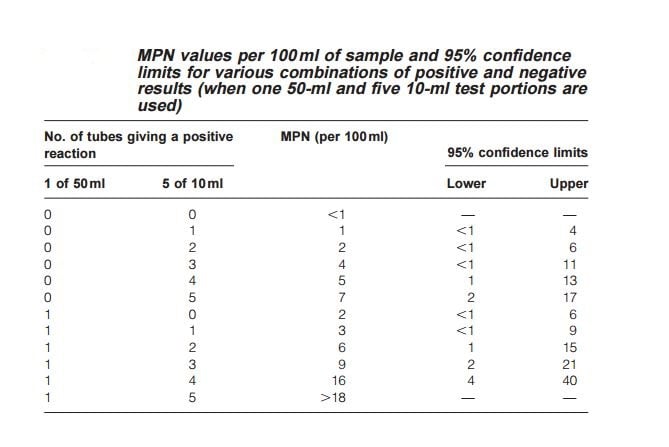 For example, a water sample tested shows a result of 1-4 (1 × 50 mL positive, 4 × 10 mL positive) gives an MPN value of 16, i.e. the water sample contains an estimated 16 coliforms per 100 mL.
Reading the MPN Table
The MPN table (also called the MPN index) converts the pattern of positive tubes across three successive dilutions into an estimated concentration. The standard 5-tube, 3-dilution configuration is most common.
How to record results:
After incubation, count the number of positive tubes at each of the three dilution levels and record as a three-digit sequence. For example: 3–2–1 means 3 positive tubes at the first dilution, 2 at the second, 1 at the third.
Look up this pattern in the MPN table to find the MPN index value. Multiply by the dilution factor to get the estimated count per 100 mL.
Worked examples:
Example 1. Untreated water:
- Volumes used: 10 mL (5 tubes), 1 mL (5 tubes), 0.1 mL (5 tubes)
- Results: 3 positive at 10 mL, 2 positive at 1 mL, 1 positive at 0.1 mL → pattern = 3-2-1
- MPN index from table = 17
- Result: 17 coliforms per 100 mL
- Interpretation: Exceeds WHO drinking water guideline of 0 coliforms per 100 mL → water unsafe
Example 2. Treated water:
- Volumes used: 50 mL (1 tube), 10 mL (5 tubes)
- Results: 1 positive at 50 mL, 4 positive at 10 mL → pattern = 1-4
- MPN index from the treated-water (50 mL + 5 × 10 mL) table = 16
- Result: 16 coliforms per 100 mL
- Interpretation: Any positive result in treated piped water → requires immediate investigation and remediation
WHO drinking water guideline (2022): Total coliforms should be absent (0 per 100 mL) in treated drinking water distributed through pipes. E. coli specifically should be absent in all drinking water. Any detection is a trigger for immediate investigation regardless of count.
How to use the MPN table for non-standard configurations:
The standard MPN table assumes a 10-fold dilution series (10 mL, 1 mL, 0.1 mL) with 5 tubes per dilution. If a different number of tubes or different volumes are used, a different table or calculation is required. When all tubes at a dilution are positive and all at the next dilution are negative (e.g., 5-5-0), report the result as "estimated >MPN index value." When all tubes at all dilutions are negative (0-0-0), report as "estimated <MPN index value at lowest dilution."
Confirmatory Test
Some microorganisms other than coliforms also produce acid and gas from lactose fermentation. In order to confirm the presence of coliform, a confirmatory test is done.
From each of the fermentation tubes with positive results transfer one loopful of medium to:
- 3 mL lactose-broth or brilliant green lactose fermentation tube,
- to an agar slant and
- 3 mL tryptone water.
Incubate the inoculated lactose-broth fermentation tubes at 37°C and inspect gas formation after 24 ± 2 hours. If no gas production is seen, further incubate up to a maximum of 48 ±3 hours to check gas production.
The agar slants should be incubated at 37°C for 24± 2 hours and Gram-stained preparations made from the slants should be examined microscopically.
The formation of gas in lactose broth and the demonstration of Gram-negative, non-spore-forming bacilli in the corresponding agar indicates the presence of a member of the coliform group in the sample examined.
The absence of gas formation in lactose broth or the failure to demonstrate Gram-negative, non-spore-forming bacilli in the corresponding agar slant constitutes a negative test (absence of coliforms in the tested sample).
Tryptone Water Test
- Incubate the tryptone water at (44.5 ±0.2°C) for 18-24 hours
- Following incubation, add approximately 0.1mL of Kovacs reagent and mix gently.
- The presence of indole is indicated by a red color in the Kovacs reagent, forming a film over the aqueous phase of the medium.
a. Confirmatory tests positive for indole, growth, and gas production show the presence of thermotolerant E. coli.
b. Growth and gas production in the absence of indole confirm thermotolerant coliforms.
Completed Test
Since some of the positive results from the confirmatory test may be false, it is desirable to do completed tests. For this inoculum from each positive tube of the confirmatory test is streaked on a plate of EMB or Endo agar.
In this process, a loopful of a sample from each positive BGLB tube is streaked onto selective medium like Eosin Methylene Blue agar or Endo’s medium. One plate each is incubated at 37°C and another at 44.5± 0.2°C for 24 hours.
High temperature incubation (44.5 ±0.2) is for detection of thermotolerant E.coli.
Following incubation, all plates are examined for the presence of typical colonies.
- Coliforms produce colonies with a greenish metallic sheen which differentiates it from non-coliform colonies (show no sheen). The presence of typical colonies on high temperature (44.5 ±0.2) indicates the presence of thermotolerant E.coli.
Advantages of MPN
- Ease of interpretation, either by observation or gas emission
- Sample toxins are diluted
- Effective for highly turbid samples such as sediments, sludge, and mud that cannot be analyzed by membrane filtration.
Disadvantages of MPN
- It takes a long time to get the results
- Results are not very accurate
- Requires more hardware (glassware) and media
- Probability of false positives
MPN vs Plate Count vs Membrane Filtration
| Feature | MPN | Spread / Pour Plate | Membrane Filtration |
|---|---|---|---|
| Principle | Statistical probability | Direct colony count | Direct colony count after filtration |
| Specimen type | Turbid, sediment-laden, viscous samples | Clear liquids, food homogenates | Clear or low-turbidity water samples |
| Count range | 1–1000 organisms/100 mL | 30–300 colonies/plate (after dilution) | 20–200 colonies/membrane |
| Time to result | 24–72 hours (3 steps) | 24–48 hours | 24–48 hours |
| Accuracy | Approximate (statistical estimate; 95% CI is wide) | More precise (direct count) | More precise (direct count) |
| Identifies organism? | No, requires confirmatory tests for speciation | Colonies available for isolation | Colonies available for isolation |
| Turbid samples | Yes, works well | No, interferes with colony counting | No, clogs membrane |
| Equipment needed | Test tubes, Durham tubes, incubator | Petri dishes, agar, water bath | Filtration apparatus, membranes, agar |
| Best for | Water quality; turbid environmental samples; coliforms at low counts | Food safety; clinical specimens; pure culture | Water quality; relatively clear water |
Decision rule:
- Sample is turbid or contains particulates → MPN
- Sample is clear liquid, count needed with colony isolation → membrane filtration or spread plate
- Count expected to be very low (<1 per mL) → MPN or membrane filtration
- Pure culture isolation needed alongside count → spread or pour plate
How to Remember
MPN is a probability estimate, not a direct count. This single distinction separates it conceptually from all plate-based methods. You are not counting colonies, you are counting which tubes turn positive and asking: "what concentration of organisms would most probably produce this pattern?"
The three-step sequence as a progressive filter:
| Step | What it does | What it detects | What it eliminates |
|---|---|---|---|
| Presumptive | Acid + gas from lactose broth | All acid + gas producers | Everything that can't ferment lactose |
| Confirmatory | Gas from BGLB + Gram-negative non-spore-forming bacilli | Confirmed coliforms | Non-coliform acid/gas producers (false positives) |
| Completed | Metallic sheen on EMB/Endo + Gram-negative NSFB | Complete coliform confirmation | Remaining false positives |
Each step narrows the field. The presumptive test is sensitive (catches everything); the completed test is specific (confirms coliforms only).
The Durham tube is a visual anchor: The Durham tube is an inverted small glass tube submerged in the liquid medium. As coliforms ferment lactose and produce gas (CO₂ and H₂), the gas displaces the liquid from the inverted tube, creating a visible air bubble.
No bubble = no gas = tube negative. Even a small bubble (about 10 percent of the tube volume) is positive. This simple visual makes MPN one of the most approachable methods in field and resource-limited microbiology.
Memory anchor for the indicator organism logic: E. coli is used as the indicator because: (1) it is present in the gut of all warm-blooded animals in large numbers; (2) it survives in water for a similar duration as most intestinal pathogens; (3) it is easy to detect by lactose fermentation; (4) it does not multiply in water (unlike some environmental coliforms). Detecting E. coli therefore means recent fecal contamination, not just environmental bacteria.
The three-dilution pattern as an exam question: When given a MPN result pattern (e.g., 4-2-0), the examiner is testing whether you can: (1) identify the positive tube counts at each dilution, (2) look up or recall the approximate MPN index, (3) apply the correct dilution factor, and (4) compare with the WHO guideline to state whether water is safe. Walking through this four-step process mentally is the correct approach.
References and further reading
- World Health Organization. (2022). Guidelines for Drinking-Water Quality (4th ed., incorporating the 1st and 2nd addenda). Geneva: WHO. https://www.who.int/publications/i/item/9789240045064
- American Public Health Association (APHA). (2017). Standard Methods for the Examination of Water and Wastewater (23rd ed.). APHA Press. [Method 9221: Multiple-Tube Fermentation Technique for Members of the Coliform Group]
- Madigan, M. T., Bender, K. S., Buckley, D. H., Sattley, W. M., & Stahl, D. A. (2021). Brock Biology of Microorganisms (16th ed.). Pearson.
- Cheesbrough, M. (2006). District Laboratory Practice in Tropical Countries, Part 2 (2nd ed.). Cambridge University Press.
Frequently Asked Questions
Why is the MPN test performed in three steps (presumptive, confirmatory, completed) rather than relying on the initial gas production result?
The presumptive test detects all organisms capable of fermenting lactose with acid and gas production at 37°C within 48 hours. This group includes not just coliforms but also some non-coliform organisms. Certain Aeromonas species, Clostridium species, and occasional yeasts also produce acid and gas from lactose but are not members of the coliform group.
Relying on the presumptive test alone would overestimate the coliform count by including these non-coliform false positives.
The confirmatory test (subculture to brilliant green lactose bile broth or BGLB) specifically suppresses non-coliform gram-negative bacteria and most gram-positive organisms, while confirming coliforms by their ability to survive the selective agents and continue fermenting lactose with gas.
The completed test adds microscopic examination to confirm the Gram-negative non-spore-forming bacillus morphology. Each step progressively narrows the candidates to confirmed coliforms.
In most water quality laboratories, the presumptive and confirmatory steps are used routinely, with the completed test reserved for reference or regulatory purposes.
What is the clinical significance of detecting faecal coliforms versus total coliforms in water testing?
Total coliforms include organisms from several genera (Escherichia, Klebsiella, Enterobacter, Citrobacter, Serratia) some of which occur naturally in soil and vegetation environments without indicating recent fecal contamination. The presence of total coliforms in water indicates a failure of water treatment or distribution system integrity, but does not specifically confirm fecal contamination.
Fecal coliforms (thermotolerant coliforms, primarily E. coli) are specifically adapted to the warm, nutrient-rich intestinal environment of warm-blooded animals and are shed exclusively in feces. Their detection at 44.5°C in the MPN test confirms recent fecal contamination of the water supply and therefore the potential presence of enteric pathogens including Salmonella, Shigella, Vibrio cholerae, hepatitis A virus, and rotavirus.
WHO drinking water guidelines specify zero tolerance for E. coli or thermotolerant coliforms in treated piped water precisely because their presence is a reliable proxy for these pathogenic organisms even when the pathogens themselves are undetectable by routine testing.
Why is acid alone not enough for a positive presumptive tube, why does gas matter?
Why is acid alone not enough for a positive presumptive tube, why does gas matter?
Many organisms can drop the pH of a lactose broth by producing acid, but only a subset of them release gas (CO₂ and H₂) during lactose fermentation. Coliforms are defined, in this test, by their ability to ferment lactose with gas production.
Scoring gas (the bubble in the Durham tube) as the endpoint therefore screens out a large number of acid-only fermenters that are not coliforms, which is why the Durham tube, not the color change alone, is what you read to call a presumptive tube positive.

Tankeshwar Acharya, MSc (Medical Microbiology)
Tankeshwar Acharya is an Assistant Professor in the Department of Microbiology at Patan Academy of Health Sciences (PAHS), Nepal, where he has been teaching and practicing clinical microbiology for over 14 years. He is the founder of Microbe Online, one of the leading free microbiology education resources on the web, covering bacteriology, mycology, parasitology, immunology, and clinical laboratory diagnostics written from direct experience in both the classroom and the diagnostic laboratory.
Comments
No comments yet. Be the first to share your thoughts.
Leave a comment
All comments are reviewed before they appear.