

A 34-year-old man who completed TB treatment three years ago comes back with a six-week cough. His Xpert result prints: MTB detected, trace. RIF resistance indeterminate.
The ward wants to start treatment today. But "trace" in a previously treated patient is the one result on the printout that may represent dead bacilli from his old disease rather than new active TB. And "indeterminate" means the machine detected the organism but could not read the rifampicin gene at all, so nobody knows yet whether the standard regimen will work for him.
Two lines of instrument output, and neither of them tells you what to do. This article is about reading the rest of the report.
What GeneXpert actually detects (and what it misses)
The GeneXpert MTB/RIF assay is a cartridge-based, automated nucleic acid amplification test (NAAT) that does two things at once, directly from a clinical specimen, in under two hours:
- Detects DNA of the Mycobacterium tuberculosis complex (MTBC)
- Detects mutations in the rpoB gene that confer rifampicin resistance
Conventional culture takes 2 to 6 weeks for MTBC to grow, and phenotypic drug susceptibility testing adds another 3 weeks on top. GeneXpert compresses that to a single shift.
The system integrates and automates specimen processing, DNA extraction, amplification, and detection inside one sealed disposable cartridge. Once the cartridge is loaded, there are no manual steps and no open-tube manipulation of amplified product.
What it does not detect
This is the part students consistently get wrong, so state it plainly:
| The assay does NOT detect | Why this matters |
|---|---|
| Isoniazid resistance | MDR-TB is defined as resistance to both INH and rifampicin. Xpert measures only rifampicin. The MDR-TB inference is a clinical shortcut based on the fact that RIF resistance usually travels with INH resistance, not a measurement. |
| Second-line drug resistance | Fluoroquinolone and injectable resistance require LPA or sequencing. |
| Non-tuberculous mycobacteria (NTM) | A negative Xpert in a patient with AFB-positive smear should raise suspicion of NTM. Xpert cannot identify it. |
| Species within MTBC | It cannot separate M. tuberculosis from M. bovis, M. africanum, or BCG. |
| Viability | It detects DNA, not living organisms. Xpert cannot be used to monitor treatment response. |
| rpoB mutations outside the RRDR | Roughly 5% of rifampicin-resistant strains carry mutations outside the region the assay reads, and these are reported as susceptible. |
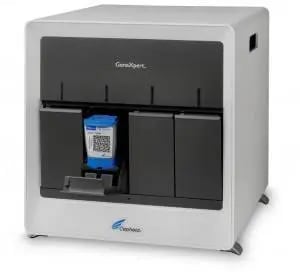 Figure: GeneXpert IV System
Principle of the GeneXpert MTB/RIF assay
The gene being read
Over 95% of rifampicin resistance in M. tuberculosis is caused by mutations in a short stretch of the rpoB gene, which encodes the beta subunit of bacterial RNA polymerase, the drug's target. That stretch is 81 base pairs long and is called the rifampicin resistance-determining region (RRDR), or the "core region."
Because almost all resistance is concentrated in these 81 bases, an assay that reads only this small window captures nearly all rifampicin-resistant strains. This is the single design insight that makes the whole test possible.
Hemi-nested real-time PCR
The cartridge performs a hemi-nested real-time PCR: an outer primer pair amplifies a larger fragment first, then an inner primer pair re-amplifies the RRDR from that product. The nesting step raises sensitivity and specificity beyond what a single round would achieve.
Five molecular beacons, and the logic of absence
Detection uses five molecular beacons, labeled A through E, that tile across the 81-bp core region with slight overlap.
A molecular beacon is a hairpin-shaped oligonucleotide carrying a fluorophore at one end and a quencher at the other. Closed, the two ends sit together and fluorescence is quenched. When the beacon finds a perfectly complementary target sequence, the hairpin opens, fluorophore and quencher separate, and the instrument records fluorescence.
Here is the key point, and it is the source of most interpretive confusion:
The assay does not read the mutation. It reads the failure of a probe to bind.
If all five beacons bind and fluoresce within the expected cycle threshold window, the sequence is wild type and the result is RIF resistance not detected. If any one beacon fails to bind, or binds unusually late (a delayed Ct relative to the others), the software concludes that the sequence under that beacon differs from wild type and reports RIF resistance detected.
The instrument never learns which base changed or whether the change is functionally meaningful. It only knows that one of five windows did not match.
This has two direct clinical consequences:
- False resistance. A silent (synonymous) mutation, or a rare non-resistance-conferring polymorphism inside the RRDR, prevents beacon binding and is reported as resistance even though the strain is fully susceptible. This is why a "detected" result requires confirmation.
- False susceptibility. A genuine resistance mutation lying outside the 81-bp window leaves all five beacons binding normally, and the strain is reported as susceptible.
Controls built into every cartridge
Two controls run alongside every specimen, and both must pass before a result is reportable.
- Sample Processing Control (SPC): a spore suspension of Bacillus globigii included in the cartridge. It verifies that the specimen was adequately processed, that lysis occurred, and that no PCR inhibitors are present. A failed SPC invalidates the run.
- Probe Check Control (PCC): performed before amplification begins. It verifies rehydration of reagents, PCR tube filling, probe integrity, and dye stability. A failed PCC produces an error, not an invalid.
Materials/System requirement
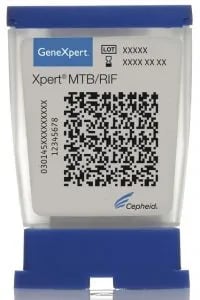 Figure: GeneXpert Cartridge
- GeneXpert System: equipped with GX2.1 software/computer/printer/barcode wand-reader and operator manual (Cepheid Inc, Sunnyvale, USA). It is available in a one, two, four, or 16-module configuration
- GeneXpert Cartridge: Single-use disposable Xpert MTB/RIF cartridges Sample extraction, amplification, and detection are all carried out within this self-contained cartridge.
- Class II biological safety cabinet (BSC)
- Sample reagent (provided in Xpert MTB/RIF kit), 8ml volume pack per cartridge. The sample reagent solution is clear but may range from colorless to golden yellow.
- Permanent marker pens.
- Sterile (individually packed) disposable transfer pipettes- with a single mark for a minimum volume of sample transfer to cartridge (provided in Xpert MTB/RIF kit).
- Sterile screw-capped specimen collection containers/cups.
- Discard containers for pipettes and sputum containers.
Specimen requirements and procedure
Accepted specimens
Pulmonary: expectorated or induced sputum (the validated and FDA-approved specimen), and, with WHO endorsement, nasopharyngeal aspirate, gastric aspirate, and stool for pediatric diagnosis.
Extrapulmonary: CSF, lymph node aspirate and tissue, pleural fluid, gastric aspirate, and other tissue biopsies. Sensitivity varies widely by specimen type and is lowest in pleural fluid.
For CSF, WHO gives the assay a strong recommendation as the initial test in suspected TB meningitis, because the alternative is waiting weeks while a patient with a high case-fatality condition goes untreated. Where volume permits, concentrate the CSF and use the pellet.
Sputum processing
- Collect at least 1 mL of sputum in a sterile, screw-capped container.
- Add sample reagent (SR) at 2:1 by volume (2 parts SR to 1 part sputum). Sample reagent is NaOH plus isopropanol.
- Shake vigorously 10 to 20 times, incubate 10 minutes at room temperature, shake again, and incubate a further 5 minutes.
- Total contact time is 15 minutes minimum. This step both liquefies the specimen and inactivates mycobacteria, which is why it matters for biosafety as much as for chemistry.
- Transfer 2 mL of the treated specimen into the cartridge with the provided sterile transfer pipette, up to the fill mark.
- Load the cartridge and start the run.
Biosafety note: specimen manipulation before the 15-minute inactivation step is the only aerosol-generating part of the procedure and should be done in a Class II biological safety cabinet where one is available. After inactivation, the closed cartridge presents minimal risk. In settings without a BSC, WHO permits Xpert testing at the same biosafety level as direct sputum smear microscopy.
Reading the result: semi-quantitative grades
Xpert does not simply report "positive." It reports a semi-quantitative grade derived from the cycle threshold (Ct) of the earliest rpoB probe to bind. The earlier a probe binds, the more target DNA was present, and the heavier the bacillary load.
Result | Approximate Ct of earliest rpoB probe | Interpretation |
|---|---|---|
MTB detected, high | Under 16 | Heavy bacillary load. Almost always smear-positive and highly infectious. |
MTB detected, medium | 16 to 22 | Moderate load. Usually smear-positive. |
MTB detected, low | 22 to 28 | Low load. Often smear-negative. |
MTB detected, very low | Over 28 | Paucibacillary. Frequently smear-negative, culture may be negative. |
MTB detected, trace | No rpoB Ct at all (Ultra only) | IS targets positive, rpoB below detection. RIF resistance cannot be called. |
MTB not detected | No amplification | See the limitations section. Does not exclude TB. |
Why the grade changes what you do
The grade is not decoration. It carries three separate pieces of clinical information:
Infectiousness and isolation. A "high" or "medium" result identifies the patient most likely to be transmitting, and supports prioritizing airborne isolation and contact tracing.
Confidence in the RIF call. Rifampicin resistance calls made on very low and trace specimens are the least reliable, because there is barely enough template for five probes to be assessed independently. A "RIF resistance detected" on a very low specimen carries a substantially higher false-positive risk than the same call on a high-grade specimen.
Distinguishing old from new disease. This is the trap in the opening case. Dead bacilli from previously treated TB can shed DNA into sputum for months to years. A very low or trace result in a patient with a treatment history may represent that residual DNA rather than active disease. The same result in a treatment-naive patient with typical symptoms and chest X-ray changes is much more likely to be true active TB.
A very low or trace result never stands alone. It is read against treatment history, symptoms, radiology, and, where possible, a repeat specimen and culture.
Reading the result: rifampicin resistance
| Report line | What the instrument saw | What to do |
|---|---|---|
| RIF resistance not detected | All five beacons bound within the expected window | Treat as rifampicin-susceptible and start a first-line regimen. Still send culture and phenotypic DST, because INH resistance is unmeasured and RRDR-external mutations are missed. |
| RIF resistance detected | One or more beacons failed to bind or bound late | Start an MDR/RR-TB regimen without waiting, but confirm with a second molecular method. Do not wait for confirmation before starting treatment in a high-burden setting. |
| RIF resistance indeterminate | MTBC detected, but rpoB signal insufficient to call | Repeat with a fresh specimen. Send for culture and phenotypic DST. Common on very low and trace specimens. |
Confirming a "detected" result
Because the assay infers resistance from probe failure rather than reading the mutation, a positive resistance call should be confirmed. The preferred confirmatory methods are now:
- Line probe assay (LPA), first-line and second-line, which also reports isoniazid, fluoroquinolone, and injectable resistance
- Targeted next-generation sequencing (tNGS), which reads the actual mutation and can distinguish silent changes from resistance-conferring ones
- Phenotypic DST on culture, which remains the reference standard
These are preferred over Sanger sequencing of rpoB alone, because the choice of regimen depends on the isoniazid and fluoroquinolone results as much as on rifampicin. A patient with confirmed RR-TB who is fluoroquinolone-susceptible may be eligible for a shorter all-oral regimen; one who is not requires a longer individualized regimen.
Do not delay treatment while confirming. In a high-TB-burden setting the pre-test probability of true resistance is high enough that the correct sequence is: start the MDR/RR regimen, confirm in parallel, and de-escalate if the confirmation contradicts the Xpert result.
Errors, invalid, and no result
Three non-result outputs exist and they are not interchangeable. Each has a different cause and a different repeat rule.
| Output | What it means | Common causes | What to do |
|---|---|---|---|
| Invalid | The specimen was processed but the SPC failed. The result cannot be trusted. | PCR inhibitors, inadequate lysis, insufficient or excessively viscous specimen, wrong SR ratio | Repeat with a new specimen and a new cartridge. Check that the 2:1 SR ratio and 15-minute inactivation were followed. |
| Error | The run aborted on an instrument or cartridge fault, usually a failed probe check or a pressure fault. | Cartridge overfilled, cartridge underfilled, reagent not rehydrated, plunger or valve failure, module fault, power interruption | Repeat with a new cartridge. If the same module errors repeatedly, take the module out of service and call service. |
| No result | The run was stopped before completion. | Operator stopped the run, power loss mid-run | Repeat with a new cartridge. |
Practical distinction to hold onto: Invalid points at the specimen. Error points at the cartridge or instrument. If you keep getting invalids on the same patient, look at the sputum. If you keep getting errors on the same module, look at the machine.
Persistent errors clustered in one module are a calibration or valve problem, not a specimen problem, and no amount of recollecting sputum will fix them.
Where GeneXpert fits in the diagnostic algorithm
The Centers for Disease Control and Prevention (CDC) recommends that NAA testing be performed on at least one respiratory specimen from patients who have a moderate or high suspicion of having pulmonary TB.
A positive Xpert result does not close the workup, and this is the point most often lost in practice.
Xpert replaces smear microscopy as the initial test. WHO recommends a rapid molecular test, not microscopy, as the first test for anyone with signs and symptoms of TB. Microscopy is retained where it still adds value, mainly for treatment monitoring, since Xpert cannot distinguish live from dead bacilli.
Xpert does not replace culture. Culture is still required to:
- perform phenotypic DST, including isoniazid and second-line drugs
- provide an isolate for genotyping and outbreak investigation
- detect NTM in an Xpert-negative, AFB-positive patient
- confirm cure at the end of treatment
A practical sequence for a patient with presumptive pulmonary TB:
- Collect sputum. Send for Xpert Ultra as the initial test.
- Simultaneously send a specimen for AFB smear and mycobacterial culture.
- If MTB detected and RIF not detected: start first-line treatment; await culture and DST.
- If MTB detected and RIF detected: start an MDR/RR regimen; send for LPA or tNGS and phenotypic DST in parallel.
- If MTB not detected but clinical suspicion remains high: repeat on a second specimen, pursue culture, consider bronchoscopy, and consider NTM and alternative diagnoses.
Xpert MTB/RIF versus Xpert MTB/RIF Ultra
Xpert MTB/RIF sensitivity is suboptimal, particularly in smear-negative and HIV-associated TB. Xpert MTB/RIF Ultra was developed by Cepheid as the next-generation assay to address these limitations, and it runs on the same GeneXpert platform. WHO now recommends Ultra as the initial diagnostic test for TB and rifampicin resistance in adults with signs and symptoms of pulmonary TB.
| Feature | Xpert MTB/RIF (G4) | Xpert MTB/RIF Ultra |
|---|---|---|
| PCR format | Hemi-nested | Fully nested |
| Reaction chamber | 25 µL | 50 µL |
| MTBC targets | rpoB only | rpoB plus multicopy IS6110 and IS1081 |
| RIF detection chemistry | 5 molecular beacons | 4 sloppy molecular beacons with melting curve analysis |
| Limit of detection | ~131 CFU/mL | ~16 CFU/mL |
| Semi-quantitative grades | High, medium, low, very low | High, medium, low, very low, trace |
| Turnaround | ~112 minutes | ~65 to 87 minutes |
Why the multicopy targets matter
rpoB is present in a single copy per bacillus. IS6110 is present at roughly 16 copies per cell. Adding IS6110 and IS1081 gives Ultra many more template copies to find in a paucibacillary specimen, which is where the roughly eight-fold improvement in limit of detection comes from. This is why Ultra outperforms Xpert most dramatically in exactly the populations where Xpert struggled: smear-negative disease, HIV-associated TB, pediatric TB, and extrapulmonary specimens.
Melting curve analysis instead of simple binding
Ultra reads rifampicin resistance differently. Instead of five beacons that either bind or fail, Ultra uses four sloppy molecular beacons and detects mutations in the RRDR as a shift in melting temperature away from the wild-type value. Sloppy beacons tolerate mismatches and bind anyway, but at a different Tm. Reading the size and direction of that shift, rather than mere absence of signal, allows Ultra to distinguish some silent mutations from true resistance mutations and reduces the false-resistance rate.
The trace result
A trace result occurs when one or both of the IS6110 and IS1081 probes are positive at a Ct below 37, but no more than one rpoB probe is positive. Because rpoB is essentially unread, rifampicin resistance cannot be interpreted on a trace specimen. Trace is a category that exists only on Ultra, and it is the direct price of Ultra's higher sensitivity: the assay can now detect DNA below the level at which it can characterize it.
How to act on a trace result:
For children, people living with HIV being evaluated for pulmonary TB, and anyone being evaluated for extrapulmonary TB, a trace result counts as bacteriological confirmation of TB. In these groups the disease is genuinely paucibacillary and trace is the expected finding, not an artifact.
For everyone else, particularly adults with a history of previous TB treatment, a trace result should prompt a repeat test on a fresh specimen. If the repeat is also trace or negative, interpret against clinical and radiological findings rather than treating the trace as confirmation. Trace results in previously treated adults carry the highest risk of representing residual DNA from cured disease.
Trace never yields a rifampicin result, so every trace requires culture and DST if treatment is to be started.
Advantages of the Xpert MTB/RIF Assay
- Rapid detection of Mycobacterium tuberculosis complex DNA and rpoB mutations conferring rifampicin resistance, with results in under two hours. The assay does not detect isoniazid resistance.
- Availability of quick test results leads to improved patient management and outcomes, and preventing unnecessary use of resources (avoiding unnecessary treatment, respiratory isolation).
- Fully automated system; minimal technical training is required to run the test.
- Prompt (quick) identification of multidrug-resistant TB (MDR TB)* cases as resistance to RIF, in most instances, co-exists with resistance to INH. Rapid diagnosis of rifampin (RIF) resistance potentially allows TB patients to start on effective treatment much sooner than waiting for results from other types of drug susceptibility testing. If rifampicin resistance is detected, confirm with a line probe assay or targeted next-generation sequencing, which also report isoniazid and second-line resistance.
*MDR TB is TB that is resistant to both isoniazid (INH) and Rifampicin (RIF).
Limitations
- A negative Xpert does not exclude TB. Sensitivity is well below culture, and lowest in smear-negative, pediatric, HIV-associated, and extrapulmonary disease. Clinical suspicion overrides a negative result.
- It cannot distinguish species within MTBC, so M. bovis and BCG are reported the same as M. tuberculosis.
- It does not detect NTM. An AFB-positive, Xpert-negative specimen suggests NTM and needs culture and identification.
- It cannot distinguish live from dead organisms, so it is unsuitable for treatment monitoring and can be positive in cured patients.
- Rifampicin resistance is inferred, not read (on the standard assay), so both false-resistant and false-susceptible results occur.
- Isoniazid resistance is invisible. Isoniazid-monoresistant TB is reported as fully susceptible.
- Roughly 5% of RIF-resistant strains carry mutations outside the RRDR and are missed.
- False-positive rifampicin resistance is concentrated in paucibacillary specimens. Interpret RIF calls on very low grades with caution.
- Culture is still required for all MTB-positive specimens, for phenotypic DST and genotyping.
- Operational constraints: cartridges require 2 to 28 °C storage, the instrument needs stable power and annual calibration, and modules fail individually. These are real limiting factors in the settings where the test is most needed.
How to Remember
Five probes, one gene, 81 bases: it is a barcode scanner, not a reader. Xpert scans rpoB the way a checkout scanner reads a label. It does not care what the letters say, only that all five bars scan cleanly. A bar that fails to scan is called resistance, even when the underlying change was harmless. That single image explains false resistance, the need for confirmation, and why sequencing is a different kind of test.
"Trace means treated, until proven otherwise." Of all the grades, trace and very low are the two most likely to be old DNA rather than new disease, and previous treatment is the history that should make you pause.
RIF alone, not the pair. MDR needs two drugs; Xpert measures one. Whenever you are tempted to say "Xpert diagnosed MDR-TB," correct it to "Xpert diagnosed rifampicin resistance, which usually predicts MDR-TB."
Invalid points at the patient, Error points at the machine. Repeated invalids mean go back to the sputum. Repeated errors on one module mean go back to the instrument.
Ultra's two gains and one cost: two extra targets (IS6110, IS1081) buy sensitivity; melting curves buy specificity on rifampicin; and the price is a trace category that cannot give you a rifampicin answer at all.
Key exam facts in one table
| Question | Answer |
|---|---|
| Test type | Cartridge-based, automated hemi-nested real-time PCR (nested in Ultra) |
| Target gene for resistance | rpoB, 81-bp RRDR ("core region") |
| Protein encoded by rpoB | Beta subunit of bacterial RNA polymerase, the target of rifampicin |
| Proportion of RIF resistance in the RRDR | Over 95% |
| Detection chemistry, Xpert | 5 molecular beacons (A to E) |
| Detection chemistry, Ultra | 4 sloppy molecular beacons plus melting curve analysis |
| Additional Ultra targets | IS6110 and IS1081 (multicopy insertion sequences) |
| Limit of detection | ~131 CFU/mL (Xpert); ~16 CFU/mL (Ultra) |
| Turnaround time | Under 2 hours (Xpert ~112 min; Ultra ~65 to 87 min) |
| Semi-quantitative grades | High, medium, low, very low (plus trace on Ultra) |
| Basis of the grade | Ct of the earliest binding rpoB probe |
| Sample reagent ratio | 2 parts SR to 1 part sputum |
| Inactivation time | 15 minutes minimum, with intermittent shaking |
| Internal controls | Sample Processing Control (SPC) and Probe Check Control (PCC) |
| SPC organism | Bacillus globigii spores |
| Drugs assessed | Rifampicin only |
| Definition of MDR-TB | Resistance to both isoniazid and rifampicin |
| Can it monitor treatment? | No. It detects DNA from dead and live organisms alike. |
| Does a positive Xpert remove the need for culture? | No. Culture is needed for phenotypic DST and genotyping. |
| WHO-recommended initial test (current) | Xpert MTB/RIF Ultra |
| Trace as confirmation | Accepted as bacteriological confirmation in children, people living with HIV, and extrapulmonary TB |
Where students get confused
- Thinking Xpert tests isoniazid. MDR-TB is defined by INH plus RIF, so students assume the assay that "diagnoses MDR-TB" must measure both. It measures rifampicin and infers the rest.
- Reading "MTB not detected" as "no TB." The assay's sensitivity is below culture, particularly in the paucibacillary populations where it is most used.
- Treating "RIF resistance detected" as a final diagnosis. It is a screening call based on probe failure and needs a confirmatory method that reads the actual mutation, especially when the grade is very low.
- Confusing Invalid, Error, and Indeterminate. Invalid is a failed SPC (specimen problem, new specimen). Error is a failed probe check or instrument fault (machine problem, new cartridge). Indeterminate means MTB was found but the rifampicin call could not be made (repeat and culture).
- Ignoring the semi-quantitative grade. Many report only "MTB detected" and drop the grade, discarding information about infectiousness, RIF-call reliability, and the possibility of residual DNA.
- Assuming a positive Xpert makes culture unnecessary. Culture is still needed for isoniazid and second-line DST, genotyping, and NTM detection.
- Believing Xpert can monitor treatment response. It detects DNA regardless of viability, so it stays positive in patients who are responding.
- Thinking trace is just a very weak positive. Trace is qualitatively different: rpoB was not read at all, so it never carries a rifampicin result.
- Assuming the whole rpoB gene is sequenced. Only 81 base pairs are interrogated, which is why RRDR-external mutations are missed.
References
- World Health Organization. WHO consolidated guidelines on tuberculosis. Module 3: Diagnosis. Rapid diagnostics for tuberculosis detection, 3rd ed. Geneva: World Health Organization; 2024.
- World Health Organization. WHO operational handbook on tuberculosis. Module 3: Diagnosis. Rapid diagnostics for tuberculosis detection. Geneva: World Health Organization; 2024.
- Tille PM, editor. Bailey and Scott's Diagnostic Microbiology. 15th ed. St. Louis: Elsevier; 2022.
- Leber AL, editor. Clinical Microbiology Procedures Handbook. 4th ed. Washington DC: ASM Press; 2016.
- Procop GW, Church DL, Hall GS, Janda WM, editors. Koneman's Color Atlas and Textbook of Diagnostic Microbiology. 7th ed. Philadelphia: Wolters Kluwer; 2017.
- Chakravorty S, Simmons AM, Rowneki M, et al. The new Xpert MTB/RIF Ultra: improving detection of Mycobacterium tuberculosis and resistance to rifampin in an assay suitable for point-of-care testing. mBio. 2017;8(4):e00812-17.
- Cepheid. Xpert MTB/RIF Ultra package insert. Sunnyvale, CA: Cepheid.
- Zifodya JS, Kreniske JS, Schiller I, et al. Xpert Ultra versus Xpert MTB/RIF for pulmonary tuberculosis and rifampicin resistance in adults with presumptive pulmonary tuberculosis. Cochrane Database of Systematic Reviews.
- Centers for Disease Control and Prevention. Report of an expert consultation on the uses of nucleic acid amplification tests for the diagnosis of tuberculosis. Atlanta: CDC.

Comments
No comments yet. Be the first to share your thoughts.
Leave a comment
All comments are reviewed before they appear.