
Biological Safety Cabinet Classes I, II, and III: Which Class for Which Organism

On this page
A laboratory sets up mycobacterial cultures inside a clean, well-maintained cabinet with a HEPA filter and a visible airflow indicator. Everything about it looks like a biosafety cabinet. It is a horizontal laminar airflow cabinet, and its filtered air flows outward, across the work surface and into the face of whoever is sitting at it. The cabinet is protecting the cultures beautifully. It is delivering every aerosol those cultures generate straight to the operator's breathing zone.
This is one of the most common and most dangerous equipment errors in microbiology, and it happens because the two cabinets look nearly identical from the front. The difference is invisible: which way the air moves, and therefore who is being protected.
Choosing a biological safety cabinet is not a choice between older and newer equipment. It is a choice between engineering solutions to three different problems. Who needs protecting: the worker, the product, the environment, or all three? The answer decides the class.
What is a biological safety cabinet, and what protection does it provide?
A biological safety cabinet (BSC) is an engineering control that protects people, the environment, and products from exposure to infectious or biohazardous aerosols and splashes. It does this by controlling airflow direction: air is drawn inward at the worker's face to protect them, downward over the work surface to protect the product, and exhausted through HEPA filtration to protect the environment.
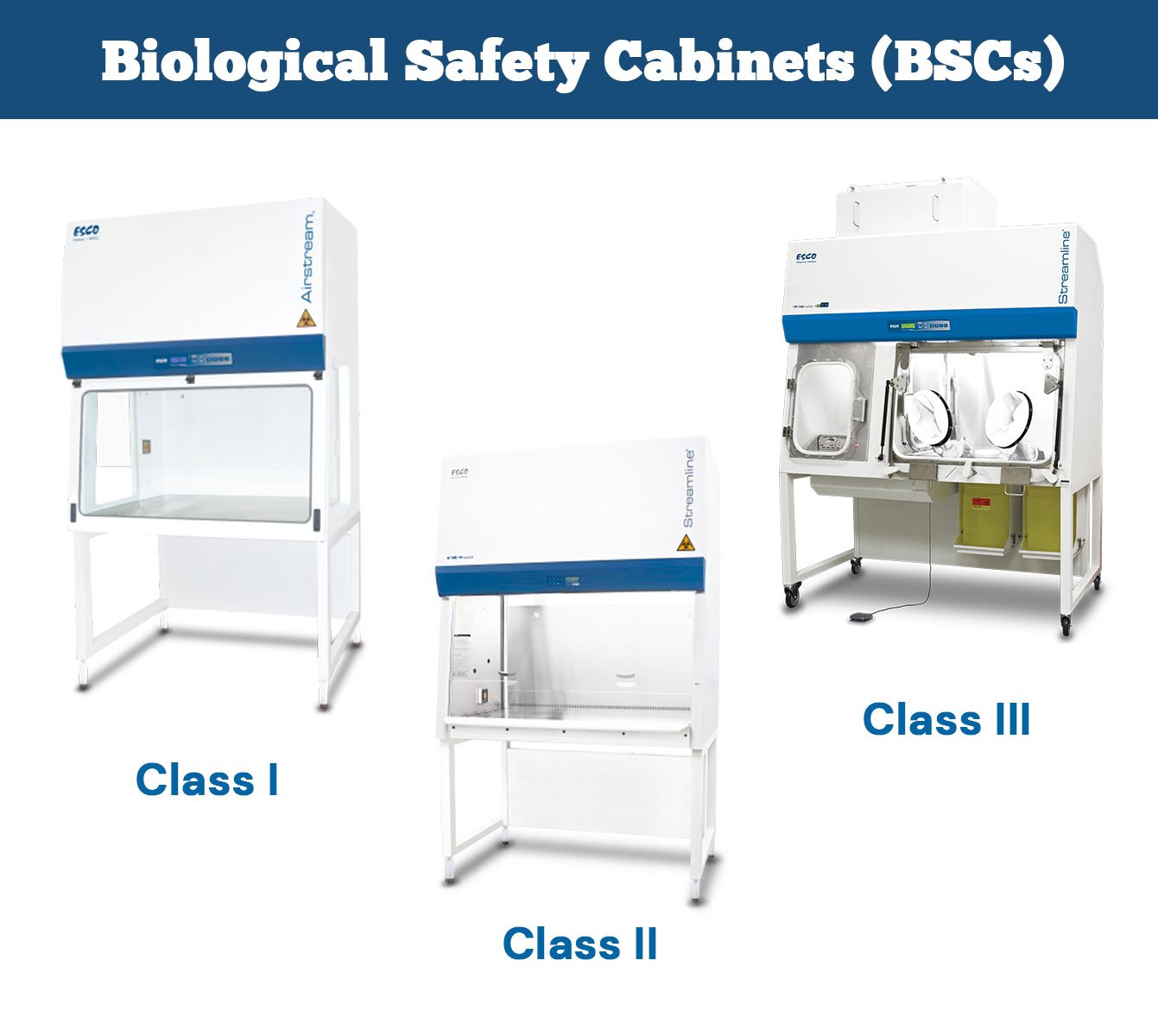 Figure: Biological Safety Cabinets (BSCs)
There are three classes of biological safety cabinets, and the difference between them is not "more or less safe." It is which combination of protections each provides. Every BSC protects the worker and the environment. Only Class II and III protect the product. The choice of which class you use depends on the risk group of the organism and the biosafety level (BSL) of the laboratory.
The core concept: Think of each class as answering a different question:
- Class I: "How do I protect my workers and the environment from this organism?" (Personnel + environmental protection)
- Class II: "How do I protect my workers, the environment, AND keep my work sterile?" (Personnel + environmental + product protection)
- Class III: "How do I handle the most dangerous organisms on Earth and never let anything escape?" (Maximum containment for RG4 agents)
A laminar airflow cabinet looks similar but answers a completely different question; for how the two differ, see Laminar Airflow Cabinet: Types and Working Principle.
Which BSC class for which biosafety level and risk group?
The choice of BSC class is not about preference; it is set by regulation based on the organism's risk group and the biosafety level of your laboratory:
| Biosafety Level | Risk Group | Appropriate BSC Class | Why this class |
|---|---|---|---|
| BSL1 | RG1 (non-pathogenic) | No BSC required; open-bench work is permitted | BSL1 organisms don't require containment. A biosafety cabinet is not mandatory, though one may be used if working with liquid cultures. |
| BSL2 | RG2 (moderate risk) | Class II (most common) | RG2 organisms can cause human disease, so Class II's three-way protection (worker, product, environment) is necessary. Class II is required for aerosol-generating procedures at BSL2. |
| BSL3 | RG3 (serious or lethal disease) | Class II or Class III, depending on the specific organism and procedures | RG3 organisms are serious; Class II is usually adequate, but some institutions use Class III for the highest-risk agents. |
| BSL4 | RG4 (life-threatening, high transmission) | Class III (or Class II inside a positive-pressure suit) | Class III is the standard for RG4. The organism is too dangerous for anything less than maximum containment. |
Key point: Class II is the standard for BSL2 work. Class I provides personnel and environmental protection but no product protection, so it is unsuitable wherever cultures must stay sterile or cross-contamination matters, which covers most diagnostic and research work. Follow your institution's biosafety policy and the requirements of your national regulator, which may be stricter than the general guidance here.
Class I Biological Safety Cabinet
Appropriate for: BSL1 work and BSL2 work in some older or resource-limited laboratories, though Class II is preferred at BSL2.
Protection provided: Personnel (worker) and environmental protection only. Does NOT protect the product or work from external contamination.
Working mechanism:
Room air is drawn in through the front opening at a minimum face velocity of 0.36 m/s (measured at the sash opening). This inward airflow protects the worker by drawing any aerosols away from the operator's breathing zone. The aerosols and other air are then directed downward and out through a HEPA filter that traps 99.97% of particles ≥0.3 µm in diameter, ensuring that only microbe-free exhaust air is discharged from the cabinet to the laboratory environment.
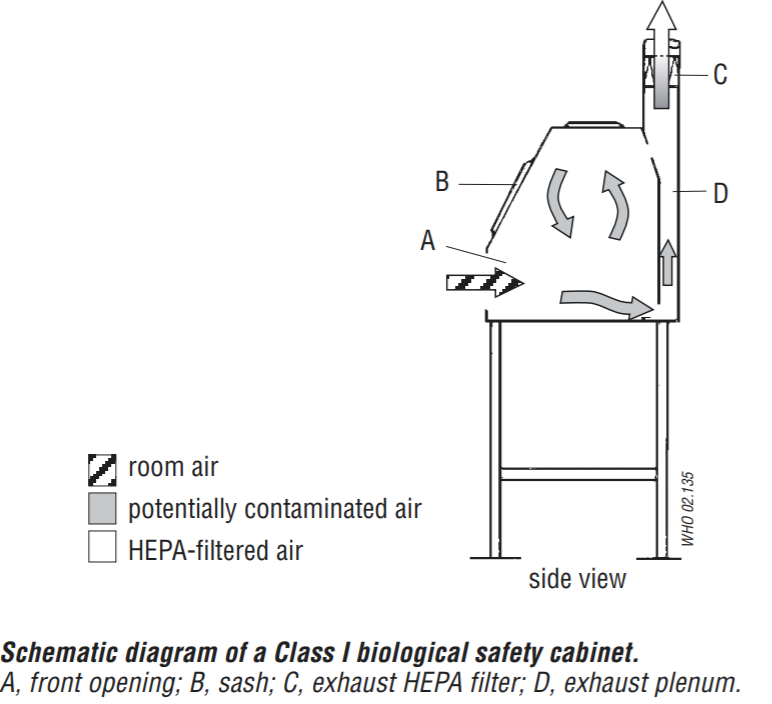 The operator's arms reach through the front opening to access the work surface while observing through a glass sash window. The window can be fully raised for cleaning or other access.
Critical limitation: Unsterilized room air flows over the work surface, so any cultures, media, or products inside the cabinet are exposed to external contamination. This is why Class I is not appropriate for work requiring sterile conditions or for product protection. For BSL2 work where both worker and product protection are required, Class II is the correct choice.
Class II Biological Safety Cabinet
Appropriate for: BSL2 and BSL3 work with Risk Group 2 and Risk Group 3 organisms, and with tissue culture work requiring sterile conditions.
Protection provided: Personnel (worker), product, and environmental protection. This is why Class II is the standard for the vast majority of microbiology and diagnostic laboratories.
Types of Class II cabinets:
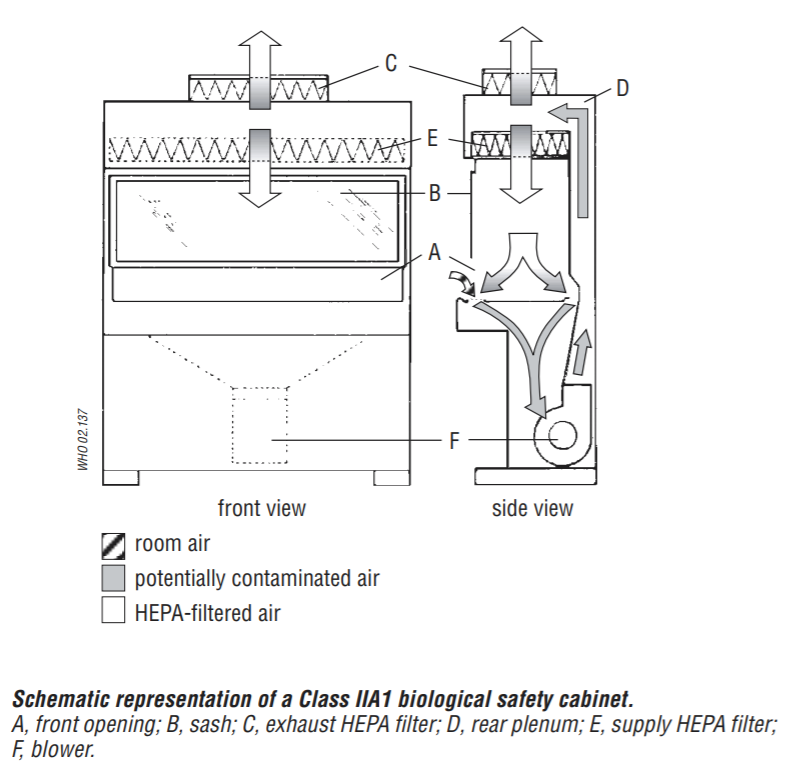 There are four types of Class II cabinets, distinguished by how much air recirculates within the cabinet versus how much is exhausted to the room or outside:
- Type A1: 70% recirculated, 30% exhausted; exhaust can go to the room or through a thimble connection. Lower cost, suitable for many BSL2 applications.
- Type A2: 70% recirculated, 30% exhausted; exhaust can go to the room or through a thimble connection. About 90% of Class II cabinets installed worldwide are Type A2. This is the workhorse of diagnostic and research labs.
- Type B1: 30% recirculated, 70% exhausted; requires hard-duct external exhaust (connection to building exhaust, not to the room). Used when volatile chemicals or more robust containment is needed.
- Type B2 (Total Exhaust): 0% recirculated, 100% exhausted; requires hard-duct external exhaust. Provides maximum containment of volatile agents; less common due to cost and energy use.
For most BSL2 and BSL3 work, Type A2 is sufficient and is the standard choice.
Working mechanism:
An open front with inward airflow protects the worker from aerosols. HEPA-filtered air flows downward over the work surface, providing product protection (keeping cultures sterile and preventing cross-contamination). The combination of inward airflow, downward flow, and HEPA filtration on exhaust provides the three-way protection that makes Class II the standard for work with pathogenic organisms.
Class III Biological Safety Cabinet
Appropriate for: BSL3 and BSL4 work with Risk Group 3 and Risk Group 4 organisms. Class III is the highest level of containment in a conventional laboratory.
Protection provided: Maximum personnel, product, and environmental protection. This cabinet is designed for work with the most dangerous organisms on Earth.
Working mechanism:
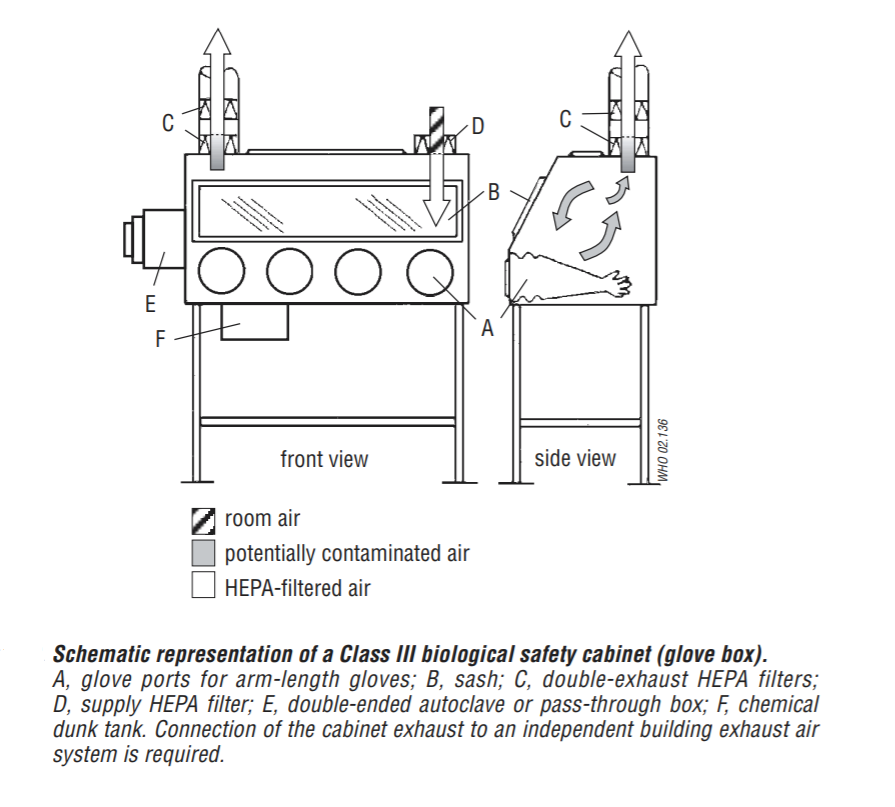 The cabinet is totally enclosed and maintains negative pressure (the interior is under lower pressure than the room, so any leak is inward, not outward). The operator accesses the work surface only through heavy-duty rubber gloves that are integral to the cabinet enclosure. Supply air is HEPA-filtered; exhaust air passes through two HEPA filters before discharge to the atmosphere through a dedicated external exhaust system.
The cabinet is tested under pressure to verify that no particles can escape into the room. A Class III cabinet is often connected to a pass-through sterilization chamber or double-door autoclave, so all materials entering and exiting the cabinet can be decontaminated without exposing the laboratory environment.
When Class III is used: A researcher working with Ebola virus or another RG4 agent does so exclusively in a Class III cabinet in a BSL4 laboratory. This is not a choice or a preference; it is a regulatory requirement. There is no alternative.
Technical specifications of BSC classes
| Feature | Class I | Class II A1 | Class II A2 | Class II B1 | Class II B2 | Class III |
|---|---|---|---|---|---|---|
| Face velocity (m/s) | 0.36 | 0.38 | 0.51 | 0.51 | 0.51 | Not applicable (enclosed) |
| Air recirculated (%) | 0% | 70% | 70% | 30% | 0% | 0% |
| Air exhausted (%) | 100% | 30% | 30% | 70% | 100% | 100% |
| Exhaust system | Hard duct (external) | Room exhaust through HEPA, or hard duct | Thimble or room exhaust | Hard duct (external) | Hard duct (external) | Hard duct (external) + double HEPA |
| Product protection | NO | YES | YES | YES | YES | YES |
| Typical use | BSL1, some BSL2 | BSL2, BSL3 | BSL2, BSL3 (most common) | BSL2, BSL3 with minute quantities of volatile chemicals | BSL2, BSL3 with volatile toxic chemicals or radionuclides | BSL3, BSL4 |
Key reading note: Higher exhaust percentage (B1 and B2) means more air leaves the cabinet rather than recirculating. This is chosen when volatile chemical fumes or maximum containment is needed, but it uses more energy. For most BSL2/BSL3 work, Type A2 is sufficient and preferred.
Certification and maintenance
A BSC is not a "set it and forget it" tool. Like any engineering control, it requires verification and maintenance:
- Initial certification: Before a new cabinet is put into service, a qualified technician must certify it, verifying airflow patterns, HEPA filter integrity, and containment of contaminated air. This is a regulatory requirement.
- Recertification: Most regulations require recertification every 12 months. Some jurisdictions require it every 6 months for heavily used cabinets.
- Filter replacement: HEPA filters have a lifespan and must be replaced when they reach saturation or if airflow becomes compromised. A clogged filter reduces protection.
- Sash operation: If a Class II cabinet's sash is stuck or moving irregularly, the airflow pattern is disrupted, and protection is compromised. Have it serviced before using the cabinet.
A cabinet that has not been certified recently is not providing verified protection, and in most jurisdictions its use is not permitted. Know the certification status of your cabinet before you work in it.
Important: Do not confuse BSC with laminar airflow cabinets
A biological safety cabinet and a laminar airflow cabinet are NOT interchangeable. They look similar and both have filtration, but they protect different things:
- A BSC protects the worker and the environment from biohazards. Inward airflow protects the worker; outward exhaust protects the environment.
- A laminar airflow cabinet protects the product from contamination. Outward airflow (toward the worker) provides no worker protection.
Using a laminar airflow cabinet for work with pathogens is a serious safety violation. For the full comparison, see Laminar Airflow Cabinet: Types and Working Principle.
How to Remember
- Class I = worker and environment only. Class II = worker, environment, and product. Class III = fortress. The more letters and protection targets, the more comprehensive the containment.
- Inward face flow = worker protected. Downward laminar flow = product protected. Both + exhaust HEPA = environment protected. Three problems, three solutions.
- Type A2 is the workhorse. 90% of BSCs are Type A2. If you're not sure which type to use at BSL2, it's probably A2.
- Class choice follows the organism, not the budget. RG2 work at BSL2 needs Class II because the work itself must stay sterile. Availability is not a reason to drop a class.
- Certification is not a one-time event. A cabinet without current certification is not providing protection, even if it looks fine. Know when your cabinet was last certified before you use it.
Key exam facts in one table
| Scenario | Correct BSC Class | Why | Common Error |
|---|---|---|---|
| Working with E. coli K-12 at BSL1 | None required; open bench is acceptable (Class I optional) | BSL1 organisms pose minimal risk; a cabinet is not mandatory | Assuming all microbiology work needs a cabinet |
| Aerosol-generating procedure with Salmonella at BSL2 | Class II (Type A2 or better) | RG2 organisms require product and worker protection; aerosols are the main exposure route | Using Class I for BSL2 work, leaving cultures unprotected |
| Routine culture work with Mycobacterium tuberculosis at BSL3 | Class II or Class III depending on procedure | RG3 organisms require robust containment; Class II is acceptable for most BSL3 work unless the organism is unusually hazardous | Assuming Class I is "good enough" for BSL3 |
| Work with Ebola virus at BSL4 | Class III (mandatory) | RG4 organisms require maximum containment; there is no alternative | Using anything other than Class III (not permitted) |
| Tissue culture work with mammalian cells (non-biohazard) | Class II preferred (protects product sterility) | Mammalian cell culture requires product protection to prevent cross-contamination; Class I does not provide it | Using Class I for tissue culture and contaminating experiments |
Bottom line: Let the risk group decide. RG2 → Class II. RG3 → Class II or III. RG4 → Class III only.
Where Students Get Confused
- Thinking Class I is "simpler" or "cheaper" so it's okay to use for BSL2 work. Class I protects you and the environment, but not your work. For most BSL2 procedures, cultures must stay sterile and cross-contamination must be prevented, which is why Class II is the standard. Choosing Class I because it is cheaper or already installed means accepting contaminated cultures and unreliable results.
- Confusing Class II BSC with laminar airflow cabinets. They look similar but are opposite. A Class II has inward airflow (away from worker) and protects the worker. A laminar airflow cabinet has air flowing toward the worker and provides no worker protection. Never confuse them. See Laminar Airflow Cabinet: Types and Working Principle for the distinction.
- Assuming "Type A2 is most common" means "Type A2 is right for every BSL2 lab." Type A2 is the standard, but Type B1 and B2 are needed in certain circumstances (volatile chemicals, maximum containment, specific institutional requirements). Check your lab's SOP, not just the common default.
- Thinking certification is a one-time event. Certification must be recurrent (usually annually). A cabinet that hasn't been certified in two years is not providing verified protection, even if it looks fine. Know the certification date before you work.
- Believing you can work in a Class II with the sash fully open. Class II cabinets have a recommended sash height (usually 8–12 inches). Working with the sash wide open disrupts the airflow pattern and compromises protection. Keep the sash at the appropriate height.
- Not recognizing that RG4 work has only one option. If your organism is RG4, you use Class III. There is no "upgrading to a higher-end Class II" that will work. The choice has been made for you by biology.
References and further reading
- U.S. Department of Health and Human Services, CDC and NIH. Biosafety in Microbiological and Biomedical Laboratories (BMBL). 6th ed. Atlanta, GA: CDC; 2020.
- World Health Organization. Laboratory Biosafety Manual. 4th ed. Geneva: WHO; 2020.
- Richmond JY, McKinney RW. Primary Containment for Biohazards: Selection, Installation and Use of Biological Safety Cabinets. 2nd ed. Washington, DC: U.S. Department of Health and Human Services, CDC, NIH; 2000.
- American Biological Safety Association International. Biological Safety Cabinets: Selection, Use and Maintenance. Mundelein, IL: ABSA International.
- NSF International/ANSI. NSF/ANSI 49: Biosafety Cabinetry: Design, Construction, Performance, and Field Certification. NSF International.
Frequently Asked Questions
When do I need a biosafety cabinet, and when is open-bench work okay?
What is the difference between Class I, Class II, and Class III cabinets?
Can I use a Class I cabinet for BSL2 work?
What is the difference between Type A2, Type B1, and Type B2 cabinets?
How often does a biosafety cabinet need to be certified?
What is the difference between a biosafety cabinet and a laminar airflow cabinet?
Is a Class II cabinet enough for all BSL3 work?

Tankeshwar Acharya, MSc (Medical Microbiology)
Tankeshwar Acharya is an Assistant Professor in the Department of Microbiology at Patan Academy of Health Sciences (PAHS), Nepal, where he has been teaching and practicing clinical microbiology for over 14 years. He is the founder of Microbe Online, one of the leading free microbiology education resources on the web, covering bacteriology, mycology, parasitology, immunology, and clinical laboratory diagnostics written from direct experience in both the classroom and the diagnostic laboratory.
Comments
No comments yet. Be the first to share your thoughts.
Leave a comment
All comments are reviewed before they appear.