
Automated Culture Media Preparation: What Gets Automated, Benefits, and When It Is Worth It

On this page
A technologist spends the morning making a batch of blood agar: weighing powder, dissolving it over a hot plate while stirring so it does not scorch, autoclaving, waiting for it to cool to just the right temperature, adding blood without contaminating it, then pouring plate after plate by hand, each one a slightly different depth, one hot flask nearly slipping. By afternoon the batch is done, and it is already running low because the next day's samples need more.
Media preparation is one of the most time-consuming, repetitive, and quietly hazardous jobs in a microbiology lab, and almost none of it requires the expertise the technologist actually trained for. That gap, high effort, low skill, constant repetition, is exactly what automated media preparation is built to close.
What automated media preparation is
Culture media are the foundation of the microbiology laboratory: without them, bacteria and yeasts cannot be isolated or identified. Preparing media by hand is a multi-step process that is lengthy, tedious, and demands constant attention. An automated culture media preparation and dispensing system takes over the most laborious of those steps, the dissolving, sterilizing, supplement addition, and dispensing, so that laboratory staff can spend their time on work that genuinely needs their expertise.
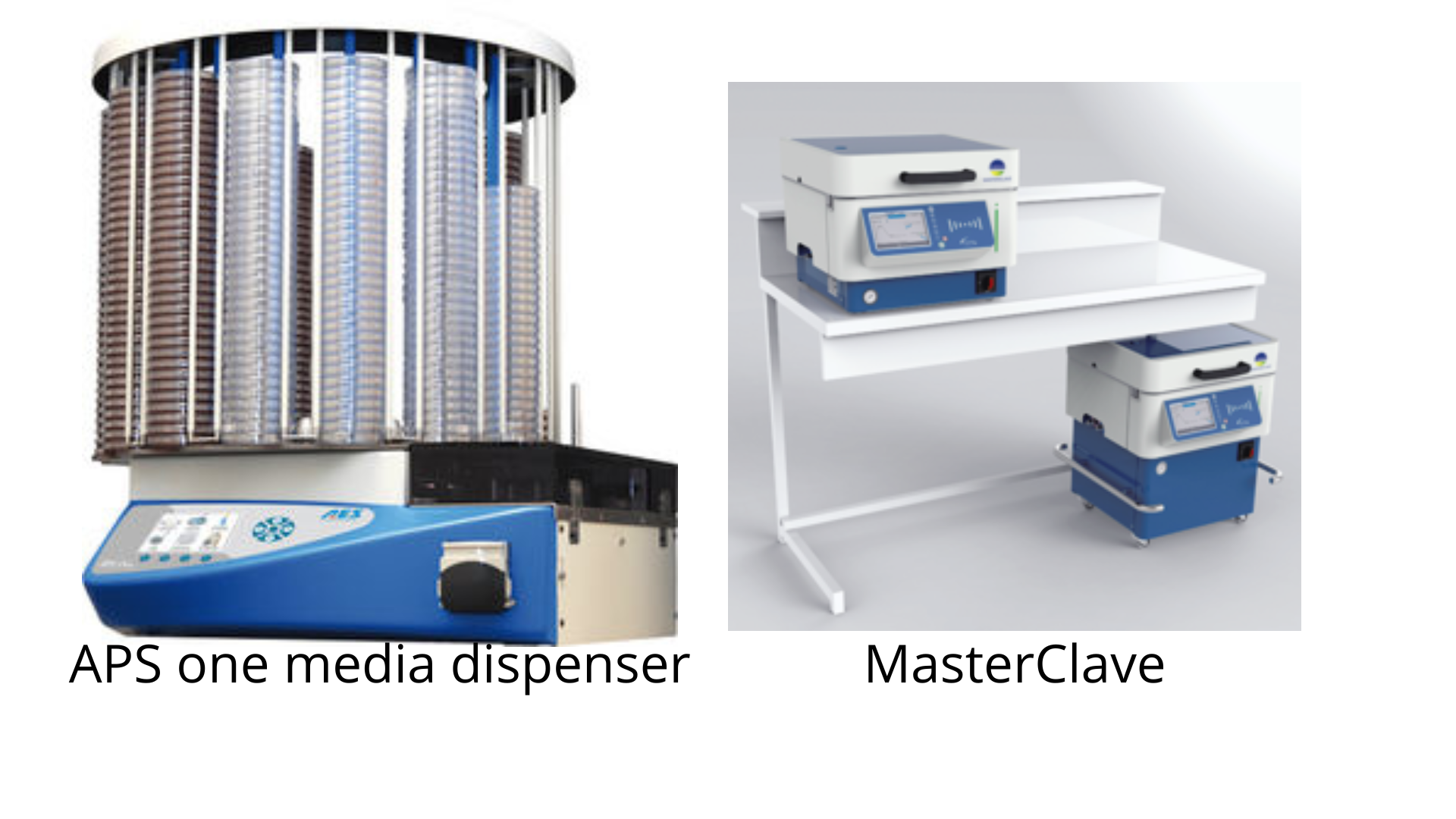 Figure: Automated Culture Media Preparation and Dispenser
Commercial systems combine media preparation and dispensing, often as a preparator unit (which dissolves and sterilizes) paired with a dispenser or plate-pourer. Several manufacturers offer them; check current models and specifications directly, since instrument lines change. These standalone systems handle the media-preparation step only; where the whole laboratory workflow is automated end to end, see Total Laboratory Automation.
The manual workflow, and where automation targets each step
To see what automation actually does, start with the manual workflow. Media preparation involves: weighing the powdered media, measuring distilled water, dissolving the powder by heating, sterilizing (usually by autoclaving), adding any heat-sensitive supplements after cooling, pouring into plates or tubes, and labeling. Automation targets the steps that are most laborious and error-prone, not all of them.
Weighing and measuring (usually still manual). Weighing the powder and measuring the water are typically done by the operator, since they set up the batch. Automation begins after this.
Dissolving the powder. Manually, the powder is dissolved by heating to boiling while stirring so it does not scorch or boil over, a step that needs watching. Automated preparators use a heated, magnetically stirred vessel that dissolves the powder evenly and controls the heating, removing the constant supervision.
Sterilization. Manually, the dissolved medium is transferred to an autoclave and sterilized, with someone monitoring the cycle, and then transferred back. Automated systems sterilize in the same vessel, no transfer, so heating, sterilizing, and holding happen in one closed unit.
Supplement addition. This is the step where automation adds the most value. Heat-sensitive supplements (blood for blood agar, urea for urea broth) must be added after the medium cools, and in manual work this means opening the sterile vessel, risking contamination at the worst moment. Automated systems add supplements through a sealed port or septum, by a small aseptic opening or a syringe, without breaking the sterile seal.
Dispensing and plate pouring. Automated dispensers, also called automated plate pourers or plate pouring systems, pour a consistent, pre-set volume into every plate or tube, at high throughput (systems can fill hundreds to around 900 plates per hour), with a walk-away capability and easy switching between plate sizes. Consistent depth matters: it affects how evenly a specimen streaks and how reproducibly colonies grow.
Labeling. Manual labeling usually records only the media name. Automated systems can print or imprint the media name, preparation date, and expiry, and generate barcodes, which feeds directly into inventory management.
The pattern across all six: automation takes the repetitive, hazardous, or contamination-prone steps (dissolving, sterilizing, supplement addition, dispensing, labeling) and leaves the judgment steps (deciding what to make, how much) with the operator.
Benefits
Frees skilled staff for skilled work. The biggest benefit. Dissolving, pouring, and labeling need little expertise but consume hours. Automating them lets trained staff spend their time on microscopy, staining, reading plates, and interpreting results, the work that actually needs a microbiologist.
Fewer contamination points. Every manual step is a chance for the medium to be contaminated, and the riskiest is opening a sterile vessel to add supplements. Sealed supplement addition and reduced handling lower that risk substantially.
Consistency and fewer errors. Automated dispensing gives uniform fill volumes, so plates behave the same way at the bench. Automated labeling with printed tags and barcodes prevents the mislabeling and lost-tag errors common in manual work. Because the system works in a closed vessel rather than glassware, it also removes the risk of broken glass.
Higher throughput. Preparation vessels handle large volumes (commonly on the order of 10 to 30 liters per batch) and dispensers fill hundreds of plates per hour, so a lab is far less likely to run short of media and interrupt work to make more.
Better safety. Staff no longer hand-pour hot media or handle heated glassware, reducing burns and spills.
Better inventory control. Printed preparation and expiry dates and barcodes make it easy to track what media exist, how old they are, and when they expire.
Limitations and cost
Automation is not right for every lab, and the main reason is cost. It is a capital investment, not the affordable upgrade it is sometimes presented as.
High capital cost. Automated media preparation and dispensing systems are significant capital investments, not a cheap upgrade. For a small laboratory, the purchase price, consumables, service contracts, and space requirements may not be justified by the volume of media it prepares. Automation pays off when media throughput is high enough to offset the cost.
Best suited to high, steady volume. The benefit scales with how much media a lab makes. A lab preparing modest volumes may find manual preparation more economical.
Dependence on the system. As with any central automated equipment, a breakdown can halt media supply. A lab relying on automation should keep a manual fallback (hot plate, autoclave, manual pouring) and a service arrangement, so a failure does not stop testing.
Not every step is automated. Weighing and initial measuring are usually still manual, and some specialized media may not suit the system. Automation reduces manual labor; it does not eliminate it.
When it is worth it
Automation makes sense when: media volumes are high and consistently so; the lab frequently runs short of media and staff spend significant time preparing it; contamination or fill-consistency problems recur with manual preparation; or trained staff are scarce and their time is better spent on skilled work than on pouring plates. It makes less sense for a small, low-volume lab where the capital cost outweighs the time saved.
How to Remember
Automate the sweat, keep the judgment. The system takes the laborious, low-skill steps, dissolving, sterilizing, supplement addition, pouring, labeling, and leaves the decisions (what media, how much) to the operator. Weighing and measuring usually stay manual.
Supplement addition is the contamination win. The single most valuable automated step. Adding blood or urea to cooled media manually means opening a sterile vessel at the worst moment. Automation adds it through a sealed port, no broken seal, no contamination.
Consistent depth, consistent colonies. Hand-poured plates vary in depth; machine-poured plates do not. Uniform fill means specimens streak and colonies grow reproducibly. That consistency is a quality benefit, not just a convenience.
The catch is cost, not difficulty. These are expensive capital instruments. They pay off at high, steady media volume, not in a small low-volume lab. If someone calls automation a cheap upgrade, they have the economics backward.
Key exam facts in one table
| Concept | Fact to remember |
|---|---|
| What is automated | Dissolving, sterilizing, supplement addition, dispensing, and labeling of culture media |
| Usually still manual | Weighing the powder and measuring the water |
| Dissolving | A heated, magnetically stirred vessel dissolves powder evenly without scorching |
| Sterilization | Done in the same closed vessel, no transfer to a separate autoclave |
| Supplement addition | Added through a sealed port or syringe without opening the sterile vessel (the key contamination benefit) |
| Dispensing | Uniform preset volume per plate, high throughput (up to around 900 plates per hour), walk-away |
| Labeling | Prints media name, preparation and expiry dates, and barcodes for inventory |
| Main benefit | Frees skilled staff from repetitive low-skill work |
| Main limitation | High capital cost; justified only at high, steady media volume |
Where Students Get Confused
Automation does not replace every step. Weighing the powder and measuring the water are usually still manual. The operator sets up the batch; the machine handles the laborious middle and end. Automation reduces manual work, it does not remove the operator.
Why sealed supplement addition matters. Heat-sensitive supplements like blood and urea must be added after the medium cools. Doing this manually means opening the sterile vessel, the highest-risk moment for contamination. Automated systems add them through a sealed port, which is the point of the feature.
Consistent fill depth is a quality issue, not just neatness. Uneven plate depth changes how specimens streak and how colonies grow. Uniform machine dispensing makes results more reproducible, so it is a genuine quality benefit.
Automation is not a cheap upgrade. These are costly capital instruments. They save time and improve quality, but they pay off only when media volume is high enough to justify the expense. For a small lab, manual preparation can be more economical.
Media preparation is not the same as media dispensing. Preparation is dissolving and sterilizing; dispensing is pouring into plates or tubes. Automated systems often combine both, but they are distinct functions, and some products do only one.
References
- Tille PM. Bailey & Scott's Diagnostic Microbiology. 15th ed. St. Louis: Elsevier; 2022.
- Leber AL, editor. Clinical Microbiology Procedures Handbook. 4th ed. Washington, DC: ASM Press; 2016.
- rapidmicrobiology. Automating Media Preparation in the Laboratory. Available at: https://www.rapidmicrobiology.com/test-method/automating-media-preparation-in-the-laboratory
Frequently Asked Questions
What steps does an automated media preparation system handle?
What steps does an automated media preparation system handle?
It typically automates dissolving the powdered media, sterilizing it, adding heat-sensitive supplements, dispensing into plates or tubes, and labeling. Weighing the powder and measuring the water are usually still done manually by the operator.
Why is automated supplement addition important?
Why is automated supplement addition important?
Supplements like blood or urea are added after the medium cools, and adding them manually means opening the sterile vessel, which risks contamination. Automated systems add supplements through a sealed port or syringe without breaking the sterile seal, greatly reducing that risk.
How many plates can an automated dispenser fill?
How many plates can an automated dispenser fill?
Throughput varies by system, but automated dispensers can fill on the order of several hundred to around 900 plates per hour, with consistent fill volume and a walk-away capability, far faster and more uniform than hand-pouring.
Is automated media preparation cheaper than manual preparation?
Is automated media preparation cheaper than manual preparation?
Not upfront. These are expensive capital instruments. They save staff time and improve consistency, but they pay off only when a lab prepares media in high, steady volumes. For a small, low-volume laboratory, manual preparation is often more economical.
Does automation completely remove the need for staff?
Does automation completely remove the need for staff?
No. An operator still weighs powder, sets up batches, monitors the system, and does the skilled bench work. Automation removes the repetitive, low-skill, and hazardous steps so staff can focus on tasks that need expertise, such as reading and interpreting cultures.
What happens if the automated system breaks down?
What happens if the automated system breaks down?
Media supply can be interrupted, so labs that rely on automation should keep a manual fallback (hot plate, autoclave, manual pouring) and a service contract. This prevents a single equipment failure from halting testing.

Tankeshwar Acharya, MSc (Medical Microbiology)
Tankeshwar Acharya is an Assistant Professor in the Department of Microbiology at Patan Academy of Health Sciences (PAHS), Nepal, where he has been teaching and practicing clinical microbiology for over 14 years. He is the founder of Microbe Online, one of the leading free microbiology education resources on the web, covering bacteriology, mycology, parasitology, immunology, and clinical laboratory diagnostics written from direct experience in both the classroom and the diagnostic laboratory.
Comments
No comments yet. Be the first to share your thoughts.
Leave a comment
All comments are reviewed before they appear.