
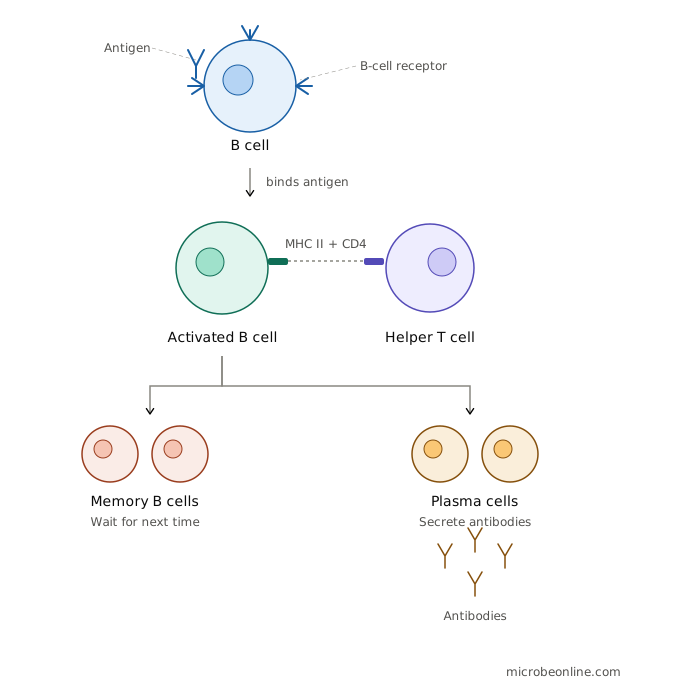
Humoral Immunity: Stages and Steps of the Antibody Response
Humoral immunity explained step by step: how a B cell meets antigen, gets T-cell help, and produces antibodies and memory, plus the active and passive types with examples.
Humoral immunity explained step by step: how a B cell meets antigen, gets T-cell help, and produces antibodies and memory, plus the active and passive types with examples.
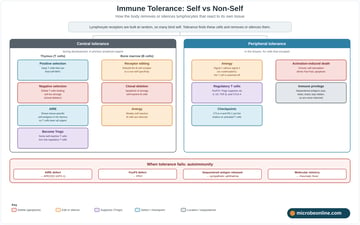
How the immune system learns self-tolerance: central and peripheral tolerance, clonal deletion, receptor editing, anergy, Tregs, and autoimmunity.
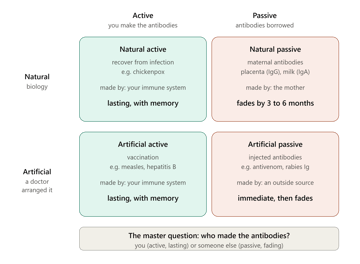
The difference between active and passive immunity, with the four types (natural and artificial) and clear examples: vaccination, infection, maternal antibodies, and antivenom. For...
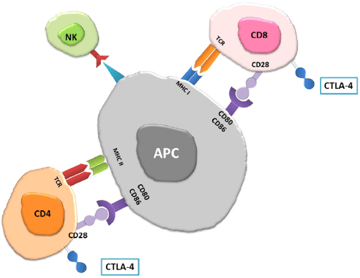
What antigen-presenting cells are, the three professional APCs (dendritic cells, macrophages, B cells), how they differ from non-professional APCs, and what makes a cell "professio...
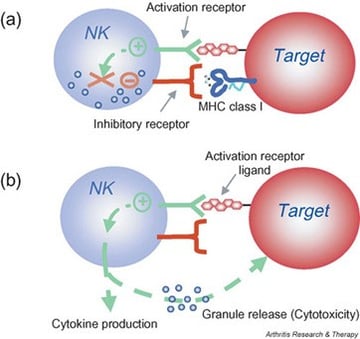
What natural killer (NK) cells are, how the missing-self mechanism lets them catch virus-infected and tumor cells that hide from T cells, and how they bridge innate and adaptive im...
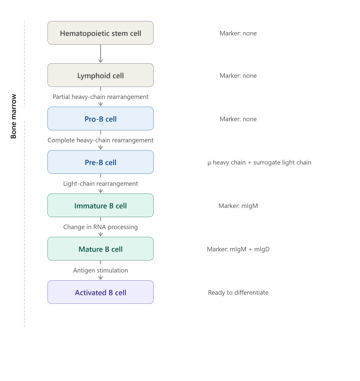
How humoral immunity works, stage by stage: B cell maturation in the bone marrow, activation by antigen, and differentiation into antibody-secreting plasma cells and memory cells....
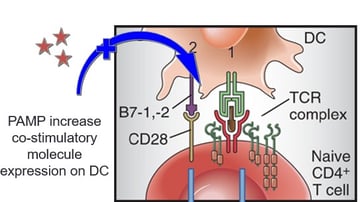
How a naive T cell is activated: the two-signal model (TCR-MHC plus co-stimulation), signal 3, and the intracellular cascade from Lck and ZAP-70 to NFAT, AP-1, and NF-kB. For micro...
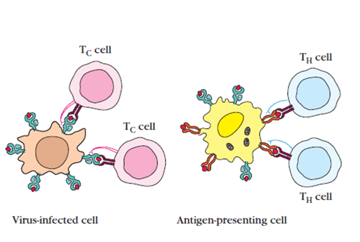
How cell-mediated immunity defends against intracellular pathogens and tumors: the T cell subsets, how cytotoxic T cells kill (perforin, granzyme, Fas), and what happens when CMI f...
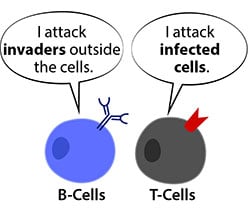
B cells vs T cells compared point by point: where they mature, how each recognizes antigen, their receptors, CD markers, and blood proportions. The one difference that explains all...
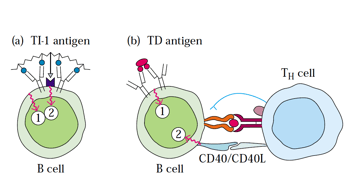
How T-dependent (protein) and T-independent (polysaccharide) antigens activate B cells differently, why polysaccharides give no memory, and how conjugate vaccines convert a polysac...
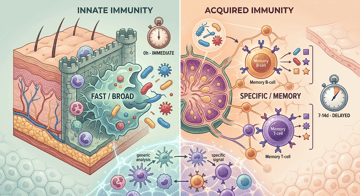
Innate vs adaptive (acquired) immunity compared point by point: speed, specificity, memory, and how the two systems work as partners rather than rivals. Full comparison table, the...
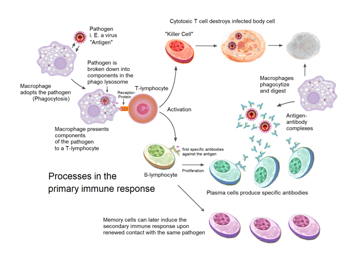
Primary vs secondary immune response explained by mechanism: why the first response is slow and IgM-dominant, why the second is fast and IgG-dominant, and how memory cells, affinit...
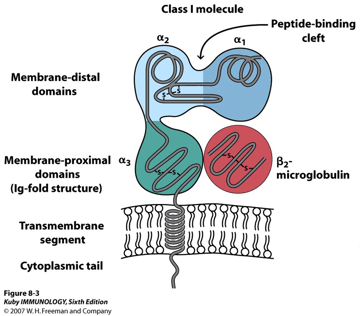
How MHC class I and class II differ: which cells carry them, endogenous vs exogenous processing, the rule of eight (CD8-MHC I, CD4-MHC II), and why MHC polymorphism matters. For mi...