
McFarland Turbidity Standards: Preparation and Use in Susceptibility Testing

On this page
A susceptibility test comes back calling an organism susceptible to an antibiotic, treatment is started, and the patient does not improve. On review, the problem was not the antibiotic. The inoculum used to set up the test had been too light, far below the density it should have been, so the zones of inhibition grew larger than they should have and a resistant organism was read as susceptible.
This is exactly what the McFarland standard exists to prevent. Matching a bacterial suspension to a 0.5 McFarland standard fixes the inoculum at the density antimicrobial susceptibility testing was validated for, and getting that one step right is the difference between a result you can trust and one that misleads treatment.
A McFarland turbidity standard is a reference suspension of known turbidity used to estimate the density of a bacterial suspension without counting cells. It is made by mixing set volumes of 1% barium chloride and 1% sulfuric acid, which react to form a fine barium sulfate (BaSO4) precipitate whose cloudiness corresponds to a known cell density.
The most important is the 0.5 McFarland standard, which matches a suspension of about 1.5 x 10⁸ CFU/mL and is the density used to set up antimicrobial susceptibility testing by the Kirby-Bauer disk diffusion method. Ready-made 0.5 McFarland standards are also available commercially.
Procedure
- Prepare a 1% solution of anhydrous barium chloride (BaCl2).
- Prepare a 1% solution of sulfuric acid (H2SO4)
- Combine and completely mix the barium chloride and sulfuric acid solutions to form a turbid suspension and BaSO4 in a specific proportion for each McFarland turbidity standard as shown in Table 1.
- Place the resulting mixture in a foil-covered screw-cap tube.
- Store the it at room temperature (25 °C) when not in use. McFarland standard density solution will precipitate and clump over time, and it needs vigorous vortexing before each use. Mark the tube to indicate the level of liquid, and check before use to be sure that evaporation has not occurred.
- Prepare a fresh standard solution every 6 months.
Table 1: McFarland turbidity standards
| McFarland turbidity standard no. | 0.5 | 1 | 2 | 3 | 4 |
|---|---|---|---|---|---|
| 1% barium chloride (ml) | 0.05 | 0.1 | 0.2 | 0.3 | 0.4 |
| 1% sulfuric acid (ml) | 9.95 | 9.9 | 9.8 | 9.7 | 9.6 |
| Approx. cell density (x108 CFU/mL) | 1.5 | 3 | 6 | 9 | 12 |
Instead of comparing against these prepared standards visually, many laboratories read the suspension turbidity directly with an instrument. The McFarland densitometer does this photometrically and avoids preparing barium chloride and sulfuric acid altogether.
Matching with turbidity standards
Density of the suspension of bacterial cells is compared to the McFarland standard (0.5 McFarland turbidity standard for antimicrobial susceptibility testing purposes) by holding the suspension and McFarland standard in front of light against a white background with contrasting black lines.
If the density is too heavy, the suspension should be diluted with saline or broth (whichever was used to make the suspension). If the density is not sufficient, additional bacteria should be added to the suspension. The adjusted suspensions should be used as inocula within 15 minutes.
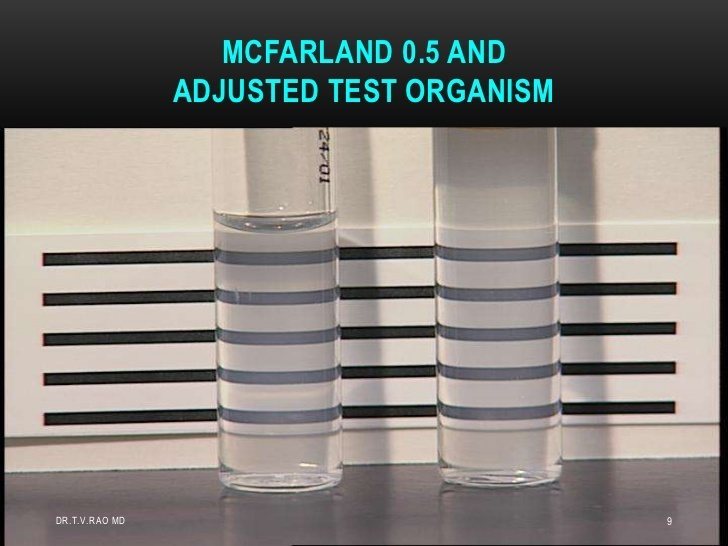 Figure: Bacterial suspension prepared to match the turbidity of the 0.5 McFarland turbidity standard
Why 0.5 McFarland Is the Target, and What Goes Wrong
Antimicrobial susceptibility testing by disk diffusion was standardized and validated using an inoculum equivalent to 0.5 McFarland. Every zone-diameter breakpoint (the cutoff that decides susceptible, intermediate, or resistant) assumes that density. If the inoculum is off, the zones are off, and the interpretation can flip.
Too dense (heavier than 0.5). More bacteria are spread on the plate, so they overwhelm the antibiotic and the zones of inhibition come out smaller than they should. A susceptible organism can then be misread as resistant, denying the patient an antibiotic that would have worked.
Too light (lighter than 0.5). Fewer bacteria mean the antibiotic clears a larger area, so the zones come out larger than they should. A resistant organism can then be misread as susceptible, and the patient is treated with a drug the organism can defeat.
This is why the density is matched carefully and why the adjusted suspension must be used within 15 minutes: the organisms keep growing, and a suspension that was 0.5 McFarland when prepared drifts denser as it sits.
Uses
- Standardizing the inoculum for antimicrobial susceptibility testing, its primary and most important use (see disk diffusion testing).
- Standardizing bacterial suspensions for identification tests and other procedures that require a known starting cell density.
- Higher standards (1, 2, 3, 4 McFarland) are used where denser, defined suspensions are needed.
How to Remember
0.5 McFarland equals 1.5 x 10⁸. The one number pair to lock in: the 0.5 standard corresponds to about 1.5 x 10⁸ CFU/mL, and that is the density for disk diffusion. If you remember "point five, one point five times ten to the eight," you have the fact every AST setup depends on.
Too dense reads resistant, too light reads susceptible. The direction of error is worth memorizing because it is dangerous either way. Heavy inoculum shrinks zones (false resistant); light inoculum enlarges zones (false susceptible). Picture more bacteria fighting the drug to a smaller zone, and it stays straight.
Key Exam Facts
| Fact | Detail |
|---|---|
| What it is | Reference turbidity suspension for estimating bacterial density |
| Made from | 1% barium chloride + 1% sulfuric acid, forming BaSO4 precipitate |
| 0.5 McFarland density | About 1.5 x 10⁸ CFU/mL |
| Main use | Inoculum for Kirby-Bauer disk diffusion susceptibility testing |
| Too dense inoculum | Smaller zones, susceptible organism misread as resistant |
| Too light inoculum | Larger zones, resistant organism misread as susceptible |
| Use adjusted suspension within | 15 minutes (organisms keep growing) |
| Visual matching | Against a black-lined white background in good light |
| Instrument alternative | McFarland densitometer (reads turbidity photometrically) |
| Storage | Foil-wrapped, room temperature, vortex before use, remake every 6 months |
Where Students Get Confused
Why 0.5 and not just "cloudy enough." Disk diffusion breakpoints were validated at 0.5 McFarland, so the density is not arbitrary. Eyeballing "cloudy" instead of matching the standard invalidates the interpretation.
Which direction the error goes. Students remember the inoculum matters but forget which way. Too dense gives falsely small zones (false resistant); too light gives falsely large zones (false susceptible). The consequence is serious in both directions.
McFarland standard vs. McFarland densitometer. The standard is the reference suspension (or the target density); the densitometer is the instrument that measures a suspension's turbidity against that scale.
Why 15 minutes. A suspension matched to 0.5 McFarland keeps growing denser as the organisms multiply, so a suspension left too long is no longer 0.5 McFarland. Inoculate within 15 minutes of adjusting.
References
- Clinical and Laboratory Standards Institute (CLSI). (2023). Performance Standards for Antimicrobial Susceptibility Testing (M100). CLSI.
- Tille, P. M. (2022). Bailey & Scott's Diagnostic Microbiology (15th ed.). Elsevier.
- Zapata, A., & Ramirez-Arcos, S. (2015). A comparative study of McFarland turbidity standards and the Densimat photometer to determine bacterial cell density. Current Microbiology, 70(6), 907–909. https://doi.org/10.1007/s00284-015-0801-2
- Swenson, J. M., & Thornsberry, C. (1984). Preparing inoculum for susceptibility testing of anaerobes. Journal of Clinical Microbiology, 19(3), 321–325. https://doi.org/10.1128/jcm.19.3.321-325.1984
Frequently Asked Questions
What is a McFarland turbidity standard?
What is a McFarland turbidity standard?
It is a reference suspension of known turbidity used to estimate the density of a bacterial suspension without counting individual cells. It is made by mixing barium chloride and sulfuric acid to form a barium sulfate precipitate whose cloudiness corresponds to a known cell density.
Why is the 0.5 McFarland standard used for susceptibility testing?
Why is the 0.5 McFarland standard used for susceptibility testing?
Disk diffusion susceptibility testing was standardized and validated using an inoculum equivalent to 0.5 McFarland, which is about 1.5 x 10^8 CFU/mL. All the zone-diameter breakpoints assume this density, so using it is what makes the result valid and comparable between laboratories.
What happens if the inoculum is too dense or too light?
What happens if the inoculum is too dense or too light?
If it is too dense, the zones of inhibition come out smaller than they should and a susceptible organism can be misread as resistant. If it is too light, the zones come out larger and a resistant organism can be misread as susceptible. Both errors can misdirect treatment.
How is a bacterial suspension matched to the standard?
How is a bacterial suspension matched to the standard?
Hold the suspension and the 0.5 McFarland standard side by side against a white background with contrasting black lines in good light, and compare the turbidity. Dilute if too dense, add organisms if too light, then use the adjusted suspension within 15 minutes.
What is the difference between a McFarland standard and a McFarland densitometer?
What is the difference between a McFarland standard and a McFarland densitometer?
The standard is the reference suspension or target density. The densitometer is an instrument that measures a suspension's turbidity photometrically and reports it in McFarland units, removing the need to prepare and compare against chemical standards.

Tankeshwar Acharya, MSc (Medical Microbiology)
Tankeshwar Acharya is an Assistant Professor in the Department of Microbiology at Patan Academy of Health Sciences (PAHS), Nepal, where he has been teaching and practicing clinical microbiology for over 14 years. He is the founder of Microbe Online, one of the leading free microbiology education resources on the web, covering bacteriology, mycology, parasitology, immunology, and clinical laboratory diagnostics written from direct experience in both the classroom and the diagnostic laboratory.
Comments
No comments yet. Be the first to share your thoughts.
Leave a comment
All comments are reviewed before they appear.