
Cellophane Tape Test for Pinworm (Enterobius vermicularis): Principle, Procedure, and Results
How to perform the cellophane (Scotch) tape test for pinworm diagnosis? When to collect the specimen, step-by-step procedure, egg morphology, and why routine stool O&P will miss this infection.

On this page
A 7-year-old girl has been waking her parents at 2 a.m. for three weeks, scratching her bottom and unable to sleep. Her teacher reports two other children in her class with similar complaints. The school nurse orders a stool O&P examination; it comes back negative. The mother is reassured, but the night-time itching continues.
The problem is the test, not the result. Enterobius vermicularis (the pinworm) rarely deposits its eggs in stool. The female worm migrates out of the anus at night to lay eggs on the perianal skin, exactly when the child is asleep. A stool sample collected in the morning captures almost nothing. The cellophane tape test, applied to the perianal skin in the early morning before the child bathes, is the only reliable diagnostic method for this infection.
Enterobius vermicularis also known as pinworm or threadworm or seatworm is a white roundworm parasite that has worldwide distribution. It affects persons of all ages and socioeconomic statuses. School-aged and pre-school-aged children are most commonly affected.
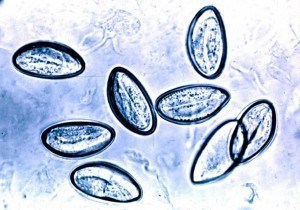 Figure: Pinworm (Image source: ASM)
Adult female worm migrates out of the anus, usually at night, and deposits her eggs on the perianal area, the eggs are not commonly found in feces though they may occasionally be found on the surface of stool specimens or on underclothing, pajamas, or sheets about 2 to 3 hours after falling asleep. The stool is not an appropriate specimen for the diagnosis of pinworm.
Itching during the night in a child’s perianal area strongly suggests pinworm infection. Diagnosis is made by identifying the worm or its eggs.
As the eggs are mostly deposited on the perianal area scotch tape preparation is used to isolate and identify the eggs of pinworm when suspected of pinworm infections. To increase the chance of finding pinworm eggs, the scotch tape preparation method should be done on three consecutive mornings.
Why Pinworm Requires a Special Specimen
Understanding the transmission cycle of E. vermicularis explains both why the cellophane tape test works and why routine stool examination fails:
- Adult worms live in the caecum and ascending colon
- At night (typically 10 p.m. – midnight), gravid female worms migrate out of the anal opening
- Each female deposits up to 16,700 eggs on the perianal folds and returns into the bowel
- Eggs are immediately infective and survive on perianal skin, clothing, and bedding for 2–3 weeks
- Children scratch the perianal area → eggs transfer to fingers → finger to mouth → autoinfection
- Eggs can also become airborne (from bedding) and be inhaled/swallowed
Why stool O&P fails: Eggs are deposited on perianal skin, not shed into the bowel lumen. Stool passing through the rectum picks up very few eggs. The stool specimen contains virtually none.
Why the whole household must be treated simultaneously: Eggs contaminate bedding, clothing, toilet seats, and door handles. Treating one child while others harbor the infection guarantees reinfection within weeks. Even asymptomatic household members may be infected, all require simultaneous treatment regardless of test results.
Principle
The clear-cellulose tape preparation is the most widely used procedure for the detection of human pinworm infections. Adult Enterobius vermicularis worms inhabit the large intestine and rectum; however, the eggs are not normally found in fecal material. During the period of extraintestinal migration, the adult female migrates out of the anal opening and deposits the eggs on the perianal skin, usually during the night.
The eggs, and occasionally the adult female worms stick to the glued (sticky) surface of the cellulose tape. These cellulose tape preparations are submitted to the laboratory, where they are examined under a microscope. Commercial collection systems ‘pinworm paddles’ are also available.
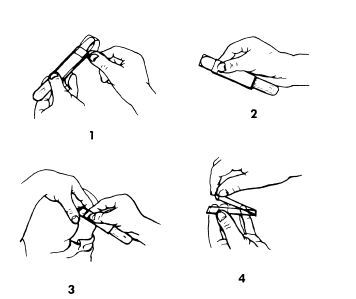 Figure: Collection of E. vermicularis eggs by the cellulose tape method (Source: Gracia L.S. 2001.Diagnostic Medical Parasitology)
Time of specimen collection
The specimen is collected from the perianal skin. An early-morning sample, before the patient has bathed, or used the toilet, is optimal. Up to six successive day morning samples should be collected before a negative result is issued.
Procedure
- Take a piece of clear (not frosted) cellophane tape (use clear, transparent tape ONLY. Cloudy, “magic” tape must not be used.) approximately 4 inches (10 cm) long.
- Hold the tape between thumbs and forefingers with a sticky side facing upward.
- While the child is still asleep during the morning, press the sticky side of the tape against the skin across the anal opening with even, thorough pressure. The eggs stick to the tape.
- Gently place the sticky side of the tape down against the surface of a clear glass slide.
- Label the slide in pencil with the patient’s name, medical record number, and the date and send it to the parasitology laboratory.
- Examine the slide under a microscope using the low power (10x) objective. The eggs can be made more visible by detaching the tape from the slide, adding a drop of xylene or toluene, and again affixing the tape.
Results
The eggs of E. vermicularis measure 50-60 micrometer x 20-30 micrometer and have a relatively thick, smooth shell and an ovoid shape flattened on one side, much like a flattened, partially inflated football. It may contain a partially or fully developed larva.
Adult worms occasionally are seen in transparency tape preparations. They measure 1 cm long, and have a pointed tail posteriorly and transparent wings flanking the anterior end.

Reporting results:
A. Report the organism and stage. Do not use abbreviations. Example: Enterobius vermicularis eggs present.
B. Report adult worms. Example: Enterobius vermicularis adult worm present.
C. Report negatives. Example: No Enterobius vermicularis eggs or adults seen.
Precautions
- The eggs of E. vermicularis are infectious if swallowed, so the person obtaining the specimen must wear the gloves.
- If an opaque tape is submitted by mistake, a drop of immersion oil on the top of the tape will clear it enough to proceed with the microscope examination.
Limitations
- The female pinworm deposits eggs on the perianal skin only sporadically.
- Without multiple tapes (taken on a consecutive morning), it is not possible to determine if the patient is positive, or negative for the infection
Where Students Actually Get Confused
1. "A negative cellophane tape test on one morning excludes pinworm." No, female worms lay eggs sporadically, not every night. The probability of detection on a single morning is low. The WHO and CDC recommend a minimum of three consecutive morning samples before reporting negative. A single negative is never a final answer for pinworm.
2. "Frosted or opaque tape works as well as clear tape." No, the tape must be clear and transparent. Frosted or "magic" tape scatters light under the microscope, making egg identification difficult or impossible.
3. "Pinworm eggs are found in the stool if you look carefully enough." Occasionally, eggs may be found on the surface of a stool specimen or on underclothing. This is sporadic and unreliable. The definitive test is always the cellophane tape test from the perianal skin. Do not substitute stool examination.
4. "Treating the child alone is sufficient." This is the most clinically consequential misconception. Given the egg survival on surfaces and the ease of auto- and household reinfection, treating only the index case virtually guarantees recurrence. All household members should be treated simultaneously with a single dose of mebendazole or albendazole, repeated after two weeks to kill newly hatched worms from any surviving eggs.
5. "The test can be collected any time of day." Collection must be done in the early morning, before bathing or defecation. The female worm laid eggs during the night; bathing washes eggs off the perianal skin; defecation also partially disturbs the perianal deposits. Daytime collection misses the eggs.
Key Exam Facts in One Table
| Fact | Detail | Memory hook |
|---|---|---|
| Causative organism | Enterobius vermicularis (pinworm/threadworm) | Most common helminth in temperate countries |
| Egg deposition site | Perianal skin (not stool) | Female migrates at night |
| Collection timing | Early morning before bathing or defecation | "Before the evidence washes away" |
| Number of samples needed | Minimum 3 consecutive mornings | One negative ≠ excluded |
| Tape type | Clear/transparent cellophane only | Frosted tape = unreadable slide |
| Egg morphology | 50–60 × 20–30 μm; oval, flattened one side; smooth thick shell | "Flattened football" shape |
| Egg contents | Partially or fully developed larva | Immediately infective when laid |
| Egg survival on surfaces | 2–3 weeks | Bedding, clothing, toilet seats |
| Stool O&P for pinworm | NOT appropriate specimen | Will give false-negative |
| Household treatment | All members simultaneously | Treats reservoir, prevents reinfection |
References
- Cho, S. Y., & Kang, S. Y. (1975). Significance of scotch-tape anal swab technique in diagnosis of Enterobius vermicularis infection. Kisaengch'unghak chapchi. The Korean Journal of Parasitology, 13(2), 102–114. https://doi.org/10.3347/kjp.1975.13.2.102
- Rawla, P., & Sharma, S. (2023). Enterobius vermicularis. In StatPearls. StatPearls Publishing. https://www.ncbi.nlm.nih.gov/books/NBK536974/
- Garcia, L. S. (2016). Diagnostic Medical Parasitology (6th ed.). ASM Press.
- Cheesbrough, M. (2006). District Laboratory Practice in Tropical Countries (2nd ed., Part 1). Cambridge University Press.
- Cook, G. C. (1994). Enterobius vermicularis infection. Gut, 35(9), 1159–1162. https://doi.org/10.1136/gut.35.9.1159
- World Health Organization. (2012). Bench aids for the diagnosis of intestinal parasites (2nd ed.). WHO. https://apps.who.int/iris/bitstream/handle/10665/37323/9789241544764_eng.pdf
Frequently Asked Questions
Why is stool examination unreliable for pinworm diagnosis?
Enterobius vermicularis (pinworm) females deposit eggs on the perianal skin at night, not in the bowel lumen. Stool passing through the rectum picks up very few eggs. The cellophane (Scotch) tape test applied to the perianal skin in the early morning before bathing is the correct diagnostic method. It has far higher sensitivity than stool O&P for pinworm diagnosis.
How do you perform the cellophane tape test for pinworm?
Why must the whole household be treated when one child has pinworm?
Pinworm eggs survive 2–3 weeks on household surfaces: bedding, clothing, toilet seats, and door handles. Infected household members (who may be asymptomatic) continuously recontaminate the environment. Treating only the index case guarantees reinfection within weeks. All household members require simultaneous treatment with mebendazole or albendazole, with a repeat dose after two weeks to kill worms hatching from surviving eggs.

Tankeshwar Acharya, MSc (Medical Microbiology)
Tankeshwar Acharya is an Assistant Professor in the Department of Microbiology at Patan Academy of Health Sciences (PAHS), Nepal, where he has been teaching and practicing clinical microbiology for over 14 years. He is the founder of Microbe Online, one of the leading free microbiology education resources on the web, covering bacteriology, mycology, parasitology, immunology, and clinical laboratory diagnostics written from direct experience in both the classroom and the diagnostic laboratory.
Comments
No comments yet. Be the first to share your thoughts.
Leave a comment
All comments are reviewed before they appear.