
BHI Broth: Composition, Preparation, and Why It's the Base for Blood Cultures

On this page
The problem a century of blood cultures still hasn't outgrown
A patient arrives in septic shock. Blood is drawn immediately and inoculated into blood culture bottles, the single most important diagnostic step that follows. Sepsis can be caused by almost any organism, including fastidious ones, viridans streptococci, and the notoriously slow-growing HACEK group among them, that a simple, low-nutrient broth might fail to recover at all, or recover too slowly to matter.
This exact problem is what Brain Heart Infusion broth was built to solve. In 1919, Edward Rosenow was trying to grow streptococci that refused to thrive on ordinary broth. He added an infusion of calf brain tissue, and the streptococci grew. Brain and heart tissue turned out to be naturally rich in the phospholipids, growth factors, and buffering capacity that fastidious organisms need but a simple peptone broth doesn't provide.
That same nutrient-rich formula, brain and heart infusion, proteose peptone, dextrose, is still, over a century later, one of the standard broth bases used in blood culture bottles today. Every modification of BHI covered in this article exists to solve one more version of the exact problem Rosenow ran into: a broth that's rich, but not quite rich enough for one more specific fastidious organism.
Brain Heart Infusion (BHI) broth is a general-purpose liquid medium used for the cultivation and maintenance of a wide variety of fastidious and non-fastidious microorganisms, including aerobic and anaerobic bacteria, yeast, and molds, from a variety of clinical and non-clinical specimens.
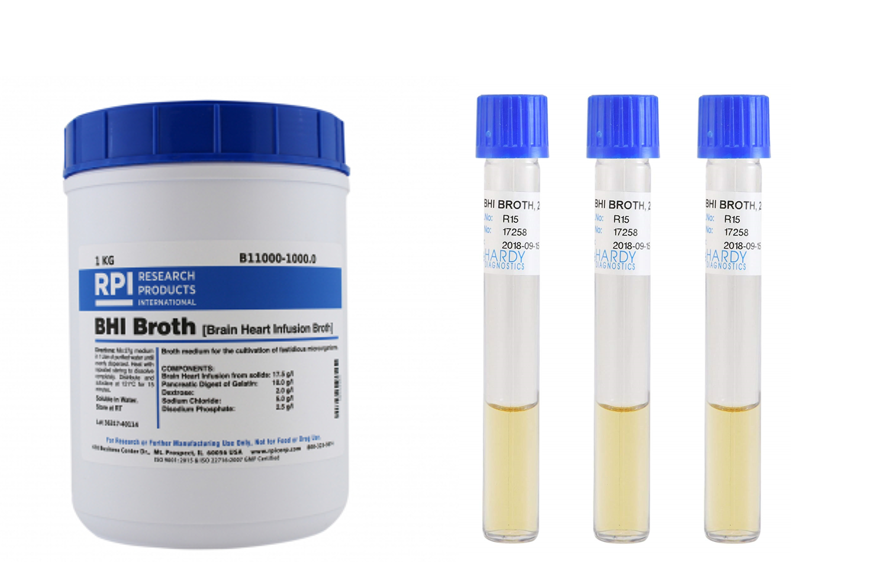 Figure: Brain Heart Infusion Broth
Why Brain and Heart Tissue Specifically?
Brain and heart tissue are naturally rich in phospholipids, cholesterol, and other growth factors that many fastidious organisms depend on but can't synthesize efficiently themselves. Combined with proteose peptone (carbon and nitrogen), dextrose (an energy source), disodium phosphate (buffering), and sodium chloride (osmotic balance), the result is a broth nutritionally complete enough to support organisms a simpler formula would struggle with.
Composition of Brain Heart Infusion (BHI) Broth
| Ingredients | Gms / Litre |
|---|---|
| Calf brain, infusion from | 200 |
| Beef heart, infusion from | 250 |
| Proteose peptone | 10 |
| Dextrose | 2 |
| Sodium chloride | 5 |
| Disodium phosphate | 2.5 |
| Final pH (at 25°C) | 7.4 ± 0.2 |
Storage, Preparation, and Procedure for Use
Storage conditions and Shelf life:
- Dehydrated medium: store at 10–30°C, use before the expiry date on the label.
- Prepared broth: store in the dark, below 20°C.
Procedure for use:
- Bring the medium to room temperature before inoculation.
- Inoculate with the specimen or organism to be cultivated.
- For anaerobic organisms, pre-reduce the medium (e.g., by boiling and cooling, or holding in an anaerobic environment) before inoculation.
- Incubate: aerobic organisms at 35°C with a loosened cap; fastidious organisms such as Haemophilus in a CO₂-enriched atmosphere; anaerobic organisms at 35°C with a loosened cap in an anaerobic environment.
Examination schedule:
- Aerobic cultures: examine at 24 hours and again at 48 hours.
- Anaerobic cultures: examine at 48 hours.
- Re-incubate and re-examine if no growth is seen at the first check.
Interpretation of Results:
- Turbidity (cloudiness) indicates growth.
- Subculture turbid broths onto solid media to assess colony morphology and proceed with identification.
Notes:
- Yeasts and fungi may require prolonged incubation beyond the standard schedule above.
- Some strains may grow poorly regardless of incubation time, since individual organisms' nutritional requirements vary even within a species.
Uses of Brain Heart Infusion Broth
Every modification below is BHI's rich base plus one more specific answer to a fastidious-organism problem plain BHI still can't solve on its own:
| Modified medium | Usage | The specific problem it solves |
|---|---|---|
| BHI with Fildes | Cultivating capsular strains of Haemophilus influenzae | Supplies the X and V growth factors H. influenzae needs but BHI alone doesn't reliably provide |
| BHI with Hemin and Vitamin K | Recovery of fastidious anaerobic organisms | Anaerobes often require these specific growth factors regardless of how nutrient-rich the base broth is |
| BHI broth (unmodified) | Inoculum suspensions for antibiotic susceptibility testing (MIC, microdilution); blood culture bottles | Rich enough to support standardized inoculum growth, and to recover bloodstream pathogens of unknown identity, including fastidious ones (see hook above) |
| BHI with 10% defibrinated sheep blood | Isolation of Histoplasma capsulatum and other dimorphic fungi | Blood supplementation supports fungal growth requirements plain BHI doesn't meet |
| BHI with 0.1% agar | Cultivation of anaerobes | A semisolid consistency limits oxygen diffusion, supporting organisms that plain liquid broth exposes to too much atmospheric oxygen |
For inoculum suspensions used in disk diffusion or MIC testing, BHI's role as a standardized, richly nutritious base is exactly why it can produce a reliable, reproducible starting density (see antimicrobial susceptibility testing procedure for the full inoculum preparation steps).
Key exam facts
| Fact | Detail |
|---|---|
| Type of medium | General-purpose, enriched liquid broth |
| Discovered by | Edward Rosenow, 1919, adding calf brain infusion to dextrose broth to grow fastidious streptococci |
| Key nutrient sources | Calf brain and beef heart infusions, proteose peptone, dextrose |
| Supports | Fastidious and non-fastidious aerobes, anaerobes, yeasts, and molds |
| Highest-stakes clinical use | Base broth for blood culture bottles, recovering fastidious bloodstream pathogens |
| Common modifications | Fildes (for H. influenzae), hemin/vitamin K (for anaerobes), sheep blood (for dimorphic fungi), added agar (for anaerobes) |
| Also used for | Standardized inoculum suspensions for antimicrobial susceptibility testing |
References
- Rosenow, E. C. (1919). Studies on elective localization: focal infection with special reference to oral sepsis. Journal of Dental Research.
- Liofilchem. Brain Heart Infusion Broth. https://www.humeau.com/media/blfa_files/TC_Brain-Heart-Infusion-Broth-55062000840-24104_EN_150518.pdf
- Dalynn Biologicals. Brain Heart Infusion Broth. https://www.dalynn.com/dyn/ck_assets/files/tech/TB63.pdf
Frequently Asked Questions
Why is BHI broth more nutritionally rich than tryptic soy broth?
BHI broth contains multiple nitrogen sources including brain heart infusion powder, casein peptone, and glucose. Thus providing a complex mixture of amino acids, peptides, vitamins, and growth factors derived from brain and heart tissue infusions (now replicated with defined extracts). This multi-source nutrition supports organisms with complex nutritional requirements that simpler broths cannot meet.
Tryptic soy broth (TSB) is the CLSI-specified standard for AST inoculum preparation due to its consistency, but BHI is chosen when maximum nutritional support is needed for fastidious organisms.
What is BHI + 6.5% NaCl used for?
BHI broth supplemented with 6.5% sodium chloride (and bromocresol purple as a pH indicator) is the standard medium for the salt tolerance test. Which is used to differentiate Enterococcus species from non-enterococcal Group D streptococci.
Enterococci grow in 6.5% NaCl broth (producing turbidity and often a colour change to yellow from acid production) within 24-72 hours. Non-enterococcal Group D streptococci (such as Streptococcus bovis/gallolyticus) are bile-esculin positive but fail to grow in 6.5% NaCl. A positive bile-esculin test plus growth in 6.5% NaCl identifies Enterococcus species.
When should BHI be chosen over Mueller-Hinton for microbiological work?
BHI and Mueller-Hinton serve different purposes and should not be substituted for each other. BHI is chosen when the goal is maximum nutritional support for organism growth: culturing fastidious bacteria (Streptococcus pneumoniae, Haemophilus influenzae, Neisseria meningitidis), growing anaerobes with appropriate supplements, or enriching fungi.
Mueller-Hinton is the CLSI-specified standard for antimicrobial susceptibility testing (disc diffusion and broth microdilution). Its defined composition, low thymidine content, and controlled cation concentrations ensure reproducible antibiotic zone sizes. Using BHI for AST instead of Mueller-Hinton would produce non-standardized, unreliable results.

Tankeshwar Acharya, MSc (Medical Microbiology)
Tankeshwar Acharya is an Assistant Professor in the Department of Microbiology at Patan Academy of Health Sciences (PAHS), Nepal, where he has been teaching and practicing clinical microbiology for over 14 years. He is the founder of Microbe Online, one of the leading free microbiology education resources on the web, covering bacteriology, mycology, parasitology, immunology, and clinical laboratory diagnostics written from direct experience in both the classroom and the diagnostic laboratory.
Comments
No comments yet. Be the first to share your thoughts.
Leave a comment
All comments are reviewed before they appear.