
Tween 80 Hydrolysis Test: Amber to Pink, and Why It Separates the Mycobacteria

On this page
Why It Matters
When a slow-growing Mycobacterium is isolated from a patient, the urgent question is whether it is a pathogen or a harmless environmental contaminant. Non-tuberculous mycobacteria (NTM) live in soil and water, and many are picked up as incidental colonizers, but some cause serious lung, lymph node, and disseminated disease, and they differ in which drugs they respond to. Telling them apart matters for treatment.
One of the simplest tools for that separation is the Tween 80 hydrolysis test, and it rests on a clinically useful pattern: among the slow-growing scotochromogens and non-chromogens, the non-pathogenic species tend to produce a lipase that hydrolyzes Tween 80, while the pathogenic ones often do not. So a positive Tween 80 result nudges the identification toward the more benign end of the spectrum, and a negative result raises concern.
The test does two specific, high-yield jobs. It rapidly flags Mycobacterium kansasii, a genuine lung pathogen that hydrolyzes Tween 80 quickly. And it separates two scotochromogens that look identical as orange colonies on the slant: M. gordonae (positive, usually a harmless tap-water contaminant) from M. scrofulaceum (negative, a cause of cervical lymphadenitis in children). Same colony color, opposite Tween 80 result, different clinical meaning.
This article covers how the color change actually works, which is not what most sources claim, and how Tween 80 hydrolysis fits into the wider mycobacterial identification scheme.
Tween 80 is the trade name of the detergent polyethylene derivative of sorbitan mono-oleate. Some Mycobacterium species possess an enzyme-lipase, that splits the compound and releases oleic acid and polyoxyethylated sorbitol.
Positive reactions occur in 1 to 4 days of incubation, and 10 days of incubation are required for confirmation of negative reactions.
The color change from amber (orange-yellow) to pink-red is the positive test, and the mechanism is worth getting right because most sources state it incorrectly. The substrate contains a neutral red indicator, and intact Tween 80 binds neutral red into an amber complex. When a lipase-positive organism hydrolyzes the Tween 80 into oleic acid and polyoxyethylated sorbitol, the detergent can no longer hold the neutral red, and the freed indicator reverts to its natural pink-red color at pH 7. So the color change is due to neutral red being released from its complex as the Tween 80 is destroyed. It is not a pH change, and it is not a change in optical rotation (a common but incorrect explanation).
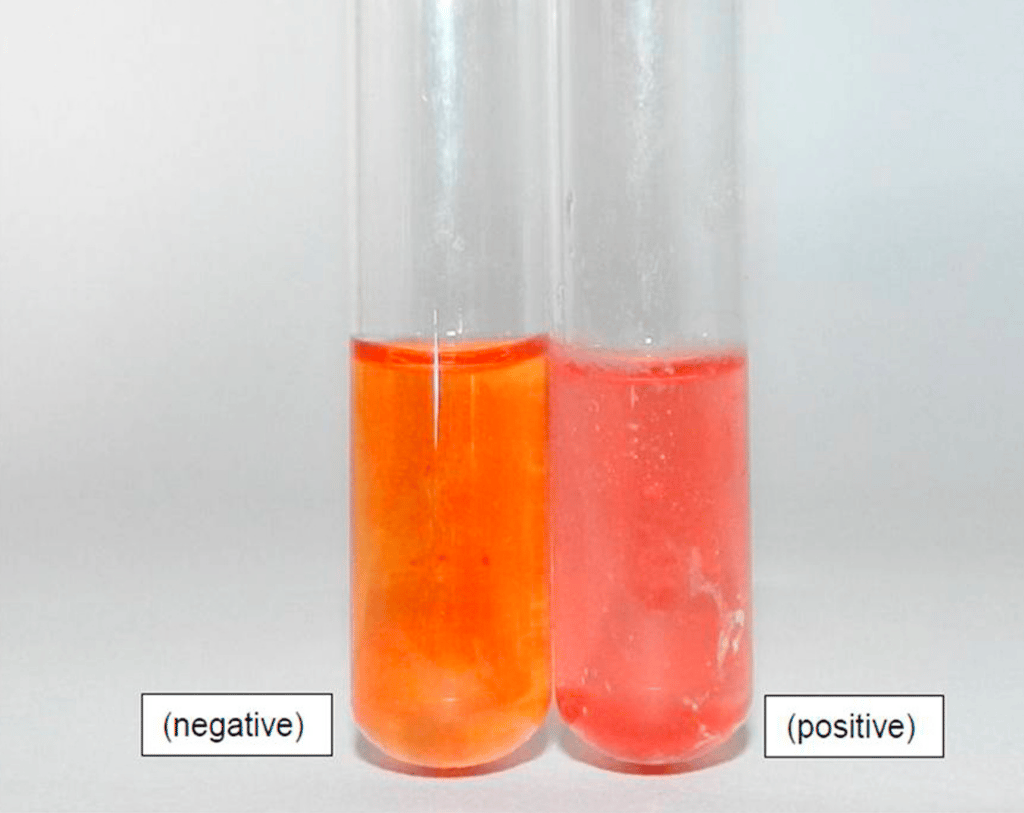 Figure: Tween-80 hydrolysis test
Uses
- This test is useful in identifying Mycobacterium kansasii, which hydrolyzes Tween 80 rapidly, often turning positive within hours to the first day rather than the several days most positive species require.
- To differentiate two scotochromogens with similar-appearing colonies, M. gordonae (positive) and M. scrofulaceum (negative). Read more about Atypical Mycobacterial Infections
Specimen
Mature colony of the unknown Mycobacterium species recovered from clinical material, growth on a Lowenstein Jensen slant.
Materials
- Supplies: sterile applicator sticks; screw-capped tubes (12×100 mm) containing 2.0 mL deionized water per tube
- Media: Lowenstein-Jensen slant (for the source culture)
- Reagent: Tween 80 hydrolysis reagent (Tween 80 in phosphate buffer with neutral red indicator)
- Equipment: biohazard hood
Procedure
- Add two drops of Tween reagent to 1 mL of sterile distilled water in screw-capped tubes
- Inoculate a loopful of organisms to be tested
- Incubate at 35°C in the dark with caps tight
- Visually read tubes in 24 hours. If negative, read again at 5 and 10 days. Compare the color of the liquid with that in the control tubes.
Results
A positive result is recorded when the liquid, turns from light orange to pink or red. M. kansasii usually turns positive rapidly, within the first 24 hours (some formulations show a reaction in as little as a few hours), unlike most positive species that require several days. Read again at 3, 5, and 10-12 days. Record results and discard positives. Discard all tubes at 12 days.
Quality Control
- Positive control: M. kansasii (ATCC-12478) incubated for 12 days.
- Negative control: Stock culture of M. intracellulare (ATCC-13950)
- Negative reagent: Un-inoculated tube of a substrate incubated for 12 days.
Procedure Notes;
Keep Tween hydrolysis reagent in the dark. Do not store or incubate tubes in the light. The red color of a positive reaction is not due to a pH change. It occurs because neutral red, which was bound to intact Tween 80 in an amber complex, is released and reverts to its pink-red form once the Tween 80 is hydrolyzed.
Tween 80 hydrolysis among the lipid tests
Tween 80 hydrolysis is one of three related tests that detect the breakdown of lipids, and they are easy to confuse because all three involve a fat-splitting enzyme but read completely differently:
| Test | Substrate | Enzyme | Positive result | Main use |
|---|---|---|---|---|
| Lipid hydrolysis (lipase) | Tributyrin | Lipase | Clear zone in opaque agar | Lipolytic bacteria, S. aureus |
| Lecithinase (Nagler) | Lecithin (egg yolk) | Lecithinase (phospholipase C) | Opaque white halo | C. perfringens (gas gangrene) |
| Tween 80 hydrolysis (this test) | Tween 80 + neutral red | Mycobacterial lipase/esterase | Amber → pink-red color change | Mycobacterial (NTM) identification |
All three detect a lipid-splitting enzyme, but the substrate, the indicator, and the visual result differ. Tween 80 hydrolysis is the mycobacterial member of the set. See the lipid hydrolysis (lipase) and lecithinase (Nagler) articles for the other two.
How to remember
Amber holds it, pink frees it. Neutral red is bound to intact Tween 80 as an amber complex. When lipase chops up the Tween 80, the neutral red is set free and turns pink-red. Positive = pink. The color is about the indicator being released, not pH and not optical rotation (ignore that common myth).
Positive leans benign. Among the slow growers, the harmless environmental species tend to hydrolyze Tween 80 (positive), while the pathogens often do not. So a pink tube nudges you toward a contaminant, a stubborn amber tube toward a pathogen. It is a lean, not a rule, always combined with other tests.
Two names to hold: kansasii fast, gordonae vs scrofulaceum. M. kansasii goes positive fast (hours to a day). And for the two orange scotochromogens that look alike, M. gordonae (tap-water bug) is positive, M. scrofulaceum (child's neck node) is negative. Same color colony, opposite Tween result.
Tween is the mycobacterial lipid test. Of the three lipid tests, tributyrin (clear zone) and egg yolk (opaque halo) are for ordinary bacteria; Tween 80 (amber to pink) is the one for mycobacteria.
Key exam facts in one table
| Question | Answer | The reason behind it |
|---|---|---|
| What does the test detect? | A mycobacterial lipase/esterase | Hydrolyzes Tween 80 |
| What is Tween 80? | Polysorbate 80, a detergent (sorbitan mono-oleate) | The substrate |
| Products of hydrolysis | Oleic acid + polyoxyethylated sorbitol | The ester bond is split |
| Indicator | Neutral red | Bound to intact Tween 80 as an amber complex |
| Positive result | Amber (orange-yellow) → pink-red | Neutral red freed as Tween 80 is destroyed |
| Negative result | Stays amber | Tween 80 intact, neutral red still bound |
| Mechanism of color change | Neutral red released from Tween 80 complex | NOT pH change, NOT optical rotation (common myth) |
| Timing | Positives 1-4 days; negatives confirmed at 10-12 days | Slow reaction; hold before calling negative |
| Rapid positive | M. kansasii (hours to first day) | A genuine lung pathogen |
| Scotochromogen split | M. gordonae (+) vs M. scrofulaceum (−) | Same orange colony, opposite result |
| Clinical pattern | Non-pathogens tend positive; pathogens tend negative | Nudges pathogen-vs-contaminant call |
| Positive QC | M. kansasii ATCC 12478 | Reliable positive |
| Negative QC | M. intracellulare ATCC 13950 | Reliable negative |
| Storage | Reagent in the dark, refrigerated, ≤2 weeks | Neutral red is light-sensitive |
| Among the lipid tests | The mycobacterial one (vs tributyrin lipase, egg-yolk lecithinase) | Different substrate and readout |
Where students get confused
It is not a pH indicator reaction. Neutral red is a pH indicator in other contexts, but here the color change is not driven by pH. The medium is buffered near pH 7 throughout. The change is about neutral red being bound (amber) versus free (pink-red), which depends on whether Tween 80 is intact.
Positive does not mean pathogen. The clinical lean is the opposite: among the slow growers, non-pathogenic species tend to be Tween 80 positive, and pathogens tend to be negative. A positive result generally points toward a more benign identification. Never read positive as "dangerous."
Reading negatives too early. Positives can take up to 4 days, and a negative is only confirmed after 10-12 days of incubation. A tube read at 24 hours that is still amber is not yet negative, except for the rapid species like M. kansasii. Hold the full incubation before calling negative.
Keep it in the dark. Neutral red is light-sensitive. Storing or incubating the tubes in light degrades the reagent and can cause false readings. Store refrigerated in the dark and incubate in the dark.
Don't confuse it with the other lipid tests. Tween 80 hydrolysis (amber to pink, mycobacteria) is distinct from lipid hydrolysis on tributyrin (clear zone, ordinary bacteria) and lecithinase on egg yolk (opaque halo, C. perfringens). All three detect lipid-splitting enzymes but use different substrates and readouts.
References
- Procop GW, Church DL, Hall GS, Janda WM, Koneman EW, Schreckenberger PC, Woods GL. Koneman's Color Atlas and Textbook of Diagnostic Microbiology. 7th ed. Philadelphia: Wolters Kluwer; 2017.
- Tille PM. Bailey and Scott's Diagnostic Microbiology. 15th ed. St. Louis: Elsevier; 2022.
- Leber AL, editor. Clinical Microbiology Procedures Handbook. 4th ed. Washington, DC: ASM Press; 2016. doi:10.1128/9781683670438
- Kubica GP, et al. Rapid Tween 80 hydrolysis test for mycobacteria.
Frequently Asked Questions
How does the color change work in the Tween 80 hydrolysis test?
What is the Tween 80 hydrolysis test used for?
Why does the Tween 80 test need to be kept in the dark?
Does a positive Tween 80 hydrolysis test mean the mycobacterium is dangerous?
How long does the Tween 80 hydrolysis test take to read?

Tankeshwar Acharya, MSc (Medical Microbiology)
Tankeshwar Acharya is an Assistant Professor in the Department of Microbiology at Patan Academy of Health Sciences (PAHS), Nepal, where he has been teaching and practicing clinical microbiology for over 14 years. He is the founder of Microbe Online, one of the leading free microbiology education resources on the web, covering bacteriology, mycology, parasitology, immunology, and clinical laboratory diagnostics written from direct experience in both the classroom and the diagnostic laboratory.
Comments
No comments yet. Be the first to share your thoughts.
Leave a comment
All comments are reviewed before they appear.