
Multiplex PCR: Principle, Procedure, Advantages, and Limitations

On this page
A three-year-old child is admitted to a pediatric ward in Mumbai with high fever, neck stiffness, and photophobia. The clinical diagnosis is bacterial meningitis. A lumbar puncture is performed and 1.5 mL CSF is collected. The sample is cloudy.
The clinician needs to know the causative organism urgently: Streptococcus pneumoniae, Haemophilus influenzae, and Neisseria meningitidis are the three most common causes in this age group, each requiring the same empirical treatment but with different implications for contact prophylaxis, vaccination recommendations, and public health reporting.
The laboratory runs a multiplex PCR panel on 200 µL of the CSF. One reaction, one tube, three primer pairs, each targeting a species-specific gene. Within four hours, the result returns: N. meningitidis serogroup B detected. Contacts are identified; prophylactic rifampicin is administered; the district health office is notified.
The alternative, running three separate PCR reactions, or waiting for culture results that may take 48–72 hours or return negative if antibiotics were given before the lumbar puncture, would have delayed every one of those decisions. Multiplex PCR panel answered three diagnostic questions simultaneously from a sample too small to divide.
Multiplex PCR is a variant of PCR methods in which more than one target sequence are amplified using multiple sets of primers within a single PCR mixture. This enables amplification of several gene segments at the same time, instead of specific test runs for each. This technology was first used by Chamberlain et al. for the diagnosis of Duchenne muscular dystrophy (1988).
Why Multiplex PCR Matters Clinically
In clinical microbiology, the same clinical syndrome can be caused by multiple different pathogens. A patient with meningitis may have bacterial, viral, or fungal aetiology. A patient with respiratory illness may have influenza A, influenza B, RSV, or any of a dozen other respiratory viruses. A patient with diarrhea may have any of fifteen different bacterial, viral, or parasitic causes.
Traditional diagnostic approaches run one test per pathogen: sequential, slow, and expensive. Multiplex PCR inverts this logic: instead of asking "does this patient have pathogen X?" one test at a time, it asks "which of these pathogens does this patient have?" in a single reaction.
This matters for three reasons:
Sample conservation: CSF, vitreous fluid, synovial fluid, and neonatal blood are available in limited volumes. Running five separate PCR reactions from a 1 mL CSF sample is not feasible. Running one multiplex reaction is.
Time to result: One reaction setup, one thermocycler run, one result compared to five sequential runs. In meningitis, sepsis, and other time-critical infections, hours matter.
Cost efficiency: Reagent costs, technician time, and equipment use are all reduced when multiple targets are detected from a single reaction.
Principle of Multiplex PCR
Multiplex PCR works on the same basic principle as standard PCR, with one change: instead of one primer pair amplifying one target, several primer pairs amplify several targets in the same tube, at the same time.
Standard PCR uses a single pair of primers, so it copies one specific DNA sequence. Multiplex PCR adds more primer pairs to the same reaction mixture. Each pair is designed to bind only its own target sequence. When the reaction runs, every primer pair finds and copies its own target independently, so a single run produces several different amplified products (amplicons) at once.
For this to work, all the primer pairs must be able to work under the same reaction conditions, because they share one tube, one temperature program, and one set of reagents. This is the central design challenge of multiplex PCR, and it is why primer design (covered below) is so much stricter than for standard PCR.
The products are then told apart in one of two ways:
- By size. Each primer pair is designed so its amplicon is a clearly different length. After the run, the products are separated by size (for example on a gel or by capillary electrophoresis), and each band's position shows which target was present.
- By probe. In real-time (probe-based) multiplex PCR, each target has its own probe labeled with a different colored fluorescent dye. The machine reads each color separately, so each target is identified by its color rather than its size. This is how most modern clinical systems work.
For RNA targets such as RNA viruses, a reverse-transcription step is added first to convert the RNA into DNA (this is called multiplex RT-PCR). After that, amplification proceeds as above.
The output of any multiplex PCR is a set of yes/no answers: for each target the assay was designed to find, the result shows whether its amplicon appeared, meaning the target was present, or did not, meaning it was absent (provided the reaction worked, which the internal control confirms; see Advantages).
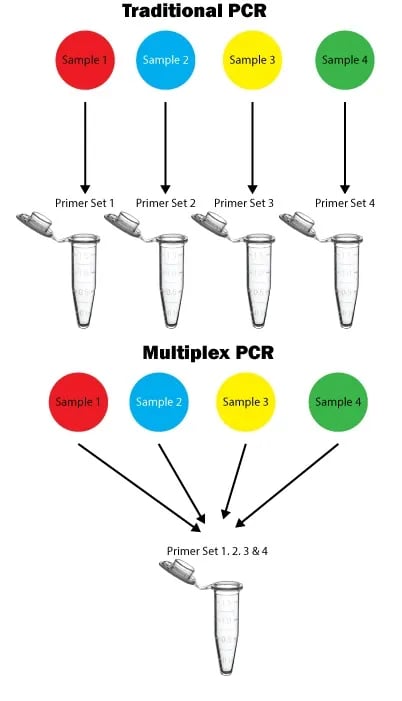 Figure: Multiplex vs Standard PCR (Image source:https://info.gbiosciences.com/)
Primer Designing
When designing amplification primers for multiplex PCR, several factors must be considered including;
- Primers length: The primer lengths should be within 18–25 nucleotides,
- Melting temperature (Tm): Tm of the primers should be either identical or within 1–2°C,
- GC content: GC content of the primer should be appropriate (50–55%), and
- Cross-complementarity: To avoid interference, primers should lack cross-complementarity.
In addition, regions with repetitive sequences, known as germline single nucleotide polymorphisms (SNPs), and regions with high homology should be avoided because they may affect the efficiency of PCR amplification and create amplification bias.
Procedure of Multiplex PCR
The workflow of a multiplex PCR follows the same stages as standard PCR, with extra care at the design and optimization stages. The core steps are:
- Nucleic acid extraction. Extract DNA (or RNA) from the specimen. Only a small amount of template is needed, roughly 10 to 200 ng, and multiplex PCR can work even when the DNA quality is not perfect. For RNA targets, the next step includes reverse transcription.
- Reaction assembly. Combine the template with the reaction mix: DNA polymerase, nucleotides (dNTPs), buffer, magnesium (MgCl₂), and all the primer pairs together in one tube. For RNA targets, add reverse transcriptase so the RNA is first copied into DNA.
- Denaturation. Heat the reaction (around 94 to 95°C) so the double-stranded DNA separates into single strands.
- Annealing. Cool the reaction (typically around 55 to 65°C) so each primer binds to its matching target sequence. Because all primer pairs share this one temperature, their melting temperatures must be closely matched, which is why primer design is so strict.
- Extension. Warm the reaction (around 72°C) so the polymerase builds a new strand from each bound primer, copying every target at once.
- Cycling. Repeat denaturation, annealing, and extension for many cycles (commonly 25 to 40). Each cycle doubles the amount of every target, so all the targets are amplified together.
- Detection and interpretation. Identify which targets were amplified, either by separating the products by size (gel or capillary electrophoresis) or by reading the fluorescent probes in a real-time machine. Then read the internal control to confirm the reaction worked before trusting any negative result.
The difference from standard PCR is not in the stages themselves but in the balancing act: one set of conditions has to satisfy every primer pair at once. Getting that balance right is the optimization work described in the challenges section below.
Advantages of Multiplex PCR
Multiplex PCR offers a couple of notable advantages such as:
1. Internal amplification controls ensure the accuracy of the negative PCR results
First, strategies that include internal controls for PCR can be developed. For example, one primer pair can be directed at sequences present in all clinically relevant bacteria (i.e., the control or universal primers) and the second primer pair can be directed at a sequence-specific for the particular gene of interest (i.e., the test primers).
The control amplicon should always be detectable after PCR. Absence of the control would indicate that PCR conditions were not met and the test would require repeating. When the control amplicon is detected, the absence of the test amplicon can be more confidently interpreted to indicate the absence of target nucleic acid in the specimen rather than a failure of the PCR system.
2. Numerous pathogens may be detected in a single reaction, even if these pathogens are from taxonomically different groups.
Another advantage of multiplex PCR is the ability to search for different targets using one reaction. Primer pairs directed at sequences specific for different organisms or genes can be put together so that the use of multiple reaction vessels can be minimized.
For example, detection of viral agents that cause meningitis or encephalitis (e.g., herpes simplex virus, enterovirus, West Nile virus) using multiplexed PCR assay.
Disadvantages and Limitations of Multiplex PCR
The main disadvantages of multiplex PCR all stem from putting several primer pairs in one reaction. Primers can interfere with one another, some targets amplify more efficiently than others, and finding one set of conditions that suits every pair takes careful optimization. The most common problems, and how to solve them, are summarized below.
| Challenge | Why it happens | How to address it |
|---|---|---|
| Competitive amplification, one target dominates | Primer pairs with different efficiencies; the most efficient pair out-competes others, producing a strong band for one target and weak or absent bands for others | Optimise primer concentrations individually; limit cycles; use equimolar primer concentrations as starting point then adjust |
| Primer-primer interactions (primer dimers) | Primers from different pairs share complementary sequences and bind to each other instead of the template | Check all primer pairs for cross-complementarity during design; use BLAST to verify; run in silico interaction checks before synthesis |
| Non-specific amplification | Primers anneal to non-target sequences due to shared homology | Increase annealing temperature; verify primer specificity against full genome database; include a no-template control in every run |
| Amplicon size overlap | Two targets produce amplicons of similar size; bands cannot be distinguished on gel | Design primer pairs to produce clearly separated amplicon sizes (at least 50–100 bp apart); use probe-based detection (TaqMan multiplex) for unambiguous differentiation |
| False-negative from inhibition | Inhibitors in clinical specimens (haem from blood, mucus from respiratory specimens) inhibit Taq polymerase more severely in multiplex than single-plex reactions | Include internal amplification control in every reaction (as described in Advantages section); extract and purify nucleic acid carefully; use inhibitor-resistant polymerases |
| Optimisation complexity | Each primer pair has a different optimal Tm, MgCl₂ concentration, and cycling conditions; finding conditions that satisfy all pairs simultaneously is difficult | Begin optimisation with each primer pair alone; then combine pairs and adjust MgCl₂ and annealing temperature; consider using a commercial multiplex PCR master mix optimised for this purpose |
Applications of Multiplex PCR
This type of PCR has many applications. It has been successfully applied in many areas such as genotyping, mutation and polymorphism analysis, microsatellite STR analysis, detection of pathogens or genetically modified organisms, etc.
In diagnostic laboratories, multiplex PCR is useful to detect different microorganisms that cause the same types of diseases. For example:
- Detection of S. pneumoniae, H. influenzae, and N. meningitidis (the most common causes of bacterial meningitis) in CSF sample,
- Detection of the viral agents of meningitis and meningoencephalitis,
- Detection and differentiation of polyomaviruses that infect humans,
- Detection of bacteria that cause middle ear infection, pneumonia, etc.
Multiplex PCR reactions are particularly useful when the number of possible pathogens is limited.
Commercial Applications
BioFire Film Array
The BioFire Film Array technology of bioMérieux uses a combination of nested, multiplex, and individual PCR reactions to detect a variety of pathogens. BioFire Film Array System is a user-friendly multiplex PCR.
It uses a plastic pouch with automated capabilities, including sample preparation, reverse transcription for RNA viruses, and a two-stage nested multiplex PCR process thus simplifying molecular testing with a completely automated protocol. The BioFire Film Array System is used to identify dozens of viruses and bacteria, including emerging infectious diseases.
eSensor technology
The eSensor technology from GenMark Diagnostics utilizes multiplex PCR and/or RT-PCR to amplify a variety of nucleic acid targets.
Multiplex PCR is now central to clinical diagnosis through syndromic panels, which test a single specimen for all the common pathogens that cause a syndrome such as a respiratory, gastrointestinal, or central nervous system infection.
For how these panels are used and how their results are interpreted at the bedside, see our article on multiplex PCR in clinical microbiology.
How to Remember
Multiplex = multiple targets, one tube. The defining feature of multiplex PCR is not the number of primers, it is that multiple targets are detected simultaneously from a single reaction vessel. One tube, one thermocycler run, multiple answers. This is the clinical value proposition.
The internal control is the quality gate. The most important design feature of a well-built multiplex PCR assay is the internal amplification control. If the control amplicon is absent, the negative result for the test targets cannot be trusted. If the control amplicon is present and the test targets are absent, that absence is meaningful. The control turns a negative result from "no band" into "genuinely not present."
Multiplex PCR is most useful when the differential is limited. Multiplex PCR works best when the number of possible pathogens is limited. This is the exam answer to "when should multiplex PCR be used?", when you have a defined panel of causative organisms for a specific syndrome (bacterial meningitis, respiratory viruses, STI panel), not when the differential is open-ended.
Same principle as PCR, just more primer pairs sharing one tube. Multiplex is not a different technique; it is standard PCR with several primer pairs added to the same reaction. Everything hard about it flows from that one fact: because they share a tube, they must share conditions, so their melting temperatures must match and they must not stick to each other. If you remember "one tube, shared conditions," the primer rules stop being a list to memorize and become obvious.
Tell the products apart by size or by color. After a multiplex run you have several amplicons mixed together, and you need to know which target each one is. Two ways: separate them by length (size), or tag each with its own colored probe (color). Size is the classic gel method; color is how modern real-time clinical machines do it. Two targets, two ways to read them.
BioFire FilmArray = nested + multiplex + singleplex combined. The FilmArray system uses a plastic pouch containing a two-stage process: first a nested multiplex PCR to amplify all targets broadly, then individual singleplex reactions for specific detection. It is the most widely deployed commercial application of multiplex PCR in clinical microbiology. If asked about automated syndromic panel testing in an exam, BioFire FilmArray and nested multiplex PCR are the answer.
Primer design rules for multiplex, the four checks:
- Length: 18–25 bp (same as standard PCR)
- Tm: identical or within 1–2°C across all pairs
- GC content: 50–55% for each primer
- Cross-complementarity: none between primers from different pairs
Key exam facts
| Topic | Key fact |
|---|---|
| Definition | PCR with multiple primer pairs in one reaction; amplifies multiple targets simultaneously |
| First described for | Diagnosis of Duchenne muscular dystrophy, Chamberlain et al., 1988 |
| Template requirement | 10–200 ng DNA; works on suboptimal quality specimens |
| Principle | Same as standard PCR, but several primer pairs amplify several targets in one tube at once. Each pair binds only its own target. |
| Why conditions must be shared | All primer pairs share one tube and one temperature program, so their melting temperatures must be closely matched and they must not cross-bind. This is the central design challenge. |
| Distinguishing products | By amplicon size (gel or capillary electrophoresis) or by probe color (real-time/fluorescent detection). Modern clinical systems mostly use probe color. |
| RNA targets | Add a reverse-transcription step first to convert RNA to DNA (multiplex RT-PCR), then amplify as usual. |
| Thermal cycling steps | Denaturation (~94 to 95°C), annealing (~55 to 65°C, shared by all pairs), extension (~72°C), repeated for ~25 to 40 cycles. |
| Reading a negative result | Trust a negative only when the internal amplification control is positive. Control absent means the run failed, so the negative is uninterpretable. |
| Primer Tm requirement | All primer pairs should have identical or within 1–2°C melting temperatures |
| GC content requirement | 50–55% for each primer in the multiplex panel |
| Cross-complementarity | Must be absent between primers from different pairs, causes primer dimers and competitive inhibition |
| Internal amplification control | Universal primer pair present in every reaction; confirms PCR conditions were met; absence invalidates negative results |
| Key advantage 1 | Multiple pathogens detected from one reaction, saves sample volume, time, and cost |
| Key advantage 2 | Internal control validates negative results, distinguishes true negative from PCR failure |
| Clinical applications | Bacterial meningitis panel (CSF), respiratory virus panel, STI panel, gastrointestinal pathogen panel |
| Meningitis panel targets | S. pneumoniae, H. influenzae, N. meningitidis |
| BioFire FilmArray | Combines nested + multiplex + singleplex PCR; automated; detects dozens of pathogens from one pouch |
| Main limitation | Competitive amplification, efficient primer pairs dominate; optimization required for balanced amplification |
| Most useful when | Differential diagnosis is limited to a defined panel of pathogens for a specific clinical syndrome |
Where Students Get Confused
"Multiplex PCR is a completely different technique from ordinary PCR." No. It is ordinary PCR with more than one primer pair in the same reaction. The chemistry and the thermal cycling are the same. What changes is that several targets are copied at once, and that everything difficult about multiplex, the primer rules and the optimization, comes from making several primer pairs work under one shared set of conditions.
"More primer pairs is simply better, because you detect more targets." Adding primer pairs adds problems. The more pairs share a tube, the more they can interfere with each other, compete for reagents, or form primer dimers. This is why multiplex works best for a defined, limited panel and why each added target makes optimization harder. Breadth has a cost.
"A negative result means the target is absent." Only if the reaction actually worked. Clinical specimens contain inhibitors (for example heme from blood, mucus from respiratory samples) that can block the reaction, and inhibition hits multiplex reactions harder than single ones. That is what the internal amplification control is for: if the control amplicon is missing, the run failed and the negative cannot be trusted. A true negative is "control positive, target absent," not just "no band."
"The bands on the gel directly name the organisms." The bands are sorted by size, not by name. You know which target is which because each primer pair was designed in advance to make an amplicon of a specific, distinct length. If two targets produce amplicons of similar size, their bands overlap and cannot be told apart, which is exactly why amplicon sizes are designed to be well separated, or why probe-based detection is used instead.
"Multiplex PCR and real-time PCR are the same thing." They answer different questions. Multiplex means many targets in one reaction. Real-time (quantitative) PCR means measuring the product as it is made, often to quantify how much is present. A reaction can be one, the other, or both: many clinical systems are multiplex and real-time at once. Do not treat the two terms as synonyms.
Frequently Asked Questions
What is multiplex PCR and how does it differ from standard PCR?
Multiplex PCR includes multiple primer pairs in a single PCR reaction, enabling simultaneous amplification of several different target sequences at once. Standard PCR uses one primer pair to detect one target per reaction. Multiplex PCR detects multiple targets (from different organisms or different genes) in the same tube, saving sample volume, reagent cost, and time.
Each primer pair produces an amplicon of a specific size, allowing identification of each target by band size on gel or by probe-specific fluorescence in real-time multiplex assays.
What is the role of the internal amplification control in multiplex PCR?
The internal amplification control is a primer pair directed at a sequence present in all specimens such as a universal bacterial gene or a human housekeeping gene, included in every multiplex PCR reaction. It serves as a quality gate: if the control amplicon is detected, the PCR conditions were met and a negative result for the test targets can be confidently interpreted as true negative.
If the control amplicon is absent, the PCR failed, likely due to inhibitors, degraded nucleic acid, or technical error and the negative result is uninterpretable. The internal control is what distinguishes a reliable negative from a failed reaction.
What are the main clinical applications of multiplex PCR in microbiology?
Multiplex PCR is used whenever a clinical syndrome can be caused by multiple pathogens and rapid identification is needed from a limited sample volume. Key applications include: bacterial meningitis panels detecting S. pneumoniae, H. influenzae, and N. meningitidis simultaneously from CSF; respiratory virus panels detecting influenza A, influenza B, RSV, and other respiratory pathogens from nasopharyngeal swabs; gastrointestinal pathogen panels; and sexually transmitted infection panels.
The BioFire FilmArray system (which combines nested, multiplex, and singleplex PCR in an automated closed pouch) is the most widely deployed commercial application.
Why is multiplex PCR challenging to optimise?
Optimizing multiplex PCR is challenging because each primer pair has different ideal conditions: melting temperature, MgCl₂ requirement, and amplification efficiency. When multiple primer pairs are combined, more efficient pairs can out-compete less efficient ones, producing strong bands for some targets and weak or absent bands for others (competitive amplification).
Primers from different pairs can also interact with each other, forming cross-dimers that consume reagents. Finding annealing temperature and buffer conditions that satisfy all primer pairs simultaneously requires systematic optimization (adjusting primer concentrations, MgCl₂, and cycling parameters) which becomes increasingly complex as the number of targets increases.
How is multiplex PCR different from real-time (quantitative) PCR?
How is multiplex PCR different from real-time (quantitative) PCR?
They describe different things. Multiplex means many targets are tested in one reaction. Real-time PCR means the product is measured as it forms, often to find out how much is present. A test can be multiplex, real-time, or both at once, so the two terms are not synonyms.
What are the advantages and disadvantages of multiplex PCR?
What are the advantages and disadvantages of multiplex PCR?
The main advantages are that it detects several targets from one small sample, saving specimen volume, time, and cost, and that a built-in internal control can confirm the reaction worked so a negative result can be trusted. The main disadvantages come from combining several primer pairs in one reaction: the primers can interfere with each other, some targets can out-compete others, and the reaction takes careful optimization to balance. It works best for a limited, defined set of targets.
What is the principle of multiplex PCR?
What is the principle of multiplex PCR?
The principle is the same as standard PCR, with one difference: several primer pairs are added to the same reaction, and each pair binds and copies only its own target. Because all the pairs share one tube and one temperature program, they must be designed to work under the same conditions. The different products are then told apart either by their size or by a colored probe for each target.
References
- Elnifro, E. M., Ashshi, A. M., Cooper, R. J., & Klapper, P. E. (2000). Multiplex PCR: optimization and application in diagnostic virology. Clinical Microbiology Reviews, 13(4), 559–570. https://doi.org/10.1128/CMR.13.4.559
- Markoulatos, P., Siafakas, N., & Moncany, M. (2002). Multiplex polymerase chain reaction: a practical approach. Journal of Clinical Laboratory Analysis, 16(1), 47–51. https://doi.org/10.1002/jcla.2058
- Chamberlain, J. S., Gibbs, R. A., Ranier, J. E., Nguyen, P. N., & Caskey, C. T. (1988). Deletion screening of the Duchenne muscular dystrophy locus via multiplex DNA amplification. Nucleic Acids Research, 16(23), 11141–11156. https://doi.org/10.1093/nar/16.23.11141
- Leber, A. L. (Ed.). (2016). Clinical Microbiology Procedures Handbook (4th ed.). ASM Press. https://doi.org/10.1128/9781683670438.CMPH
- Murray, P. R., Rosenthal, K. S., & Pfaller, M. A. (2021). Medical Microbiology (9th ed.). Elsevier.

Tankeshwar Acharya, MSc (Medical Microbiology)
Tankeshwar Acharya is an Assistant Professor in the Department of Microbiology at Patan Academy of Health Sciences (PAHS), Nepal, where he has been teaching and practicing clinical microbiology for over 14 years. He is the founder of Microbe Online, one of the leading free microbiology education resources on the web, covering bacteriology, mycology, parasitology, immunology, and clinical laboratory diagnostics written from direct experience in both the classroom and the diagnostic laboratory.
Comments
No comments yet. Be the first to share your thoughts.
Leave a comment
All comments are reviewed before they appear.