
Immunology MCQs With Answers and Explanations
Immunology multiple choice questions with answers and explanations covering active and passive immunity, antibodies, B and T cells, self-tolerance, and vaccines. A foundation for first-year MBBS microbiology.

On this page
Fifteen multiple choice questions to check your understanding of basic immunology: definitions, terms, and core concepts, with a full answer key and explanations at the end. Write down your answers first, then check them against the key.
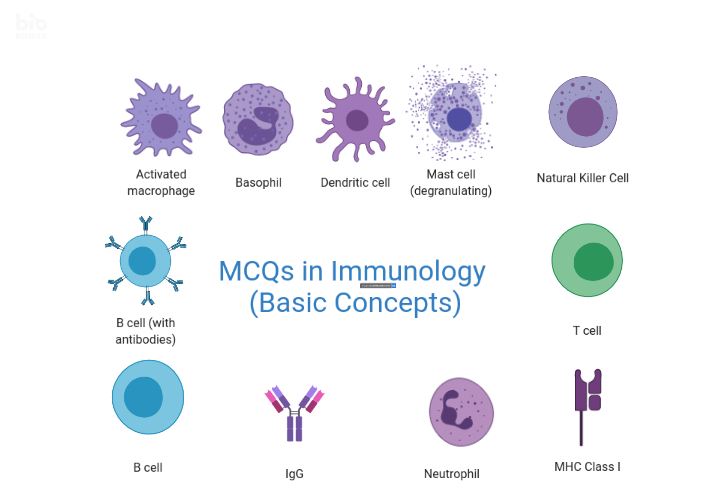 1. Naturally acquired active immunity is most likely acquired through which of the following processes?
a. Vaccination
b. Drinking colostrum
c. Natural birth
d. Infection with a disease-causing organism followed by recovery
2. Which of the following conveys the longest-lasting immunity to an infectious agent?
a. Naturally acquired passive immunity
b. Artificially acquired passive immunity
c. Naturally acquired active immunity
d. All of these
e. None of these
3. Which substances will not stimulate an immune response unless they are bound to a larger molecule?
a. Antigen
b. Virus
c. Hapten
d. Miligen
e. Antibody
4. B and T cells are produced by stem cells that are formed in the:
a. Bone marrow
b. Liver
c. Circulatory system
d. Spleen
e. Lymph nodes
5. B cells mature in the __ while T cells mature in the __
a. Thymus / bone marrow and gut-associated lymphoid tissue (GALT)
b. Spleen / bone marrow and GALT
c. Bone marrow and GALT / thymus
d. Liver / kidneys
6. Which of the following immune cells or molecules are most effective at destroying intracellular pathogens?
a. T helper cells
b. B cells
c. Antibodies
d. Complement
e. T cytolytic cells
7. A living microbe with reduced virulence that is used for vaccination is considered:
a. A toxoid
b. Dormant
c. Virulent
d. Attenuated
e. Denatured
8. B cells that produce and release large amounts of antibodies are called:
a. Memory cells
b. Basophils
c. Plasma cells
d. Killer cells
e. Neutrophils
9. The specificity of an antibody is due to:
a. Its valence
b. The heavy chains
c. The Fc portion of the molecule
d. The variable portion of the heavy and light chains
10. In agglutination reactions the antigen is a __ and in precipitation reactions the antigen is a __
a. Whole cell / soluble molecule
b. Soluble molecule / whole cell
c. Bacterium / virus
d. Protein / carbohydrate
e. Protein / antibody
11. B cells are activated by:
a. Complement
b. Antibody
c. Interferon
d. Memory cells
e. Antigen
12. Fusion between a plasma cell and a tumor cell creates a:
a. Myeloma
b. Natural killer cell
c. Lymphoblast
d. Lymphoma
e. Hybridoma
13. Monoclonal antibodies recognize a single:
a. Antigen
b. Bacterium
c. Epitope
d. B cell
e. Virus
14. Cell-mediated immunity is carried out by __ while humoral immunity is mainly carried out by __
a. B cells / T cells
b. Epitopes / antigens
c. T cells / B cells
d. Antibodies / antigens
e. Antibodies / phagocytes
15. The ability of the immune system to recognize self-antigens versus non-self antigens is an example of:
a. Specific immunity
b. Self-tolerance or immunological tolerance
c. Cell-mediated immunity
d. Antigenic immunity
e. Humoral immunity
Browse other immunology MCQs by topic:
Answer key
- d. Infection with a disease-causing organism followed by recovery
- c. Naturally acquired active immunity
- c. Hapten
- a. Bone marrow
- c. Bone marrow and GALT / thymus
- e. T cytolytic cells
- d. Attenuated
- c. Plasma cells
- d. The variable portion of the heavy and light chains
- a. Whole cell / soluble molecule
- e. Antigen
- e. Hybridoma
- c. Epitope
- c. T cells / B cells
- b. Self-tolerance or immunological tolerance
Why these are the answers
1. Infection with a disease-causing organism followed by recovery. Naturally acquired active immunity develops when a person meets a live pathogen in the ordinary course of life, mounts their own immune response, recovers, and is left with memory cells. The word active means the person's own immune system did the work; naturally acquired means it happened through natural exposure, not a vaccine. Vaccination is artificially acquired active immunity, and colostrum or placental transfer gives passive immunity.
2. Naturally acquired active immunity. Active immunity lasts far longer than passive immunity, because the host makes their own antibodies and, crucially, memory cells that persist for years. Passive immunity (whether from breast milk or an injected antibody preparation) fades within weeks to months once the borrowed antibodies are cleared. Among the options given, the only active form is naturally acquired active immunity, so it provides the most durable protection.
3. Hapten. A hapten is a small molecule that can bind an antibody but is too small to trigger an immune response on its own. It becomes immunogenic only when it attaches to a larger carrier protein. This is why some small drug molecules cause allergy only after binding body proteins. (Miligen is not a real term and is included as a distractor.)
4. Bone marrow. Both B and T lymphocytes arise from hematopoietic stem cells, and in the fully developed human those stem cells reside in the bone marrow. Blood formation shifts location during development (the fetal liver is an early site), but the definitive lifelong source of the stem cells that give rise to both lineages is the bone marrow.
5. Bone marrow and GALT / thymus. The clean way to remember this is that T cells are thymus-derived, they mature in the thymus, while B cells mature in the bone marrow (the option also lists GALT, which plays this role in some species). The key contrast to carry is simply: T cells mature in the thymus, B cells in the bone marrow.
6. T cytolytic cells. Pathogens that live inside host cells, such as viruses and some bacteria, are hidden from circulating antibodies, which can only reach targets in the blood and tissue fluid. Cytotoxic (CD8) T cells recognize infected host cells by the foreign peptides they display and kill them, eliminating the pathogen's hiding place. Antibodies, B cells, and complement act mainly against extracellular targets, which is why they are less effective here.
7. Attenuated. Attenuated means weakened. A live attenuated vaccine uses a living microbe that has been altered so it can no longer cause disease (its virulence is reduced) but can still replicate enough to provoke a strong, lasting immune response (its immunogenicity is retained). A toxoid, by contrast, is an inactivated toxin, not a live microbe.
8. Plasma cells. When a naive B cell meets its specific antigen and receives help from T cells, it differentiates into a plasma cell, the effector cell of the antibody response. Plasma cells are antibody factories, secreting thousands of antibody molecules per second. Memory cells, by contrast, persist quietly and respond faster on a future encounter but do not pour out antibody the way plasma cells do.
9. The variable portion of the heavy and light chains. An antibody's specificity, its ability to recognize one particular target, comes from the antigen-binding site formed by the variable regions at the tips of both the heavy and light chains. Genetic recombination of these variable segments generates millions of different binding sites, which is how the immune system can recognize an enormous range of antigens. The Fc portion, by contrast, is constant and determines effector function, not specificity.
10. Whole cell / soluble molecule. The two reactions differ by the physical state of the antigen. Agglutination involves particulate antigens, whole cells such as bacteria or red blood cells, that clump into visible aggregates when antibody cross-links them. Precipitation involves soluble antigens that cross-link with antibody into a lattice large enough to fall out of solution. Particle equals agglutination; soluble equals precipitation.
11. Antigen. A naive B cell is switched on when a specific antigen binds the membrane-bound immunoglobulin that serves as its B-cell receptor. That binding starts the intracellular signaling that leads to activation and, with T-cell help, differentiation into plasma cells and memory cells. The other options are molecules and cells involved elsewhere in immunity, but the initiating signal for the B cell is its antigen.
12. Hybridoma. A hybridoma is made by fusing an antibody-producing plasma B cell with an immortal myeloma (tumor) cell. The fusion combines the plasma cell's antibody specificity with the tumor cell's ability to divide indefinitely, giving a cell line that produces one defined antibody forever. This is the basis of monoclonal antibody production.
13. Epitope. A monoclonal antibody is derived from a single clone and recognizes a single epitope, the precise small region of an antigen (also called the antigenic determinant) that the antibody binds. A whole antigen usually carries several different epitopes; a monoclonal antibody sees only one of them, which is the source of its high specificity.
14. T cells / B cells. The adaptive immune response has two arms. Cell-mediated immunity is carried out mainly by T lymphocytes, which act on infected or abnormal cells directly. Humoral (antibody-mediated) immunity is carried out by B lymphocytes, which differentiate into plasma cells and secrete antibodies into the body fluids (the humors). Matching each arm to its lymphocyte is the point of the question.
15. Self-tolerance or immunological tolerance. Self-tolerance is the immune system's learned ability to leave the body's own molecules alone while still attacking foreign ones. It is established as developing lymphocytes that react too strongly against self-antigens are removed or silenced. When self-tolerance breaks down, the immune system attacks the body's own tissues, which is the basis of autoimmune disease.

Tankeshwar Acharya, MSc (Medical Microbiology)
Tankeshwar Acharya is an Assistant Professor in the Department of Microbiology at Patan Academy of Health Sciences (PAHS), Nepal, where he has been teaching and practicing clinical microbiology for over 14 years. He is the founder of Microbe Online, one of the leading free microbiology education resources on the web, covering bacteriology, mycology, parasitology, immunology, and clinical laboratory diagnostics written from direct experience in both the classroom and the diagnostic laboratory.
Comments
No comments yet. Be the first to share your thoughts.
Leave a comment
All comments are reviewed before they appear.