
Ebola Virus Disease (EVD): Symptoms, Transmission, and Diagnosis
Ebola virus disease is a severe illness spread through body fluids. Learn its symptoms, how it spreads, how it is diagnosed, and how vaccines and treatments now change survival.

On this page
A health worker in West Africa sees a patient with fever, headache, and muscle pain. Nothing yet separates this from the malaria and typhoid cases seen every day. That is the central danger of Ebola. For its first days it wears the face of ordinary illness, and by the time the bleeding and vomiting make it unmistakable, the patient has already been infectious to everyone who touched them without protection. Recognizing Ebola early, before it announces itself, is the whole challenge.
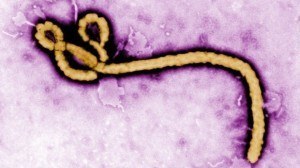 Figure: Ebola virus structure
Ebola virus disease (EVD), formerly known as Ebola hemorrhagic fever, is a severe and often fatal illness in humans. Its case fatality rate averages around 50 percent but has ranged from 25 to 90 percent across different outbreaks, depending on the virus species and the quality of medical care available. It is one of the most feared infectious diseases known, both for its high mortality and for how readily it spreads through contact with body fluids.
Ebola first appeared in 1976 in two simultaneous outbreaks, one in a village near the Ebola River in the Democratic Republic of the Congo and the other in what is now South Sudan.
"Ebola" is not a single virus. Several species cause human disease, and they differ sharply in how deadly they are. Ebola virus (the species long known as Zaire ebolavirus, now formally renamed Orthoebolavirus zairense) is the most lethal and the one behind the largest outbreaks. Sudan virus and Bundibugyo virus cause serious outbreaks too but with lower fatality. This distinction matters clinically, because the licensed vaccine and treatments protect against Ebola virus (Zaire) only, not the other species.
Properties
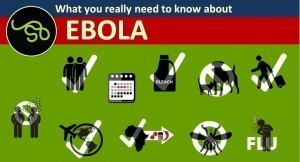 1. The Ebola virus got its name from the river where the first outbreak emerged in 1976 – the Ebola River in the Democratic Republic of the Congo (formerly Zaire) in Africa.
Fruit bats of the Pteropodidae family are considered to be the natural host of the Ebola virus.
Ebola is not a respiratory disease. It does not spread through the air, through coughing or sneezing, through casual contact, or through water. This is one of the most important facts about Ebola, because it means the disease spreads only through direct contact with body fluids, which is exactly what makes careful infection control so effective at stopping it.
Infected fruits bats or primates (apes and monkeys) can transmit the Ebola virus. Dogs or cats are not able to spread Ebola to people or other animals.
Mosquitoes that transmit many deadly diseases such as Malaria, Filariasis, and Japanese Encephalitis are not able to carry and transmit the Ebola virus.
If an exposed person does not develop Ebola symptoms after 21 days, he/she will not have Ebola.
Ebola spreads from one person to another only after symptoms begin. A person who is infected but not yet showing symptoms cannot pass the virus to others. This single fact governs how contacts are traced and monitored during an outbreak.
Transmission
The Ebola virus is transmitted to people from wild animals and spreads in the human population through human-to-human transmission. It transmits via the body fluids (blood, vomit, urine, feces, sweat, and other fluids) of a person who is infected with or who died from Ebola or via objects contaminated with the virus (like needles and syringes, etc.).
Infection occurs from direct contact (human to human transmission) through broken skin or mucous membranes with infected people’s blood or other bodily fluids or secretions (stool, urine, saliva, etc.). Infection can also occur if a healthy person’s broken skin or mucous membranes come into contact with environments contaminated with an Ebola patient’s infectious fluids, such as soiled clothing, bed linen, or used needles.
Risk Groups
During an outbreak, those at higher risk of infection are:
- health workers;
- family members or others in close contact with infected people;
- mourners who have direct contact with the bodies of the deceased as part of burial ceremonies.
Signs and symptoms of Ebola
Ebola does not begin with bleeding. It begins like many common tropical illnesses, which is exactly why early diagnosis is so hard. The symptoms follow a rough progression.
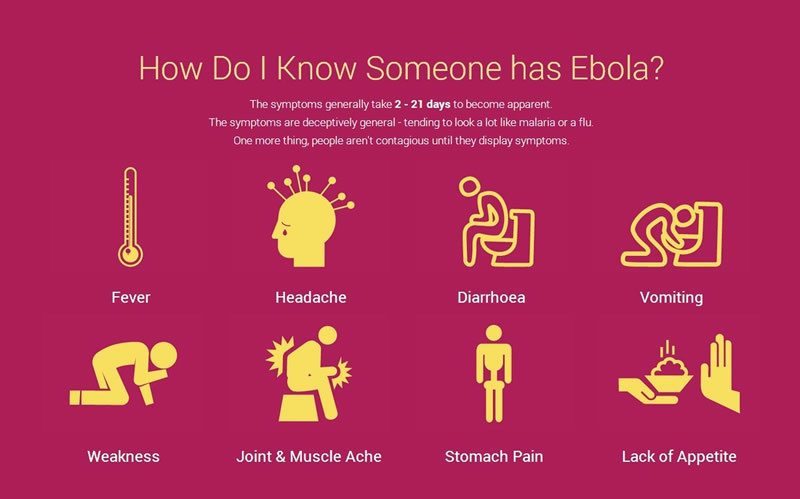 Figure: Early Ebola symptoms overlap with malaria and typhoid, making history essential.
Incubation (2 to 21 days): No symptoms. The person is infected but not yet ill, and importantly, not yet contagious.
Early phase (first few days of illness): Sudden fever, severe headache, muscle and joint pain, intense weakness and fatigue, and sore throat. At this stage Ebola is clinically indistinguishable from malaria, typhoid fever, or many other febrile illnesses. Nothing here points specifically to Ebola, which is why travel and contact history carry so much weight.
Progressive phase: Vomiting, diarrhea (often severe and leading to dangerous fluid loss), abdominal pain, and a rash. Impaired kidney and liver function begin to appear.
Severe/late phase: In some patients, internal and external bleeding appears, such as oozing from the gums, blood in the stool, or bleeding from injection sites. Not every patient bleeds. Massive hemorrhage is usually seen only in fatal cases. Death, when it occurs, is most often from fluid loss, shock, and multi-organ failure rather than from blood loss alone.
Typical laboratory findings: low white blood cell count, low platelet count (thrombocytopenia), and elevated liver enzymes.
The clinical lesson: the severe bleeding that most people associate with Ebola is a late and not universal feature. Waiting for it to confirm a diagnosis wastes the critical early window for isolation and supportive care.
Diagnosis
Diagnosing Ebola in someone infected for only a few days is difficult because the early symptoms, such as fever, are nonspecific to Ebola infection. Also, these symptoms are similar in patients with more commonly occurring diseases, such as malaria and typhoid fever.
The choice of diagnostic test depends on how long the patient has been ill, because different markers appear at different stages. Early in infection, the virus itself is detectable. Later, the body's antibodies become the marker. This is why a single test is not enough on its own, and why timing changes which test is meaningful.
| Timeline of infection | Diagnostic tests available |
|---|---|
| Within a few days after symptoms begin | Antigen-capture ELISA, RT-PCR, virus isolation |
| A few days to weeks into illness | IgM antibodies, then IgG antibodies (by ELISA) |
| Later in the disease course or after recovery | IgM and IgG antibodies |
| Retrospectively, in deceased patients | Immunohistochemistry, RT-PCR, virus isolation |
RT-PCR is the mainstay of confirmation during an outbreak because it detects the virus early, is highly specific, and gives results quickly.
However, if a person has the early symptoms of Ebola and has had contact with the blood or body fluids of a person sick with Ebola, contact with objects contaminated with the blood or body fluids of a person sick with Ebola, or contact with infected animals, they should be isolated, and public health professionals notified. Samples from the patient can then be collected and tested to confirm infection.
Download Laboratory Guidelines for Testing of Ebola Virus Disease: Click to Download
Prevention of Ebola Virus Disease
A licensed vaccine and specific treatments for Ebola now exist, which has changed outbreak response significantly. They are covered in the treatment section below. Even so, prevention through avoiding exposure remains the foundation of control, because the vaccine and treatments protect against only one Ebola species (Ebola virus, the Zaire species) and access during outbreaks can be limited.
If you travel to or are in an area with Ebola outbreak, or you are a healthcare worker or a family or friend of a person suffering from Ebola virus disease, below mentioned steps will help you to reduce the chances of contracting the Ebola virus disease.
- Hand washing is the best tool to combat any infectious disease, including Ebola. Practice careful hygiene. For example, wash your hands with soap and water or an alcohol-based hand sanitizer and avoid contact with blood and body fluids.
- Do not handle items that may have come in contact with an infected person’s blood or body fluids (such as clothes, bedding, needles, and medical equipment).
- Avoid funeral or burial rituals that require handling the body of someone who has died from Ebola.
- Avoid contact with bats and nonhuman primates or blood, fluids, and raw meat prepared from these animals.
- Avoid unnecessary visits to healthcare facilities that are actively treating Ebola patients, unless you are seeking care yourself, since these settings carry higher exposure risk during an outbreak.
- After you return from Ebola-affected regions, monitor your health for 21 days and seek medical care immediately if you develop symptoms of Ebola.
- To protect yourself, your family, and your community from EVD transmission, immediately report to the nearest health facility if you develop symptoms of EVD, including high fever, body aches, joint pain, vomiting, diarrhea, or hemorrhaging.
Safety Steps for Healthcare Workers With Risk of Exposure
Healthcare workers who may be exposed to people with Ebola should follow these steps:
- Wear protective clothing, including masks, gloves, gowns, and eye protection.
- Practice proper infection control and sterilization measures.
- Isolate patients with Ebola from other patients.
- Avoid direct contact with the bodies of people who have died from Ebola.
- Notify health officials if you have had direct contact with the blood or body fluids, such as but not limited to feces, saliva, urine, and vomit of a person who is sick with Ebola. The virus can enter the body through broken skin or unprotected mucous membranes in, for example, the eyes, nose, or mouth.
Treatment of Ebola virus disease
For many years there was no specific treatment for Ebola, and care was entirely supportive. That has changed. There are now both a licensed vaccine and approved specific treatments, though supportive care remains essential.
Supportive care is still the foundation and can substantially improve survival on its own. It includes intravenous fluids and electrolytes to counter the severe fluid loss from vomiting and diarrhea, maintaining blood pressure and oxygen, and treating any additional infections. Early supportive care is one of the strongest predictors of survival.
Specific treatments. Two monoclonal antibody therapies are now approved for Ebola virus (the Zaire species). Inmazeb, a combination of three monoclonal antibodies, was approved in 2020 as the first treatment for Ebola virus infection. Ebanga, a single monoclonal antibody, was approved shortly after. Both work by targeting the viral surface glycoprotein the virus uses to enter cells. In clinical trials, both improved survival compared with earlier treatments.
Vaccine. Ervebo, a single-dose vaccine, is licensed and used in outbreak settings to protect health workers and the contacts of infected people. It is currently the vaccine held in the global emergency stockpile. A separate two-dose vaccine regimen (Zabdeno and Mvabea) is also licensed.
An important limitation. These vaccines and treatments protect against Ebola virus (the Zaire species) only. They do not protect against Sudan virus or Bundibugyo virus, for which specific vaccines and treatments are still in development. This is why identifying which species is causing an outbreak is not an academic detail. It determines whether these tools can even be used.
Alongside treatment, people suspected or confirmed to have Ebola should be isolated and cared for by health workers using strict infection control, both to give the patient the best chance and to stop the virus from spreading further.
How to Remember
The incubation-to-isolation window ("2 to 21"): the numbers do double duty. Incubation is 2 to 21 days, and a contact who stays symptom-free for 21 days is in the clear. One number pair anchors both the incubation period and the monitoring rule.
Why early Ebola is missed ("FHM = Fever, Headache, Malaise, looks like Malaria"): the early triad is nonspecific and mimics malaria and typhoid. If you remember that Ebola hides as malaria first, you remember why history matters more than symptoms early on.
The contagious rule in four words: symptoms first, then spread. No symptoms means no transmission. This one line answers most exam questions about Ebola infectiousness and contact tracing.
Species and the tools ("Zaire has the tools"): vaccine and treatments work for Ebola virus (Zaire species) only. Sudan and Bundibugyo do not yet have them. If a question ties a treatment to Sudan virus, it is testing this exact gap.
Key exam facts
| Fact | Detail |
|---|---|
| Family / genus | Filoviridae; genus Orthoebolavirus |
| Most lethal species | Ebola virus (Orthoebolavirus zairense, formerly Zaire ebolavirus) |
| Natural reservoir | Fruit bats (Pteropodidae), strongly suspected |
| Genome | Enveloped, negative-sense single-stranded RNA |
| Case fatality rate | ~50% average; 25 to 90% range by outbreak and species |
| Incubation period | 2 to 21 days |
| When contagious | Only after symptoms begin (not during incubation) |
| Transmission | Direct contact with body fluids; not airborne, not by casual contact or water |
| Early symptoms | Fever, headache, muscle pain, weakness, sore throat (mimics malaria/typhoid) |
| Later symptoms | Vomiting, diarrhea, rash, organ impairment, sometimes bleeding |
| Key lab findings | Low WBC, low platelets, elevated liver enzymes |
| Confirmatory test | RT-PCR (mainstay during outbreaks) |
| Vaccine | Ervebo (single dose); Zabdeno + Mvabea (two-dose). Zaire species only |
| Treatments | Inmazeb and Ebanga (monoclonal antibodies). Zaire species only |
| Highest-risk groups | Health workers, family/caregivers, mourners handling bodies |
Where Students Get Confused
"Is Ebola airborne?" No. This is the single most common misconception. Ebola spreads through direct contact with infected body fluids, not through the air like measles or tuberculosis. A person cannot catch it by being in the same room as a patient without contact. This is precisely why standard barrier precautions work.
"Can you catch Ebola from someone before they show symptoms?" No. A person becomes contagious only once symptoms begin. During the incubation period (2 to 21 days) they are infected but not infectious. This is the foundation of contact tracing: contacts are monitored for 21 days, and if no symptoms appear, they cannot have transmitted the virus.
"Does every Ebola patient bleed?" No. Despite the old name "Ebola hemorrhagic fever," visible bleeding is a late feature and does not occur in every case. Many patients die from fluid loss, shock, and organ failure without dramatic hemorrhage. Waiting for bleeding to suspect Ebola is a dangerous mistake.
"There's no treatment or vaccine for Ebola, right?" Not anymore. This is outdated. A licensed vaccine (Ervebo) and two approved monoclonal antibody treatments (Inmazeb and Ebanga) now exist. The crucial catch: they work only against Ebola virus (the Zaire species), not against Sudan or Bundibugyo virus.
"Why is Ebola so hard to diagnose early?" Because its first symptoms, fever and headache, are identical to common diseases like malaria and typhoid. Early diagnosis depends less on symptoms and more on travel history and known contact with a case, combined with laboratory testing (RT-PCR).
"Do mosquitoes spread Ebola?" No. Unlike dengue or malaria, Ebola is not spread by mosquitoes or any insect vector. Its reservoir is fruit bats, and human spread is through fluid contact.
References
- World Health Organization. (2025). Ebola disease [Fact sheet]. World Health Organization. https://www.who.int/news-room/fact-sheets/detail/ebola-disease
- Centers for Disease Control and Prevention. (2024). Ebola disease. National Center for Emerging and Zoonotic Infectious Diseases. https://www.cdc.gov/ebola/
- U.S. Food and Drug Administration. (2020). FDA approves first treatment for Ebola virus [Inmazeb; Ebanga]. https://www.fda.gov/emergency-preparedness-and-response/mcm-issues/ebola
- U.S. Food and Drug Administration. (2019). First FDA-approved vaccine for the prevention of Ebola virus disease [Ervebo]. https://www.fda.gov/emergency-preparedness-and-response/mcm-issues/ebola
- World Health Organization. (2025). Ebola virus disease vaccines [Questions and answers]. https://www.who.int/news-room/q-a-detail/ebola-vaccines

Tankeshwar Acharya, MSc (Medical Microbiology)
Tankeshwar Acharya is an Assistant Professor in the Department of Microbiology at Patan Academy of Health Sciences (PAHS), Nepal, where he has been teaching and practicing clinical microbiology for over 14 years. He is the founder of Microbe Online, one of the leading free microbiology education resources on the web, covering bacteriology, mycology, parasitology, immunology, and clinical laboratory diagnostics written from direct experience in both the classroom and the diagnostic laboratory.
Comments
No comments yet. Be the first to share your thoughts.
Leave a comment
All comments are reviewed before they appear.