
Kligler’s Iron Agar (KIA): Principle, Procedure, Results
A faint black line at the slant-butt junction is easy to overlook, and it is exactly the reaction that can point toward Salmonella Typhi. Full KIA principle, tube-reading rules, and the KIA/TSI distinction explained.

On this page
The reaction that's easy to miss and easy to over-read
A stool sample from a patient with suspected enteric fever is inoculated onto Kligler's Iron Agar as part of the standard Enterobacteriaceae workup. Overnight, the tube comes back alkaline slant, acid butt, the classic non-lactose-fermenter pattern consistent with Salmonella. The technologist checks for hydrogen sulfide next, and finds almost nothing: at most, a barely visible thin black line right at the slant-butt junction, easy to overlook entirely if the tube is not examined carefully against a bright background.
That faint line matters. Salmonella Typhi is notorious for producing only weak, scanty hydrogen sulfide on KIA, nothing like the heavy, fully blackened butt seen with Proteus or many other Salmonella serovars. A technologist expecting a strong, obvious H₂S reaction, and dismissing this faint one as negative, risks steering the workup away from typhoid entirely. Reading this tube correctly is not about memorizing a color chart. It is about knowing exactly which reactions on this test are meant to be strong and unambiguous, and which ones are subtle enough that a rushed reading can miss them.
Kligler's Iron Agar (KIA) is used for the detection of carbohydrate fermentation. Its reactions help include or exclude a bacterial isolate from the family Enterobacteriaceae. If an organism cannot ferment glucose, KIA shows an alkaline slant/alkaline butt (no change) reaction, and that result alone is sufficient to exclude the isolate from Enterobacteriaceae, since fermenting glucose is part of how that family is biochemically defined. KIA is also used for the presumptive identification of Salmonella, Shigella, and other Enterobacteriaceae members.
The composition of KIA is identical to Triple Sugar Iron Agar (TSI), except that TSI adds 10 g of sucrose. This single difference is the reason the two media occasionally disagree on certain organisms, most notably Vibrio cholerae.
Composition of Kligler's Iron Agar
| Ingredient | Gram/Liter |
|---|---|
| Beef extract | 3 gm |
| Yeast extract | 3 gm |
| Peptone | 15 gm |
| Proteose peptone | 5 gm |
| Lactose | 10 gm |
| Glucose | 1 gm |
| Ferrous sulfate | 0.2 gm |
| Sodium chloride | 5 gm |
| Sodium thiosulfate | 0.3 gm |
| Agar | 12 gm |
| Phenol red | 0.024 gm |
| Distilled water to 1 L |
Final pH: 7.4
The four protein derivatives (beef extract, yeast extract, peptone, proteose peptone) make KIA nutritionally rich, and the absence of inhibitors allows growth of all but the most fastidious species and obligate anaerobes. Glucose and lactose are distributed evenly through both slant and butt, but lactose is present at 10 times the concentration of glucose. Sodium thiosulfate supplies sulfur; ferrous sulfate detects the hydrogen sulfide produced from it. Phenol red turns yellow below pH 6.8; because the uninoculated medium is buffered at pH 7.4, even small amounts of acid produce a visible color change.
Procedure
Preparation. KIA is best prepared from ready-to-use dehydrated powder, typically at 5.5 g per 100 mL distilled water (concentration varies by manufacturer).
- Prepare as instructed by the manufacturer. Once cooled to 50–55°C, mix well and dispense in 6 mL amounts into large tubes (approximately 16 x 160 mm).
- Sterilize by autoclaving, caps loosened, at 121°C for 15 minutes.
- Allow the molten agar to solidify in a slanted position, creating two distinct reaction chambers in the same tube: the slant, exposed to atmospheric oxygen (aerobic), and the butt, protected from air (relatively anaerobic).
- The butt should be at least as long as the slant, ideally both around 3 cm, to preserve this two-chamber effect.
- Date the medium, assign a batch number, and store in a cool, dark place or at 2–8°C.
Shelf life is about 3 weeks or longer if caps are tightly screwed and there is no sign of contamination, deterioration, or pH shift. Working pH range: 7.2–7.6 at room temperature.
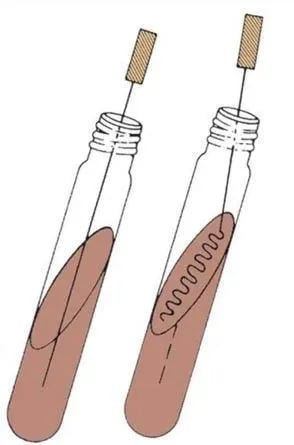 Figure: Inoculation in KIA
Inoculation. Use a straight wire, stab the butt first, then streak the slant in a zig-zag pattern. Leave tube caps loose after inoculation. The reaction depends on differential oxygen access, and a tightly capped tube disrupts that.
Principle
Non-lactose fermenter.
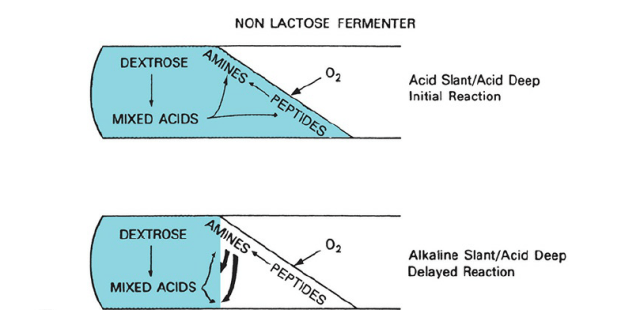 An organism that ferments glucose but not lactose produces only a small amount of acid, from the 0.1% glucose concentration present. In the first 8–12 hours, this acid is enough to turn both slant and butt yellow. But once the limited glucose is exhausted, the organism (in the slant, where oxygen is available) shifts to oxidative degradation of amino acids, releasing alkaline amines that neutralize the small amount of acid there. By 18–24 hours, the slant reverts to red (alkaline), while the butt, with no oxygen to support that reversal, stays yellow (acid). This alkaline slant/acid butt pattern is the signature of a non-lactose fermenter.
Lactose fermenter.
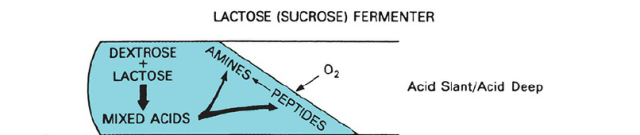 An organism that can also ferment lactose (present at 10x the concentration of glucose) keeps producing acid well past the point where glucose alone would run out. At 18–24 hours, both slant and butt remain yellow: acid slant/acid butt.
Results
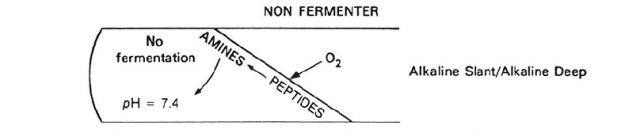
Reaction | Meaning | Example Organisms |
Alkaline slant / Alkaline butt (K/K) | No carbohydrate fermentation | Pseudomonas aeruginosa (non-fermenter, excluded from Enterobacteriaceae) |
Alkaline slant / Acid butt (K/A) | Glucose fermented, lactose not | Shigella spp., Salmonella spp. |
Acid slant / Acid butt (A/A) | Both glucose and lactose fermented | E. coli, Klebsiella, Enterobacter |
Reading-order checklist: "Color, then crack, then black." Read the tube in that order: slant/butt color first (fermentation pattern), then look specifically for gas (cracks or displacement in the agar, not a color change), then check for blackening (H₂S) last, and look closely, since some of the most clinically important reactions (like S. Typhi's) are the faintest ones.
Gas production is read by physical evidence, space at the tube bottom or a split in the agar, not by color. Hydrogen sulfide production shows as a black butt; if the entire butt blackens, assume the underlying reaction is still acidic (yellow), just masked by the black precipitate.
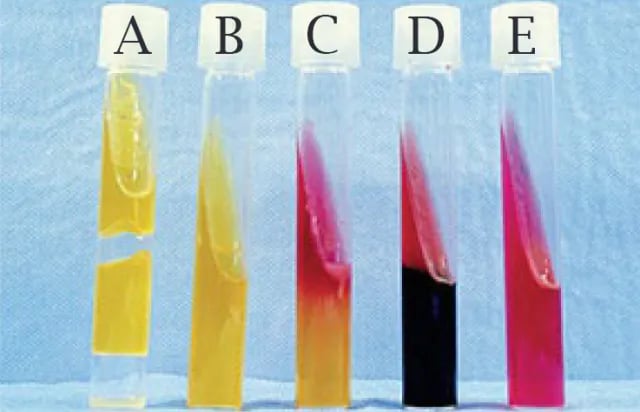 Figure: Kligler’s iron agar (KIA) tubes with several reaction patterns A: Acid/Acid, Gas; B: Acid/Acid, No gas; C: Alkaline/Acid; D: Alkaline /Acid, H₂S+; E: Alkaline/Alkaline
KIA vs. TSI: "Kligler keeps it simple." KIA tests two sugars, TSI tests three. The only organism reaction that meaningfully changes between the two tests due to that difference is one that ferments sucrose but not lactose, exactly the V. cholerae case above.
Organism Reactions on KIA
| Organism | Slant/Butt | Gas | H₂S |
|---|---|---|---|
| Pseudomonas aeruginosa | Alk/Alk | – | – |
| E. coli | Acid/Acid or Alk/Acid | + | – |
| Shigella spp. | Alk/Acid | – | – |
| Salmonella Paratyphi A | Alk/Acid | + | – |
| Salmonella Paratyphi B | Alk/Acid | + | + |
| Salmonella Paratyphi C | Alk/Acid | + | + |
| Salmonella Typhi | Alk/Acid | − (anaerogenic) | Weak/scanty, often easy to miss |
| Other Salmonella serovars | Alk/Acid | + (weak) | Variable |
| Klebsiella pneumoniae | Acid/Acid | ++ | – |
| Klebsiella oxytoca | Acid/Acid | ++ | – |
| Enterobacter cloacae | Acid/Acid | ++ | – |
| Citrobacter freundii | Acid/Acid or Alk/Acid | + | + |
| Serratia marcescens | Alk/Acid | + | – |
| Proteus vulgaris | Alk/Acid | +/– | + |
| Proteus mirabilis | Alk/Acid | + | + |
| Morganella morganii | Alk/Acid | + | – |
| Yersinia enterocolitica | Alk/Acid | – | – |
(+ = 90% or more strains positive; – = 90% or more strains negative; d = variable between strains)
Note the pattern: S. Typhi is the anaerogenic exception (no gas, weak H₂S), and S. Paratyphi A is H₂S negative. The other paratyphi and most non-typhoidal serovars produce both gas and H₂S. This is why gas and H2S together, not either one alone, help place a Salmonella isolate.
Note on Salmonella Typhi's H₂S reaction: some sources report it as essentially negative on KIA; others describe it as weak and scanty rather than fully absent. Given this genuine variability across references, do not treat a faint or absent H₂S reaction as ruling out S. Typhi on its own, exactly the trap illustrated in the hook above.
Vibrio cholerae on KIA vs. TSI. V. cholerae ferments both glucose and sucrose. Since KIA contains no sucrose, it shows alkaline slant/acid butt, the same pattern as a non-lactose fermenter. On TSI, which does contain sucrose, the same organism shows acid slant/acid butt instead, revealing its sucrose fermentation. Neither gas nor H₂S is produced. This is the clearest practical illustration of why the sucrose difference between the two media actually matters, not just a footnote to memorize.
How to Remember
KIA is TSI minus sucrose. Two sugars instead of three. The only time the two media disagree is on an organism that ferments sucrose but not lactose, and the classic example is Vibrio cholerae: K/A on KIA, A/A on TSI. If you remember that one organism, you remember why the sucrose matters.
Color, then crack, then black. Read the tube in that order: fermentation color first (slant and butt), then gas (cracks or displacement, not color), then H₂S (black), last and most carefully. The faintest reaction, S. Typhi's thin black line, is the one a rushed reading misses.
The Typhi signature: no gas, barely any black. Most Salmonella make gas and strong H₂S. S. Typhi makes neither convincingly: it is anaerogenic (no gas) and its H₂S is a faint line at the junction. That combination, K/A with no gas and only a whisper of H₂S, is the typhoid clue. Do not read the faint H₂S as negative.
A black butt hides a yellow butt. When H₂S blackens the whole butt, the acid (yellow) reaction underneath is still there, just masked. Record the butt as acid, not as no-change.
Key Exam Facts
| Concept | Key exam fact |
|---|---|
| What it detects | Glucose and lactose fermentation, gas, and H₂S, for gram-negative enteric rods |
| Two sugars | Glucose 0.1%, lactose 1% (lactose ten times glucose). The low glucose creates the K/A vs A/A distinction |
| K/A | Alkaline slant, acid butt: glucose-only fermenter. Salmonella, Shigella |
| A/A | Acid slant, acid butt: glucose and lactose fermenter. E. coli, Klebsiella, Enterobacter |
| K/K | No fermentation: non-fermenter, excluded from Enterobacteriaceae. Pseudomonas |
| H₂S indicator | Ferrous sulfate plus sodium thiosulfate, black FeS, forms in the acidic butt |
| Salmonella Typhi signature | K/A, no gas (anaerogenic), only weak/scanty H₂S. The classic reading trap |
| Salmonella Paratyphi A | H₂S negative, unlike Paratyphi B and C |
| Cap position | Left loose. A tight cap removes the oxygen the slant needs for alkaline reversion |
| Reading window | 18 to 24 hours. Earlier gives false A/A; later gives false K/K reversion |
| KIA vs TSI | KIA has no sucrose. Sucrose fermenters (V. cholerae) read K/A on KIA but A/A on TSI |
Where Students Get Confused
- Reading gas production by color instead of physical signs. Gas shows up as cracks, bubbles, or a displaced agar column, not as a shade of yellow or red.
- Assuming a negative or faint H₂S reaction rules out Salmonella Typhi. It does not. S. Typhi is known for weak, easy-to-miss H₂S production on KIA; a heavily blackened butt is far more typical of organisms like Proteus or other Salmonella serovars.
- Mixing up KIA and TSI results for Vibrio cholerae. KIA (no sucrose) shows alkaline slant/acid butt; TSI (has sucrose) shows acid slant/acid butt for the same organism. Which medium was used changes the expected pattern.
- Forgetting that a fully black butt can hide an acid reaction. If the entire butt has blackened from H₂S production, assume the underlying color is still acid (yellow), even though it is no longer visible.
References
- Procop GW, Church DL, Hall GS, Janda WM, Koneman EW, Schreckenberger PC, Woods GL. Koneman's Color Atlas and Textbook of Diagnostic Microbiology. 7th ed. Philadelphia: Wolters Kluwer; 2017.
- Tille PM. Bailey and Scott's Diagnostic Microbiology. 15th ed. St. Louis: Elsevier; 2022.
- Cheesbrough M. District Laboratory Practice in Tropical Countries, Part 2. 2nd ed. Cambridge: Cambridge University Press; 2006.
- World Health Organization. Background document: The diagnosis, treatment and prevention of typhoid fever. Geneva: WHO; 2003. (WHO/V&B/03.07)

Tankeshwar Acharya, MSc (Medical Microbiology)
Tankeshwar Acharya is an Assistant Professor in the Department of Microbiology at Patan Academy of Health Sciences (PAHS), Nepal, where he has been teaching and practicing clinical microbiology for over 14 years. He is the founder of Microbe Online, one of the leading free microbiology education resources on the web, covering bacteriology, mycology, parasitology, immunology, and clinical laboratory diagnostics written from direct experience in both the classroom and the diagnostic laboratory.
Comments
No comments yet. Be the first to share your thoughts.
Leave a comment
All comments are reviewed before they appear.