
Handheld Digital Microscope: Parts, Principle, and Uses
A handheld digital microscope has no eyepiece. A CMOS image sensor captures the magnified image and sends it to a phone or computer screen. Here is how it works, its parts, and its uses.

On this page
A handheld digital microscope is a small, portable microscope that has no eyepiece. Instead of looking through the instrument with your eye, you view the magnified image on a phone or computer screen. A built-in electronic image sensor captures the image, and a USB cable or WiFi link sends it to the screen. Because it connects to a computer over USB, it is also called a USB microscope.
This is the one feature that defines it. In an ordinary light microscope, your eye is the detector: light from the specimen passes through the lenses and forms an image on your retina. In a digital microscope, an electronic sensor replaces your eye. The image is captured, shown live on a screen, and can be saved, measured, and shared.
If the instrument has an eyepiece you look through with your eye, it is an optical instrument such as a pocket microscope, not a digital one. The presence of a screen instead of an eyepiece is what makes a microscope digital.
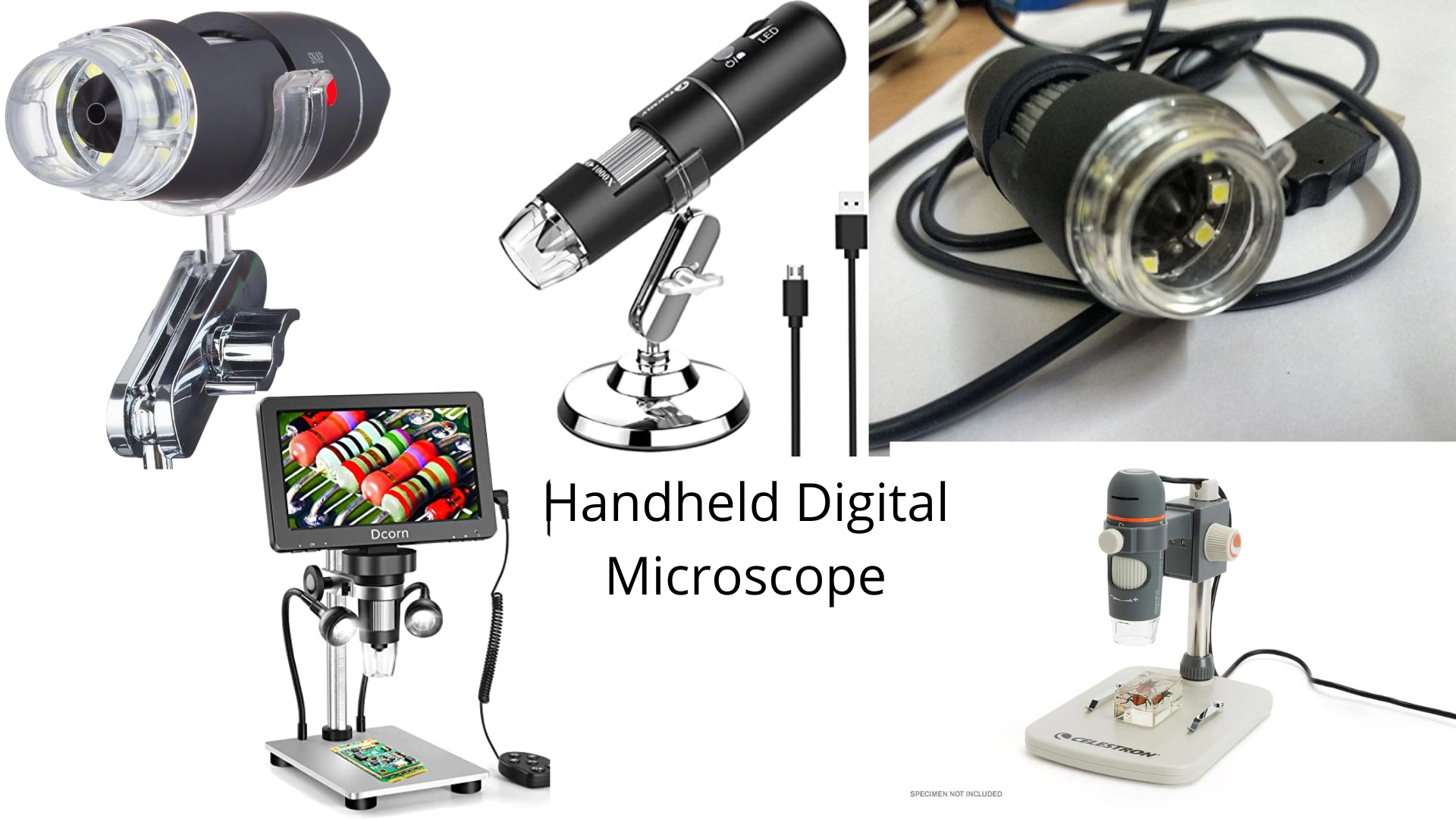 Figure: Different types of handheld digital microscope
Working Principle of Handheld Digital Microscope
A handheld digital microscope works in three steps: magnify, capture, display.
Magnify. A small objective lens (usually a macro lens) sits close to the specimen and produces a magnified optical image, the same optical step as in any light microscope. An LED next to the lens lights the specimen. Because most specimens are opaque (a coin, a circuit board, skin), the light reflects off the surface rather than passing through it.
Capture. Instead of an eyepiece, an electronic image sensor (typically a CMOS sensor, the same kind used in phone cameras) sits behind the lens. The sensor converts the optical image into a digital signal. This is the step that makes the instrument digital.
Display. The digital signal travels over USB or WiFi to a phone or computer, where software shows the image live on the screen and lets you capture, measure, and save it.
This two-part design gives two kinds of magnification. Optical magnification comes from the lens and fixes how much real detail the sensor can resolve. Digital magnification comes from enlarging the image on the screen; it makes the image bigger but adds no new detail. This is why the stated magnification of a digital microscope depends partly on screen size, and why digital zoom past a point only produces a larger, blurrier picture. The real limit is the optics and the sensor, not the screen.
Parts of Handheld Digital Microscope
The parts of a handheld digital microscope are broadly divided into two types; hardware and software.
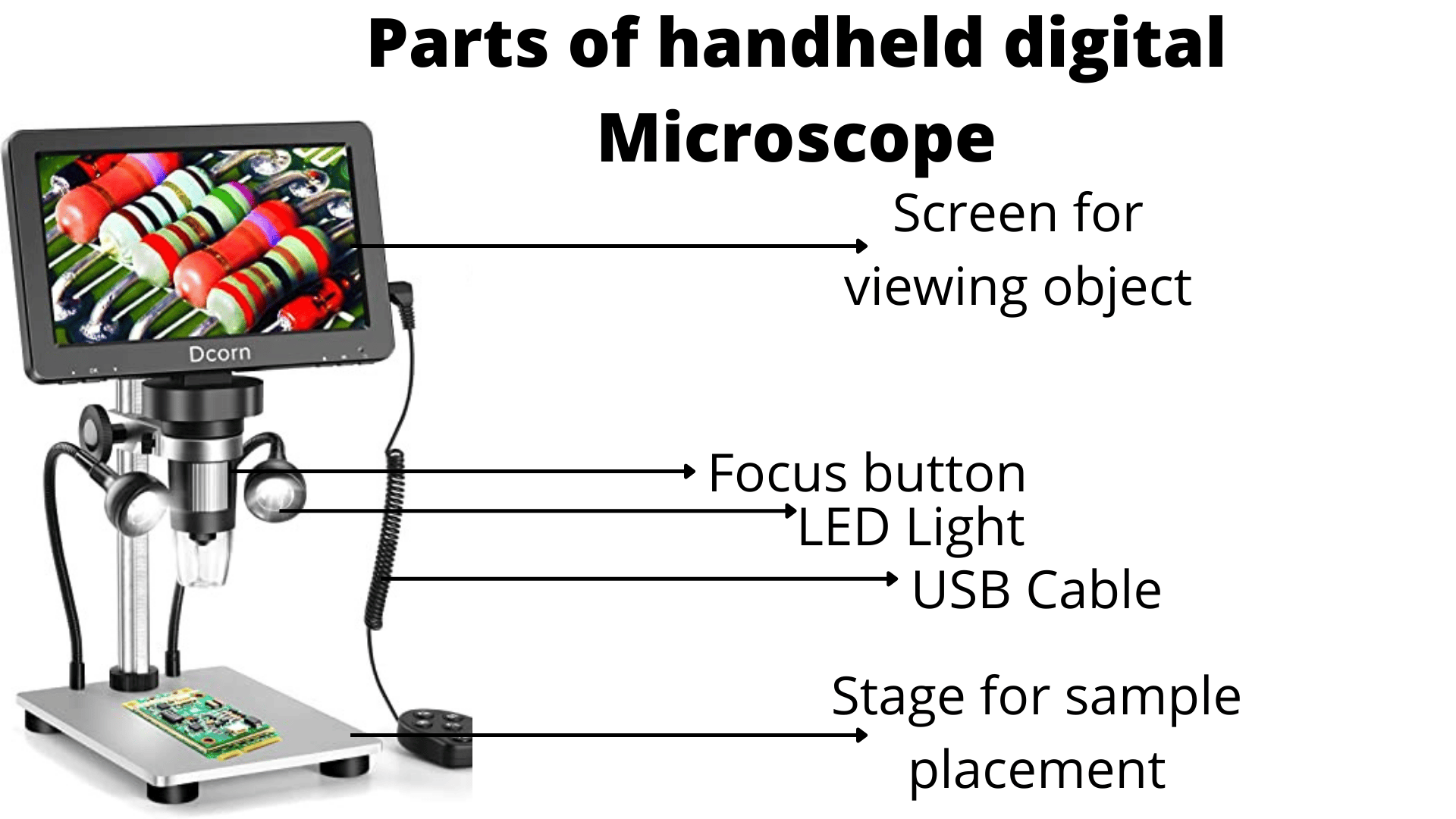 Figure: Parts of handheld digital microscope
Objective lens: A small macro lens close to the specimen produces the magnified optical image. This is the true objective. It sets the optical magnification and the real detail the microscope can resolve.
Image sensor: An electronic sensor (usually CMOS) sits behind the lens and captures the optical image, converting it to a digital signal. The sensor replaces the eyepiece and the eye. It is the detector.
LED light source: One or more LEDs next to the lens illuminate the specimen. The brightness is usually adjustable. Because most specimens are opaque, the light reflects off the surface.
Focus knob or ring: Adjusts the distance between lens and specimen to bring the image into sharp focus.
Working stage or base: The surface the specimen rests on, or the base the instrument is held against.
USB port and cable: Carry the digital signal and power between the microscope and the computer or phone. Some models use WiFi instead of a cable.
The phone or computer serves as the display and the storage device. Its screen shows the live image; its software captures and saves it. Note the phone is the display, not the objective. The microscope's own lens does the optical magnification.
Each microscope comes with software from its maker, usually free, that runs on Windows, macOS, or Linux. The software shows the live image, captures stills and video, and often adds on-screen measurement and annotation. Some models work through a plain webcam interface with no special software at all.
Uses of Handheld Digital Microscope
The handheld digital microscope is used in various fields, science as well as non-science. Some of its uses along with the fields are as follows:
- Automobile industries: It helps in inspecting brake pads,
- Cosmetic field: Dermatologists, beauticians, and cosmetic manufacturers use the handheld digital microscope to analyze skin, hair, and product quality.
- Biological laboratories: It is helpful in the analysis of flower structures, seed structures, and the structure of live insects in biological laboratories.
- Medical procedures: These microscopes’ portable, smaller, and digital imaging nature is helpful in medical procedures involving microsurgery.
- Forensic sciences: Since forensic sciences involve collecting proof after analyzing plants, insects, soils, and other biological components, this microscope is handy for research and storing images.
- Research: Research in different fields involves proper documentation after analysis of the required components; the microscope helps obtain good-quality images and store them properly.
- Coin study: The miniature carvings in the coin are of great interest to people interested in coin collection and research. A handheld digital microscope makes the investigation easier.
Benefits of Handheld Digital Microscope
Like a portable analog microscope, a handheld digital microscope also has excellent benefits, which are as follows:
- Portable: A handheld digital microscope is small in size. It is easy to travel with, and portable to any surrounding as long as the USB connection is available. Some handheld digital microscope requires WiFI connectivity. So, places with good WiFi connectivity are ideal for working with these kinds of microscopes.
- Easy to use: The working principle of the handheld digital microscope is simple and requires menial components to work. Zooming and focusing on the object is easier than on other light microscopes. So, it is relatively easy to use.
- Less stress on the eyes: These microscopes use mobile phones or computers to view images instead of eyepieces with a small viewing area. So, handheld digital microscopes are less stressful for our eyes.
- Digital images: the image is captured directly as a file, so there is no need to photograph an eyepiece view. Images are easy to save, measure, annotate, and share.
- Good image quality: Clicking images from analog microscopes generates inadequate or unfocused images. The handheld digital microscope helps to obtain good quality focused images.
- Magnification: For a small microscope, 100x magnification is quite impressive. Further zooming in on the digitized image is also possible.
- Cost-efficient: The cost of the microscopes is affordable. The price changes based on the magnification available.
Digital Versions of Other Microscopes
Almost any optical microscope can be built with a sensor and screen instead of an eyepiece. The word "digital" describes the detector, not the optics. The underlying optical method still decides what the instrument does:
- A stereo digital microscope keeps the two-path optics that give a three-dimensional view of whole, solid specimens.
- A fluorescence digital microscope captures light emitted by fluorescent labels.
- A polarizing digital microscope uses polarized light to reveal birefringent (anisotropic) materials such as crystals and certain minerals.
- Phase contrast and inverted designs also come in digital forms.
In each case the optical principle is unchanged; only the detector is digital.
How to Remember
- The one-line test for "is it digital?": look for the eyepiece. If you put your eye to it, it is optical. If the image goes to a screen, it is digital. Everything else (portable, USB, LED) is shared with optical pocket microscopes; the screen is the dividing line.
- Optical vs digital magnification, in one sentence: the lens decides how much you can see, the screen decides how big it looks. Digital zoom past the optical limit only gives you a bigger blur, not more detail.
Key exam facts
| Feature | Handheld digital microscope |
|---|---|
| Detector | Electronic image sensor (usually CMOS), replaces the eyepiece and eye |
| Viewing | On a phone or computer screen; no eyepiece |
| Connection | USB cable or WiFi |
| Light source | LED, usually adjustable; mostly reflected (incident) light on opaque specimens |
| Magnification | Optical (from the lens, sets real detail) plus digital (from the screen, adds size only) |
| Typical magnification | About 20x to 200x optical, depending on model and screen size |
| Also called | USB microscope |
| Key limit | Optical magnification and sensor resolution, not screen size; cannot resolve bacteria |
| Defining trait | Screen instead of eyepiece |
Where Students Get Confused
- Thinking the screen or the phone camera is the objective lens. It is not. The microscope has its own objective lens that does the optical magnification. The sensor behind that lens captures the image, and the screen only displays it. The phone is the detector and display, never the magnifying lens.
- Treating digital magnification as real magnification. Enlarging the image on the screen makes it bigger but adds no detail. Real resolving power comes from the optics and the sensor. A "1000x" digital figure on a cheap model is mostly empty magnification.
- Confusing a handheld digital microscope with a pocket microscope. Both are small and portable, but a pocket microscope is optical: you look through an eyepiece. A handheld digital microscope has no eyepiece and shows the image on a screen.
- Expecting it to replace a compound microscope for microbiology. Its magnification and resolution are far too low to see bacteria. It is built for surfaces (skin, coins, circuit boards, insects), not stained slides at 1000x.
Resumen en español: microscopio digital portátil
Un microscopio digital de mano es un microscopio pequeño y portátil que no tiene ocular. En lugar de mirar por el instrumento con el ojo, la imagen se ve en la pantalla de un teléfono o una computadora. Un sensor electrónico de imagen (por lo general CMOS) capta la imagen, y un cable USB o una conexión WiFi la envía a la pantalla. También se le llama microscopio USB.
Partes del microscopio digital:
- Lente objetivo: produce la imagen óptica ampliada. Fija la magnificación óptica real.
- Sensor de imagen (CMOS): capta la imagen y la convierte en señal digital. Reemplaza al ocular y al ojo.
- Fuente de luz LED: ilumina la muestra, casi siempre por luz reflejada.
- Perilla de enfoque: ajusta la nitidez de la imagen.
- Platina o base: sostiene la muestra.
- Puerto y cable USB: conectan el microscopio con la computadora o el teléfono.
Principio: amplía (lente), capta (sensor) y muestra (pantalla). La magnificación óptica viene del lente y define el detalle real. La magnificación digital solo agranda la imagen en la pantalla, sin añadir detalle.
Diferencia clave: si tiene ocular para mirar con el ojo, es óptico (como un microscopio de bolsillo). Si muestra la imagen en una pantalla, es digital.
Frequently Asked Questions
What is a handheld digital microscope?
What is a handheld digital microscope?
It is a small, portable microscope with no eyepiece. An electronic image sensor captures the magnified image, and the image is viewed on a phone or computer screen over a USB cable or WiFi. Because it connects over USB, it is also called a USB microscope.
How is a digital microscope different from an optical microscope?
How is a digital microscope different from an optical microscope?
An optical microscope uses your eye as the detector: you look through an eyepiece. A digital microscope replaces the eyepiece with an electronic image sensor and shows the image on a screen. The optics can be similar; the difference is the detector and the display.
What is the difference between optical and digital magnification?
What is the difference between optical and digital magnification?
Optical magnification comes from the lens and determines how much real detail the microscope can resolve. Digital magnification enlarges the captured image on the screen; it makes the image bigger but adds no new detail. Only optical magnification adds real information.
Can a handheld digital microscope see bacteria?
Can a handheld digital microscope see bacteria?
No. Typical models reach about 20x to 200x optical magnification, far below the roughly 1000x with oil immersion needed to see bacteria. Digital microscopes are built for surfaces such as skin, coins, insects, and circuit boards, not stained bacterial slides.
Is a handheld digital microscope the same as a pocket microscope?
Is a handheld digital microscope the same as a pocket microscope?
No. A pocket microscope is optical; you look through an eyepiece with your eye. A handheld digital microscope has no eyepiece and shows the image on a screen. Both are small and portable, but the detector is different.
References
- Digital Imaging in Optical Microscopy: Introduction. Nikon MicroscopyU. https://www.microscopyu.com/digital-imaging (accessed August 2026).
- Concepts in Digital Imaging Technology: CMOS Image Sensors. Molecular Expressions, Florida State University. https://micro.magnet.fsu.edu/primer/digitalimaging/cmosimagesensors.html (accessed August 2026).
- Anatomy of the Microscope: Numerical Aperture and Resolution. Nikon MicroscopyU. https://www.microscopyu.com/microscopy-basics/numerical-aperture (accessed August 2026, for the optical-vs-digital-magnification limit).

Tankeshwar Acharya, MSc (Medical Microbiology)
Tankeshwar Acharya is an Assistant Professor in the Department of Microbiology at Patan Academy of Health Sciences (PAHS), Nepal, where he has been teaching and practicing clinical microbiology for over 14 years. He is the founder of Microbe Online, one of the leading free microbiology education resources on the web, covering bacteriology, mycology, parasitology, immunology, and clinical laboratory diagnostics written from direct experience in both the classroom and the diagnostic laboratory.
Comments
No comments yet. Be the first to share your thoughts.
Leave a comment
All comments are reviewed before they appear.