
FTA-ABS Test: Interpretation, When It Confirms Syphilis, and FTA-ABS vs TPPA

On this page
A 24-year-old pregnant woman attends her first antenatal visit. A routine RPR screening test returns reactive at a titer of 1:16. Her clinician needs to answer one critical question before starting treatment: is this true syphilis, or one of the many other conditions that can cause a false-positive non-treponemal result?
Autoimmune disease, pregnancy itself, infectious mononucleosis, malaria, and leprosy are all known to produce false-positive RPR results. Treating a pregnant woman for syphilis she does not have causes unnecessary anxiety and medication exposure. Missing true syphilis puts her baby at 70–100% risk of congenital syphilis; a preventable cause of stillbirth, neonatal death, and disability.
The FTA-ABS test resolves this question. Unlike the RPR, which detects antibodies to cardiolipin (a lipid released by damaged cells), the FTA-ABS detects antibodies specifically directed against Treponema pallidum itself. A reactive FTA-ABS alongside a reactive RPR confirms syphilis and justifies treatment. A non-reactive FTA-ABS in the face of a reactive RPR points toward a biological false positive — a different diagnosis is needed.
Fluorescent treponemal antibody-absorption (FTA-ABS) test is a specific application of the indirect fluorescent antibody (IFA) test: the patient's anti-treponemal antibody binds fixed T. pallidum, and a labeled anti-human antibody makes that binding glow. It is used as a confirmatory (treponemal) test for syphilis. For how indirect immunofluorescence works in general, see Immunofluorescence assay.
FTA-ABS becomes reactive early in infection, typically 3 to 4 weeks after exposure, and historically was regarded as the earliest treponemal test to turn positive. Note that this long-standing claim has been revised: in current CDC-reviewed data, TPPA is at least as sensitive as FTA-ABS in primary syphilis (one large study reported primary-stage sensitivities of about 78% for FTA-ABS versus about 95% for TPPA). FTA-ABS is still an early and useful confirmatory test, but it is no longer considered the most sensitive option in primary syphilis.
This test is inexpensive confirmatory test performed in reference to public health laboratories. FTA-ABS test results are positive in most patients with primary syphilis and the test result remains positive for life so the FTA-ABS test for syphilis cannot be used to determine the response to treatment.
Modern high-volume laboratories increasingly use a reverse-sequence algorithm, screening first with an automated treponemal immunoassay (EIA or CIA) and confirming discordant results with a second treponemal test. In this landscape TPPA has largely replaced FTA-ABS as the preferred manual treponemal test, because it is at least as sensitive, is easier to standardize, and does not require a fluorescence microscope. FTA-ABS remains valuable where a manual treponemal confirmatory test is needed and for adjudicating discordant serology.
FTA-ABS Test Principle
Serum from patients suspected of having syphilis because of previous positive VDRL or RPR test is diluted in 1:5 sorbent (patients’ serum is absorbed with treponemes other than Treponema pallidum to remove nonspecific antibodies).
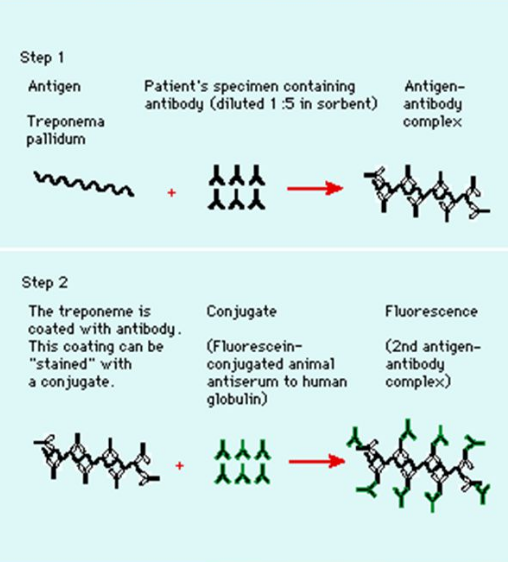 Figure: fta-abs-test-principle
Note: Sorbent is an extract from cultures of Treponema phagedenis, Reiter treponeme.
This absorbed serum is layered on a microscope slide which contains fixed T. pallidum subspecies pallidum. If the patient’s serum contains a specific antibody, the antibody will coat the treponeme. Next, fluorescein isothiocyanate (FITC)-labeled antihuman immunoglobulin is added; this combines with the patient’s IgG and IgM antibodies that are adhering to T. pallidum, and results in a visible test reaction when examined by fluorescence microscopy. FTA-ABS test should not be used as a primary screening procedure.
The "ABS" in FTA-ABS refers to the absorption step that makes this test specific. Before testing, the patient's serum is pre-absorbed with the Reiter treponeme (Treponema phagedenis), a non-pathogenic treponeme that shares some antigens with T. pallidum. This absorption step removes group-reactive antibodies that would cross-react with any treponeme, leaving only antibodies specifically directed against pathogenic T. pallidum antigens.
Without this absorption step, false-positive results from antibodies to non-pathogenic treponemes in the mouth and gut would make the test non-specific. The absorption is what distinguishes FTA-ABS from the older, less specific FTA test.
Sample Acceptance/Rejection Criteria
Specimen: Serum is the most appropriate specimen for the FTA-ABS test; however, spinal fluid may be used.
- Specimen should not contain particulate matter that would interfere with reading test results.
- Specimens that are excessively hemolyzed (i.e. when printed matter cannot be read through it), grossly contaminated with bacteria, chylous, or otherwise extremely turbid are unsatisfactory. Note. Hemolysis may be caused by transporting blood in freezing or extremely hot weather without proper insulation.
- An acceptable spinal fluid specimen must be crystal clear. Any visible tinge of blood may lead to invalid results
When an unsatisfactory sample is received in the laboratory, notify the requesting physician and discuss whether testing is appropriate for that specimen.
Materials/Reagents
These reagents can be purchased from commercial suppliers in ready-to-use form; read the insert or description/manual of the suppliers for detailed information; other routine instruments required in a lab has not been listed here.
- Treponema pallidum antigen (Suspension of T. pallidum-Nichols strain)
- FITC-labeled antihuman immunoglobulin
- Sorbent (cultures of nonpathogenic Reiter treponemes)
- Reactive control serum (a pool of human serum is obtained from syphilitic donors that are 4+ reactive)
- Nonspecific control serum (the nonspecific control serum is a serum pool obtained from individuals without syphilis).
- Immersion oil
- Acetone
Procedure
Preparation of Smears
- Prepare thin smears of T. pallidum (Nichols strain) on glass slides using the antigen suspension provided. Air dry and fix with acetone for 10 minutes at room temperature.
- Fixed slides can be stored at −20°C until use.
FTA-ABs Test Procedure
- Absorption step: Dilute patient serum 1:5 in sorbent (Reiter treponeme extract). Allow to stand for 30 minutes at room temperature to absorb non-specific antibodies.
- Add 30 µL of the absorbed patient serum to the T. pallidum antigen smear. Include controls in every run:
- Reactive control (4+ fluorescence)
- Minimally reactive control (1+ fluorescence)
- Non-specific staining control (serum from syphilis-negative individual)
- Incubate slides in a moist chamber for 30 minutes at 35–37°C.
- Rinse slides twice with phosphate-buffered saline (PBS), pH 7.2; final rinse for 5 minutes.
- Blot dry, do not rub.
- Add one drop of FITC-labelled anti-human immunoglobulin (conjugate) to each smear.
- Incubate again in moist chamber for 30 minutes at 35–37°C.
- Rinse with PBS as above; blot dry.
- Mount coverslip with non-fluorescent mounting medium.
- Examine immediately under fluorescence microscope (excitation filter 490 nm; barrier filter 520 nm).
Critical technical notes:
- All steps after applying FITC conjugate must be performed in subdued light, FITC bleaches rapidly under bright light
- Slides should be read within 4 hours of preparation; fluorescence fades on storage
- Immersion oil used must be certified non-fluorescent
Results and Interpretation
FTA-ABS results are graded by the intensity of apple-green fluorescence observed on the treponemes under fluorescence microscopy:
| Grade | Fluorescence pattern | Interpretation |
|---|---|---|
| 4+ | Brilliant apple-green fluorescence; treponemes clearly visible | Strongly reactive |
| 3+ | Moderate intensity apple-green fluorescence | Reactive |
| 2+ | Low intensity but definite apple-green fluorescence | Reactive |
| 1+ | Very faint, barely visible fluorescence | Minimally reactive, repeat testing recommended |
| Borderline | Faint fluorescence not meeting 1+ criteria | Borderline, repeat with new specimen in 1–2 weeks |
| Non-reactive | No fluorescence; treponemes appear as dark or slightly grey structures | Non-reactive |
Reporting:
- Reactive (2+ or greater): Consistent with treponemal infection (syphilis or other treponematoses: yaws, pinta, bejel). Interpret with clinical context and RPR/VDRL titer.
- Minimally reactive (1+) or Borderline: Not diagnostic. Repeat with a fresh specimen. If borderline on repeat, report as equivocal.
- Non-reactive: No evidence of treponemal antibodies. If clinical suspicion for primary syphilis is high, repeat in 2–4 weeks (early primary syphilis may be seronegative).
Clinical interpretation table:
| RPR/VDRL | FTA-ABS | Interpretation |
|---|---|---|
| Reactive | Reactive | Confirmed syphilis (active, latent, or past), treat according to stage |
| Reactive | Non-reactive | Biological false-positive RPR, investigate other causes |
| Non-reactive | Reactive | Past treated syphilis; or very early primary (before RPR seroconversion) |
| Non-reactive | Non-reactive | No serological evidence of syphilis |
Sensitivity and Clinical Significance by Stage
| Stage of syphilis | FTA-ABS sensitivity | Clinical note |
|---|---|---|
| Primary (chancre present) | 85–90% | Becomes reactive early (3–4 weeks post-infection). Historically considered the earliest treponemal test to turn positive, but current data show TPPA is at least as sensitive in primary syphilis; interpret alongside darkfield microscopy and RPR |
| Secondary | 100% | All treponemal tests reactive; high RPR titers |
| Early latent (<1 year) | ~100% | All treponemal tests reactive |
| Late latent / unknown duration | ~98% | Still highly sensitive; better than RPR at this stage |
| Tertiary (cardiovascular, gummatous, neurosyphilis) | ~98% | Treponemal tests remain sensitive even when RPR may be low or negative |
Why FTA-ABS is positive for life: Once antibodies to T. pallidum are formed, they persist indefinitely regardless of treatment or disease resolution. Treponemal tests (FTA-ABS, TPHA, TPPA) are immunological memory. This is why a reactive FTA-ABS in a patient who was treated for syphilis 10 years ago does not indicate active current infection; serial RPR titers must be used to assess treatment response and disease activity.
Limitations of FTA-ABS
- Cannot differentiate active from past infection. Reactive FTA-ABS persists for life; cannot distinguish someone who was treated 20 years ago from someone with active untreated syphilis. RPR/VDRL titer monitoring is required for activity assessment.
- Cannot be used for treatment monitoring. Unlike RPR, FTA-ABS titers do not decline predictably with treatment. A reactive FTA-ABS after treatment does not indicate treatment failure.
- False positives in certain conditions. Although rare (1–2%), false-positive FTA-ABS can occur in:
- Systemic lupus erythematosus (SLE): beaded or atypical fluorescence pattern rather than the typical homogeneous pattern
- Lyme disease (Borrelia burgdorferi): cross-reactive treponemal antibodies
- Other spirochaetal infections (leptospirosis, relapsing fever)
- Pregnancy (rarely)
- Requires fluorescence microscopy. Not available in all laboratories; more technically demanding than TPHA; dependent on microscope maintenance and reader expertise.
- Technically demanding. Fluorescence intensity fades; slides must be read within hours; FITC conjugate and microscopy must be standardized.
- Cross-reactivity with non-venereal treponematoses. FTA-ABS cannot distinguish syphilis from yaws (T. pallidum pertenue), pinta (T. carateum), or bejel (T. pallidum endemicum), all will give reactive results. Relevant when interpreting results from patients from endemic regions.
FTA-ABS vs TPPA: which treponemal test to use
| Feature | FTA-ABS | TPPA |
|---|---|---|
| Principle | Indirect fluorescent antibody | Particle agglutination |
| Equipment | Fluorescence microscope | Standard microtiter setup, read by eye |
| Sensitivity, primary syphilis | Lower (~78%) | Higher (~95%) |
| Sensitivity, late/latent | ~98% | ~98% |
| Specificity | ~99% | ~99% |
| Quantitative | No (grade only) | Yes (titer) |
| Reader dependence | High (subjective fluorescence) | Low (objective pattern) |
| Availability | Reference/public health labs | More widely available |
| Current status | Largely superseded as the preferred manual test | Preferred manual treponemal test (CDC 2024) |
In practice: TPPA has replaced FTA-ABS as the preferred manual treponemal test. It is at least as sensitive, including in primary syphilis, needs no fluorescence microscope, and gives an objective, quantifiable result.
The FTA-ABS test is still useful for double-checking unclear test results and in labs that already use it. For the wider RPR-versus-treponemal landscape, see the TPHA article's syphilis serology framework.
How to Remember
FTA-ABS = find the antibodies stuck to actual treponemes, lit up by fluorescence.
The test is literally a microscope slide covered with fixed T. pallidum organisms. If the patient has antibodies to T. pallidum, those antibodies coat the organisms. You then add a fluorescent marker (FITC-labelled anti-human IgG) that glows green wherever antibody has attached. Under the fluorescence microscope, positive samples show treponemes glowing apple-green; negative samples show dark treponemes.
The absorption step: Without the Reiter treponeme sorbent, normal people who have commensal oral treponemes would produce false-positive results. The absorption removes cross-reactive antibodies, leaving only T. pallidum-specific antibodies. Remove the "ABS" and you have a non-specific test.
The three syphilis serology rules:
| Rule | Applies to |
|---|---|
| Positive for life | FTA-ABS and TPHA cannot distinguish active from past treated infection |
| Monitors treatment | RPR and VDRL titer falls with successful treatment |
| Earliest treponemal reactivity | FTA-ABS turns positive ~3–4 weeks post-infection, but TPPA matches or exceeds it in primary-stage sensitivity |
Confirming step:
- RPR reactive + FTA-ABS reactive = confirmed syphilis → treat.
- RPR reactive + FTA-ABS non-reactive = biological false positive → investigate.
This two-step logic is the practical reason FTA-ABS exists.
References
- Larsen, S. A., Steiner, B. M., & Rudolph, A. H. (1995). Laboratory diagnosis and interpretation of tests for syphilis. Clinical Microbiology Reviews, 8(1), 1–21.
- Centers for Disease Control and Prevention. (2024). Laboratory recommendations for syphilis testing, United States, 2024. MMWR Recommendations and Reports, 73(1).
- Centers for Disease Control and Prevention. (2021). Sexually transmitted infections treatment guidelines, 2021: Syphilis. MMWR, 70(4).
- Tille, P. M. (2022). Bailey & Scott's Diagnostic Microbiology (15th ed.). Elsevier.
- World Health Organization. (2006). The use of rapid syphilis tests. Geneva: WHO.
Frequently Asked Questions
Why does the FTA-ABS test remain positive for life after treated syphilis, and what are the implications?
The FTA-ABS detects IgG antibodies directed specifically against Treponema pallidum antigens. Once the immune system has generated these antibodies in response to a treponemal infection, immunological memory B cells persist indefinitely and continue producing low levels of anti-treponemal IgG even after the infection has been eradicated by antibiotics. Antibiotic treatment kills the bacteria and stops the stimulus for new antibody production, but it cannot eliminate existing long-lived plasma cells or memory B cells that were generated during the infection.
As a result, anti-treponemal antibody titers decline slowly but rarely reach undetectable levels. Most treated patients remain FTA-ABS reactive for years to decades, and many remain positive for life. The clinical implication is that FTA-ABS cannot be used to confirm cure or active infection in a previously treated patient: a reactive FTA-ABS in someone with a history of treated syphilis five years ago simply confirms past infection.
Only non-treponemal tests (RPR, VDRL) with their declining titers post-treatment can monitor treatment response and distinguish active from past infection.
What is the significance of a beaded or atypical fluorescence pattern on FTA-ABS?
A beaded or atypical fluorescence pattern on FTA-ABS, where discrete fluorescent beads appear along the length of the treponemes rather than the uniform homogeneous fluorescence seen in true positive results, is associated with systemic lupus erythematosus (SLE).
In SLE patients, auto-antibodies (particularly anti-DNA and anti-nuclear antibodies) can cross-react with treponeme antigens non-specifically, producing fluorescence that follows the outline of the organism but with an irregular, beaded appearance rather than the smooth, bright green fluorescence of a true positive.
This atypical beaded pattern on FTA-ABS in a patient with known SLE or strong clinical features of autoimmune disease should be interpreted as a false positive rather than evidence of syphilis.
Confirmation with an alternative treponemal test (TPHA or TPPA) and correlation with clinical findings, risk factors for syphilis, and RPR/VDRL results is essential before making a syphilis diagnosis in this context.
Why is FTA-ABS considered more sensitive than TPHA in early primary syphilis?
In the first 3–4 weeks after T. pallidum infection, the immune response is still developing and antibody concentrations are low. Both FTA-ABS and TPHA detect treponemal antibodies, but they differ in their detection mechanisms and sensitivity thresholds at this early stage.
FTA-ABS uses fluorescence microscopy to directly visualize antibody coating on individual T. pallidum organisms, even small amounts of antibody produce detectable fluorescence on the treponemes.
TPHA requires antibodies to agglutinate T. pallidum-sensitized red blood cells, a threshold event that requires somewhat higher antibody concentrations to produce visible agglutination.
Because FTA-ABS can detect treponemal antibodies at slightly lower concentrations than TPHA, it becomes positive 1–2 weeks earlier in the primary stage, when antibodies are just beginning to appear.
In established primary syphilis with a visible chancre, FTA-ABS has approximately 85–90% sensitivity compared to TPHA's 65–76%. This meaningful difference makes FTA-ABS the preferred test when primary syphilis is strongly suspected and TPHA is negative.

Tankeshwar Acharya, MSc (Medical Microbiology)
Tankeshwar Acharya is an Assistant Professor in the Department of Microbiology at Patan Academy of Health Sciences (PAHS), Nepal, where he has been teaching and practicing clinical microbiology for over 14 years. He is the founder of Microbe Online, one of the leading free microbiology education resources on the web, covering bacteriology, mycology, parasitology, immunology, and clinical laboratory diagnostics written from direct experience in both the classroom and the diagnostic laboratory.
Comments
No comments yet. Be the first to share your thoughts.
Leave a comment
All comments are reviewed before they appear.