
Bacteriophage: Structure, Replication (Lytic and Lysogenic), and Uses
The structure of a bacteriophage, how lytic and temperate phages replicate, the cI/cro switch that decides lysis versus lysogeny, and how prophages give bacteria toxin genes (lysogenic conversion).

On this page
Some of the most dangerous bacterial toxins in medicine, diphtheria toxin, botulinum neurotoxin, cholera toxin, Shiga-like toxin, and the erythrogenic toxin of Streptococcus pyogenes, are not made by bacterial genes at all. They are made by genes that belong to a virus.
A strain of Corynebacterium diphtheriae without its phage is harmless. Infect it with a temperate phage carrying the tox gene, let that phage settle into the bacterial chromosome as a dormant prophage, and the same strain now produces diphtheria toxin for as long as the prophage remains. Lose the phage, and toxin production stops. The bacterium's own genome never changed; a virus quietly living inside it did the work.
This is why the two replication paths a phage can take, immediately destroying its host (lytic) or settling in silently for the long term (lysogenic), are not just a classification exercise. Which path a phage takes can be the difference between a bacterium that is merely present and one that is actively making a patient sick.
What is a bacteriophage?
Bacteriophages ("bacteria-eaters") are viruses that replicate as obligate intracellular parasites inside bacteria, with high host selectivity. They are powerful regulators of bacterial populations in natural ecosystems and are found in soil, plants, and rivers, and as part of the human microbiome.
Phages colonize all body niches, including the skin, oral cavity, lungs, gut, and urinary tract. Blood was long considered sterile, but metagenomic studies have detected phages of the families Myoviridae, Podoviridae, Siphoviridae, Microviridae, and Inoviridae in it.
Phages were first observed by Frederick Twort in England in 1915 and independently by Felix d'Herelle in France in 1917. D'Herelle named them bacteriophages. In the 1920s and 1930s, phages were used to treat bacterial infections in Europe and the Soviet Union, but after the discovery of penicillin their use as antimicrobial agents declined. The rise of antimicrobial resistance has renewed interest in phage therapy. Using phages to treat bacterial infections is called phage therapy.
Structure of Bacteriophage
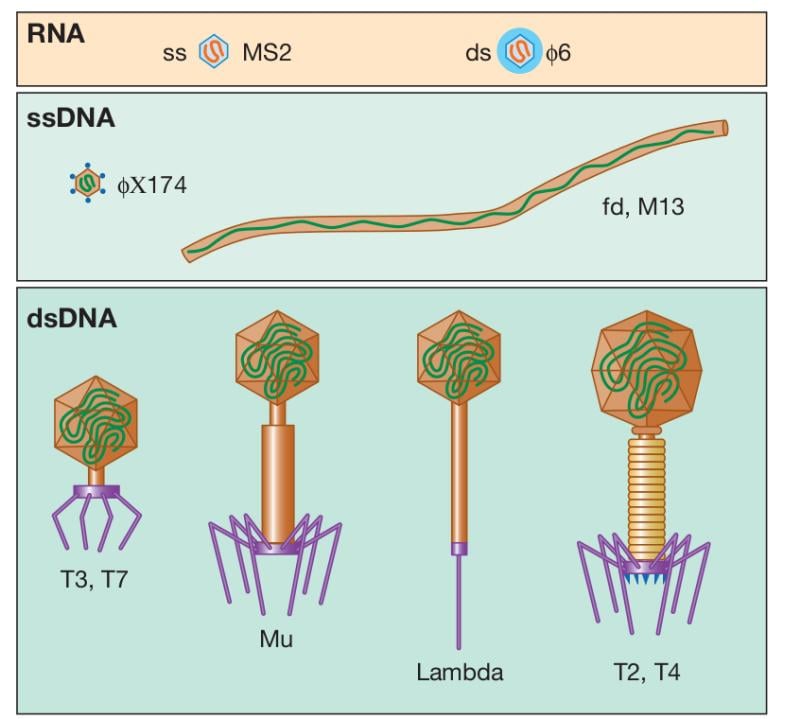 Figure: Schematic representation of the main types of phages (image source: Brock Biology of Microorganisms)
Bacteriophage structures are diverse, but most share common features. For example, bacteriophage T4 of Escherichia coli has an icosahedral head made of repeating protein subunits (the capsid), and that head contains a linear double-stranded DNA genome.
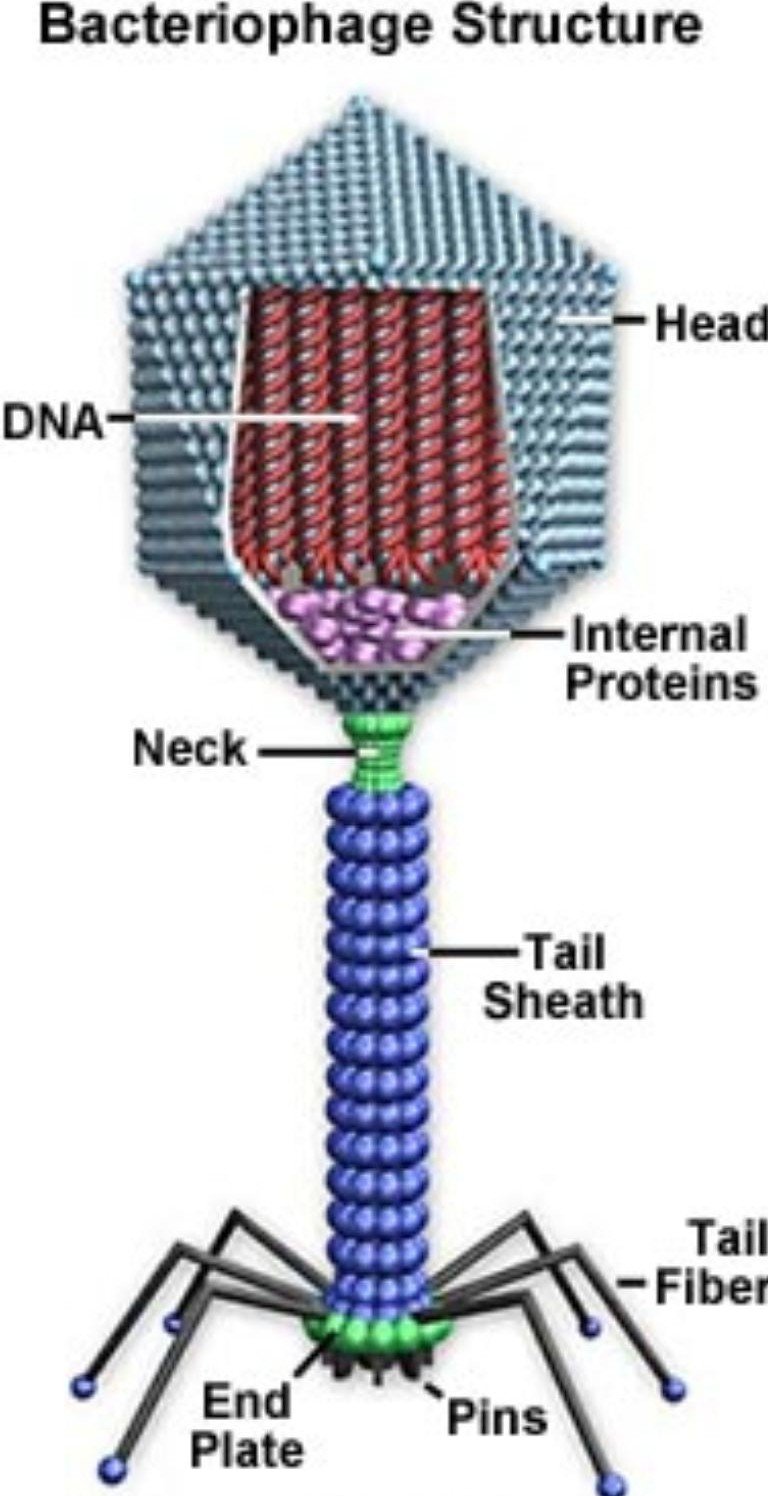 Figure: Structure of phage λ (lambda)
Phage genomes range in size from roughly 2 to 200 kilobases per strand. The nucleic acid varies considerably and can be dsDNA, dsRNA, ssDNA, or ssRNA, but most known bacteriophages have dsDNA genomes.
The head of phage T4 is attached to a helical tail through a collar (neck). The tail ends in a series of tail fibers and tail pins. These syringe-like structures bind receptors on the bacterial cell surface. Not all bacteriophages have a tail.
Replication
Phages are grouped by their mode of replication:
- Virulent (lytic) phages: these replicate inside a susceptible bacterium, make many copies of themselves, and destroy the host by lysis. Examples: the T-even phages T2 and T4 of E. coli.
- Temperate phages: infection can take either of two paths, lytic growth or lysogeny (a non-lytic prophage state).
Replication of Lytic Phages
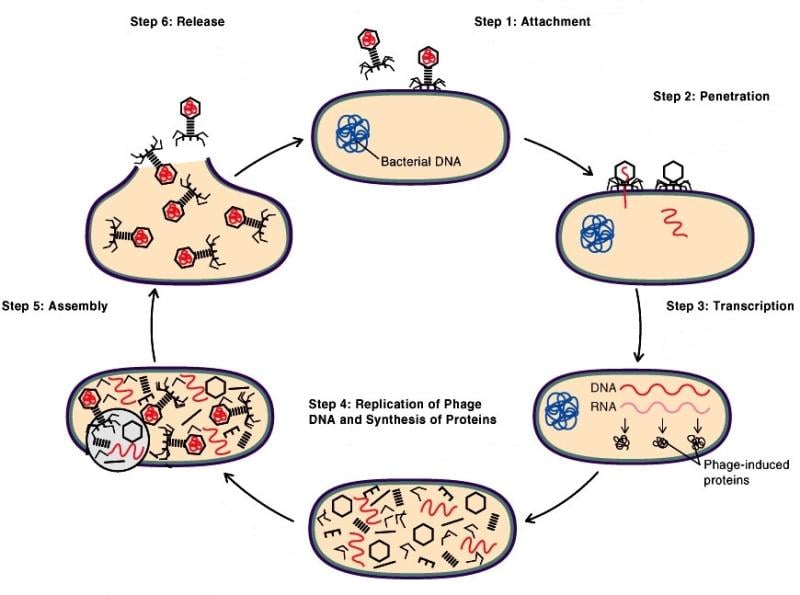 Figure: Replication of a lytic bacteriophage
Adsorption (attachment). Adsorption is the first step of infection. Binding proteins on the phage, mostly on the tail fibers, recognize and attach to specific receptors on the bacterial cell wall. Attachment causes morphological changes in both phage and bacterium that help the phage penetrate the host.
Penetration. A lysozyme-like enzyme in the phage tail weakens the bacterial cell wall. The tail sheath contracts, and the hollow core tube pushes through the weakened wall to reach the cell membrane. Viral DNA passes from the head, through the tube, into the bacterial cytoplasm, while the empty capsid stays outside.
Replication. Phage genes take over the host cell's machinery and direct it to make viral products only. Host DNA is degraded, and its nucleotides are reused as building blocks for new phage DNA. Phage DNA is transcribed into mRNA by host machinery, and translation produces capsid proteins and viral enzymes.
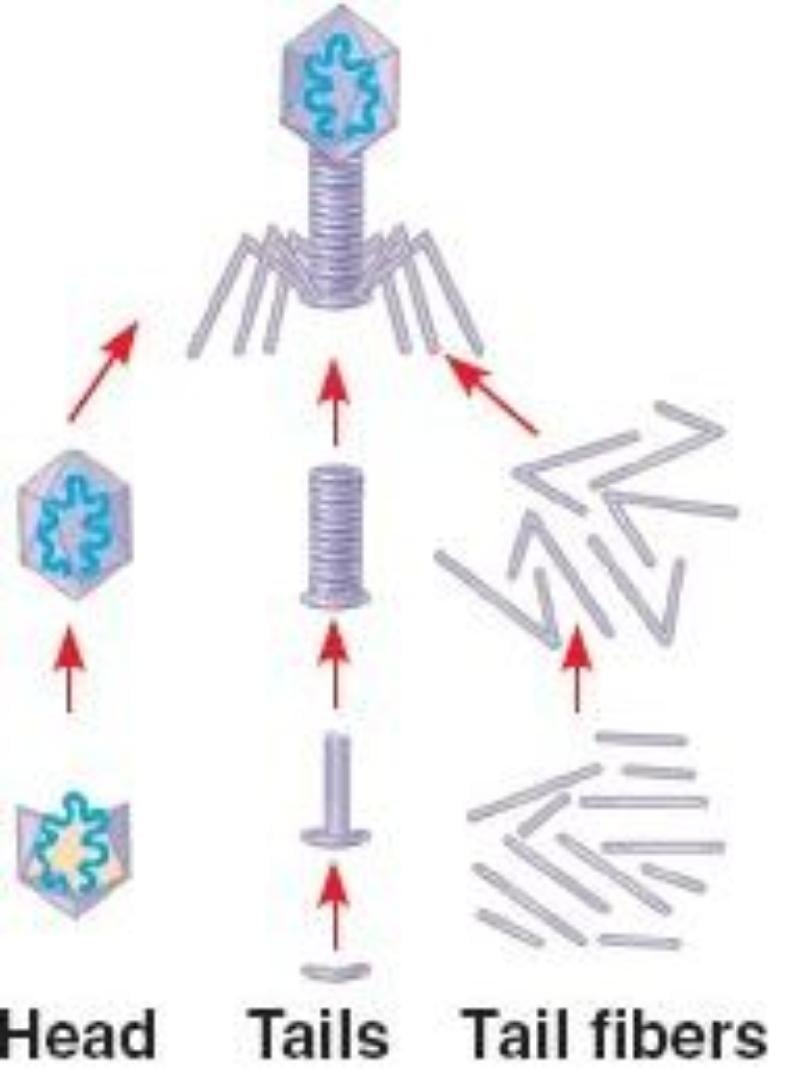 Assembly. The T4 phage head is assembled in the host cytoplasm from new capsid proteins, and one dsDNA molecule is packed into each head. Tails are assembled separately from base plates, sheaths, and collars. Each packed head is joined to a tail, tail fibers are added, and mature, infective phages are complete.
Lysis and release. Lysozyme breaks down the bacterial cell wall and the host cell is lysed. The released phages infect other susceptible bacteria and the cycle begins again.
Burst time (adsorption to lysis) is generally 20 to 40 minutes. Burst size (the number of new virions released per host cell) is 50 to 200 for T4.
Replication of Temperate Phages
Temperate phages usually enter lysogeny but can switch to the lytic pathway after induction. The best-characterized temperate phage is E. coli phage λ (lambda).
Lysogeny is a special kind of latent viral infection: a stable, long-term relationship in which the phage nucleic acid becomes part of the host chromosome. The integrated phage genome, now called a prophage, replicates along with the bacterial chromosome.
Process of lysogeny. Phage λ attaches to the bacterium and injects its linear DNA into the cytoplasm. The phage DNA circularizes and then integrates into the circular bacterial chromosome at a specific site. Once integrated as a prophage, the phage can stay dormant for a long time. Every time the bacterium divides, the prophage is copied as part of the chromosome and passed to both daughter cells. This period of bacterial growth carrying a prophage is the lysogenic cycle.
Either spontaneously or in response to an outside trigger, the prophage can become active and start a lytic cycle. This is called induction. The common trigger is DNA damage (for example, UV light), which activates the host SOS response; the RecA protein then promotes cleavage of the phage repressor, switching the phage from lysogeny to lysis.
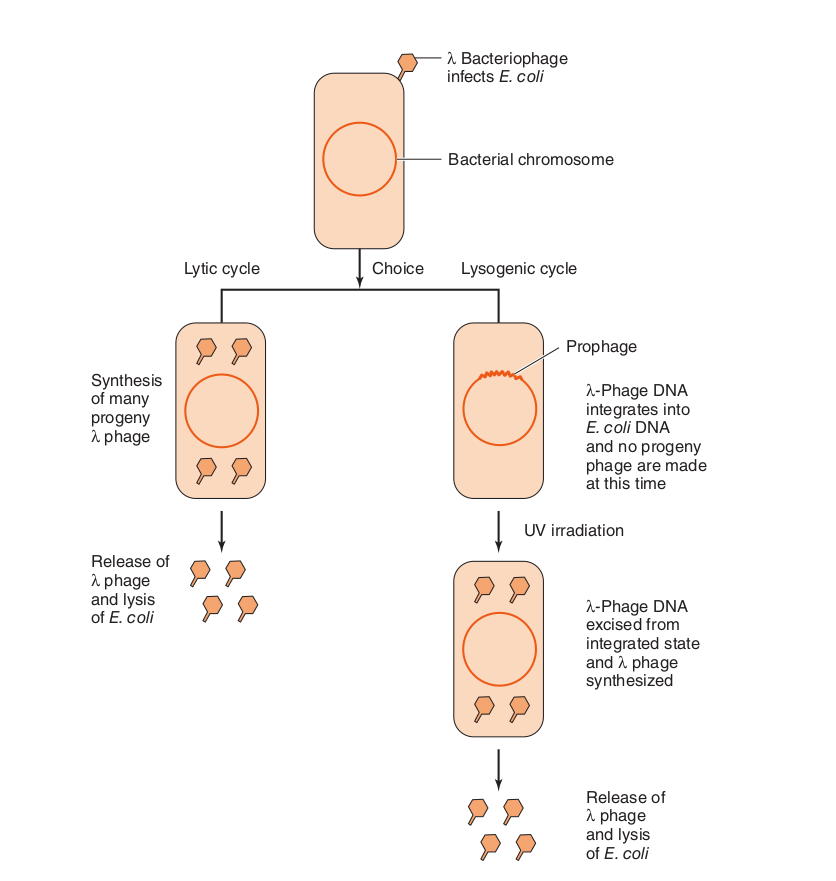 Figure: Lytic or lysogenic cycle of a bacteriophage
Lysogenic or lytic: what decides the fate?
The decision depends on the balance between two phage proteins:
- the repressor (CI), produced by the cI gene, and
- Cro, produced by the cro gene, which opposes the repressor.
If the repressor (CI) predominates, it binds the two operator sites that control the early genes, shuts off transcription of the lytic genes, and lysogeny follows. If Cro prevents enough repressor from being made, the lytic genes are transcribed and the cell is lysed. In short, CI is the switch held toward "stay dormant," Cro is the switch pushed toward "replicate and burst," and induction (via the SOS response) is what flips a dormant prophage from the first state to the second.
Lysogenic conversion
When a prophage is integrated, expression of some of its genes can give the host bacterium new properties. This is called lysogenic conversion. The key point, and the one students most often get wrong, is that the new trait comes from a gene carried on the phage's own genome, not from bacterial DNA transferred between cells.
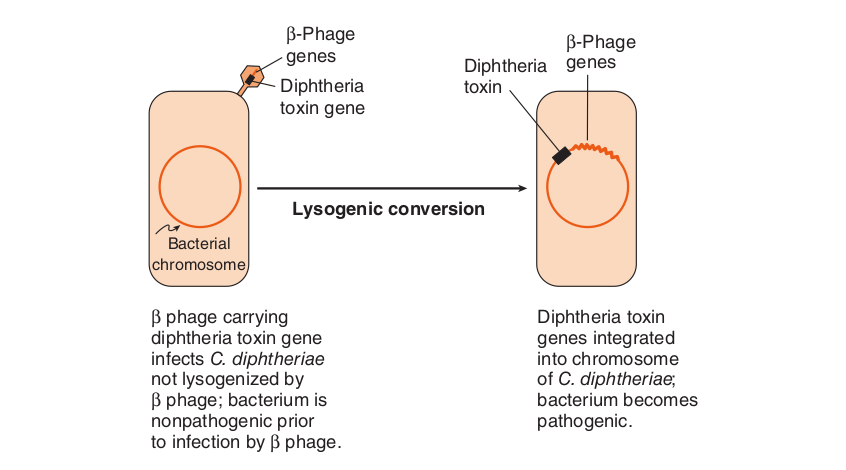 Figure: Lysogenic conversion
The classic examples are bacterial exotoxins whose genes sit on the prophage: without the prophage, the bacterium does not make the toxin and is often non-pathogenic.
| Organism | Phage-encoded virulence factor |
|---|---|
| Corynebacterium diphtheriae | Diphtheria toxin |
| Streptococcus pyogenes | Erythrogenic (pyrogenic) toxin |
| Escherichia coli | Shiga-like toxin |
| Clostridium botulinum | Botulinum neurotoxins (types C, D, E) |
| Staphylococcus aureus | Staphylokinase, enterotoxin A |
(Cholera toxin of Vibrio cholerae is another classic example, encoded on the CTXφ prophage.)
Do not confuse lysogenic conversion with transduction. They both involve a phage moving genetic information, but they are different:
- Lysogenic conversion: the new phenotype comes from a gene that is part of the phage genome, expressed while the phage sits in the host as a prophage. The diphtheria tox gene is a phage gene.
- Transduction: a phage accidentally packages a piece of the host bacterium's own DNA and carries it to a new bacterium. Here the transferred material is bacterial, not phage. See more about generalized transduction in this article.
A prophage also gives its host immunity to further infection by phages of the same type, though not against a different temperate phage or a virulent one.
Uses of Phages
Phage research gave us much of our early understanding of viruses and many foundational concepts of molecular biology, because phages are simple, fast-replicating model systems for studying gene expression.
Clinically, lytic phages are being revisited as an alternative to antibiotics. Phage therapy was developed in the 1920s and 1930s in Eastern Europe and the Soviet Union with mixed results, and the spread of multidrug-resistant bacteria has revived it a century later. In 2019 the FDA approved the first US clinical trial of intravenously administered phage therapy.
Because phages transfer DNA efficiently by transduction, they are also used in recombinant-DNA work to construct mutants and move genes of interest between bacteria, and as biocontrol agents in agriculture and industry.
How to Remember
Lytic is "smash and grab," lysogeny is "move in quietly." A lytic phage takes over the cell, mass-produces itself, and bursts the cell open in 20 to 40 minutes. A temperate phage in lysogeny does the opposite: it integrates, goes silent, and gets copied for free every time the bacterium divides, doing no visible damage until something induces it.
CI keeps the peace; Cro calls for war. The lysogeny-versus-lysis decision is a tug-of-war between two proteins. CI (the repressor, from cI) holds the phage dormant. Cro (from cro) pushes it toward lysis. Whichever protein wins the early race decides the cell's fate. Induction (usually DNA damage, through the SOS response) is what tears CI down and lets Cro win, flipping a long-dormant prophage into a lethal lytic cycle.
Conversion is the phage's gene; transduction is the bacterium's gene. This is the single most confused pair on the topic. In lysogenic conversion, the toxin gene belongs to the phage (diphtheria, botulinum, cholera, Shiga, erythrogenic toxins are all phage genes switched on inside the host). In transduction, the phage is just a delivery truck carrying a stolen piece of bacterial DNA to a new cell. Same courier, different cargo.
Key exam facts
| Feature | Bacteriophage |
|---|---|
| What it is | A virus that infects bacteria; obligate intracellular parasite, highly host-specific |
| Typical structure (T4) | Icosahedral head with linear dsDNA, helical tail, collar, tail fibers and pins for attachment |
| Genome | 2 to 200 kb; can be dsDNA, dsRNA, ssDNA, or ssRNA, but most are dsDNA |
| Lytic cycle steps | Adsorption, penetration, replication, assembly, lysis and release |
| Burst time / burst size (T4) | 20 to 40 minutes; 50 to 200 virions per cell |
| Temperate phage | Can enter lysogeny (integrate as a prophage) or, after induction, go lytic |
| Lysis vs lysogeny switch | CI repressor (cI) favors lysogeny; Cro (cro) favors lysis |
| Induction trigger | DNA damage (e.g. UV) activates the SOS response; RecA promotes CI cleavage, switching to lytic |
| Lysogenic conversion | Prophage genes give the host new traits (toxins); the gene is the phage's own |
| Conversion vs transduction | Conversion = phage's own gene expressed; transduction = transfer of host bacterial DNA |
| Classic converted toxins | Diphtheria, botulinum, cholera, Shiga-like, streptococcal erythrogenic |
| Model phages | T2/T4 (lytic), λ (temperate) |
Where Students Get Confused
- "Lysogenic conversion and transduction are the same thing." They are not, and this is the most common error on the topic. In lysogenic conversion the new trait (a toxin, usually) comes from a gene that belongs to the phage genome and is expressed while the phage sits inside the host as a prophage. In transduction the phage carries a piece of the host bacterium's own DNA to a new cell. The courier is a phage in both cases, but the cargo is phage DNA in one and bacterial DNA in the other.
- "A prophage is actively making new phages." No. A prophage is dormant. Its lytic genes are switched off by the CI repressor, so no infectious phage is produced and the cell is not harmed. It only starts making phages after induction flips it into the lytic cycle.
- "Temperate phages never kill the cell." They can. Temperate means they have the option of lysogeny, not that they are permanently harmless. After induction (often triggered by DNA damage), a temperate phage runs a full lytic cycle and lyses the cell, exactly like a virulent phage.
- "cI and cro are bacterial genes." They are phage genes. The whole lysis-versus-lysogeny decision is made by phage-encoded proteins competing inside the host, not by the bacterium.
References
- Madigan MT, Bender KS, Buckley DH, Sattley WM, Stahl DA. Brock Biology of Microorganisms. 16th ed. Pearson; 2021.
- Manohar P, Tamhankar AJ, Leptihn S, Ramesh N. Pharmacological and immunological aspects of phage therapy. Infectious Microbes & Diseases. 2019;1(2):34-42.
- Navarro F, Muniesa M. Phages in the human body. Frontiers in Microbiology. 2017;8:566.
- Van Belleghem JD, Dąbrowska K, Vaneechoutte M, Barr JJ, Bollyky PL. Interactions between bacteriophage, bacteria, and the mammalian immune system. Viruses. 2018;11(1):10.

Tankeshwar Acharya, MSc (Medical Microbiology)
Tankeshwar Acharya is an Assistant Professor in the Department of Microbiology at Patan Academy of Health Sciences (PAHS), Nepal, where he has been teaching and practicing clinical microbiology for over 14 years. He is the founder of Microbe Online, one of the leading free microbiology education resources on the web, covering bacteriology, mycology, parasitology, immunology, and clinical laboratory diagnostics written from direct experience in both the classroom and the diagnostic laboratory.
Comments
No comments yet. Be the first to share your thoughts.
Leave a comment
All comments are reviewed before they appear.