
Antibody Affinity vs Avidity: Difference, Examples, and Clinical Use
Affinity vs avidity made clear: affinity is the strength of one binding site, avidity is the total strength of all sites. Why IgM's high avidity beats its low affinity, and how avidity testing dates an infection. For micro and health-science students.

On this page
Picture one hand gripping a rope versus ten hands gripping the same rope. Each individual hand might have a weak grip, but ten weak grips together can hold on far more tightly than one strong grip alone. This is the whole difference between affinity and avidity.
Affinity is the strength of a single grip; avidity is the total strength of all grips working together. It sounds like a small distinction, but it explains why IgM, whose individual grips are weak, is one of the most effective antibodies at holding onto a pathogen, and it even lets a lab tell whether an infection is recent or old. This article makes the difference concrete.
Antigens and antibodies bind by weak forces such as hydrogen bonds, ionic bonds, hydrophobic interactions, and van der Waal’s forces rather than covalent bonds. The strength of this noncovalent interaction between a single antigen-binding site on an antibody and the single epitope is the affinity of this antibody for that epitope.
Affinity vs avidity in one line
Affinity is the strength of binding at a single site: one antigen-binding arm of the antibody (the paratope) gripping one epitope on the antigen. It is the strength of one handshake.
Avidity is the total strength of binding when multiple sites act together: all the arms of the antibody gripping a multivalent antigen at once. It is the combined strength of many handshakes.
The key consequence: avidity is not just the sum of the affinities, it is much greater. Once one arm binds, the others are held nearby and bind far more easily, and once several are bound, the whole antibody comes off only if all of them release at the same moment, which is very unlikely. This is why many weak grips together vastly outperform one strong grip.
| Affinity | Avidity | |
|---|---|---|
| Measures | One binding site | All binding sites together |
| Also called | Intrinsic binding strength | Functional binding strength |
| Depends on | Fit of paratope to epitope | Affinity × valency (number of sites) |
| Best example | A single IgG arm | Whole pentameric IgM (10 sites) |
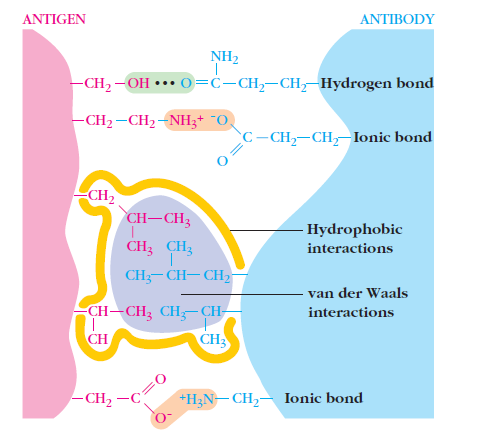 Figure: Interaction between antibody and antigen (Image source-Ref-2)
Antibody affinity is proportionate to the fit of the antigen with its antibody-combining site. Low-affinity antibodies bind antigen weakly and tend to dissociate readily, whereas high-affinity antibodies bind antigen more tightly and remain bound longer.
One crucial effect of booster doses of vaccines is to improve antibody binding by enhancing the affinity maturation process.
The affinity of antibodies for the antigen increases with each successive exposure, known as affinity maturation. Antibody binding improves because mutations occur in the hypervariable region of the DNA that encodes the antigen-binding site (a process called somatic hypermutation). Some of those mutations result in the formation of plasma cells with better antigen-binding sites. Follicular dendritic cells and follicular helper T cells select only those plasma cells with improved antigen-binding sites for clonal expansion.
So affinity maturation is the immune system improving affinity over time: each round of exposure selects B cells whose single-site grip has become tighter. Avidity, by contrast, is improved not by better individual grips but by having more of them, which is IgM's strategy from the start.
Pentameric IgM is the textbook example of avidity beating affinity. Each of its ten binding sites has a relatively low affinity, weaker than a typical IgG site. But because all ten can grip a repetitive antigen at once, IgM's total avidity is the highest of any antibody. This is why early IgM, made before affinity maturation has improved the individual grips, still binds pathogens effectively: it wins by valency, not by per-site strength.
Antibody avidity incorporates the affinity of multiple antigen-binding sites.
The affinity at one binding site does not always reflect the true strength of the antigen-antibody interaction. The avidity of an antibody is a better measure of its binding capacity within biological systems than the affinity of its binding sites.
When complex antigens containing multiple, repeating epitopes are mixed with antibodies containing multiple binding sites, the interaction of an antibody molecule with an antigen molecule at one site will increase the probability of reaction between those two molecules at a second site. The combined binding strength of such multiple interactions between a multivalent antibody and antigen is called the avidity.
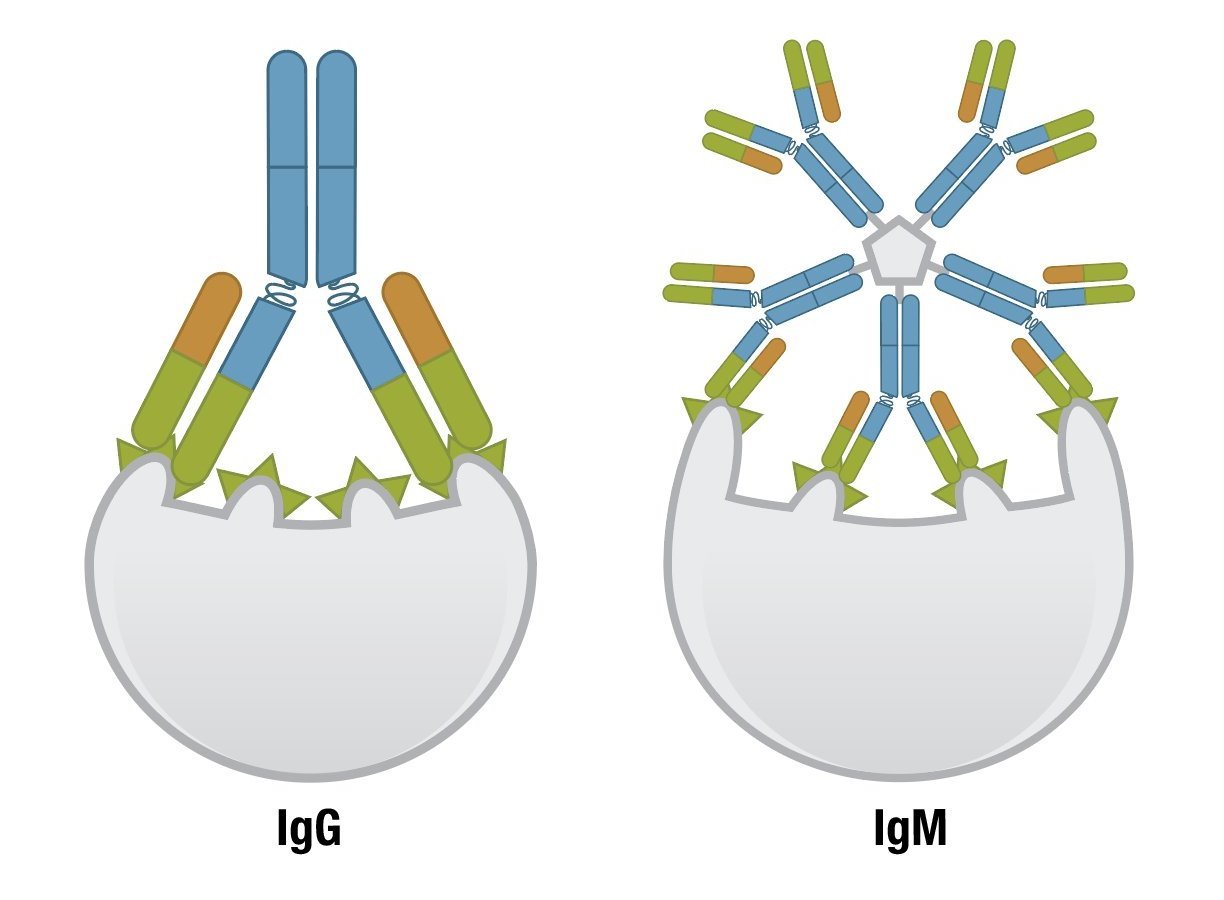 Figure: Each IgG antigen-binding site typically has a high affinity for its target. IgM typically has low-affinity antigen-binding sites, but the combined strength of all 10 sites (avidity) is high.
IgM often has a lower affinity than IgG, but the high avidity of IgM, resulting from its higher valence, enables it to bind antigens effectively. High avidity compensates for its low affinity.
Why this matters in the clinic: avidity testing
The affinity-avidity distinction is not just theory. It gives labs a way to tell how recent an infection is, which matters a great deal in pregnancy.
Here is the logic. Early in an infection, the antibodies made are low-affinity, because affinity maturation has not yet had time to improve them. Weeks to months later, affinity maturation has produced high-affinity antibodies. So the affinity (measured as avidity) of a patient's IgG tells you the age of the infection: low-avidity IgG means recent infection, high-avidity IgG means past infection.
This is used clinically for infections like toxoplasmosis, rubella, and cytomegalovirus in pregnant women. If a pregnant woman tests positive for IgG against one of these, the critical question is whether she caught it recently (a risk to the fetus) or long ago (usually not a risk). An IgG avidity test answers exactly that: high-avidity IgG is reassuring, pointing to old, resolved infection.
How to remember
One hand vs many hands. Affinity is one hand's grip strength. Avidity is all the hands gripping together. Ten weak grips beat one strong grip.
Affinity = single site; Avidity = All sites (A for All). The word avidity starts with A for All the sites combined.
IgM: low affinity, high avidity. The classic example. Weak per-site, but ten sites make it the strongest overall gripper.
Affinity matures; avidity comes from valency. The immune system raises affinity over time (affinity maturation). Avidity comes instead from having many binding sites.
Low avidity = new, high avidity = old. In IgG avidity testing, a low-avidity result points to recent infection, a high-avidity result to past infection.
Key exam facts in one table
| Fact | Detail |
|---|---|
| Affinity | Strength of one antigen-binding site |
| Avidity | Total strength of all binding sites together |
| Bonds involved | Non-covalent (H-bonds, ionic, hydrophobic, van der Waals) |
| Avidity depends on | Affinity and valency (number of sites) |
| Highest avidity antibody | Pentameric IgM (10 sites) |
| IgM affinity vs avidity | Low affinity, high avidity |
| Affinity maturation | Somatic hypermutation + selection in germinal centers |
| Avidity > sum of affinities | Yes (cooperative binding) |
| Clinical use of avidity | Dating infection (low = recent, high = past) |
| Avidity testing examples | Toxoplasma, rubella, CMV in pregnancy |
Where students get confused
"Affinity and avidity are the same thing." No. Affinity is the strength of one binding site. Avidity is the combined strength of all sites acting together. IgM has low affinity but high avidity, which shows they are different.
"Avidity is just affinity added up across the sites." No, it is more than the sum. Because bound arms hold the others nearby, and the antibody only releases if all sites let go at once, avidity is much greater than adding the individual affinities.
"High affinity always means strong binding." Not the whole story. A single high-affinity IgG site can still be outperformed in total binding by a low-affinity but multivalent IgM, because avidity, not affinity, determines real-world holding strength.
"Affinity maturation increases the number of binding sites." No. Affinity maturation improves the fit of the existing binding site through mutation and selection. The number of sites (valency) is fixed by the antibody class.
"Low-avidity antibodies are defective." No. Low avidity simply means recent production, before affinity maturation. It is a useful signal, not a defect, and it is exactly what avidity testing uses to date an infection.
References and further readings
- Abbas AK, Lichtman AH, Pillai S. Cellular and Molecular Immunology. 10th ed. Elsevier; 2022.
- Punt J, Stranford SA, Jones PP, Owen JA. Kuby Immunology. 8th ed. W.H. Freeman; 2019.
- Delves PJ, Martin SJ, Burton DR, Roitt IM. Roitt's Essential Immunology. 13th ed. Wiley-Blackwell; 2017.
Frequently Asked Questions
What is the difference between affinity and avidity?
What is the difference between affinity and avidity?
Affinity is the binding strength at a single antigen-binding site (one paratope to one epitope). Avidity is the total binding strength of all the sites on an antibody acting together. Affinity is one grip; avidity is all grips combined.
Why does IgM have high avidity but low affinity?
Why does IgM have high avidity but low affinity?
Each of IgM's ten binding sites binds relatively weakly (low affinity), but because all ten can grip a repetitive antigen at once, the combined strength (avidity) is the highest of any antibody. IgM wins by having many sites, not strong ones.
Is avidity just the sum of the affinities?
Is avidity just the sum of the affinities?
No, it is greater. Once one site binds, the others are held close and bind more easily, and the antibody only releases if all sites let go at the same time. This makes avidity much stronger than adding up the individual affinities.
What is affinity maturation?
What is affinity maturation?
It is how the immune system improves affinity over time. In germinal centers, B cells mutate their antigen-binding site (somatic hypermutation), and those with the best-fitting sites are selected. This produces higher-affinity antibodies with each exposure.
How is avidity used in medical testing?
How is avidity used in medical testing?
Avidity testing dates an infection. Recently made IgG has low avidity; older IgG has high avidity. This is used in pregnancy for infections like toxoplasmosis, rubella, and CMV, where knowing if the infection is recent or past changes the risk to the fetus.

Tankeshwar Acharya, MSc (Medical Microbiology)
Tankeshwar Acharya is an Assistant Professor in the Department of Microbiology at Patan Academy of Health Sciences (PAHS), Nepal, where he has been teaching and practicing clinical microbiology for over 14 years. He is the founder of Microbe Online, one of the leading free microbiology education resources on the web, covering bacteriology, mycology, parasitology, immunology, and clinical laboratory diagnostics written from direct experience in both the classroom and the diagnostic laboratory.
Comments
No comments yet. Be the first to share your thoughts.
Leave a comment
All comments are reviewed before they appear.