
Monoclonal Antibodies: Hybridoma Production, Types, and Applications
How monoclonal antibodies are made by hybridoma technology, why HAT medium selects the right cells, the four types from mouse to fully human, and their diagnostic and therapeutic uses. For micro and health-science students.

On this page
When your body fights an infection, it makes a chaotic mixture of thousands of different antibodies, each B cell clone contributing its own. That mixture is powerful but impossible to standardize or reproduce exactly. For research, diagnosis, and treatment, scientists needed something the immune system does not naturally provide: an unlimited supply of one single, identical antibody, targeting one exact spot, made the same way every time.
The problem was that the cells which make a specific antibody die quickly in culture, while the cells that live forever do not make the antibody you want. The elegant solution, fusing the two into a single immortal antibody factory, won a Nobel Prize and created the monoclonal antibody. This article covers how it is made, the types, and why monoclonals are now among the most important drugs in medicine.
Monoclonal antibodies (mAb) are defined as the antibodies derived from a single clone of plasma cell, all having the same antigen specificity, i.e. produced against a single epitope of an antigen.
Polyclonal vs Monoclonal Antibodies
When an antigen with multiple epitopes enters the body, each epitope may stimulate one clone of B cells to produce one type of antibody. Hence the resultant antibody mixture in serum is polyclonal, i.e. contains a mixture of antibodies derived from different clones of B cells. Because one organism contains many different epitopes, the host’s serum contains various polyclonal antibodies.
Polyclonal antibodies used in immunodiagnosis are prepared by immunizing animals (usually rabbits, sheep, or goats) with an infectious agent and then isolating and purifying the resulting antibodies from the animal’s serum.
However, when only one clone of B cell is stimulated by a single epitope of an antigen and then is allowed to proliferate and produce antibodies, such antibodies are referred to as monoclonal antibodies (mAb). Monoclonal antibodies are produced by Hybridoma technique, developed by G Kohler and C Milstein (1975), for which they were awarded Nobel Prize in 1984.
The problem hybridoma technology solves
Making a monoclonal antibody requires combining two things that do not naturally come together.
The cell that makes your desired antibody is a plasma cell (from an immunized animal's spleen). It makes exactly the antibody you want, but it dies within days in culture. It is specific but mortal.
The cell that lives forever is a myeloma cell, a cancerous plasma cell. It divides indefinitely in culture, but it does not make your antibody. It is immortal but useless on its own.
The solution is to fuse them. The resulting hybridoma cell inherits the best of both: the antibody specificity of the B cell, and the immortality of the myeloma cell. It is a permanent factory for one exact antibody. Every step of the procedure below exists to create these hybridomas and then separate them from the two unfused cell types.
Principle
A clone of B cell stimulated against a single epitope of antigen (i.e. antibody-producing plasma B cell) is fused with a malignant antibody-producing myeloma cell to produce a hybridoma cell. This hybridoma cell has two unique properties:
- Produces monoclonal antibody of same antigen specificity (due to B cell component).
- Multiplies indefinitely produce a clone of identical cells (due to the immortal myeloma cell component).
Procedure
The process starts by immunizing a mouse with the antigen for which an antibody is to be produced.
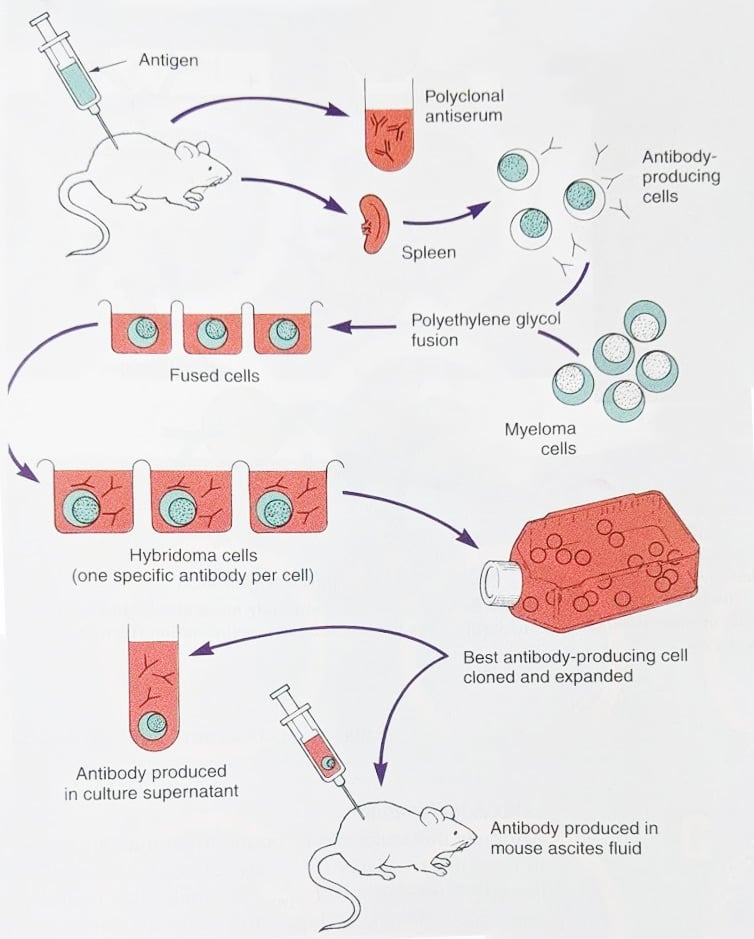 Figure: Production of monoclonal antibody
Mouse splenic B cells: The mouse is injected with an antigen containing the desired epitope. The animal responds by producing many antibodies to the epitope injected. After an interval, the mouse’s spleen which contains antibody-producing plasma cells, is removed and emulsified so that antibody-producing cells can be separated and placed into individual wells of a microdilution tray. These cells cannot remain viable in the cell culture for a long time, so they must be fused with cells capable of surviving and multiplying in tissue culture.
Myeloma cells are used as a source of such immortal cells. They are cancerous plasma cells. They closely resemble mouse B cells; hence are compatible for fusion. However, myeloma cells also can produce their antibodies. Hence myeloma cells are genetically modified with two mutations (double mutated cells), so they lose the ability to produce their antibody but retain the immortal property. These cells are also deficient in the enzyme hypoxanthine-guanine phosphoribosyltransferase (HGPRT). This defect leads to their inability to survive in a medium containing hypoxanthine, aminopterin, and thymidine (HAT medium).
Fusion: The mouse splenic B cells and mutated myeloma cells are fused in polyethylene glycol broth. In the reaction chamber, as a result, three types of cells are generated:
- Unfused myeloma cells
- Unfused mouse splenic B cells
- Fused hybridoma cells
The challenge after fusion is that the reaction chamber contains three cell types, and only the hybridomas are wanted. HAT medium is a clever trap that kills the other two automatically. The logic in one line: HAT blocks the normal nucleotide pathway, forcing every cell onto a backup pathway that the myeloma cells cannot use, so only cells carrying the B cell's backup enzyme survive, and those are the hybridomas.
Purification (by subculturing on HAT media)
The next step is to remove the unwanted unfused cells and propagate the clone of hybridoma cells. This is carried out by subculturing the cells in a reaction chamber onto a special medium called HAT medium (medium containing hypoxanthine, aminopterin, and thymidine).
- Mammalian cells (e.g. splenic B cells) synthesize purine by either de novo or salvage pathways.
- Aminopterin blocks the de novo pathway, so the cell has to perform the salvage pathway to synthesize purines for survival.
- Salvage pathway requires two important enzymes- HGPRT and thymidine kinase.
As myeloma cell lacks HGPRT, they cannot grow on HAT medium but antibody-producing spleen cells can survive as they possess this enzyme.
Fate of three types of cells on HAT media
- Hybridoma cells: Fused hybridoma cells survive in the selective medium and can be recognized by their ability to grow indefinitely in the medium.
- Unfused splenic B cells: They can grow but do not survive long as they are not immortal.
- Unfused myeloma cells cannot grow as they lack the HGPRT enzyme to perform the salvage pathway of purine synthesis.
| Cell type | Immortal? | Has HGPRT (salvage enzyme)? | Survives HAT? |
|---|---|---|---|
| Unfused myeloma | Yes | No | No (cannot use salvage) |
| Unfused B cell | No | Yes | No (dies, not immortal) |
| Hybridoma | Yes (from myeloma) | Yes (from B cell) | Yes (both properties) |
The table makes the selection instantly clear: only the hybridoma has both boxes ticked.
If the original antigen used has multiple epitopes, many B cells would fuse with myeloma cells to produce a mixture of hybridoma cells each having specificity for one epitope. The medium containing hybridoma cells is then diluted into multi-well plates to such an extent that each well contains only one cell. The growth medium supernatant from the microdilution tray wells in which hybridoma cells are growing is then tested for the presence of desired monoclonal antibody using radioimmunoassay or ELISA techniques.
When a good candidate antibody-producing cell is found, the hybridoma cells are selectively proliferated either in cell culture in vitro or are reinjected into the peritoneal cavity of many mice, where the cells multiply and produce large quantities of antibody in the ascitic (peritoneal) fluid. Ascitic fluid can be removed from mice many times over the animals’ lifetimes, and the desired antibody is harvested. Such mAb may not be in pure form (maybe mixed with other antibodies); hence, it is purified by chromatography or by immunoprecipitation test.
Types of Monoclonal Antibodies
The procedure mentioned above would yield monoclonal antibodies whose 100% amino acids are mouse-derived. The problem with mouse monoclonal antibodies is that the mouse proteins being foreign; can induce an immune response in humans producing human anti-mouse antibodies (HAMA); that in turn eliminate the monoclonal antibodies faster from the body.
Hence mouse-derived monoclonal antibodies are not the best for human use.
| Type | Origin | Naming stem | % human | Examples |
|---|---|---|---|---|
| Mouse | 100% mouse | -omab | 0% | (early mAbs) |
| Chimeric | Mouse variable + human constant | -ximab | ~65% | Rituximab, Infliximab, Cetuximab |
| Humanized | Only the CDRs are mouse | -zumab | ~90% | Trastuzumab, Bevacizumab, Natalizumab |
| Human | 100% human | -umab | 100% | Adalimumab, Ipilimumab, Golimumab |
Since the discovery of the hybridoma technique, various modifications have been attempted to produce monoclonal antibodies by recombining human and mouse proteins.
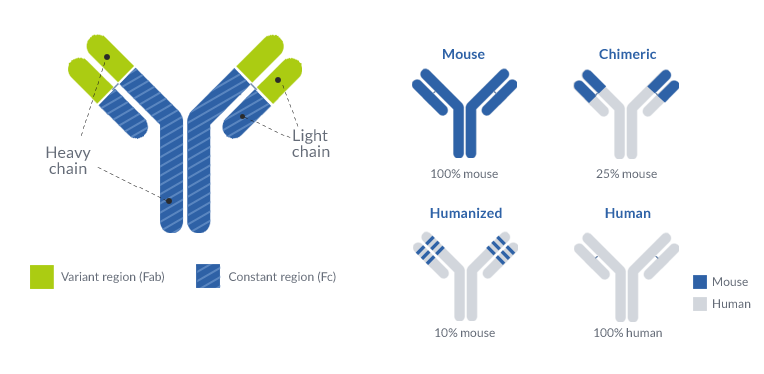 Figure: Types of monoclonal antibodies
- Mouse mАb (-omab): It contains 100% mouse-derived proteins. They can lead to an allergic reaction in humans.
- Chimeric mAb (-ximab): It is prepared by recombination of mouse proteins (variable region) and human proteins (constant region). These can also cause an allergy.
- Humanized mAb (-zumab): Here, only the antigen-binding site (i.e. CDR-complementarity determining region) is mouse-derived (10%) and the remaining part of mAb is human-derived.
- Human mAb (-umab): It contains 100% human-derived amino acids. It is the best-accepted mAb in humans.
A note on naming: the stems above (-omab, -ximab, -zumab, -umab) are the classic WHO system, and they still describe the thousands of antibodies named under it, so they remain essential to know for exams.
However, in 2021 the WHO retired the "-mab" suffix for newly named antibodies, because so many antibodies existed that the old stems ran out of room. New antibodies now use different suffixes. For learning the mouse-to-human spectrum, the classic stems remain the clearest teaching tool, which is why they are used here.
Applications of Monoclonal Antibodies
Isolation and purification: Monoclonal antibodies can purify individual molecules from a mixture even when they are present in low concentrations, e.g. interferon and coagulation factor VIII.
Identification of cells and clones: For example TH, and TC cells are identified by using anti-CD4 and anti-CD8 mAb.
Diagnostic reagents: The antigen detection kits employ various mAb tagged with detection molecules, such as fluorescent dye or enzyme to detect the specific antigens in the clinical specimen such as:
- Detection of infections, such as hepatitis B, serogrouping of streptococci, etc.
- Pregnancy detection test-by using monoclonal antibodies against human chorionic gonadotropin (HCG).
- Blood grouping can be done by using anti-A and anti-B monoclonal antibodies.
- Tumor detection and imaging: By using mAb specific for tumor antigens secreted by tumor cells (e.g. prostate-specific antigen).
- Tissue typing for transplantation can be done by using anti-HLA monoclonal antibodies.
Monitoring proteins and drug levels in serum.
Passive immunity: For post-exposure prophylaxis against various infections, mAb targeting specific antigens of the infecting organism can be administered. Examples include immunoglobulins against hepatitis B, rabies, and tetanus.
Therapeutic use: Monoclonal antibodies are used to treat various inflammatory and allergic diseases and cancers. Monoclonal antibodies (mAbs) are useful to treat some cancer types. Naked mAbs (antibodies without attached drug or radioactive material) are the most common type of mAbs used to treat cancer. So far, the US FDA has approved more than a dozen mAbs e.g. alemtuzumab, trastuzumab to treat certain cancers. Similarly, basiliximab treats transplant rejection while belimumab treats systemic lupus erythematosus.
The mechanisms by which the mAb work as a therapeutic agent are:
- Suppress the immune system
- Kill or inhibit malignant cells
- Inhibit angiogenesis.
Used as immunotoxin: mAb conjugated with bacterial/ chemical toxins(e.g. diphtheria toxin) can be used to kill the target cells such as cancer cells. Here, mAb against surface receptors helps bind to the target cells and the toxin helps in target cell killing.
Used as enzymes: Abzyme is a monoclonal antibody with catalytic activity.
How to remember
The core trick: mortal-but-specific + immortal-but-useless = immortal factory. Fuse the B cell (specific, dies) with the myeloma (immortal, no useful antibody) to get the hybridoma (specific AND immortal).
HAT selection: only the hybridoma has both keys. The myeloma is immortal but lacks HGPRT; the B cell has HGPRT but is not immortal; only the hybridoma has both, so only it survives HAT.
The naming ladder, mouse to human: O-XI-ZU-U. -omab (mouse), -ximab (chimeric), -zumab (humanized), -umab (human). As you go down, more human, fewer reactions. A memory line: "Oh, eXcellent, ZUper, U-man" — increasingly human.
More human = safer. Mouse mAbs trigger HAMA (human anti-mouse antibodies) and get cleared fast. Fully human mAbs are best tolerated.
Köhler and Milstein, 1975 (Nobel 1984). The inventors of hybridoma technology.
Key exam facts
| Fact | Detail |
|---|---|
| Definition | Antibodies from a single B-cell clone; one epitope specificity |
| Invented by | Köhler and Milstein, 1975 (Nobel 1984) |
| Made by | Hybridoma technology |
| Hybridoma = | B cell (specificity) + myeloma (immortality) |
| Selection medium | HAT (hypoxanthine, aminopterin, thymidine) |
| Aminopterin blocks | The de novo nucleotide pathway |
| Salvage enzyme needed | HGPRT (myeloma lacks it) |
| Only survivor in HAT | Hybridoma (has both properties) |
| Cloning method | Limiting dilution (one cell per well) |
| Four types (mouse→human) | -omab, -ximab, -zumab, -umab |
| HAMA problem | Mouse mAbs trigger human anti-mouse antibodies |
| Key uses | Diagnosis, imaging, cancer therapy, transplant |
Where students get confused
"The myeloma cell provides the antibody." No, the opposite. The B cell provides the desired antibody specificity; the myeloma provides only immortality. The myeloma is modified so it does not make its own antibody.
"HAT medium directly kills the unwanted cells." Not directly. HAT blocks the normal (de novo) nucleotide pathway. Cells that cannot use the backup (salvage) pathway then die because they cannot make DNA. The myeloma dies because it lacks HGPRT; the unfused B cell dies simply because it is not immortal.
"Humanized and human monoclonal antibodies are the same." No. A humanized mAb still has mouse CDRs (about 10% mouse). A human mAb is 100% human. Humanized is "-zumab," human is "-umab."
"More mouse content makes a better antibody." The reverse. More mouse content means more risk of a HAMA response and faster clearance. The trend has been steadily toward fully human antibodies for safety.
"Monoclonal antibodies give active immunity like a vaccine." No. Giving a preformed monoclonal antibody is passive immunity: immediate but temporary, with no memory. This is why therapeutic mAbs must be re-dosed.
References and further readings
- Punt J, Stranford SA, Jones PP, Owen JA. Kuby Immunology. 8th ed. W.H. Freeman; 2019.
- Abbas AK, Lichtman AH, Pillai S. Cellular and Molecular Immunology. 10th ed. Elsevier; 2022.
- Köhler G, Milstein C. Continuous cultures of fused cells secreting antibody of predefined specificity. Nature. 1975;256(5517):495–497. https://doi.org/10.1038/256495a0
- Mitra S, Tomar PC. Hybridoma technology: advancements, clinical significance, and future aspects. J Genet Eng Biotechnol. 2021;19(1):159. https://doi.org/10.1186/s43141-021-00264-6
Frequently Asked Questions
What is a monoclonal antibody?
What is a monoclonal antibody?
A monoclonal antibody is an antibody produced from a single clone of B cells, so all the molecules are identical and target one exact epitope. This contrasts with polyclonal antibodies, which are a mixture from many clones.
How are monoclonal antibodies made?
How are monoclonal antibodies made?
By hybridoma technology. A B cell that makes the desired antibody is fused with an immortal myeloma cell. The resulting hybridoma is both immortal and antibody-producing, so it serves as a permanent factory for one specific antibody.
Why is HAT medium used?
Why is HAT medium used?
To select only the hybridoma cells. HAT blocks the normal nucleotide pathway, forcing cells onto a backup pathway that needs the enzyme HGPRT. Myeloma cells lack HGPRT and die; unfused B cells die because they are not immortal; only hybridomas, which have both properties, survive.
What is the difference between humanized and human monoclonal antibodies?
What is the difference between humanized and human monoclonal antibodies?
A humanized antibody (-zumab) is mostly human but keeps the mouse antigen-binding regions (CDRs), about 10% mouse. A human antibody (-umab) is 100% human. More human content means fewer immune reactions and better tolerance.
What are monoclonal antibodies used for?
What are monoclonal antibodies used for?
Diagnosis (pregnancy tests, blood typing, infection detection), imaging, and treatment of cancers, autoimmune diseases, and transplant rejection. Given as a drug, they provide passive immunity, immediate but temporary.
Who invented monoclonal antibody technology?
Who invented monoclonal antibody technology?
Georges Köhler and César Milstein developed hybridoma technology in 1975, and were awarded the Nobel Prize in 1984.

Tankeshwar Acharya, MSc (Medical Microbiology)
Tankeshwar Acharya is an Assistant Professor in the Department of Microbiology at Patan Academy of Health Sciences (PAHS), Nepal, where he has been teaching and practicing clinical microbiology for over 14 years. He is the founder of Microbe Online, one of the leading free microbiology education resources on the web, covering bacteriology, mycology, parasitology, immunology, and clinical laboratory diagnostics written from direct experience in both the classroom and the diagnostic laboratory.
Comments
No comments yet. Be the first to share your thoughts.
Leave a comment
All comments are reviewed before they appear.