
Ethylene Oxide (ETO) Sterilization: Mechanism, Cycle Parameters, and Why Hospitals Still Use a Carcinogen

On this page
The gas hospitals can't fully replace, and can't fully trust
In 2019, community groups near a sterilization plant in Willowbrook, Illinois, raised alarm over ethylene oxide emissions after federal regulators reassessed the chemical's cancer risk and found it considerably more dangerous than previously estimated. Local and state authorities moved to shut the facility down. It wasn't an isolated case: several other ethylene oxide sterilization plants across the country came under similar scrutiny and pressure around the same time.
The result caught hospitals off guard. Ethylene oxide sterilizes a very large share of the single-use, heat- and moisture-sensitive medical devices used in U.S. healthcare every year, catheters, certain surgical kits, complex devices with long narrow lumens that steam and dry heat simply cannot penetrate or survive. When ETO sterilization capacity suddenly dropped, the FDA issued public warnings about the risk of shortages for some of these devices, and manufacturers scrambled to shift volume to the handful of remaining facilities.
The episode captured something genuinely unusual about this sterilant: it is simultaneously indispensable and dangerous. Nothing else sterilizes certain complex, heat-sensitive devices as effectively as ethylene oxide does. And ethylene oxide is also, by regulatory classification, a known human carcinogen, explosive in air, and toxic enough that every item it sterilizes must sit through a mandatory aeration period, often longer than the sterilization cycle itself, before it is considered safe to touch.
ETO Overview
Ethylene oxide (ETO) has been widely used as a low-temperature sterilant. It is a colorless gas that is flammable and explosive at concentrations above roughly 3% in air, but it is liquid at temperatures below 10.8°C.
ETO is an effective sterilizing agent for heat- and moisture-sensitive materials in hospitals, industries, and laboratories. Bacterial spores show little resistance to destruction by this agent, despite spores being the most resistant form of microbial life against most other sterilization methods. ETO is effective at relatively low temperatures and does not damage most materials exposed to it, which is exactly why it remains in use despite its hazards: for certain plastics, electronics, and long narrow-lumened devices, there is often no equally effective alternative.
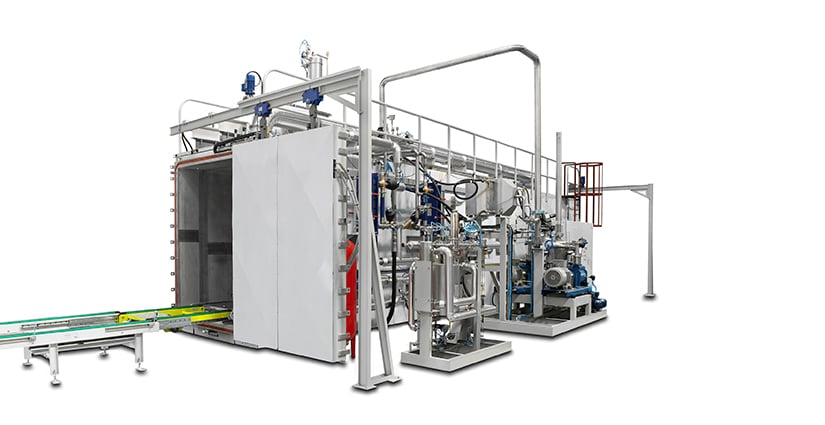 Figure: ETO sterilization machine
It has high penetrating power and can sterilize large packages of materials, bundles of cloth, and even certain plastics and device lumens.
Mode of Action
Ethylene oxide is an alkylating agent, not an oxidizer. It reacts with nucleophilic (electron-rich) chemical groups, sulfhydryl (–SH), amino (–NH), hydroxyl (–OH), and carboxyl (–COOH) groups, found in proteins and nucleic acids. This alkylation replaces a labile hydrogen atom with a hydroxyethyl radical, permanently altering the structure of enzymes, structural proteins, and DNA. Because these modifications are irreversible, cellular metabolism and replication are permanently disrupted, killing the organism, including bacterial endospores.
Standard Cycle Parameters
An effective ETO sterilization cycle depends on four controlled variables working together, not any single one alone:
| Parameter | Typical range |
|---|---|
| ETO gas Concentration | 450–1200 mg/L |
| Temperature | 37–63°C |
| Relative Humidity | 40–80% (moisture is required for the alkylation reaction to proceed efficiently) |
| Exposure Time | 1–6 hours, depending on concentration and temperature |
Mnemonic for the four cycle parameters: "C-T-H-T": Concentration, Temperature, Humidity, Time. Get all four wrong-ratio, and the cycle fails even if the gas is present.
Aeration is a mandatory, separate phase that follows exposure, not an optional afterthought. Because ETO is readily absorbed by many materials, especially plastics and rubber, items must be aerated to remove residual gas before they are safe for patient contact. Mechanical aeration at an elevated temperature typically takes 8–12 hours; aeration at room temperature without a mechanical aerator can take up to seven days. In many real sterilization workflows, aeration takes longer than the exposure phase itself.
Monitoring
The effectiveness of an ETO sterilization cycle is validated using a biological indicator containing spores of Bacillus atrophaeus (formerly Bacillus subtilis var. niger), the same organism used to monitor dry heat sterilization. This shared indicator organism reflects a shared vulnerability: both dry heat and ETO rely on relatively slow, non-aqueous killing mechanisms, in contrast to moist heat sterilization, which is monitored using Geobacillus stearothermophilus.
Uses
Ethylene oxide is used to sterilize spices, biological preparations, soil, plastics, certain medical preparations, and contaminated laboratory equipment, along with a wide range of heat- and moisture-sensitive medical devices in hospital central sterile supply departments.
Why This Matters Clinically
- The 2019 shortage was not a one-off. ETO remains, by most estimates, one of the two or three most heavily used sterilization methods for medical devices worldwide, precisely because so many modern devices, catheters, complex electronic components, certain polymers, cannot tolerate steam or dry heat.
- Inadequate aeration has real patient consequences. Residual ETO on a device that skipped or shortened its aeration phase can cause tissue irritation, chemical burns, or hemolysis if the device contacts blood or mucous membranes.
- Alternatives are expanding but not universal. Low-temperature hydrogen peroxide gas plasma and vaporized hydrogen peroxide are increasingly used as ETO substitutes where compatible, but ETO's superior penetration into long, narrow lumens means it remains necessary for certain complex device geometries that these alternatives cannot reliably reach.
Limitations
- Comparatively slow action on microorganisms, and a lengthy total processing time once exposure and mandatory aeration are both counted.
- Higher cost than heat-based sterilization methods.
- Sterilization chamber capacity is typically small compared to autoclaves.
- ETO mixed with air at a ratio of at least 3% ETO gas forms an explosive mixture; ETO cartridges must be stored in a flammable liquid-storage cabinet.
- Potential hazards to patients and staff. ETO is classified as a known human carcinogen. Acute exposure can cause irritation and central nervous system depression. Chronic inhalation has been linked to cataract formation, cognitive impairment, and neurologic dysfunction. Occupational exposure in healthcare facilities has been linked to hematologic changes, increased risk of spontaneous abortion, and various cancers.
- ETO is absorbed by many materials, which is exactly why mandatory aeration, not just exposure, is required to make items safe for use.
Advantages
- Compatible with most medical materials; can sterilize heat- or moisture-sensitive medical equipment without damaging the device.
- Equipment is relatively simple to operate and monitor.
- Penetrates packaging materials and narrow device lumens effectively.
- Single-dose cartridge and negative-pressure chamber designs minimize the potential for gas leaks and occupational exposure.
How to Remember
Anchor for why aeration matters so much: sterilizing the item is the easy part of an ETO cycle; getting the item safe enough to touch afterward is the hard, slow part. A device can finish its exposure phase in a couple of hours and then sit in aeration for most of a week before it is truly ready for a patient.
Key exam facts in one table
| Fact | Detail |
|---|---|
| Physical state | Colorless gas; liquid below 10.8°C; flammable and explosive above ~3% concentration in air |
| Class of agent | Alkylating agent (not an oxidizer) |
| Mechanism | Alkylates sulfhydryl, amino, hydroxyl, and carboxyl groups in proteins and nucleic acids, irreversibly disrupting structure and replication |
| Typical concentration | 450–1200 mg/L |
| Typical temperature | 37–63°C |
| Typical relative humidity | 40–80% |
| Typical exposure time | 1–6 hours |
| Aeration time | 8–12 hours (mechanical, elevated temperature) up to 7 days (room temperature) |
| Biological indicator | Bacillus atrophaeus spores (same organism used for dry heat) |
| Best suited for | Heat- and moisture-sensitive items: certain plastics, electronics, long narrow-lumened devices |
| Major limitations | Known human carcinogen, explosive, slow, costly, small chamber capacity |
| 2019 real-world event | Plant closures over carcinogenicity concerns triggered FDA warnings of potential medical device shortages |
Where Students Get Confused
- Alkylation vs. oxidation. ETO kills by alkylation. Hydrogen peroxide, chlorine compounds, ozone, and peracetic acid kill primarily by oxidation. These are frequently lumped together as "chemical sterilants" without distinguishing the actual mechanism, which is an easy exam trap.
- "Low-temperature" does not mean "fast" or "risk-free." ETO operates at low temperatures compared to steam or dry heat, but this does not make it a quick or inherently safe process; the mandatory aeration phase and carcinogenicity risk are the trade-off for being gentle on heat-sensitive materials.
- Exposure time vs. total cycle time. The 1–6 hour exposure window is only part of the process. Total turnaround time, including mandatory aeration, is almost always much longer, and this is the number that actually matters for scheduling and device availability.
- Which biological indicator goes with which method. Bacillus atrophaeus is used for both dry heat and ETO, while Geobacillus stearothermophilus is used for moist heat/autoclave. Students frequently assume every physical or chemical sterilization method has its own unique indicator organism.
References
- Centers for Disease Control and Prevention. (2008). Guideline for Disinfection and Sterilization in Healthcare Facilities. https://www.cdc.gov/hicpac/pdf/guidelines/Disinfection_Nov_2008.pdf
- U.S. Food and Drug Administration. (2019). Statement on efforts to advance medical device sterilization and address the potential impact of a national shortage of sterile devices.
- Block, S. S. (Ed.). (2001). Disinfection, Sterilization, and Preservation (5th ed.). Philadelphia, PA: Lippincott Williams & Wilkins.
Frequently Asked Questions
What is ethylene oxide sterilization?
How does ethylene oxide kill microorganisms?
What are the standard parameters for an ETO sterilization cycle?
Why does ETO sterilization require aeration afterward?
What biological indicator is used to monitor ETO sterilization?
Why is ethylene oxide still used if it's a carcinogen?
What happened with ethylene oxide sterilization plants in 2019?
What are the alternatives to ethylene oxide sterilization?

Tankeshwar Acharya, MSc (Medical Microbiology)
Tankeshwar Acharya is an Assistant Professor in the Department of Microbiology at Patan Academy of Health Sciences (PAHS), Nepal, where he has been teaching and practicing clinical microbiology for over 14 years. He is the founder of Microbe Online, one of the leading free microbiology education resources on the web, covering bacteriology, mycology, parasitology, immunology, and clinical laboratory diagnostics written from direct experience in both the classroom and the diagnostic laboratory.
Comments
No comments yet. Be the first to share your thoughts.
Leave a comment
All comments are reviewed before they appear.