
Antibiotic Resistance: Causes, Mechanisms, and Types Explained
What causes antibiotic resistance, the 5 mechanisms bacteria use, intrinsic vs acquired resistance, and how it spreads, explained with clear examples.

On this page
A woman comes to a clinic with a simple urinary tract infection, the kind treated for decades with a cheap, reliable antibiotic. It does not work. A second antibiotic fails too. The laboratory report explains why: the E. coli growing in her urine is resistant to almost every oral drug available, and she needs an intravenous antibiotic in hospital for an infection that used to be cured with a few tablets at home. This is antibiotic resistance, and it is turning routine infections back into dangerous ones. Understanding where it comes from, how bacteria do it, and how it spreads is the first step to slowing it down.
What is antibiotic resistance?
Antibiotic resistance is the ability of a bacterium to survive and multiply in the presence of an antibiotic that would normally stop or kill it. It happens when bacteria change in ways that reduce or cancel the drug's effect, so the bacteria keep growing even at therapeutic doses. The resistance instructions are carried in the bacterium's DNA, either on its chromosome or on a plasmid, and they can be passed on to the next generation and to other bacteria. When a bacterium resists several unrelated antibiotics at once, it is called multidrug-resistant (MDR), and such organisms are often referred to as superbugs.
Why antibiotic resistance matters
Antibiotics are the foundation of modern medicine. They make surgery, chemotherapy, childbirth, and the care of premature babies safe by controlling infection. As resistance spreads, that foundation weakens: infections last longer, need more expensive drugs, more often require hospital admission, and more often end in death. The World Health Organization lists antimicrobial resistance among the top global public health threats. Familiar examples already causing hard-to-treat infections include methicillin-resistant Staphylococcus aureus (MRSA), vancomycin-resistant enterococci (VRE), and multidrug-resistant Mycobacterium tuberculosis (MDR-TB). This is the resistance side of the story; the drugs these bacteria defeat are covered in Mechanism of Action of Antibiotics, and resistance is its mirror image.
Types of antibiotic resistance: intrinsic vs acquired
Bacteria can be resistant for two very different reasons, and telling them apart is the single most useful distinction in this topic.
Intrinsic (natural) resistance is built into a species by its anatomy or biology, so the drug never worked against it in the first place. For example, antibiotics that block cell wall synthesis are useless against Mycoplasma, which has no cell wall, and most gram-negative bacteria are naturally resistant to vancomycin because the molecule is too large to cross their outer membrane. Because these bacteria were never susceptible, this is not usually counted as true "resistance." Worked examples across many organisms are collected in Bacteria Associated with Intrinsic Antibiotic Resistance.
Acquired resistance is different: the bacterium was susceptible, then gained the ability to resist, either by a mutation in its own DNA or by picking up resistance genes from other bacteria. This is the resistance that clinical medicine worries about, because it spreads.
How resistance arises and spreads: mutation vs gene transfer
Acquired resistance appears in two ways, and students constantly mix them up, so it is worth being precise: mutation creates resistance, and gene transfer spreads it.
Mutation is a stable, heritable change in the bacterium's own genes. A random mutation in a chromosomal gene can, by chance, change the target an antibiotic binds or a pump that removes it, and if that bacterium then meets the antibiotic it survives while its neighbors die.
Gene transfer moves ready-made resistance genes from one bacterium to another. It happens two ways:
Vertical gene transfer passes resistance genes from a parent cell to its daughter cells during normal reproduction.
Horizontal gene transfer passes resistance genes between bacteria that are not parent and offspring, even between different species and genera, which is what makes it so dangerous. It occurs by three routes:
- Conjugation: two bacteria join and a plasmid carrying resistance genes is copied across, the most important route for spreading resistance in the gut and in hospitals.
- Transformation: a bacterium dies and releases its DNA, and a nearby bacterium takes up that free resistance DNA from the environment.
- Transduction: a bacteriophage (a virus that infects bacteria) accidentally packages a resistance gene from one bacterium and injects it into the next one it infects.
Selection pressure: why antibiotics drive resistance
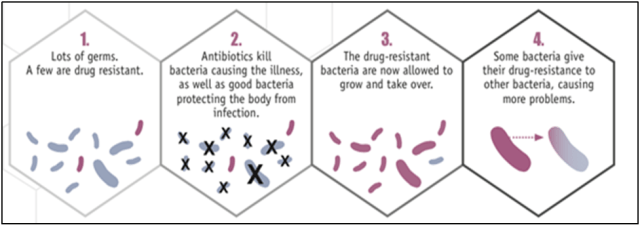 Figure: Selection Pressure (source: cdc.gov)
An antibiotic does not create resistance, but it decides who survives. In a large bacterial population, a few cells may already carry a resistance trait. When the antibiotic arrives, it kills the susceptible majority and leaves the resistant few behind with no competition, so they multiply and quickly dominate.
This is selection pressure. It explains why bacteria from hospital-acquired infections, exposed to antibiotics constantly, are so often resistant, and why a single resistant cell becomes a real problem once it multiplies and shares its resistance genes with others.
What causes antibiotic resistance? The main causes
Resistance is a natural process, but human behavior accelerates it enormously. The main drivers are:
- Overuse of antibiotics. The more antibiotics are used, the more selection pressure bacteria face, and the faster resistance spreads.
- Taking antibiotics for viral illnesses. Antibiotics do nothing against colds, flu, and most sore throats, so using them there adds selection pressure for no benefit.
- Incomplete or incorrect courses. Wrong drug, wrong dose, wrong duration, or stopping early once symptoms improve all leave hardier bacteria alive to regrow.
- Agricultural and non-medical use. Antibiotics given to farm animals for growth promotion and disease prevention expose huge numbers of bacteria at low doses, breeding resistance that reaches humans through food and contact.
- Poor infection control. Weak hygiene in hospitals and the community lets resistant bacteria spread from person to person and through contaminated water and the environment.
- Few new antibiotics. The pipeline of genuinely new antibiotic classes has slowed, so as older drugs fail there are fewer replacements.
The 5 mechanisms of antibiotic resistance
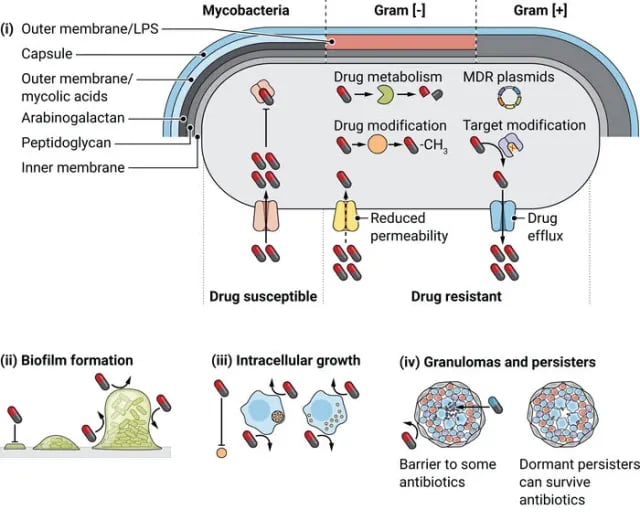 Figure: Mechanism of Antibiotic Resistance Development
However a bacterium becomes resistant, the resistance works through one of five mechanisms. Each one is the counter-move to a mechanism of action, so this list mirrors the targets in Mechanism of Action of Antibiotics.
- Decreased uptake (reduced permeability). The bacterium lets less drug in. Changes in the porin channels of the gram-negative outer membrane cut the entry of beta-lactams and aminoglycosides, as in Pseudomonas aeruginosa resistance to imipenem.
- Increased efflux. The bacterium pumps the drug back out before it can act. Efflux pumps drive tetracycline resistance and macrolide resistance in streptococci and staphylococci.
- Altered target. The bacterium changes the drug's binding site so the drug no longer fits. A changed penicillin-binding protein (PBP) stops beta-lactams from binding, which is exactly how MRSA defeats the whole class.
- Enzymatic inactivation. The bacterium makes an enzyme that destroys or modifies the drug. Beta-lactamase enzymes break the beta-lactam ring of penicillins and cephalosporins; see Beta-Lactam Antibiotics.
- Bypass of the metabolic pathway. The bacterium sidesteps the step the drug blocks. Sulfonamide-resistant bacteria stop needing PABA and use preformed folic acid instead, so the drug has nothing to block.
| Mechanism | How the bacterium resists | Example |
|---|---|---|
| Decreased uptake | Fewer or altered porins reduce drug entry | P. aeruginosa resistance to imipenem |
| Efflux | Pumps expel the drug before it binds | Tetracycline and macrolide resistance |
| Altered target | Binding site is modified so the drug cannot bind | MRSA (altered PBP); vancomycin resistance (altered cell wall precursor) |
| Enzymatic inactivation | Enzyme destroys or modifies the drug | Beta-lactamase against penicillins; aminoglycoside-modifying enzymes |
| Metabolic bypass | Bacterium avoids the blocked step | Sulfonamide resistance (uses preformed folate) |
The altered-target and enzymatic mechanisms carry most clinically important resistance, so here are fuller examples:
| Altered-target resistance | How it works |
|---|---|
| Staphylococcal resistance to methicillin and other beta-lactams; penicillin and cephalosporin resistance in S. pneumoniae and viridans streptococci | Mutated PBPs, or acquired new PBPs, that do not bind beta-lactams well enough to stop cell wall synthesis |
| Enterococcal and S. aureus resistance to vancomycin | Altered cell wall precursor lowers vancomycin binding, so cell wall synthesis continues |
| Enterococcal resistance to streptomycin | Altered ribosomal binding site (may also involve enzymatic modification) |
| Resistance to quinolones | Altered DNA gyrase subunits reduce quinolone binding |
| Streptococcal and staphylococcal resistance to macrolides | Enzymatic alteration of the ribosomal target reduces drug binding |
| Enzymatic-inactivation resistance | How it works |
|---|---|
| Staphylococcal resistance to penicillin; Enterobacteriaceae and P. aeruginosa resistant to penicillins, cephalosporins, and aztreonam | Beta-lactamase enzymes destroy the beta-lactam ring, so the drug cannot bind PBPs |
| Gram-positive and gram-negative resistance to aminoglycosides | Modifying enzymes change the aminoglycoside so it can no longer bind the ribosome |
How to remember
The two-word summary of the whole topic: mutation makes it, transfer spreads it. Mutation is the origin of a new resistance trait; horizontal gene transfer (conjugation, transformation, transduction) is how it moves through a bacterial population.
The 5 mechanisms map to four everyday images plus a detour: lock the door (reduced uptake), throw the drug out (efflux), change the lock (altered target), shred the drug (enzymatic inactivation), and take a detour around the roadblock (metabolic bypass).
Horizontal transfer routes, "the 3 Ts of sharing": Touch (conjugation, cell-to-cell), Take-up (transformation, free DNA), and Transduction (by phage).
Where students actually get confused
Intrinsic vs acquired resistance. Intrinsic resistance is predictable and affects a whole species by its biology (the drug never worked). Acquired resistance is gained by a previously susceptible strain through mutation or gene transfer. Only acquired resistance spreads.
Mutation vs gene transfer. Mutation creates a new resistance trait inside one lineage. Gene transfer copies an existing resistance gene into other bacteria. They are different events, and horizontal transfer is what turns one resistant cell into an outbreak.
Resistance vs tolerance vs persistence. Resistance means the bacterium grows despite the drug (a change in MIC). Tolerance and persistence mean the bacterium survives the drug by slowing down or going dormant without a change in MIC. Only resistance is inherited genetic change.
MDR vs XDR vs PDR. Multidrug-resistant (MDR) means resistant to at least one drug in three or more classes; extensively drug-resistant (XDR) means resistant to nearly all classes; pandrug-resistant (PDR) means resistant to all available agents.
How to prevent antibiotic resistance
Resistance cannot be eliminated, but it can be slowed. The core measures are:
Test before treating. Culture the clinical sample, identify the organism, and run susceptibility testing, including MIC where needed, so the right drug and dose are chosen the first time.
Use antibiotics wisely. Prescribe the correct drug, dose, and duration; prefer narrow-spectrum agents that hit the pathogen and spare the rest; and finish or stop courses based on evidence rather than habit. Stop an antibiotic that testing shows is ineffective, and stop antibiotics started empirically once infection is ruled out.
Prevent infection in the first place. Vaccination lowers the number of infections that need antibiotics at all, and fewer infections mean less resistance. Reducing unnecessary intravenous lines and catheters cuts hospital infections.
Stop the spread. Good hygiene and hand hygiene, isolation where appropriate, and reducing person-to-person and environmental transmission all limit how far resistant bacteria travel.
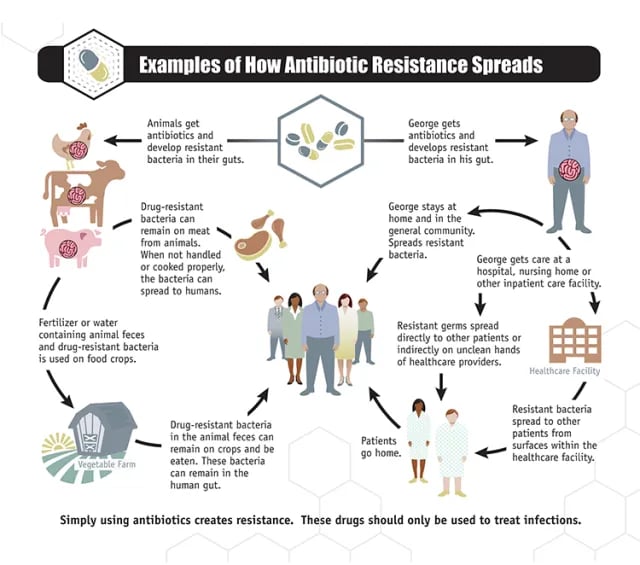 Figure: Examples of How Antibiotic Resistance Spreads (source: CDC)
Combination therapy has a role for some serious infections, because hitting a bacterium at two different targets makes simultaneous resistance less likely, though it is not a reliable answer against established MDR organisms.
Key exam facts
| Concept | Key point |
|---|---|
| Definition | Bacterial survival and growth at antibiotic doses that normally inhibit or kill |
| Intrinsic resistance | Natural, whole-species, drug never worked (e.g. Mycoplasma and beta-lactams) |
| Acquired resistance | Previously susceptible strain gains resistance by mutation or gene transfer |
| Origin vs spread | Mutation creates resistance; horizontal gene transfer spreads it |
| Horizontal transfer routes | Conjugation, transformation, transduction |
| 5 mechanisms | Decreased uptake, efflux, altered target, enzymatic inactivation, metabolic bypass |
| Selection pressure | Antibiotic use selects pre-existing resistant cells; it does not create them |
| MDR / XDR / PDR | Resistant to 3+ classes / nearly all classes / all available drugs |
Frequently Asked Questions
What is antibiotic resistance in simple terms?
What is antibiotic resistance in simple terms?
It is when bacteria change so that an antibiotic that used to kill or stop them no longer works, letting the infection continue despite treatment.
What are the main causes of antibiotic resistance?
What are the main causes of antibiotic resistance?
Overuse of antibiotics, using them for viral illness, incomplete or incorrect courses, agricultural use in animals, poor infection control, and too few new antibiotics.
What are the 5 mechanisms of antibiotic resistance?
What are the 5 mechanisms of antibiotic resistance?
Decreased uptake of the drug, increased efflux, an altered drug target, enzymatic inactivation of the drug, and bypass of the blocked metabolic pathway.
What is the difference between intrinsic and acquired resistance?
What is the difference between intrinsic and acquired resistance?
Intrinsic resistance is natural to a whole species (the drug never worked), while acquired resistance is gained by a previously susceptible strain through mutation or gene transfer, and only acquired resistance spreads.
How does antibiotic resistance spread between bacteria?
How does antibiotic resistance spread between bacteria?
Mainly by horizontal gene transfer: conjugation (cell-to-cell plasmid transfer), transformation (uptake of free DNA), and transduction (transfer by bacteriophage).
How can antibiotic resistance be prevented?
How can antibiotic resistance be prevented?
Test before treating, use the right drug and dose for the right duration, prefer narrow-spectrum drugs, prevent infections through vaccination and hygiene, and limit the spread of resistant bacteria.
References
- Madigan MT, Martinko JM (2006). Brock Biology of Microorganisms. 11th edn. Pearson Educational International. pp. 692-698.
- Pelczar MJ, Chan ECS, Krieg NR (2007). Microbiology. 5th edn. Tata McGraw-Hill. pp. 531-532.
- Hugo WB, Russell AD (2004). Pharmaceutical Microbiology. 7th edn. Blackwell Scientific Publications. pp. 220-232.
- Reygaert WC (2018). An overview of the antimicrobial resistance mechanisms of bacteria. AIMS Microbiology. 4(3): 482-501.
- Munita JM, Arias CA (2016). Mechanisms of antibiotic resistance. Microbiology Spectrum. 4(2): VMBF-0016-2015.
- World Health Organization (2023). Antimicrobial resistance. WHO Fact Sheet. Available at: who.int/news-room/fact-sheets/detail/antimicrobial-resistance.
- Centers for Disease Control and Prevention (2019). Antibiotic Resistance Threats in the United States, 2019. US Department of Health and Human Services, CDC.

Tankeshwar Acharya, MSc (Medical Microbiology)
Tankeshwar Acharya is an Assistant Professor in the Department of Microbiology at Patan Academy of Health Sciences (PAHS), Nepal, where he has been teaching and practicing clinical microbiology for over 14 years. He is the founder of Microbe Online, one of the leading free microbiology education resources on the web, covering bacteriology, mycology, parasitology, immunology, and clinical laboratory diagnostics written from direct experience in both the classroom and the diagnostic laboratory.
Comments
No comments yet. Be the first to share your thoughts.
Leave a comment
All comments are reviewed before they appear.