
Mixed Acid Fermentation: The Pathway That Makes E. coli Methyl Red-Positive
Mixed acid fermentation splits glucose into a mixture of strong acids, lactate, acetate, formate, succinate, plus ethanol, in variable proportions. That flood of acid drops the pH below 4.4, which is exactly what the methyl red test detects. Here is the pathway, the enzymes, why "mixed" is the whole point, and how it differs from the 2,3-butanediol route that VP detects.
Why It Matters
Most students meet mixed acid fermentation not as biochemistry but as a test result: E. coli is methyl red-positive. This article is about why, and the why is worth knowing, because it explains a whole family of biochemical tests.
When an organism like E. coli runs out of oxygen, it ferments glucose. But it does not make a single tidy product. It runs several pathways at once, producing a mixture of strong acids, lactic, acetic, formic, and succinic, along with ethanol and gas. That is what "mixed acid" means: not one end product in a fixed amount, but several acids in proportions that vary with the organism and conditions.
The diagnostic consequence is direct. All those acids pour into the medium and drive the pH sharply down, below 4.4. The methyl red test is simply a way of asking "did the pH drop that far?", and it drops that far only in an organism running mixed acid fermentation. So E. coli, a mixed-acid fermenter, turns methyl red red; Klebsiella and Enterobacter, which take a different route (the 2,3-butanediol pathway, detected by the Voges-Proskauer test), do not.
Understanding the pathway turns a memorized test result into a mechanism you can reason from. This article covers the biochemistry of mixed acid fermentation, the enzymes and end products, and how it connects to the methyl red, Voges-Proskauer, and carbohydrate fermentation tests.
Fermentation is an anaerobic process of breaking down molecules like glucose and other carbohydrates. The fermentation process is usually helpful in alcohol production. Bacteria follow different fermentation pathways.
Among them, mixed acid fermentation is a characteristic feature of the family Enterobacteriaceae, especially the genera Citrobacter, Proteus, Shigella, Salmonella, Escherichia, Aeromonas, Yersinia, Vibrio, and some species of Aeromonas. Some anaerobic fungi also follow this pathway.
These microorganisms ferment monosaccharides, disaccharides, polyalcohol, and frequently polysaccharides. The glycolytic pathway of this type of fermentation produces lactic acid, succinic acid, formic acids, acetic acids, and ethanol.
Reactions Involved in Mixed Acid Fermentation
In mixed acid fermentation reactions, two stages are present. The first stage of mixed acid fermentation is glycolysis, converting glucose to pyruvate. Here two NADH molecules are produced.
The second stage of mixed acid fermentation follows the following reactions the conversion of the pyruvate produced after glycolysis to one or more end products. The two NADH molecules produced in the first stage are reoxidized to NAD+. The reactions in the second stage are discussed below.
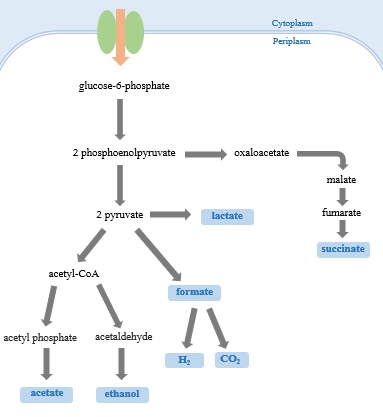 Figure: Mixed acid fermentation in E coli
Lactate Production
The enzyme lactate dehydrogenase catalyzes the formation of lactate/lactic acid. Here, glycolysis generates two molecules of pyruvate. Each molecule converts to lactate in the presence of a NADH+H+ molecule.
The overall reaction of lactate production is as follows:
Pyruvate → Lactate; in presence of lactate dehydrogenase and NADH+H+, which converts to NAD+
Acetate Production
In this reaction, pyruvate converts to acetyl CoA with the enzyme pyruvate dehydrogenase and NADH catalysts. The acetyl CoA now converts to acetate, which produces ATP by substrate-level phosphorylation. The conversion of acetyl CoA to acetate is a two-step process requiring two separate enzymes; phosphate acetyltransferase and acetate kinase.
The overall reaction of this reaction is as follows;
- Pyruvate → Acetyl CoA in the presence of pyruvate dehydrogenase
- Acetyl CoA + Phosphate → Acetyl phosphate + CoA in the presence of phosphate acetyltransferase.
- Acetyl phosphate + ADP → Acetate + ATP.
Ethanol Production
The reduction of Acetyl CoA with the help of NADH forms the third end product of mixed acid fermentation; ethanol. This ethanol production is a two-step reaction and requires the enzyme alcohol dehydrogenase.
The overall reaction of this step of fermentation is;
- Acetyl CoA + NADH +H+→ Acetaldehyde + NAD++ CoA
- Acetaldehyde + NADH + H+→ Ethanol + NAD+
Formate Production
The cleavage of pyruvate helps in the production of Formate. The enzyme pyruvate-formate-lyase catalyzes this production reaction. The enzyme pyruvate-formate-lyase also plays an essential role in regulating anaerobic fermentation in Enterobacteriaceae.
The overall reaction of the formate production is as follows;
Pyruvate + CoA → Acetyl CoA + Formate; catalyzed by pyruvate-formate-lyase.
Succinate Production
The production of succinate is a multi-step process. The glycolytic pathway intermediate, phosphoenol pyruvate, is the first substrate for carboxylation to form oxaloacetate, with the enzyme phosphoenol pyruvate carboxylase catalyzing this step.
In the second step, the oxaloacetate converts to malate in the presence of malate dehydrogenase. The third step is the formation of fumarate from the dehydration of malate in the fact of fumarate hydratase.
Phosphoenol pyruvate + HCO3→ Oxaloacetate +Phosphate
Oxaloacetate + NADH + H+→ Malate + NAD+
Malate → Fumarate + H2O
The final step is succinate production by reducing formate catalyzed by the enzyme fumarate reductase.
Fumarate + NADH + NAD+→ Succinate + NAD+
The reduction is the anaerobic respiration reaction that uses electrons in NADH dehydrogenase and the electron transport chain. ATP is produced using electrochemical balance and ATP synthetase—this step of fermentation produces ATP, not through substrate-level phosphorylation.
Hydrogen and Carbon Dioxide Production
The enzyme formate hydrogen lyase catalyzes the conversion of formate to hydrogen carbon dioxide gas. The production of these gases helps in preventing acidic condition inside the cells.
End products of mixed acid fermentation
| End product | Formed from | Key enzyme | Note |
|---|---|---|---|
| Lactic acid | Pyruvate | Lactate dehydrogenase | Reduces pyruvate, regenerates NAD⁺ |
| Formic acid | Pyruvate | Pyruvate-formate-lyase | May be split further into CO₂ + H₂ |
| Acetic acid | Acetyl-CoA | Via acetyl-phosphate | Yields extra ATP |
| Ethanol | Acetyl-CoA | Alcohol dehydrogenase (2 steps) | Regenerates NAD⁺ |
| Succinic acid | PEP → oxaloacetate | PEP carboxylase, then reduction | Multi-step; consumes CO₂ |
| CO₂ + H₂ (gas) | Formic acid | Formate hydrogen-lyase | The gas seen in Durham tubes |
The defining feature is in the plural: several of these are produced at once, in proportions that vary by species. E. coli makes two-to-threefold more lactic, succinic, and acetic acid than Enterobacter does. This variable mixture, rather than a single fixed product, is what distinguishes mixed acid fermentation from pathways like homolactic (lactate only) or alcoholic (ethanol + CO₂) fermentation.
Why "mixed" is the whole point
The name is doing real work. Many fermentations produce one product in a fixed amount: homolactic fermentation makes only lactate; alcoholic fermentation makes ethanol and CO₂. Mixed acid fermentation is different: it runs several terminal pathways simultaneously, producing a mixture of acids whose proportions shift with the organism and the growth conditions.
This matters for two reasons:
- It is why the pH crashes. A single weak acid might not lower the pH much. But several strong acids accumulating together drive the pH below 4.4, low enough for methyl red (which changes color at pH 4.4) to register. A butanediol fermenter, making mostly neutral products, never gets there.
- It is why the products are useful industrially. Because E. coli can be pushed toward one product or another, strains have been engineered to over-produce ethanol (biofuel), succinate, lactate, or acetate. The same flexibility that makes the pathway "mixed" makes it a target for metabolic engineering.
So the "mixed" in mixed acid fermentation is not incidental. It is the reason the test works and the reason the pathway is industrially valuable.
The fork: mixed acid vs 2,3-butanediol
After glucose is fermented to pyruvate, enteric bacteria take one of two roads, and which road they take is the basis of two classic tests:
- The mixed acid road produces the strong acids described above, drops the pH below 4.4, and is detected by the methyl red test (positive: red). E. coli, Salmonella, Shigella, Proteus take this road.
- The 2,3-butanediol road produces mostly neutral acetoin and 2,3-butanediol, spares the pH, and is detected by the Voges-Proskauer test (positive: red with the addition of reagents that detect acetoin). Klebsiella, Enterobacter, Serratia take this road.
The two roads are largely mutually exclusive, which is why methyl red and VP usually give opposite results in the same organism, and why they are run from the same MR-VP broth. Mixed acid fermentation is the biochemistry behind the "MR" half of that pairing.
For the tests themselves, see the methyl red test (which detects mixed acid fermentation) and the Voges-Proskauer test (which detects the butanediol alternative). For the general reading of sugar fermentation and gas production, see the carbohydrate fermentation test.
Application of Mixed Acid Fermentation
Mixed Acid fermentation is applicable in various fields of science, especially for producing many helpful end products. The applications of mixed acid fermentation are as follows:
- The use of single bacteria can help produce various products in biotechnology and the food industry.
- Likewise, many different strains of bacteria have been metabolically engineered in the laboratory to increase the yield of the specific end product.
- This fermentation method is applied to identify bacteria in the laboratory. Methyl red test is standard for detecting the bacteria following the mixed acid fermentation reaction. Here, the test solution turns red if the pH drops below 4.4 in the presence of those microorganisms that follows the mixed acid fermentation pathway.
How to remember
"Mixed" = many acids at once = low pH = methyl red red. The logic chains cleanly. The organism makes a mixture of strong acids simultaneously; the acids crash the pH below 4.4; methyl red turns red at 4.4. So mixed acid fermentation is why an organism is methyl-red-positive. E. coli is the poster child.
Mixed acid vs butanediol is MR vs VP. Two roads from pyruvate: the acid road (methyl red-positive, E. coli) and the neutral butanediol road (VP-positive, Klebsiella). Same MR-VP broth, opposite results, because the two roads are mutually exclusive.
Formate is the gas source. Formic acid can be split by formate hydrogen-lyase into CO₂ and H₂, the gas you see in a Durham tube. So a mixed-acid fermenter that has this enzyme is also gas-positive; one that lacks it (like Shigella) is anaerogenic.
Variable, not fixed. Unlike homolactic (only lactate) or alcoholic (only ethanol + CO₂) fermentation, mixed acid makes several products in proportions that shift. That variability is the defining trait and the reason the pathway is engineered industrially.
Key exam facts in one table
| Question | Answer | The reason behind it |
|---|---|---|
| What is mixed acid fermentation? | Fermentation producing a mixture of acids | Several terminal pathways run at once |
| End products | Lactic, acetic, formic, succinic acids + ethanol + gas | Multiple, in variable proportions |
| Key distinguishing feature | Multiple products, variable amounts | Unlike single-product fermentations |
| Classic organism | Escherichia coli | The model mixed-acid fermenter |
| Detected by | Methyl red test | The acids drop pH below 4.4 |
| Why pH drops so low | Several strong acids accumulate together | Enough to reach the MR threshold (4.4) |
| Alternative pathway | 2,3-butanediol (acetoin) | Neutral products; detected by VP |
| Organisms taking the butanediol road | Klebsiella, Enterobacter, Serratia | MR-negative, VP-positive |
| Formate → gas | Formate hydrogen-lyase → CO₂ + H₂ | The Durham-tube gas |
| Anaerogenic mixed-acid fermenter | Shigella, S. Typhi (no gas) | Lack/limited formate hydrogen-lyase |
| Succinate formation | PEP → oxaloacetate → succinate | PEP carboxylase; consumes CO₂ |
| Ethanol formation | Acetyl-CoA → acetaldehyde → ethanol | Alcohol dehydrogenase; regenerates NAD⁺ |
| Formate formation | Pyruvate → acetyl-CoA + formate | Pyruvate-formate-lyase |
| Industrial relevance | Engineered for ethanol, succinate, lactate | The variable pathway is tunable |
| Relationship to MR/VP | MR detects this pathway; VP detects the alternative | Two roads from pyruvate |
Where students get confused
Thinking mixed acid fermentation makes one product. The defining feature is the opposite: it makes several acids at once, in variable proportions. "Mixed" is literal. Homolactic fermentation makes only lactate; mixed acid makes lactate and acetate and formate and succinate, plus ethanol.
Separating the pathway from the test. Mixed acid fermentation is the biochemistry; the methyl red test is how you detect it. They are two views of the same thing. An organism is methyl-red-positive because it runs mixed acid fermentation and crashes the pH. Do not treat them as unrelated facts.
Confusing it with the VP pathway. Mixed acid (MR-positive) and 2,3-butanediol (VP-positive) are the two roads from pyruvate, and they are largely mutually exclusive. An organism is usually one or the other, which is why MR and VP typically give opposite results. Mixing them up is a classic error.
Assuming all mixed-acid fermenters make gas. Gas (CO₂ + H₂) comes from splitting formate via formate hydrogen-lyase. A mixed-acid fermenter with this enzyme is gas-positive; one without it, like Shigella or S. Typhi, ferments to acid but makes no gas (anaerogenic). Acid production and gas production are separate.
Overstating the fixed proportions. The amounts of each acid vary with the organism and the conditions. E. coli and Enterobacter both can do mixed-acid chemistry but in different proportions. The pathway is defined by variability, not a fixed recipe.
References
- Thakker C, Martínez I, San KY, Bennett GN. Succinate production in Escherichia coli. Biotechnol J. 2012;7(2):213-224. doi:10.1002/biot.201100061
- Vuoristo KS, Mars AE, Sangra JV, Springer J, Eggink G, Sanders JP, Weusthuis RA. Metabolic engineering of the mixed-acid fermentation pathway of Escherichia coli for anaerobic production of glutamate and itaconate. AMB Express. 2015;5:61. doi:10.1186/s13568-015-0147-y
- Madigan MT, Bender KS, Buckley DH, Sattley WM, Stahl DA. Brock Biology of Microorganisms. 15th ed. Boston: Pearson; 2018.
- Tille PM. Bailey and Scott's Diagnostic Microbiology. 15th ed. St. Louis: Elsevier; 2022.
Frequently Asked Questions
Why is E. coli methyl red-positive?
What makes mixed acid fermentation different from other fermentations?
What is the difference between mixed acid fermentation and the 2,3-butanediol pathway?
Why do some mixed acid fermenters produce gas and others do not?
Why is mixed acid fermentation important in biotechnology?

Tankeshwar Acharya, MSc (Medical Microbiology)
Tankeshwar Acharya is an Assistant Professor in the Department of Microbiology at Patan Academy of Health Sciences (PAHS), Nepal, where he has been teaching and practicing clinical microbiology for over 14 years. He is the founder of Microbe Online, one of the leading free microbiology education resources on the web, covering bacteriology, mycology, parasitology, immunology, and clinical laboratory diagnostics written from direct experience in both the classroom and the diagnostic laboratory.