

Mycosis (plural mycoses) is a fungal infection or disease caused by fungi. It varies in severity from mild symptoms such as rash to life-threatening infections. Severity depends on the site of infection, the extent of infection, and also on the immune status of the host. Both yeast and molds are involved to cause mycosis.
Why this classification matters
Before memorizing the classification scheme, understand why it exists: the site-based classification of mycoses directly predicts which organism you should suspect, which specimen to collect, and which test to order.
A clinician who sees a patient with a chronic skin lesion approaches the diagnostic workup completely differently than one managing a neutropenic patient with pulmonary infiltrates even though both might ultimately be fungal infections. The classification framework below is not academic categorization; it is the clinical decision tree microbiologists and physicians use every day.
Mycoses can be classified based on the
- site of the infection
- route of acquisition of the pathogen, and
- type of virulence exhibited by the fungus
Site of infection
Based on site of infection, mycoses are of 4 types;
Superficial or Cutaneous mycoses
Superficial or cutaneous mycoses are fungal infections of the skin, hair, and nails that are restricted to the keratinized layers of the skin and its appendages. They cause little or no inflammation and there is no direct invasion of deeper tissues. Most cutaneous mycoses are caused by dermatophytes (agents of ringworm, athlete’s foot, etc), but may also be caused by yeasts of the Candida genus and other non-dermatophytic fungi, like tinea and piedra.
| Fungal Disease | Causative agent |
|---|---|
| Black piedra | Piedraia hortae |
| White piedra | Trichosporon beigelii |
| Pityriasis versicolor | Malassezia furfur |
| Tinea nigra | Phaeoannellomyces werneckii |
| Candidosis | Candida albicans |
| Dermatophytosis | Trichophyton, Microsporum, Epidermophyton |
Superficial/Cutaneous Mycoses
Signs and symptoms of cutaneous mycoses vary depending on the infectious agent, site of the infection, and severity of the infection. For example, an itchy rash, and ring-like lesions at the site of infection is present with dermatophyte infections (tineas), while cutaneous candidiasis can present with a localized rash in skinfold areas.
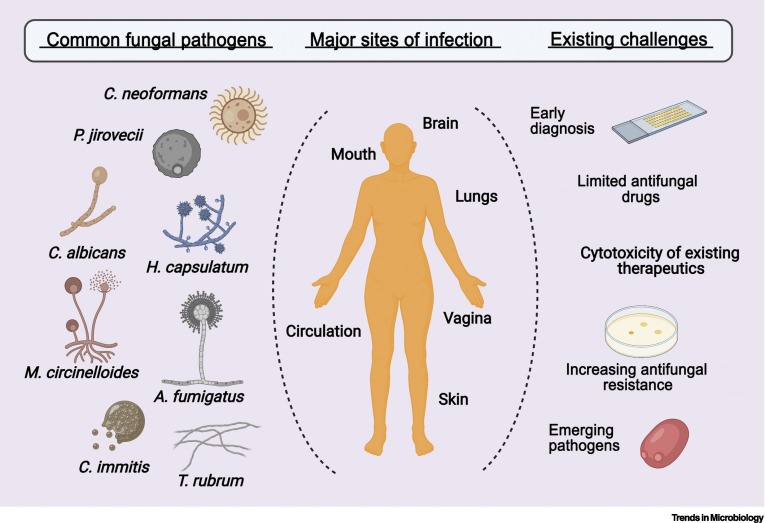 Figure: Common Fungal Pathogens and Major Sites of Infections (image source cell.com)
Subcutaneous mycoses
Subcutaneous mycoses are localized infections of the skin and underlying tissues. It occurs when the fungus from the environment gains access to deeper tissues via a cut or puncture wound on the skin. An inflammatory response develops in the subcutaneous tissue frequently with extension into the epidermis. Symptoms vary among the different diseases, but the common ones are the presence of a localized nodule, ulcerations, granulomatous tissue, subcutaneous mass with abscesses, and fistulae.
| Disease | Fungal Pathogen |
|---|---|
| Sporotrichosis | Sporothrix schenckii |
| Chromoblastomycosis | Fonsecaea, Phialophora, Cladophialophora etc |
| Phaeohyphomycosis | Cladophialophora, Exophiala, Curvularia, Exserohilum etc |
| Mycotic mycetoma | Scedosporium, Madurella, Trematosphaeria, Acremonium, Exophiala, etc |
| Subcutaneous zygomycosis | Basidiobolus ranarum, Conidiobolus coronatus |
| Subcutaneous zygomycosis (Mucormycosis) | Rhizopus, Mucor, Rhizomucor, Lichtheimia, Saksenaea etc |
Systemic mycoses
Systemic mycoses are fungal infections affecting internal organs such as the lungs, brain eyes, etc. It occurs when fungi enter the body and are disseminated via the bloodstream to multiple organs.
Systemic mycoses are common in immune-compromised individuals but may affect immunocompetent individuals too. Symptoms may vary according to the disease but fever, cough, and loss of appetite are common symptoms.
| Disease | Fungal Pathogen |
|---|---|
| Histoplasmosis | Histoplasma capsulatum |
| Coccidiodomycosis | Coccidioides immitis |
| Blastomycosis | Blastomyces dermatitidis |
| Paracoccidiodomycosis | Paracoccidioides brasiliensis |
| Aspergillosis | Aspergillus species |
Systemic mycosis can be categorized into two types;
- endemic respiratory infections (affecting both immunocompetent and immunosuppressed) and
- opportunistic infections (greater risk in immunocompromised).
Opportunistic mycoses
Opportunistic mycoses are caused by fungi that are normally found as human commensals or in the environment. They can cause infections in immuno-suppressed individuals (people infected with HIV infections, undergoing cancer therapy or organ transplant recipients, etc).
| Disease | Fungal Pathogen |
|---|---|
| Candidosis | Candida albicans Other Candida species |
| Cryptococcosis | Cryptococcus neoformans |
| Zygomycosis | Rhizopus, Mucor, and Absidia |
| Aspergillosis | Aspergillus fumigatus, Aspergillus niger, and Aspergillus flavus |
| Penicilliosis | Penicillium marneffei and other Penicillum species |
| Pneumocystosis | Pneumocystis jirovecii |
| Fusariosis | Fusarium species |
Candidosis, cryptococcosis, aspergillosis, and zygomycosis can also show superficial and systemic manifestations.
Mycosis Type to Organism to Article
| Mycosis category | Typical organisms | Typical host | Dedicated article |
|---|---|---|---|
| Superficial/cutaneous | Dermatophytes (Trichophyton, Microsporum, Epidermophyton), Malassezia | Any host | Dermatophytes: Tinea and Lab Diagnosis |
| Subcutaneous | Sporothrix schenckii, Mycetoma agents | Trauma/inoculation (gardeners, farmers) | Sporothrix: Characteristics, Pathogenesis and Lab Diagnosis, Mycetoma |
| Systemic (endemic) | Histoplasma capsulatum, Blastomyces dermatitidis, Coccidioides immitis | Both immunocompetent and immunosuppressed | Dimorphic Fungi, Histoplasma capsulatum, Blastomyces dermatitidis |
| Systemic (opportunistic) | Candida spp., Cryptococcus neoformans, Aspergillus spp., Mucorales | Immunocompromised (HIV, transplant, neutropenia) | Candida albicans, Cryptococcus neoformans, Aspergillus, Mucormycosis |
For diagnostic methodology applicable across all these categories, see Laboratory Diagnosis of Fungal Infections
Route of acquisition of the pathogen
On the basis of the route of acquisition, fungal infections may be exogenous or endogenous in origin.
Exogenous
When the pathogen is transmitted through an external source (either airborne, cutaneous or percutaneous), the mycoses are called exogenous mycoses. Examples include histoplasmosis, coccidioidomycosis, and blastomycosis.
Endogenous
When the pathogen is acquired from colonization or reactivation of a fungus from latent infection, it is called endogenous mycoses. Examples include Cryptococcus neoformans and Candida spp.
Type of virulence exhibited by the fungus
According to virulence exhibited by the pathogen, fungal infections are classified as primary or opportunistic infections.
Primary infection
Primary infection is when a pathogen establishes infection in an immunologically normal host. Example: histoplasmosis.
Opportunistic infection
An opportunistic infection is when the pathogen requires some compromise of host defenses in order for infection to become established. This may be secondary to an underlying disease process, such as diabetes mellitus, or due to an immunosuppressive agents.
Any fungi could be considered an opportunistic pathogen in the appropriate clinical settings. Fungi previously thought to be non-pathogenic may be the cause of infections. The most common encountered opportunistic fungal pathogens are Aspergillus, Candida, Cryptococcus, Pneumocystis jirovecii, etc.
"The site of a fungal infection is not just where it happens to be; it tells you which organism to suspect and which test to order first."
Key exam facts
| Question | Answer |
|---|---|
| What are the 4 site-based categories of mycosis? | Superficial/cutaneous, subcutaneous, systemic (endemic), systemic (opportunistic) |
| What distinguishes endemic from opportunistic systemic mycoses? | Endemic infects both healthy and immunocompromised hosts; opportunistic mainly affects immunocompromised |
| What is an exogenous mycosis? | Acquired from an external source (airborne, cutaneous, percutaneous) |
| What is an endogenous mycosis? | Caused by normal commensal flora becoming pathogenic (e.g. Candida overgrowth) |
| Which organisms can show BOTH superficial and systemic manifestations? | Candida, Cryptococcus, Aspergillus, and zygomycetes (Mucorales) |
References
- Walsh TJ, Dixon DM. Spectrum of Mycoses. In: Baron S, editor. Medical Microbiology. 4th edition. Galveston (TX): University of Texas Medical Branch at Galveston; 1996. Chapter 75. Available from: https://www.ncbi.nlm.nih.gov/books/NBK7902/
- Bailey & Scott’s Diagnostic Microbiology, Forbes, 11th edition

Comments
No comments yet. Be the first to share your thoughts.
Leave a comment
All comments are reviewed before they appear.