
Culture media for Salmonella typhi and paratyphi

On this page
Salmonella is a member of the family Enterobacteriaceae. It is a Gram-negative bacilli, motile and non-lactose fermenter. The genus can be divided into two species (S. enterica and S. bongori), based on their phenotypic profile.
It causes acute gastroenteritis and when Salmonella infections become invasive, they can affect the bloodstream (bacteremia), bone (osteomyelitis), joint (septic arthritis), brain, or nervous system (meningitis). Salmonella bacteria are classified as either “typhoidal” or “nontyphoidal,” based on their serotype.
- Typhoidal Salmonella refers to the specific Salmonella serotypes which cause typhoid fever or paratyphoid fever, including typhi, paratyphi A, paratyphi B, and paratyphi C.
- Nontyphoidal Salmonella refers to all otherSalmonella serotypes.
For the recovery of Salmonella from clinical specimens, three general types of media are available.
- Non-selective media for primary isolation (blood agar)
- Selective or differential agar (e.g. MacConkey agar, hektoen enteric agar); and
- Enrichment broths (e.g. selenite broth)
Commonly used culture media for isolation ofSalmonellaand their colony characteristics
- Bismuth sulfite agar: Salmonellae produce black colonies.
- Blood Agar: S. typhi and S. paratyphi usually produce non-hemolytic smooth whitecolonies.
- MacConkey Agar: Non-lactose fermenting smooth colonies i.e. pale colonies
- Deoxycholate Citrate Agar (DCA): Salmonella appear as pale colonies.
 Figure: Colonies of Salmonella typhi in DCA Agar.Source: bacteriainphotos.com
Xylose Lysine Deoxycholate (XLD) Agar: Salmonella appear as pink (lactose non-fermenting colonies) with a black center (due to H2S production)
Salmonella-Shigella (SS) Agar: Used for selective recovery of Salmonella from stool culture (contains five times the concentration of bile salts compared with MacConeky Agar). Salmonellae usually produce lactose non-fermenting colonies with black centres (except S. paratyphi A, whose colonies do not have black centres).
Hektoen Enteric (HE) Agar: On hektoen enteric agar, salmonellae produce transparent green colonies with black centres (except S. paratyphi A, whose colonies do not have black centres).
Eosin Methylene Blue (EMB) Agar: Non-lactose fermenters, including Salmonella, Shigella and Proteus forms colorless or transparent colonies.
Wilson Blair media:
S.Typhi forms large black colonies with a metallic sheen.
S.Paratyphi A produces green colonies due to the absence of H2S production.
Selenite brothor Tetrathionate broth: For the enrichment of Salmonellae present in feces. Feces is incubated for 12-18 hours before subculture into plates.
Trypticase soy brothor brain heart infusion broth: Non-selective broth for primary blood culture.
Biochemical Tests
Commonly used Biochemical tests for the identification of Salmonella and their results are as follows;
| Biochemical Tests | Result |
|---|---|
| Catalase test | Positive |
| Oxidase test | Negative |
| Indole test | Negative |
| Voges-Proskauer (VP) test (media: MR/VP broth) | Negative |
| Methyl-red (MR) test | Positive |
| Citrate Utilization test (media: Simmon’s citrate agar) | Positive |
| Urea hydrolysis test (urease test in urea medium) | Negative |
| Nitrate recduction test | Negative |
| Triple sugar iron agar (TSI) test | Alk/Acid, H 2 S |
| Arginine-dihydrolase test | Variable |
| Lysine-decarboxylase test | Positive |
| Ornithine-decarboxylase test | Positive |
| Sucrose/salicin | Usually not fermented |
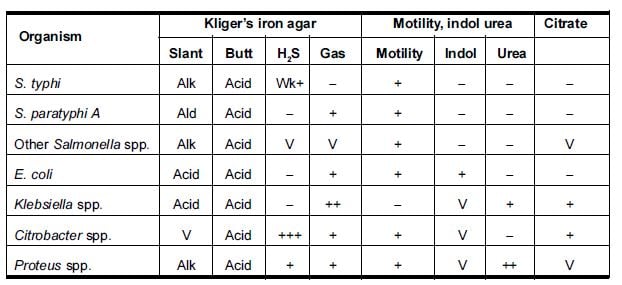 Figure: Biochemical test for Salmonella
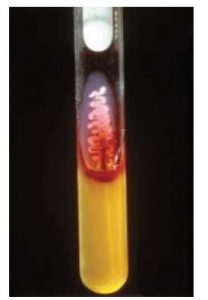 Figure: Salmonella typhi in TSI agar orKIA agar
References and Further Reading
- Ruiz, J., Núñez, M. L., Lorente, I., Pérez, J., Simarro, E., & Gómez, J. (1996). Performance of six culture media for isolation of Salmonella species from stool samples. European journal of clinical microbiology & infectious diseases : official publication of the European Society of Clinical Microbiology, 15(12), 922–926. https://doi.org/10.1007/BF01690509
- Uyttendaele, M., Bagamboula, C. F., De Smet, E., Van Wilder, S., & Debevere, J. (2001). Evaluation of culture media for enrichment and isolation of Shigella sonnei and S. flexneri. International journal of food microbiology, 70(3), 255–265. https://doi.org/10.1016/s0168-1605(01)00549-9
- Dekker, J. P., & Frank, K. M. (2015). Salmonella, Shigella, and yersinia. Clinics in laboratory medicine, 35(2), 225–246. https://doi.org/10.1016/j.cll.2015.02.002

Tankeshwar Acharya, MSc (Medical Microbiology)
Tankeshwar Acharya is an Assistant Professor in the Department of Microbiology at Patan Academy of Health Sciences (PAHS), Nepal, where he has been teaching and practicing clinical microbiology for over 14 years. He is the founder of Microbe Online, one of the leading free microbiology education resources on the web, covering bacteriology, mycology, parasitology, immunology, and clinical laboratory diagnostics written from direct experience in both the classroom and the diagnostic laboratory.
Comments
No comments yet. Be the first to share your thoughts.
Leave a comment
All comments are reviewed before they appear.