
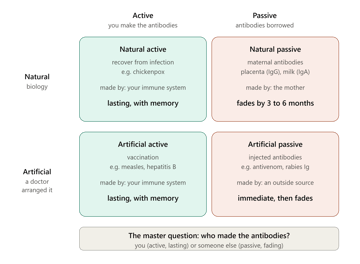
Active vs Passive Immunity: Types, Differences, and Examples
The difference between active and passive immunity, with the four types (natural and artificial) and clear examples: vaccination, infection, maternal antibodies, and antivenom. For...
Articles related to Innate Immunity.
The difference between active and passive immunity, with the four types (natural and artificial) and clear examples: vaccination, infection, maternal antibodies, and antivenom. For...
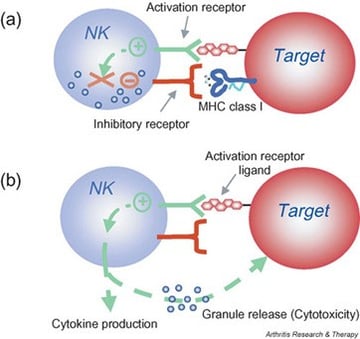
What natural killer (NK) cells are, how the missing-self mechanism lets them catch virus-infected and tumor cells that hide from T cells, and how they bridge innate and adaptive im...

The components of the innate immune system explained as one working team: barriers, phagocytes, NK cells, complement, and the cytokines that connect them. How each part contributes...
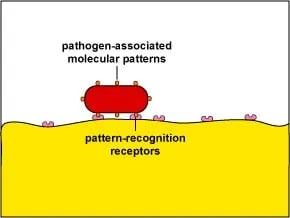
The steps of phagocytosis, from chemotaxis and opsonin recognition to the respiratory burst that kills the microbe, and what happens when it fails (chronic granulomatous disease)....
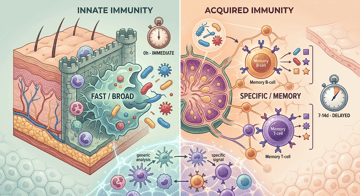
Innate vs adaptive (acquired) immunity compared point by point: speed, specificity, memory, and how the two systems work as partners rather than rivals. Full comparison table, the...
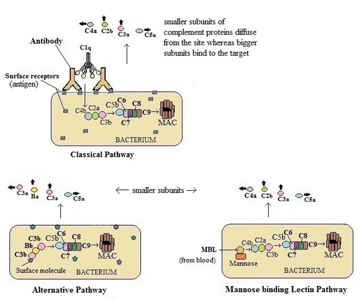
The complement system explained by mechanism: how the classical, alternative, and lectin pathways all converge on C3, why C3 is the hub of the whole system, how the membrane attack...
Cytokines explained by mechanism: what they are, the main families (interleukins, interferons, TNF, chemokines, CSFs, TGF), and the four properties (pleiotropy, redundancy, synergy...