
Virology MCQs (With Answers): Virus Structure and Classification
Ten basic virology MCQs with answers and explanations on virus size, capsid shape, structure, bacteriophages, cell culture, and DNA versus RNA viruses. A foundation for medical virology practice questions.

On this page
These multiple-choice questions or MCQs on virology test your knowledge and understanding of the structure of viruses (shape, size, chemical components) and classification of viruses. These questions are very basic to check your understanding of basic virology. Answers to these questions are given at the end of this blog post.
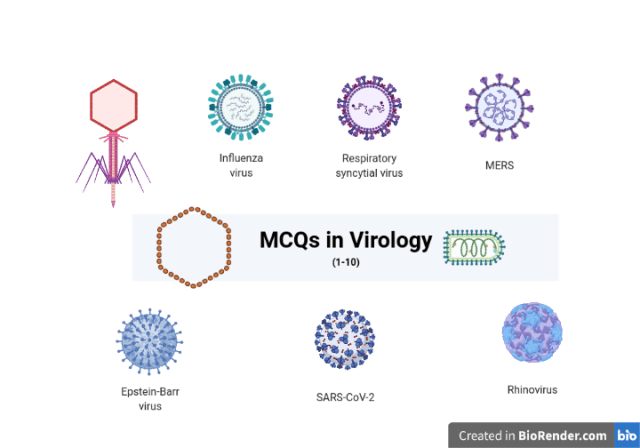 ## Virus structure: size, capsid, and components
- Viruses range in size from:
a. 1-100 nm
b. 25-300 nm
c. 10-100 μm
d. 400-1000 nm
e. 1-10 μm - A structural component that is found in all viruses is:
a. The envelope
b. DNA
c. Capsid
d. Tail fibers
e. Spikes - A chemical component that is found in all viruses is:
a. Protein
b. Lipid
c. DNA
d. RNA
e. Glycoproteins - A common polyhedral capsid shape of viruses is a :
a. Pentagon
b. Cube
c. Icosahedron
d. Pyramid
e. Sphere
Virus classification, bacteriophages, and cultivation
- Enteroviruses differ from rhinoviruses mainly in their:
a. Type of nucleic acid
b. Size
c. Capsid shape
d. Ability to survive acidic conditions
e. Strandedness - Viruses that can remain latent (usually in neurons) for many years are most likely:
a. Togaviruses
b. Herpesviruses
c. Enteroviruses
d. Rhinoviruses
e. Retroviruses - What types of viruses contain the enzyme lysozyme to aid in their infection?
a.Bacteriophage
b. Animal Viruses
c. Plant Viruses
d. Fungal Viruses
e. Human Viruses - The process of readily counting Bacteriophages is called:
a. Immunoassays
b. ELISA
c. Plaque assays
d. Tissue cell culture
e. Electron Microscopy - A type of cell culture that can reproduce for an extended number of generations and is used to support viral replication is
a. Primary cell culture
b. Continuous cell line
c. Cell strain
d. Diploid fibroblast cell
e. Connective tissue - Which of the following is not an RNA virus?
a. Retrovirus
b. Enterovirus
c. Rhabdovirus
d. Adenovirus
e. Rubella virus
Answer Keys
- b. 25-300 nm
- c. Capsid
- a. Protein
- c. Icosahedron
- d. Ability to survive acidic conditions
- b. Herpesviruses
- a. Bacteriophage
- c. Plaque assays
- b. Continuous cell line
- d. Adenovirus
Why these are the answers
- 25 to 300 nm. Viruses are far smaller than the cells they infect, measured in nanometers rather than micrometers. A range of roughly 25 to 300 nm covers most familiar viruses, from the small picornaviruses up to the large poxviruses. The options given in micrometers (μm) describe the size of bacteria and cells, which is why they are wrong: mixing up nm and μm is the trap here.
- Capsid. Every virus has a capsid, the protein coat that encloses and protects the nucleic acid. The other options are found in only some viruses: an envelope is present in enveloped viruses but not naked ones, the genome is DNA in some and RNA in others (so neither DNA nor RNA is in all), and tail fibers and spikes are specialized features of particular groups. The capsid is the one universal structural component.
- Protein. This is the chemical companion to question 2. All viruses contain protein, at minimum the capsid protein. They do not all contain lipid (only enveloped viruses do), and while every virus has a nucleic acid, it is DNA in some and RNA in others, so neither DNA nor RNA alone is present in all viruses. Protein is the one chemical component shared by every virus.
- Icosahedron. The common polyhedral capsid shape is the icosahedron, a symmetrical solid with 20 triangular faces. This shape lets identical protein subunits assemble into a closed shell using the least genetic information, which is efficient for a small viral genome. The other options are not true capsid geometries: viruses are not built as pentagons, cubes, pyramids, or simple spheres.
- Ability to survive acidic conditions. Enteroviruses and rhinoviruses are both small RNA picornaviruses of similar size and shape, so those features do not separate them. The key difference is acid stability: enteroviruses are acid-stable and survive passage through the stomach to infect the gut (entero meaning intestine), while rhinoviruses are acid-labile and are restricted to the cooler, non-acidic environment of the nose (rhino meaning nose). That single property explains where each one causes disease.
- Herpesviruses. Herpesviruses are the classic latent viruses: after the initial infection they persist for life, often in neurons (for example, herpes simplex in sensory ganglia and varicella-zoster in dorsal root ganglia), and reactivate later to cause recurrent disease such as cold sores or shingles. Retroviruses do integrate into host DNA, but the question's specific clue, latency in neurons for many years, points to the herpesviruses.
- Bacteriophage. Bacteriophages use lysozyme to break through the bacterial cell wall. Many, such as phage T4, carry a tail-associated lysozyme in the virion that locally digests the peptidoglycan so the tail can penetrate and inject the DNA on entry. Phages also make a separate lysozyme (endolysin) at the end of the cycle to break the cell open and release new virus. So lysozyme helps the phage both get in and get out, which is why it is the phage, not animal or plant viruses, that the question describes.
- Plaque assays. A plaque assay counts infectious virus particles. Phages are mixed with a lawn of host bacteria on a plate, and each infectious phage kills the cells around it, producing a clear zone (a plaque) in the bacterial lawn. Counting the plaques gives the number of infectious units. The other options detect or visualize virus but do not readily count infectious particles this way.
- Continuous cell line. A continuous (immortalized) cell line can divide for an essentially unlimited number of generations, which makes it a convenient and renewable substrate for growing viruses in the laboratory. Primary cultures and diploid fibroblast strains have a limited lifespan and stop dividing after a set number of passages, so they cannot be maintained indefinitely. The continuous line is the one built for long-term propagation.
- Adenovirus. Adenovirus is a DNA virus, so it is the odd one out. Retroviruses, enteroviruses, rhabdoviruses, and rubella virus all have RNA genomes. A quick way to remember adenovirus: it is a naked, double-stranded DNA virus, in contrast to the RNA viruses it is listed with here.

Tankeshwar Acharya, MSc (Medical Microbiology)
Tankeshwar Acharya is an Assistant Professor in the Department of Microbiology at Patan Academy of Health Sciences (PAHS), Nepal, where he has been teaching and practicing clinical microbiology for over 14 years. He is the founder of Microbe Online, one of the leading free microbiology education resources on the web, covering bacteriology, mycology, parasitology, immunology, and clinical laboratory diagnostics written from direct experience in both the classroom and the diagnostic laboratory.
Comments
No comments yet. Be the first to share your thoughts.
Leave a comment
All comments are reviewed before they appear.