
D-Test for Inducible Clindamycin Resistance: Why "Clindamycin-Susceptible" Isn't Always True

On this page
Inducible clindamycin resistance in staphylococci and streptococci can be detected by the disk diffusion method using clindamycin and erythromycin disks or broth microdilution methods. D-zone test is described in this post.
The CLSI recommends testing for inducible clindamycin resistance in all staphylococci, Streptococcus pneumoniae, and beta-hemolytic streptococci that are erythromycin-resistant and clindamycin susceptible or intermediate prior to reporting clindamycin results.
Principle
D-zone test is performed by disk diffusion, placing a 15-μg erythromycin disk in proximity to a 2-μg clindamycin disk on an agar plate that has been inoculated with a staphylococcal or streptococcal isolate; the plate is then incubated overnight.
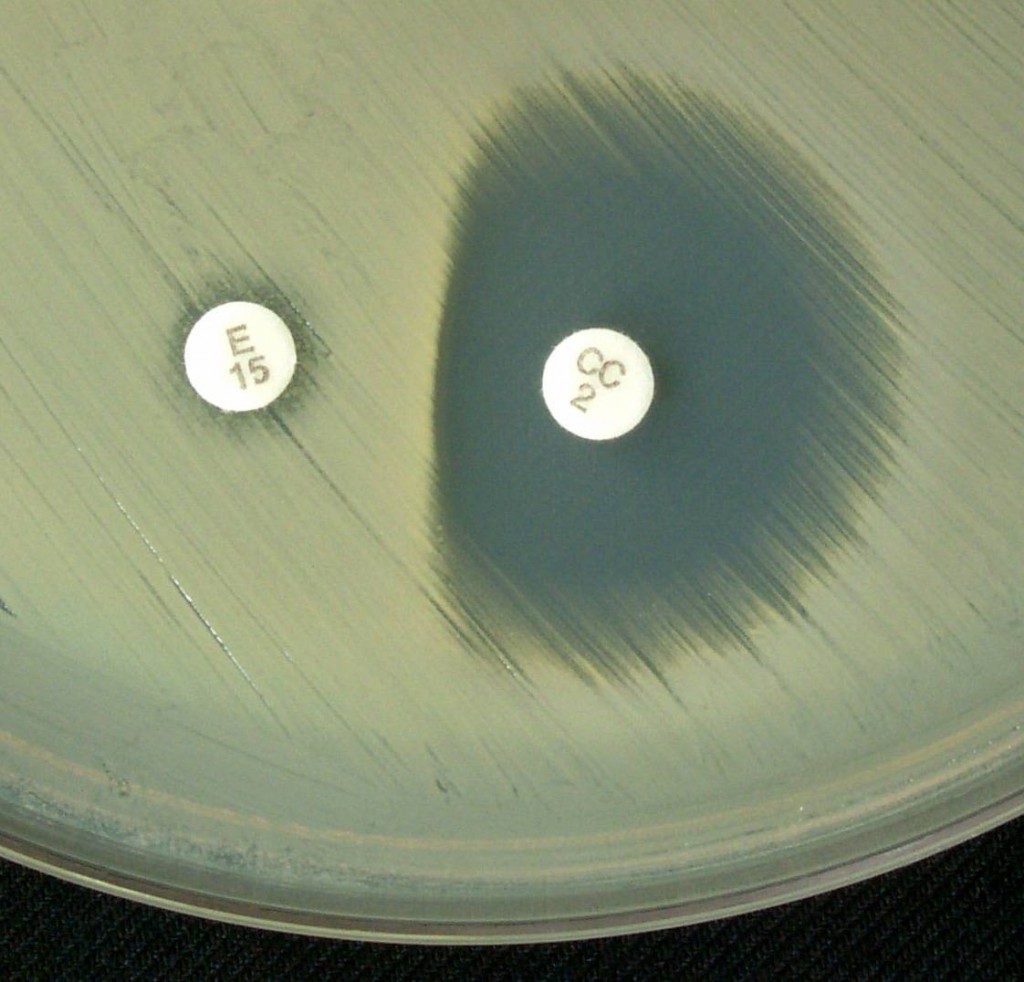 Figure: Positive Inducible Clindamycin Resistance (D-test) test
A flattening of the zone of inhibition around the clindamycin disk proximal to the erythromycin disk (producing a zone of inhibition shaped like the letter D) is considered a positive result and indicates that the erythromycin has induced clindamycin resistance (a positive “D-zone test”).
For erythromycin-resistant isolates, induction tests can help laboratories determine whether results for clindamycin should be reported as susceptible (when the induction test is negative) or as resistant (when the induction test is positive).
Mechanism of Action of Erythromycin and Clindamycin and Development of Resistance
Erythromycin (a macrolide) and clindamycin (a lincosamide) represent two distinct classes of antimicrobial agents that inhibit protein synthesis by binding to the 50S ribosomal subunits of bacterial cells. In staphylococci, resistance to both of these antimicrobial agents can occur through methylation of their ribosomal target site. Such resistance is typically mediated by erm genes.
Clinical significance of Inducible Clindamycin resistance
Macrolide-lincosamide-streptogramin B (MLSB) resistance, which is mediated by target side modification mechanism, results in resistance to erythromycin, clindamycin, and streptogramin B. This mechanism can be:
| Constitutive Resistance | Inducible Resistance | |
|---|---|---|
| Methylase production | Always on | Only switched on by an inducing agent (erythromycin is an effective inducer) |
| Routine report (without D-test) | Correctly shows resistant to both erythromycin and clindamycin | Misleadingly shows resistant to erythromycin but susceptible to clindamycin |
| D-test result | Not needed, already resistant on routine testing | D-zone positive reveals the resistance routine testing missed |
| Risk if clindamycin is prescribed | None, resistance is already known | Treatment can select for constitutive mutants mid-therapy, causing clinical failure |
Clinical Significance of D Test
Clindamycin is an attractive agent for empirical therapy for suspected S. aureus infections because of its excellent pharmacokinetic and pharmacodynamic properties. Clinical failures of clindamycin therapy for the treatment of MRSA infections have been documented for strains that were clindamycin sensitive but erythromycin resistant. The failures were due to inducible resistance to clindamycin.
In such cases, In vivo, therapy with Clindamycin may select for constitutive erm mutants, which may lead to clinical failure. Clindamycin resistance may be constitutive or inducible. Routine antibiotic susceptibility tests cannot identify these strains. The D test is employed to detect inducible clindamycin resistance.
Learning and Remembering
A routine report calling an isolate "clindamycin-susceptible" can be hiding resistance that only shows itself once the drug is already being used, which is exactly the gap the D-test closes.
Clinical story: A patient with a Staphylococcus aureus skin infection gets a susceptibility report showing erythromycin-resistant, clindamycin-susceptible, a result that looks like clindamycin is a safe choice. Clindamycin is started. Without a D-test, what the report can't show is that the isolate carries an inducible erm gene.
A few days into therapy, exposure to the drug itself selects for the constitutively resistant subpopulation that was hiding underneath the susceptible-looking result, and the infection that seemed to be responding stalls. The D-test exists specifically to catch this before it happens, not after.
Quick hook: D for D-zone, D for Don't use clindamycin. A positive (D-shaped) result means clindamycin should be reported and treated as resistant, regardless of what the routine susceptibility test showed.
Procedure for D-zone Test
- Prepare 0.5 McFarland standard suspension of erythromycin-resistant Staphylococcus aureus isolates using either direct colony suspension or log-phase method of inoculum preparation.
- Make a lawn culture of bacteria in agar plates and allow it to stand for 3 to 15 min. Mueller-Hinton agar (MHA) for staphylococci, MHA with 5% sheep blood or TSA supplemented with 5% sheep blood for streptococci
- Put clindamycin (2-μg ) and erythromycin (15-μg ) disks approximately 15 mm apart (measured edge to edge). For beta-hemolytic streptococci and S. pneumoniae, place disks 12 mm apart.
- Invert plates and incubate the plate for 16 to 18 hours at 35°C.
- Incubate staphylococci for 16 to 18 h at 35°C in an ambient-air incubator. Incubate beta-hemolytic streptococci and S. pneumoniae for 20 to 24 h at 35°C in 5% CO₂ incubator.
Interpretation and Reporting
- Inducible clindamycin resistance = flattening of the zone of inhibition adjacent to the erythromycin disk (D-zone)
- No inducible clindamycin resistance = completely round zone of inhibition around clindamycin disk
- Hazy growth within the zone of inhibition around the clindamycin disk indicates clindamycin resistance, even if no D-zone is apparent.
Inducible clindamycin-resistant isolates should be reported as clindamycin-resistant alongside a comment stating that inducible clindamycin resistance is in vitro results and clindamycin may still be effective in some patients.
Limitations
- Despite positive results for inducible clindamycin resistance, clindamycin may still be effective in some patients.
- The D-zone test is only standardized to detect inducible clindamycin resistance for Staphylococcus spp., S. pneumoniae, and beta-hemolytic Streptococcus.
- Strict adherence to protocol is required to ensure reliable results as numerous factors such as inoculum size, rate of growth, pH and formulation of media, incubation condition and duration, disk content, etc can affect the result.
Exam facts
| Question | Answer |
|---|---|
| When is the D-test indicated? | Isolate is erythromycin-resistant AND clindamycin-susceptible or intermediate |
| Disk potencies used? | Erythromycin 15 ug, clindamycin 2 ug |
| Disk spacing for staphylococci? | ~15 mm edge to edge |
| Disk spacing for beta-hemolytic strep and S. pneumoniae? | ~12 mm edge to edge |
| What gene mediates this resistance? | erm genes (ribosomal methylase) |
| What does a positive result look like? | Flattened, D-shaped zone around the clindamycin disk, on the side facing erythromycin |
| What does hazy growth inside an otherwise round clindamycin zone mean? | Resistant, even without a visible D-shape |
| How should a positive isolate be reported? | Clindamycin-resistant, with a comment that this is an in vitro finding and clindamycin may still work in some patients |
References
- Kishk, R. M., Anani, M. M., Nemr, N. A., Soliman, N. M., & Fouad, M. M. (2020). Inducible clindamycin resistance in clinical isolates of staphylococcus aureus in Suez Canal University Hospital, Ismailia, Egypt. Journal of Infection in Developing Countries, 14(11), 1281-1287. https://doi.org/10.3855/jidc.12250
- Prabhu, K., Rao, S., & Rao, V. (2011). Inducible Clindamycin Resistance in Staphylococcus aureus Isolated from Clinical Samples. Journal of Laboratory Physicians, 3(1), 25-27. https://doi.org/10.4103/0974-2727.78558
- CLSI. M100, Performance Standards for Antimicrobial Susceptibility Testing. Clinical and Laboratory Standards Institute; current annual edition.

Tankeshwar Acharya, MSc (Medical Microbiology)
Tankeshwar Acharya is an Assistant Professor in the Department of Microbiology at Patan Academy of Health Sciences (PAHS), Nepal, where he has been teaching and practicing clinical microbiology for over 14 years. He is the founder of Microbe Online, one of the leading free microbiology education resources on the web, covering bacteriology, mycology, parasitology, immunology, and clinical laboratory diagnostics written from direct experience in both the classroom and the diagnostic laboratory.
Comments
No comments yet. Be the first to share your thoughts.
Leave a comment
All comments are reviewed before they appear.