
IMViC Tests: Principle, Results & Genus Identification Patterns
The IMViC panel (Indole, MR, VP, Citrate) explained with a full genus result-pattern table, including why E. coli and Proteus vulgaris can look identical on IMViC alone.

On this page
IMViC is an acronym for four classic biochemical tests used together to differentiate members of the Enterobacteriaceae family: Indole, Methyl Red, Voges-Proskauer (the lowercase "i" is just for pronunciation), and Citrate utilization.
Why It Matters
The four IMViC results are usually read as a single four-letter code. For example, E. coli is ++ – - (indole +, MR +, VP –, citrate –). That code is one of the fastest ways to narrow down an unknown Enterobacteriaceae isolate. But it has a real limit worth knowing before you rely on it: identical IMViC patterns don't always mean identical organisms. Proteus vulgaris is also ++- -, the same pattern as E. coli — yet one is a normal gut commensal and the other is a classic UTI/wound pathogen with a completely different treatment-relevant profile. IMViC narrows the field; it doesn't always finish the job.
Several quick checks settle it instantly when IMViC alone can't. Proteus is rapid urease -positive (E. coli is urease-negative), swarms across blood agar, and is phenylalanine deaminase-positive as a member of the Proteeae, while E. coli is none of these and ferments lactose on MacConkey. Any one of urease, PDA, swarming, or lactose fermentation separates the two in minutes.
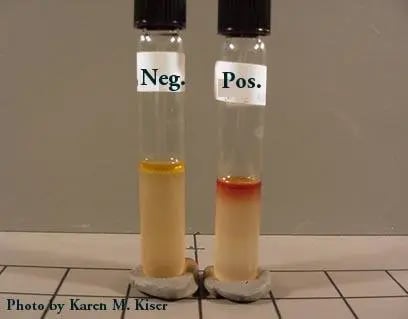 Figure: Indole Test Results: Positive-development of Red-ring
The Four Tests
Each test is covered in full depth: principle, procedure, common pitfalls, and result interpretation, in its own article. This page is the quick-reference index.
| Test | What it detects | Full article |
|---|---|---|
| Indole | Tryptophan → indole via tryptophanase | Indole Test |
| Methyl Red (MR) | Mixed-acid fermentation of glucose | Methyl Red Test |
| Voges-Proskauer (VP) | 2,3-butanediol pathway (acetoin production) | Voges-Proskauer Test |
| Citrate | Ability to use citrate as sole carbon source | Citrate Utilization Test |
All four are read from the same culture: tryptone broth for Indole, a shared MR-VP broth for MR and VP, and Simmons citrate agar for Citrate. Inoculate from an 18–24 hour pure culture and incubate at 35–37°C but note the timelines genuinely differ test to test (Indole and Citrate can read at 18–24 hours; MR needs a minimum of 48; VP can screen at 24 and re-test to 48 if negative). See each linked article for the exact reading windows and common misreads.
IMViC Patterns by Genus
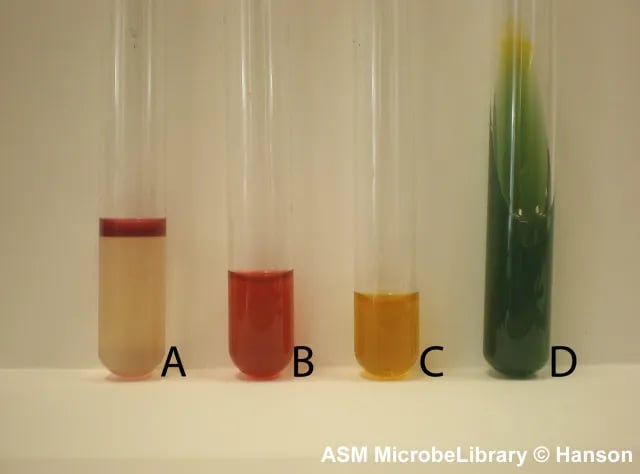 Figure: IMViC Test of E. coli:++–-
| Organism | Indole | MR | VP | Citrate |
|---|---|---|---|---|
| Escherichia coli | + | + | – | – |
| Proteus vulgaris | + | + | – | – |
| Klebsiella aerogenes (formerly Enterobacter aerogenes) | – | – | + | + |
| Klebsiella pneumoniae | – | – | + | + |
| Citrobacter freundii | – | + | – | + |
| Proteus mirabilis | – | + | variable | + |
| Salmonella (most, excl. Typhi/Paratyphi A) | – | + | – | + |
| Shigella species | – | + | – | – |
E. coli and Proteus vulgaris sharing ++– – is the single most important "gotcha" in this table: don't stop at IMViC for either one without a confirming test like urease or motility/swarming. In a strict sense; Proteus vulgaris is citrate variable
Limitations
IMViC results alone are presumptive, not confirmatory. Confirm with additional tests (TSI, urease, motility) before finalizing species-level identification.
How to Remember
The coliform split: E. coli is ++– – and the Klebsiella/Enterobacter group is – –++. The two classic fecal coliforms sit at opposite corners. E. coli makes acid (indole+, MR+) but can't use citrate or make acetoin. The Klebsiella-Enterobacter group is the mirror image: no indole, no mixed acid, but VP+ and citrate+. If you anchor these two opposite patterns, most of the table follows.
MR and VP are almost always opposites. They test two branches of the same glucose fermentation. MR detects stable mixed acids; VP detects the neutral 2,3-butanediol pathway. An organism usually commits to one branch, so MR+ tends to go with VP–, and VP+ with MR–. When you see one, predict the other.
IMViC gives you the code, not the culprit. The same ++– – belongs to both E. coli and Proteus vulgaris. The panel narrows the field; urease, swarming, or PDA name the organism.
References
- Tille PM. Bailey and Scott's Diagnostic Microbiology. 15th ed. St. Louis: Elsevier; 2022.
- Procop GW, Church DL, Hall GS, Janda WM, Koneman EW, Schreckenberger PC, Woods GL. Koneman's Color Atlas and Textbook of Diagnostic Microbiology. 7th ed. Philadelphia: Wolters Kluwer; 2017.
- Madigan MT, Bender KS, Buckley DH, Sattley WM, Stahl DA. Brock Biology of Microorganisms. 15th ed. Boston: Pearson; 2018.
- Pelczar MJ, Chan ECS, Krieg NR. Microbiology. 5th ed. New Delhi: Tata McGraw-Hill; 2007.
Frequently Asked Questions
What does IMViC stand for?
What is the IMViC pattern of E. coli?
What is the IMViC pattern of E. coli?
++– – : indole-positive, methyl red-positive, Voges-Proskauer-negative, and citrate-negative. This is the classic pattern, but note that Proteus vulgaris shares it, so a confirming test (urease, swarming) is needed to separate the two.
Why are MR and VP usually opposite?
Can IMViC identify an organism to species level?
No. IMViC gives a presumptive pattern that narrows the possibilities, but identical patterns can belong to different organisms (E. coli and Proteus vulgaris are both ++– –). Species-level identification needs confirmatory tests such as urease, TSI, and motility.

Tankeshwar Acharya, MSc (Medical Microbiology)
Tankeshwar Acharya is an Assistant Professor in the Department of Microbiology at Patan Academy of Health Sciences (PAHS), Nepal, where he has been teaching and practicing clinical microbiology for over 14 years. He is the founder of Microbe Online, one of the leading free microbiology education resources on the web, covering bacteriology, mycology, parasitology, immunology, and clinical laboratory diagnostics written from direct experience in both the classroom and the diagnostic laboratory.
Comments
No comments yet. Be the first to share your thoughts.
Leave a comment
All comments are reviewed before they appear.