
Homogenizer: Types, How to Choose One, Parts, and Functions

On this page
A student needs to extract DNA from a fungal culture and reaches for the lab's rotor-stator homogenizer, the one that works beautifully on soft animal tissue. After several minutes the spores are still intact and the yield is almost nothing. The homogenizer was not faulty. Fungal cell walls are tough, and shearing them with a rotor blade barely dents them; they need to be physically ground open, which is what a bead-beater does. This is the key thing about homogenizers: the word covers several very different machines, and choosing the wrong one for your sample means no result at all. Knowing which type matches which sample is more useful than knowing how any single one is built.
The term covers several distinct machines, including high-shear (rotor-stator) mixers, high-pressure homogenizers, bead-mills, and ultrasonic homogenizers. The first high-pressure homogenizer was patented in 1899 by Auguste Gaulin for homogenizing milk. The primary purpose of a homogenizer is to reduce particles or globules to sizes of 0.2 to 2 microns and blend them to create stable dispersion and emulsion. Similarly, homogenizer can help perform processes like shredding, wetting, dissolving, emulsifying, extraction, precipitation, and cell rupture.
A Family of Machines, Not One Device
"Homogenizer" is not a single instrument but a family of machines that share one goal: to break a sample down into a uniform mixture, whether that means rupturing cells to release their contents or blending components into a stable emulsion. What differs is the mechanism they use to do it, and that mechanism is what determines which samples each can handle. The four main types below disrupt a sample in fundamentally different ways, and matching the mechanism to the sample is the whole skill.
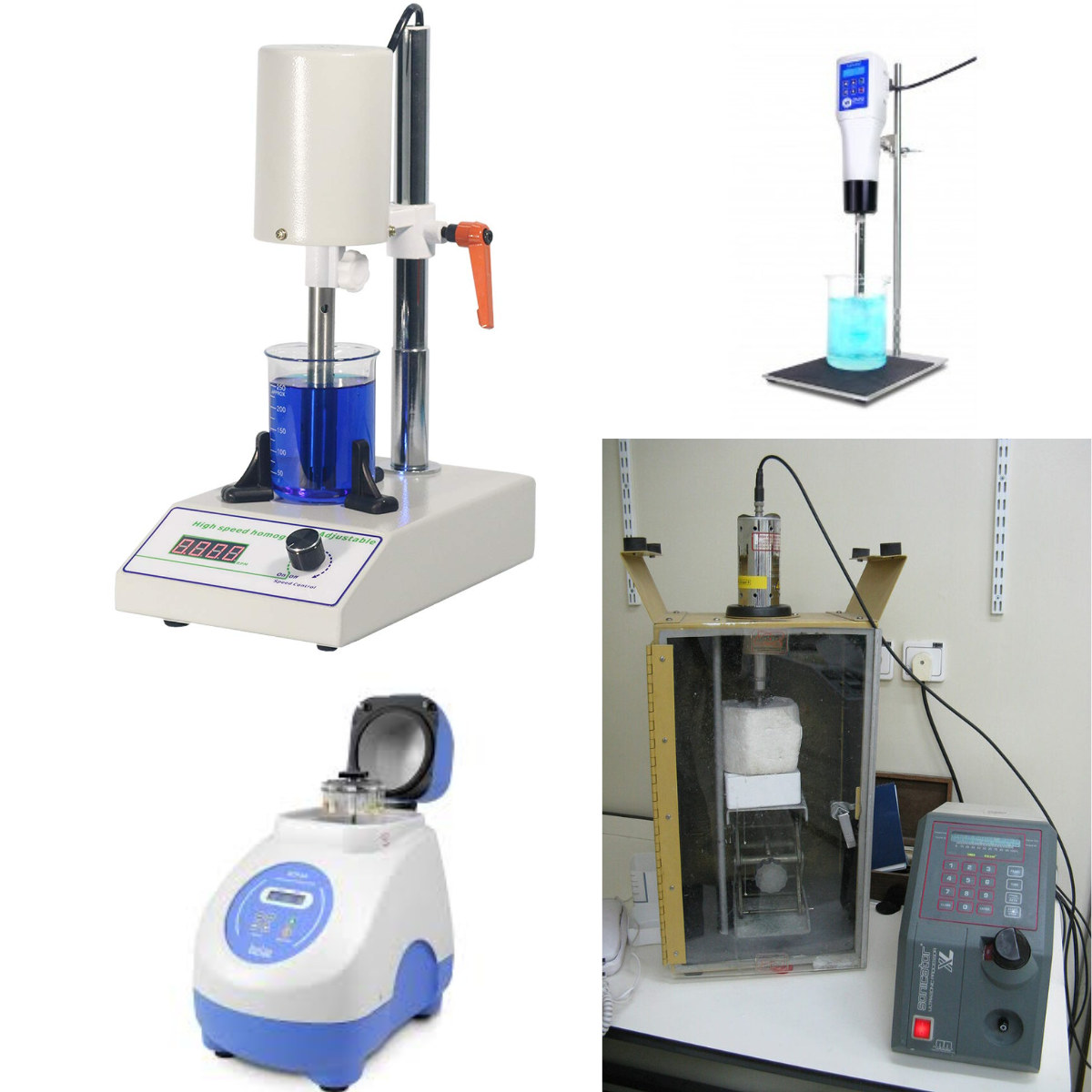 Figure: Different types of homogenizer
Types of Homogenizer
There are different types of homogenizers. Each type has advantages and drawbacks; these make them suitable for a particular application. These include mechanical (rotor-stator) homogenizers, high-pressure homogenizers, bead-mill (bead-beater) homogenizers, and ultrasonic homogenizers.
Mechanical (rotor-stator) homogenizer. A fast-spinning rotor inside a fixed stator draws the sample in and shears it in the narrow gap between them, like a high-speed handheld blender. It is the workhorse for soft samples: animal tissues, plant material, and cell suspensions. Fast and simple, but it generates heat and struggles with tough-walled cells.
Pressure (high-pressure) homogenizer.
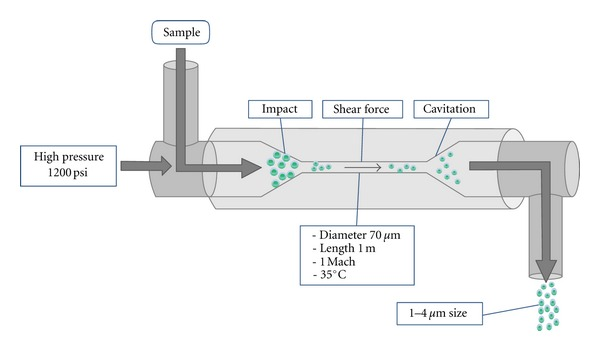 Figure: High-pressure homogenizer
The sample is forced under very high pressure through a tiny valve or gap. The intense shear and the sudden pressure drop on the other side rupture cells and break droplets into fine, uniform sizes. It is used for large-volume cell disruption and for making stable emulsions and suspensions, including in the dairy and pharmaceutical industries (homogenized milk is made this way).
Bead-mill (bead-beater) homogenizer.
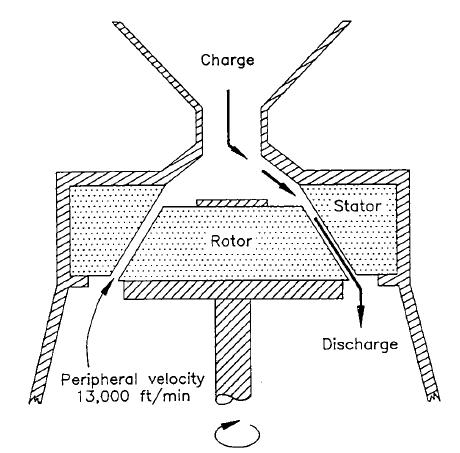 Figure: Mechanical homogenizer (colloid mill type
The sample is shaken violently with small hard beads that grind and collide with the cells, physically smashing them open. This is the method for tough samples that other homogenizers cannot break: fungi, yeast, bacterial spores, mycobacteria, and plant or environmental material. The bead size and material are matched to the organism.
Ultrasonic homogenizer (sonicator).
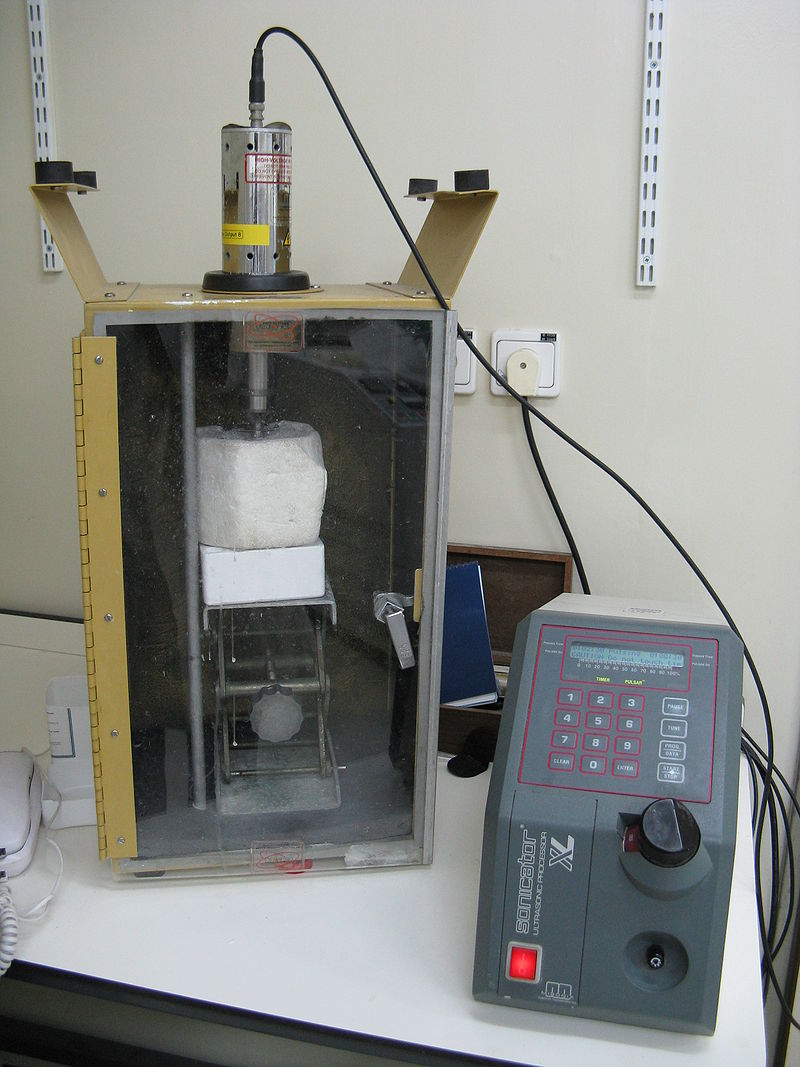 Figure: Ultrasonic homogenizer Image
High-frequency sound creates imploding bubbles whose shear forces disrupt cells (cavitation). It is covered in full in the ultrasonication article. In brief, it suits small-volume cell lysis but generates heat, so the sample must be kept cold.
Which Homogenizer for Which Sample
The right choice depends almost entirely on how tough the sample is and what you are trying to make.
| Sample or goal | Best homogenizer | Why |
|---|---|---|
| Soft animal tissue, cell suspensions | Rotor-stator (mechanical) | Fast shearing is enough; no tough wall to break |
| Plant tissue | Rotor-stator or bead-mill | Depends on how fibrous or tough the material is |
| Fungi, yeast, spores, mycobacteria | Bead-mill (bead-beater) | Tough walls must be physically ground open |
| Small-volume cell lysis for extraction | Ultrasonic | Effective on small samples; keep cold |
| Large-volume cell disruption | High-pressure | Handles volume with consistent rupture |
| Emulsions, uniform suspensions, milk | High-pressure | Forces droplets to a fine, uniform size |
The rule that runs through the table: match the mechanism to the toughness of the sample. Soft samples shear easily, so a rotor-stator is enough. Tough-walled cells resist shearing and must be ground (bead-mill) or hit with high pressure. Choosing a gentle method for a tough cell is the most common reason a homogenization fails.
Main Components of Homogenizer
The major components of a homogenizer are: the pump, homogenizing valve, breaker ring, tension spring, and valve seat.
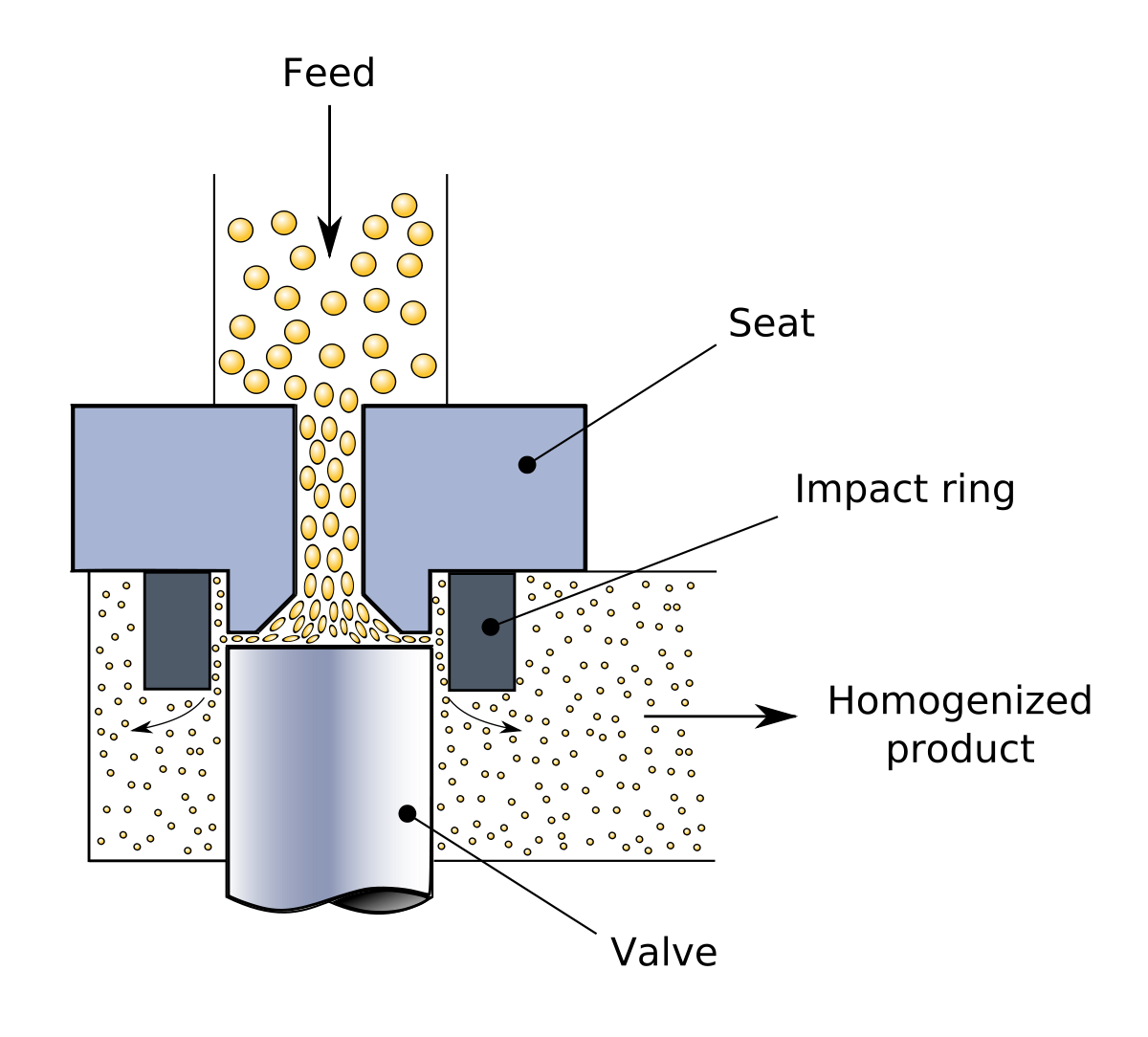 Figure: Homogenizer valve
Homogenizing valve: It is a significant component in the homogenization process. It may be of different shapes and sizes. Based on the number of valves used, homogenizers are of two types: single-stage homogenizers (uses a single valve) and two-stage homogenizers (uses two valves).
Valve seat: Both homogenizing valve and seat form the opening of the homogenizer.
Breaker ring: The valve consists of a breaker ring. The fluid passing through the opening formed by the valve and seat strikes perpendicularly on the breaker ring inner wall. As a result, size reduction of the larger particles or globules into finer forms takes place.
Tension spring: It holds the valve against its seat at an adjustable, preset tension. When fluid pressure exceeds that tension, the valve lifts slightly, opening the narrow orifice through which the sample is forced.
Homogenizing pumps: It imparts the desired pressure required for homogenization.
Principle
The working principle of the homogenizer is based on the conversion of large globules or coarse particles into fine globules or particles by passing them under high pressure through a narrow orifice. Thus, the product formed has a high degree of uniformity and stability. In a homogenizer, homogenizing action occurs by the combined effect of three major physical principles: shearing, turbulence, and cavitation.
Shearing
The shearing effect occurs when large particles are caught between fluid layers moving at different velocities. The resulting shear force breaks the large particles into smaller sizes.
Turbulence
It occurs when fluid experiences high velocity. The high velocity generates irregular motion within the fluid. Irregular motion in a fluid results from the conversion of kinetic energy into internal energy in the form of eddy currents and some heat. The eddy current developed helps to convert larger particles into finer sizes.
Cavitation
Cavitation occurs when there is a significant drop in pressure in the fluid. In a homogenizer, a pump that lies upstream of homogenizing valve helps to introduce high pressure within the fluid. The force of the fluid converts into kinetic energy when it passes to the valve.
When the local pressure drops below the liquid's vapor pressure, vapor-filled cavities form. As the fluid moves past the valve and pressure recovers, these cavities collapse, releasing shock waves that break the particles in the mixture.
Functions or uses of homogenizer
Homogenizers have wide application in pharmaceuticals, food and beverage production, agriculture products production, chemical processing, and laboratory testing. Besides its use in producing emulsions and suspension, homogenizer also performs other functions, including:
- It helps in microbial inactivation by finely breaking the cell structure of dispersed microorganisms. Therefore, it helps to increase the shelf life of food in food industries.
- It supports cell fractionation, where cells are ruptured gently enough to keep organelles intact for separation and downstream recovery of intracellular products used in agricultural and pharmaceutical manufacturing.
- High-pressure homogenization can modify the structure of enzymes. By adjusting pressure, enzymes can be targeted for activation or deactivation process, which is applicable in beverages and liquor production.
- It also helps extract high-value compounds such as polyphenols, flavonoids, lycopene, etc.
- Cell disruption and extraction: homogenizers rupture cells to release proteins, enzymes, and nucleic acids, a common first step before DNA extraction and protein purification. The method is chosen to match the toughness of the cell.
Differences between homogenizer and mixer
Although the homogenizer and mixer have the same function of mixing substances, there exist some differences between them which are as follows:
| Homogenizer | Mixer |
|---|---|
| Homogenizer works by specific cooperation of the rotor and stator, the rotor rotates at high speed and steadily to obtain homogeneity. | Mixer works by rotating the blade at the bottom of the mixing cup at high speed. |
| It uses various methods of mixing and provides thorough mixing. | It uses traditional mixing method that results in simple mixing. |
| Its general use is in tissue dispersion in biotechnology, sample preparation, and enzyme treatment in the food industry. | It is generally used to mix a variety of fruits and vegetables. |
| There is a shearing and refining effect to obtain homogeneity in the mixture. | There is no shearing and refining effect, only simple mixing is carried out. |
| It requires high power consumption and high maintenance cost. | It requires low power consumption and low maintenance cost. |
How to Remember
Match the method to the toughness. The single selection rule: soft samples shear open, tough cells must be ground or pressurized open. A rotor-stator for tissue, a bead-beater for fungi and spores. If a sample will not break, you are almost always using too gentle a method for its cell wall.
Homogenizer is a family name. Do not picture one machine. Picture four: a blender (rotor-stator), a high-pressure valve, a jar of grinding beads, and a sonic probe. They share a goal, not a mechanism.
Key Exam Facts
| Fact | Detail |
|---|---|
| What a homogenizer does | Breaks a sample into a uniform mixture; ruptures cells or forms emulsions |
| Rotor-stator (mechanical) | Shears soft samples in a rotor-stator gap; tissue and cells |
| High-pressure | Forces sample through a valve; large-volume lysis and emulsions (milk) |
| Bead-mill (bead-beater) | Grinds cells open with beads; tough cells (fungi, spores, mycobacteria) |
| Ultrasonic | Cavitation; small-volume lysis; keep cold (see ultrasonication) |
| Selection rule | Match the mechanism to the toughness of the sample |
| Tough-cell method | Bead-beating, because shearing barely dents thick walls |
| Common failure | Using too gentle a method for a tough-walled cell |
| Shared side effect | Mechanical and ultrasonic methods generate heat |
| Main lab use | Cell disruption to release proteins and nucleic acids |
Where Students Get Confused
A homogenizer is not one machine. The term covers rotor-stator, high-pressure, bead-mill, and ultrasonic devices that work in completely different ways. Choosing the type is the first decision, not an afterthought.
Why tough cells need a bead-beater. Fungi, yeast, spores, and mycobacteria have walls that resist shearing. A rotor-stator or gentle method barely touches them; they must be physically ground open with beads. This is the most common selection mistake.
Homogenizer vs. sonicator. A sonicator is one kind of homogenizer (the ultrasonic type). It uses cavitation and suits small-volume lysis, while a rotor-stator or bead-mill handles larger or tougher samples. They are not alternatives for the same job.
Heat is a side effect again. Like sonication, mechanical and ultrasonic homogenization generate heat that can denature the target. Keep samples cold when extracting heat-sensitive proteins or nucleic acids.
References
- Wilson, K., & Walker, J. (2018). Principles and Techniques of Biochemistry and Molecular Biology (8th ed.). Cambridge University Press.
- Tille, P. M. (2022). Bailey & Scott's Diagnostic Microbiology (15th ed.). Elsevier.
- Goldberg, S. (2008). Mechanical/physical methods of cell disruption and tissue homogenization. Methods in Molecular Biology, 424, 3–22. https://doi.org/10.1007/978-1-60327-064-9_1
Frequently Asked Questions
What is a homogenizer used for?
What is a homogenizer used for?
A homogenizer breaks a sample into a uniform mixture, either by rupturing cells to release their contents (proteins, enzymes, nucleic acids) or by blending components into a stable emulsion. In the laboratory its main use is cell disruption before extraction and purification.
What are the main types of homogenizer?
What are the main types of homogenizer?
The four main types are rotor-stator (mechanical shearing), high-pressure (forcing the sample through a narrow valve), bead-mill or bead-beater (grinding cells with beads), and ultrasonic (cavitation from high-frequency sound). Each disrupts a sample by a different mechanism.
Which homogenizer is best for tough cells like fungi or spores?
Which homogenizer is best for tough cells like fungi or spores?
A bead-mill (bead-beater) is best for tough-walled cells such as fungi, yeast, bacterial spores, and mycobacteria. Their walls resist shearing, so they must be physically ground open by hard beads, which gentler methods like a rotor-stator cannot achieve.
What is the difference between a homogenizer and a sonicator?
What is the difference between a homogenizer and a sonicator?
A sonicator is one type of homogenizer, the ultrasonic type, which uses cavitation to lyse cells and suits small volumes. Other homogenizers (rotor-stator, high-pressure, bead-mill) use mechanical shearing, pressure, or grinding and handle larger or tougher samples.
Why does the sample get hot during homogenization?
Why does the sample get hot during homogenization?
Mechanical and ultrasonic homogenization put energy into the sample, which turns into heat. This heat can denature the proteins, enzymes, or nucleic acids being extracted, so heat-sensitive samples are kept cold, often on ice, during the process.

Tankeshwar Acharya, MSc (Medical Microbiology)
Tankeshwar Acharya is an Assistant Professor in the Department of Microbiology at Patan Academy of Health Sciences (PAHS), Nepal, where he has been teaching and practicing clinical microbiology for over 14 years. He is the founder of Microbe Online, one of the leading free microbiology education resources on the web, covering bacteriology, mycology, parasitology, immunology, and clinical laboratory diagnostics written from direct experience in both the classroom and the diagnostic laboratory.
Comments
No comments yet. Be the first to share your thoughts.
Leave a comment
All comments are reviewed before they appear.