
Tetracyclines: Mode of Action and Mechanism of Resistance
How tetracyclines inhibit protein synthesis at the 30S ribosome, how they are classified, the five ways bacteria resist them, and why the drug binds teeth, bone, dairy, and antacids.

On this page
A nine-year-old with an atypical pneumonia would respond well to a tetracycline, yet the physician deliberately reaches for a different drug. The reason is not effectiveness but chemistry: a tetracycline binds calcium in growing bone and teeth and can stain a child's adult teeth permanently.
That same calcium-binding chemistry is why the drug should not be taken with milk or antacids, and it starts with the four-ring structure that defines the class. Understanding that structure explains how tetracyclines kill bacteria, how bacteria fight back, and when the drug should be avoided.
Tetracyclines are a group of broad-spectrum antibiotics effective against a wide range of gram-positive and gram-negative bacteria, and several intracellular bacterial pathogens such as Chlamydia, Rickettsia, and Mycoplasma. Tetracyclines are usually considered bacteriostatic antibiotics.
The first tetracyclines, chlortetracycline and oxytetracycline, were discovered in the late 1940s, derived naturally from Streptomyces aureofaciens and S. rimosus respectively. Several semi-synthetic tetracyclines are available today.
 Figure: Tetracyclines
Structure
Tetracyclines share a four-ring (naphthacene) core, labeled rings A to D, with the antibacterial activity depending on the arrangement of oxygen-containing groups along the lower edge of the molecule.
That lower edge chelates divalent and trivalent metal cations (calcium, magnesium, iron, aluminum), which is the single most useful fact about the structure: it explains why the drug binds bone and teeth, why dairy, antacids, and iron supplements block its absorption, and why later members were engineered for better absorption and potency.
Why this matters
Knowing the mechanism explains everything else about this class. It explains the broad spectrum, including the reach into intracellular pathogens that many other antibiotics miss entirely (this is why doxycycline is first-line for several infections). It explains the resistance patterns now spreading through common pathogens. And it explains the clinical cautions that come up on every ward and every exam, all of which trace back to the same four-ring, metal-binding structure above.
Classification of Tetracyclines
Conventionally, tetracyclines are divided into three generations.
| Generation | Members | Note |
|---|---|---|
| First (natural) | chlortetracycline, oxytetracycline, tetracycline | The originals, from Streptomyces |
| Second (semi-synthetic) | doxycycline, minocycline | Better absorbed, longer acting; doxycycline is the clinical workhorse and is safer in renal impairment |
| Third (glycylcyclines) | tigecycline | Engineered to evade the two main resistance mechanisms (efflux and ribosomal protection) |
Mode of Action of Tetracyclines
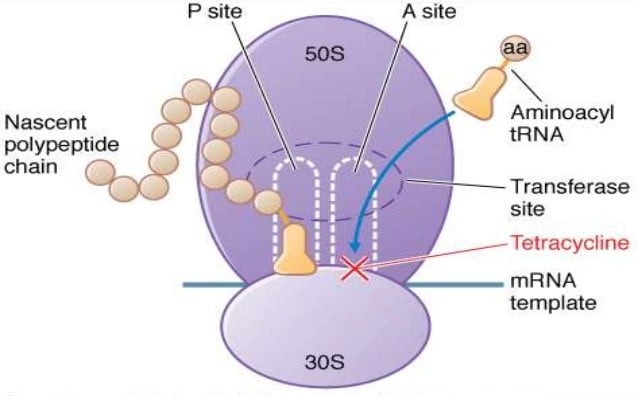 Figure: Mechanism of action of tetracyclines
Tetracyclines inhibit bacterial protein synthesis by binding reversibly to the bacterial 30S ribosomal subunit. This blocks the binding of incoming aminoacyl-tRNA to the ribosomal A site, so the peptide chain cannot grow.
Tetracyclines are one of several antibiotic classes that work by inhibiting bacterial protein synthesis at the 30S subunit. To see where this class sits among the others, read the article on the mechanisms of action of antibiotics.
Resistance Mechanism against Tetracyclines
The molecular mechanisms of tetracycline resistance are: (1) efflux, (2) ribosomal protection, (3) reduced permeability, (4) ribosomal mutation, and (5) enzymatic inactivation. Each is a specific example of a general antibiotic-resistance strategy.
| Tetracycline resistance mechanism | General Antibiotic Resistance Mechanism |
|---|---|
| Efflux pumps (tet efflux genes, e.g. tetA) | Active efflux |
| Ribosomal protection (tetM, tetO) | Target protection |
| Ribosomal mutations (16S rRNA) | Target modification |
| Reduced drug permeability | Decreased uptake |
| Enzyme inactivation (tetX) | Enzymatic inactivation |
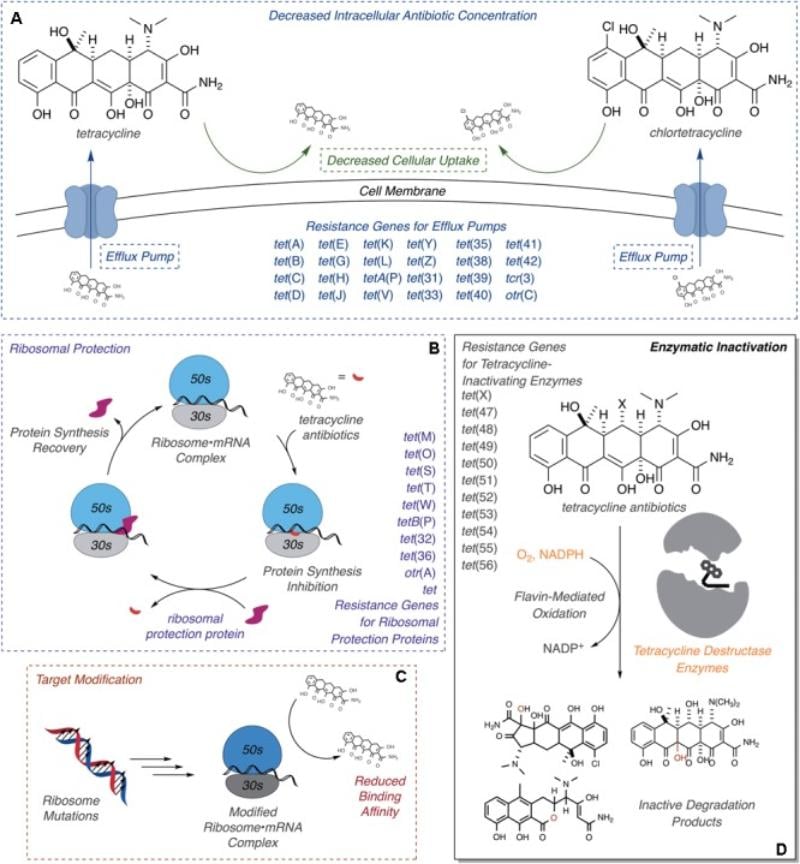 Figure: Molecular mechanisms of tetracycline resistance. (A) Efflux and exclusion, (B) ribosome protection, (C) ribosome modification, (D) enzymatic inactivation.
Efflux pumps
The main way bacteria limit tetracycline's access to the ribosome is to pump the drug out of the cell at a rate equal to or greater than its uptake, keeping the intracellular concentration low. Efflux pumps are present in both gram-negative and gram-positive bacteria. Among them, the TetA pump is the most frequent tetracycline-resistance determinant in gram-negative bacteria. These pumps exchange a proton for a tetracycline molecule and expel the drug against its concentration gradient. Most tetracycline efflux pumps confer resistance to tetracycline itself but are less effective against the second-generation agents doxycycline and minocycline, and confer little or no resistance to the third-generation glycylcyclines such as tigecycline.
Ribosomal protection
Acquired resistance is often mediated by ribosomal protection proteins that resemble elongation factor G (EF-G). These proteins interact with the ribosome so that protein synthesis continues despite the presence of the antibiotic. The most common determinants are encoded by the tet(M) and tet(O) genes.
Reduced drug permeability
Resistance can also come from reduced uptake, through morphological changes and the modification or reduced expression of porins. This likely contributes to clinical tetracycline resistance.
Ribosomal mutations
This route is less common. Certain resistance-conferring mutations and deletions around the tetracycline-binding site, and point mutations in the 16S rRNA, can confer tetracycline resistance.
Enzymatic inactivation
A group of enzymes called tetracycline destructases selectively oxidize tetracyclines, covalently destroying the antibiotic scaffold and permanently abolishing its activity. Unlike efflux and ribosomal protection, these enzymes can inactivate even the newer agents, minocycline and tigecycline, that were designed to evade those two mechanisms. The tet(X) gene is a well-characterized example.
Spectrum and clinical uses
Tetracyclines are used for acne, chlamydial infections, atypical and community-acquired pneumonia, rickettsial diseases (including Rocky Mountain spotted fever, where doxycycline is first-line even in children because the disease is life-threatening), Lyme disease, brucellosis, cholera, and, as doxycycline, for malaria prophylaxis.
Notable cautions: permanent tooth discoloration and effects on bone growth (avoid in pregnancy and in children under 8, with the rickettsial exception above), photosensitivity, esophagitis if taken without enough water, and reduced absorption with dairy, antacids, or iron.
How to remember
The members, oldest to newest: "Tetra, then Doxy and Mino, then Tigi." Tetracycline is the original, doxycycline and minocycline are the everyday semi-synthetics, and tigecycline is the resistance-beating newcomer.
The 30S pairing: "buy AT 30." The two classes that hit the 30S subunit are Aminoglycosides and Tetracyclines. The macrolides and the rest hit the 50S.
The chelation caution: tetracyclines grab metal cations, so keep them away from "milk, antacids, and iron," and away from growing teeth.
Key exam facts
| Feature | Tetracyclines |
|---|---|
| Target | 30S ribosomal subunit |
| Action | Block aminoacyl-tRNA binding to the A site |
| Cidal or static | Bacteriostatic |
| Spectrum | Broad, including intracellular Chlamydia, Rickettsia, Mycoplasma |
| Main resistance | Efflux (tet genes), ribosomal protection (TetM, TetO) |
| Key members | tetracycline, doxycycline, minocycline, tigecycline |
| Major cautions | Teeth and bone (children, pregnancy), photosensitivity, chelation with dairy/antacids/iron |
Where students actually get confused
Tetracyclines and aminoglycosides both act on the 30S subunit, but tetracyclines are bacteriostatic and aminoglycosides are bactericidal. Same target, opposite outcome.
Tetracyclines (30S) versus macrolides (50S): both inhibit protein synthesis, but on different subunits. See Mechanism of Action article for detailed information.
The two main resistance routes are efflux (the bacterium pumps the drug out) and ribosomal protection (a protein knocks the drug off the ribosome). These are different mechanisms, not the same thing, and tigecycline was designed to defeat both.
Doxycycline is not just "another tetracycline." It is better absorbed, longer acting, and cleared largely by the gut rather than the kidney, so it is preferred in patients with renal impairment.
References and Further Readings
- Askari Rizvi SF. Tetracycline: classification, structure activity relationship, and mechanism of action as a theranostic agent for infectious lesions, a mini-review. Biomedical Journal of Scientific & Technical Research. 2018;7(2).
- Chopra I, Roberts M. Tetracycline antibiotics: mode of action, applications, molecular biology, and epidemiology of bacterial resistance. Microbiology and Molecular Biology Reviews. 2001;65(2):232-260. DOI: 10.1128/MMBR.65.2.232-260.2001
- Markley JL, Wencewicz TA. Tetracycline-inactivating enzymes. Frontiers in Microbiology. 2018;9:1058.
- Grossman TH. Tetracycline antibiotics and resistance. Cold Spring Harbor Perspectives in Medicine. 2016;6(4):a025387. DOI: 10.1101/cshperspect.a025387
Frequently Asked Questions
What is the mode of action of tetracyclines?
What is the mode of action of tetracyclines?
They bind reversibly to the 30S ribosomal subunit and block aminoacyl-tRNA from entering the A site, halting protein synthesis. This makes them bacteriostatic.
Are tetracyclines bactericidal or bacteriostatic?
Are tetracyclines bactericidal or bacteriostatic?
Bacteriostatic. They stop bacterial growth and leave the killing to the host immune system.
How do bacteria become resistant to tetracyclines?
How do bacteria become resistant to tetracyclines?
Mainly two ways: active efflux that pumps the drug out (tet efflux genes) and ribosomal protection proteins (TetM, TetO) that dislodge the drug from the ribosome. Less commonly, ribosomal mutation, reduced uptake, or enzymatic inactivation.
Why are tetracyclines avoided in young children and pregnancy?
Why are tetracyclines avoided in young children and pregnancy?
They bind calcium in developing teeth and bone and can cause permanent tooth discoloration. The exception is life-threatening rickettsial disease, where doxycycline is still first-line.
Why should tetracyclines not be taken with milk or antacids?
Why should tetracyclines not be taken with milk or antacids?
They chelate calcium, magnesium, iron, and aluminum, which are in dairy, antacids, and supplements, and this sharply reduces absorption.
What is the difference between tetracycline and doxycycline?
What is the difference between tetracycline and doxycycline?
Doxycycline is better absorbed, longer acting, and cleared mainly through the gut, so it is safer in renal impairment and is the usual clinical choice.

Tankeshwar Acharya, MSc (Medical Microbiology)
Tankeshwar Acharya is an Assistant Professor in the Department of Microbiology at Patan Academy of Health Sciences (PAHS), Nepal, where he has been teaching and practicing clinical microbiology for over 14 years. He is the founder of Microbe Online, one of the leading free microbiology education resources on the web, covering bacteriology, mycology, parasitology, immunology, and clinical laboratory diagnostics written from direct experience in both the classroom and the diagnostic laboratory.
Comments
No comments yet. Be the first to share your thoughts.
Leave a comment
All comments are reviewed before they appear.