
Selenite Broth: Composition, Principle, Preparation, and Uses in Salmonella Enrichment
Selenite broth is the most widely used enrichment medium for isolating Salmonella from stool, urine, and food. Learn its principle, why selenite inhibits coliforms, preparation without autoclaving, and how to use it before XLD or DCA subculture.
A 35-year-old food handler at a school canteen is identified as a suspected typhoid carrier after 12 children develop fever following a school meal. His stool sample arrives in the laboratory. Direct plating on selective agar may miss Salmonella Typhi if the carrier state involves very low numbers of organisms shedding intermittently — far too few to produce visible colonies among millions of commensal E. coli. The solution is enrichment culture: inoculate the specimen into a liquid medium that preferentially suppresses the normal flora while allowing Salmonella to multiply, then subculture onto solid selective agar after 12–18 hours.
That enrichment liquid is selenite broth — and in typhoid carrier screening, outbreak investigation, and food safety testing, it is the critical first step that makes the difference between finding the pathogen and missing it entirely.
Selenite broth is used as an enrichment medium for the isolation of Salmonella and Shigella from stool, urine, water and food products. It is the most widely used enrichment medium to isolate Salmonella Typhi from fecal specimen of suspected patients and/or from carriers during Salmonella outbreaks. Selenite is inhibitory to coliforms and certain other microbial species found in faecal specimens. After the inoculation of the sample, selenite broth is incubated for 12-18 hours at 35°C -37°C and then subculture is done in selective agar (e.g., bismuth sulfite or desoxycholate citrate agar).
Rappaport-Vassiliadis (RV) medium is now being recommended as an alternative of Selenite Broth/Tetrathionate broth for the selective enrichment of Salmonella spp. from food and sewage polluted water.
Principle
Selenite broth is an enrichment medium, not a selective plating medium. The distinction is important:
- Enrichment media are liquid — they increase the relative concentration of a target organism by suppressing competing flora during a timed incubation, then require subculture onto solid selective agar for isolation and identification.
- Selective plating media (XLD, DCA, SS agar) are solid — they provide both suppression and differentiation in one plate, but only work well when the target organism is present in sufficient numbers.
Selenite broth bridges this gap: when Salmonella organisms are present in very low numbers relative to the enormous commensal load in stool, direct plating may yield no visible colonies. Selenite enrichment allows a 12–18 hour head start, multiplying Salmonella while suppressing coliforms, before subculture onto solid media.
Mechanism of selective inhibition:
Sodium hydrogen selenite (sodium biselenite) is the active selective agent. It exerts its inhibitory effect by reacting with sulphur-containing compounds and sulphydryl (-SH) groups in critical enzymes and structural proteins of bacterial cells. Gram-positive organisms and most coliforms (including E. coli, fecal streptococci) are susceptible — selenite disrupts key metabolic pathways and prevents their growth.
Salmonella species and Shigella species possess metabolic resistance mechanisms that allow them to tolerate selenite concentrations inhibitory to coliforms. Proteus and Pseudomonas species are also selenite-resistant (as non-lactose fermenters that metabolise nutrients differently), but they are not the intended targets.
Why lactose is in an enrichment broth: Lactose in selenite broth serves a regulatory role rather than a differential one. Lactose fermenters that survive selenite (any residual coliforms) produce acid, which would eventually drop the pH and reduce selenite's inhibitory activity. The lactose and sodium phosphate buffer together maintain pH near neutral throughout the enrichment period, preserving selenite activity for the full 12–18 hours.
The time window is critical: Selenite's inhibitory effect against coliforms is strongest in the first 6–12 hours. After 12–18 hours, as Salmonella grows and coliform inhibition wanes, the competitive balance shifts back. Subculture must occur at 12–18 hours — not at 24 hours. Waiting too long allows coliforms to recover and overgrow Salmonella colonies on the subsequent plate.
Safety warning — sodium hydrogen selenite: Sodium biselenite is highly toxic, corrosive, and teratogenic. Handle only with gloves and in a well-ventilated area. If skin contact occurs, wash immediately with large amounts of water. Avoid inhalation of powder during preparation. Treat all waste containing selenite as hazardous waste.
Uses of Selenite Broth
1. Enrichment for Salmonella from stool specimens Selenite broth is the standard enrichment step for stool cultures from:
- Suspected typhoid fever (especially when direct plating is negative but clinical suspicion remains)
- Typhoid carrier screening (food handlers, healthcare workers)
- Non-typhoidal Salmonellosis outbreaks from food or water sources
2. Enrichment from urine Low-count or intermittently positive urine specimens in suspected Salmonella bacteraemia or carrier states can be enriched in selenite broth before subculture onto XLD or bismuth sulphite agar.
3. Food safety microbiology Selenite broth is used to detect Salmonella in food products (poultry, eggs, dairy, processed meats) and water samples, where the organism may be present in very small numbers relative to background flora.
4. Outbreak investigation Environmental samples (water, surfaces, food contact equipment) collected during outbreak investigations are inoculated into selenite broth before solid media plating to maximise recovery.
Rappaport-Vassiliadis (RV) medium is now recommended by WHO and ISO as the preferred enrichment medium for Salmonella in food and environmental samples, particularly because it has greater selectivity and is less toxic than selenite broth. In clinical specimens (human stool, urine), selenite broth remains widely used. Check local or national guidelines for the current recommendation in your setting.
Selenite Broth in the Stool Culture Workflow
| Step | Action | Timing | Purpose |
|---|---|---|---|
| 1 | Inoculate 1–2 g stool into selenite broth (10–15% by volume) | Day 0 | Initiate enrichment |
| 2 | Incubate at 35–37°C in ambient air | 12–18 hours | Suppress coliforms; allow Salmonella to multiply |
| 3 | Subculture from broth to XLD agar ± DCA or bismuth sulphite agar | After 12–18 hrs | Transfer enriched Salmonella to selective solid medium for isolation |
| 4 | Incubate plates at 35–37°C | 18–24 hours | Colony development |
| 5 | Read colonies: red + black centre (XLD) = Salmonella suspect | — | Pick for TSI, urease, serology |
Do not use selenite broth as the sole isolation medium. Subculture onto solid selective media is always required — selenite broth cannot show colony morphology or provide any differential information on its own.
Composition
Casein enzymic hydrolysate provides nitrogenous substances and carbon compounds required for bacterial growth.
| Ingredients | Gms/liter |
|---|---|
| Casein enzymic hydrolysate | 5.00 |
| Lactose | 4.00 |
| Sodium phosphate | 10.00 |
| Sodium hydrogen selenite | 4.00 |
 Lactose (fermentable carbohydrate) serves to maintain the pH of medium. Any increase in pH will reduce the selective activity of selenite. Proteus and Pseudomonas species which are non-lactose fermenter appear to be resistant to effects of selenite. Sodium phosphate maintains a stable pH and also lessens the toxicity of selenite. Selenite exerts selective inhibitory effects. It is suggested that it reacts with sulphur and sulphydral groups of in critical cell components of microorganisms. Coliforms, fecal streptococci, and Gram-positive organisms are inhibited by sodium selenite.
Caution: Sodium hydrogen selenite (Sodium biselenite) is very toxic, corrosive agent and causes teratogenicity. Handle with great care. If there is contact with skin, wash immediately with lot of water.
Final pH (at 25°C): 7.0 ± 0.2
The formula may vary slightly from manufacturer to manufacturer.
NOTE: L-cystine supplement may be available (depending upon the manufacturer) to use as an enrichment agent to increase the recovery of Salmonella.
Preparation of Selenite Broth
- Suspend 23 g of the dehydrated powder in 1 liter of purified water (if twin pack is available for use; dissolve 4g of sodium biselenite in 1 liter of distilled water and then add 19g of Selenite Broth Base- check manufacturer’s instruction labeled/available in the pack).
- Sterilise in a boiling water bath, or in free flowing steam, for 10 minutes. Avoid overheating (as it is detrimental). Do not autoclave.
- Distribute in sterile test tubes. (Note: Discard the prepared medium if large amount of red precipitate is seen at the bottom of the tube/bottle)
- Label the side of each tube with date of preparation and batch number.
- Perform sterility testing.
- Store at 2-8°C
- Test samples of the finished product for performance using stable, typical control cultures.
Appearance of Selenite Broth
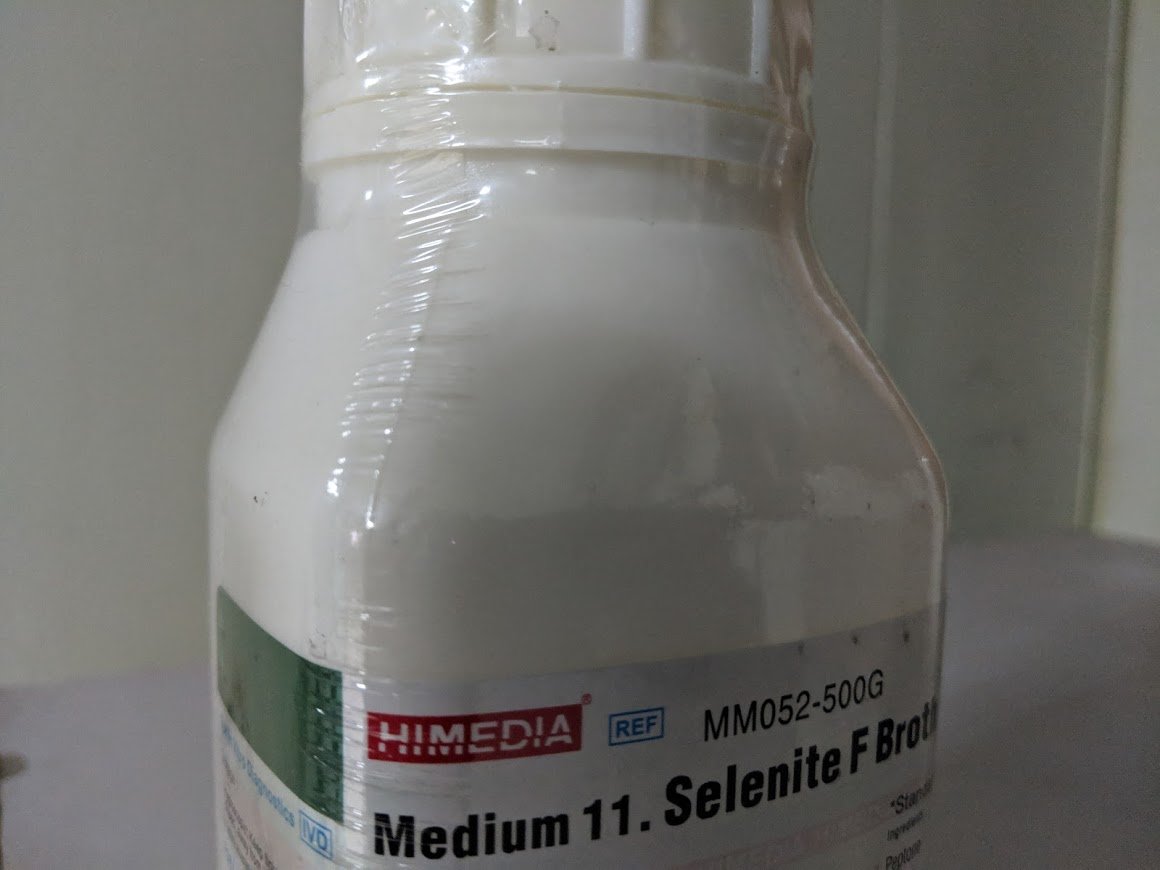
- Dehydrated medium: Straw coloured, free-flowing powder
- Prepared medium: Light straw coloured solution
Storage conditions and Shelf life
- Dehydrated medium: Store at 10-30°C and use before the expiry date on the label.
- Prepared medium: Store at 2-8°C away from light. It can be used up to eighteen months provided there is no change in the appearance of the medium to suggest contamination or deterioration.
Inoculation of Selenite Broth
- Inoculate the tube of selenite with 1-2 gm of stool sample or other samples (approximately 10-15% by volume) and emulsify the broth.
- Incubate in ambient air at 35-37°C for up to 24 hours (Coliforms may overgrow the pathogens if incubated for longer than 24 hours).
- After 12-18 hours of incubation, subculture the broth into selective and differential enteric culture medium such as XLD, HE Agar. Streak for isolation.
- Incubate the culture plates in ambient air at 35°C-37°C for 18-24 hours.
- Search for typical colony morphology (which differs according to media used)
NOTE: Selenite broth should not be used as the sole isolation medium for the isolation of Salmonella. It should be used in conjunction with selective and nonselective plating media to increase the probability of isolating pathogens, especially when they may be present in small numbers.
Limitations
- The inhibitory effect of selenite diminishes after the first 6-12 hours of incubation.
- Discard media if selenite oxidizes and forms large amounts of a red precipitate. A small amount of colored precipitate is not detrimental.
How to Remember
Enrichment media are always liquid — selective media are always solid. This is the single most important conceptual distinction. Selenite broth enriches; XLD, DCA, and SS agar select and differentiate. They work in sequence, not as alternatives.
The 12–18 hour window — why it matters: Selenite kills coliforms in the first 6–12 hours. Salmonella survives and multiplies. After 18–24 hours, the window closes and coliforms begin recovering. Think of selenite as a timer: it gives Salmonella a head start, but the race is finite. Subculture at 12–18 hours, not 24.
The red precipitate rule: A small amount of coloured precipitate at the bottom of the selenite broth tube is normal — oxidation of a small amount of selenite. A large amount of red precipitate means significant selenite oxidation has occurred, reducing selective activity. Discard and replace the batch.
Selenite vs tetrathionate — two enrichment options: Both suppress coliforms and enrich Salmonella. Tetrathionate broth (with iodine) also inhibits Shigella, making it less suitable when both Salmonella and Shigella are suspected. Selenite broth enriches both, but is the preferred choice for Salmonella typhi specifically. For food and environmental samples, RV medium has largely replaced both.
References
- Cheesbrough, M. (2006). District Laboratory Practice in Tropical Countries, Part 2 (2nd ed.). Cambridge University Press.
- Tille, P. M. (2017). Bailey and Scott's Diagnostic Microbiology (14th ed.). Elsevier.
- World Health Organization. (2003). Manual for the Laboratory Identification and Antimicrobial Susceptibility Testing of Bacterial Pathogens of Public Health Importance in the Developing World. Geneva: WHO. (WHO/CDS/CSR/RMD/2003.6)
- International Organization for Standardization (ISO). (2017). ISO 6579-1: Microbiology of the food chain — Horizontal method for the detection, enumeration and serotyping of Salmonella. ISO.

Tankeshwar Acharya, MSc (Medical Microbiology)
Tankeshwar Acharya is an Assistant Professor in the Department of Microbiology at Patan Academy of Health Sciences (PAHS), Nepal, where he has been teaching and practicing clinical microbiology for over 14 years. He is the founder of Microbe Online, one of the leading free microbiology education resources on the web, covering bacteriology, mycology, parasitology, immunology, and clinical laboratory diagnostics written from direct experience in both the classroom and the diagnostic laboratory.