

A child has a Haemophilus influenzae isolate from a sterile site, and the team needs to know tonight whether ampicillin will work. A full susceptibility panel is still hours away. A single disk, smeared with one colony, turns bright red within a minute. That color change answers the question immediately: the organism makes beta-lactamase, so ampicillin will fail. Reading that one disk correctly can redirect therapy a full day before the MIC comes back.
The nitrocefin test is a rapid, sensitive method for detecting beta-lactamase-producing bacteria. It is also called the beta-lactamase test, and its most common commercial form is the Cefinase disk. It is used to test isolates of Neisseria gonorrhoeae, Haemophilus influenzae, Staphylococcus species, Enterococcus species, Moraxella catarrhalis (formerly Branhamella catarrhalis), and some anaerobes. For Enterococcus, nitrocefin is the most reliable way to detect beta-lactamase production.
It provides the most sensitive test for most β-lactamases, exceptions being staphylococcal penicillinase and ROB-1, an uncommon plasmid-mediated enzyme of haemophili. Another chromogenic cephalosporin, PADAC, exists but is less sensitive and is not readily available. Rapid beta-lactamase tests can yield clinically relevant information earlier than a MIC or disk diffusion test.
Nitrocefin is a chromogenic cephalosporin that changes from yellow to red when the amide bond in the beta-lactam ring is hydrolyzed by beta-lactamase. It is sensitive to hydrolysis by all known lactamases produced by Gram-positive and Gram-negative bacteria.
Although the test can be performed by using a nitrocefin solution, nitrocefin is very expensive, light sensitive, and not easily obtained. Most laboratories find it more convenient to use a commercially available nitrocefin test kit.
Beta-lactamase detection using nitrocefin solution (from powder)
- A 0.5 mM nitrocefin solution is prepared by dissolving 2.58 mg of pure powder in 0.5 mL of dimethylsulphoxide (DMSO) then diluting with 9.5 mL of 0.1 M phosphate buffer, pH 7.0. Note: This solution is stable for 10 days at 4°C in a foil-wrapped bottle. Glass containers should be used, since DMSO degrades plastics.
- Colonies of the test isolates are scraped from nutrient agar plates and are suspended in 20 µL volumes of 0.1 M phosphate buffer pH 7.0, to produce a dense suspension on a glass slide, and 20 µL amounts of the nitrocefin solution are added.
- β-Lactamase activity is indicated by a red color within 1-2 min.
- Weak activities may take longer to appear, but reactions taking >10 min should be treated with skepticism, as they may reflect the secondary ß-lactamase activity of those penicillin-binding proteins that form unstable acyl complexes.
Beta-lactamase detection using a nitrocefin disk
- Using sterile forceps, remove a Nitrocefin disk from the vial and place it on an empty petri dish or microscopic slide. Immediately place the remaining unused disks into the freezer.
- Prior to inoculation, allow the Nitrocefin disk to equilibrate to room temperature.
- Moisten each disk with one drop of sterile deionized water. Do not over-saturate the disk, which could dilute the reagent. Note: Water is critical to the development of the color reaction, if the disk begins to dry out it may be necessary to rehydrate the reaction area of the Nitrocefin disk with a small amount of water.
- With a sterilized loop or applicator stick remove a well-isolated colony and spread it on the disk surface.
- Observe the inoculated disk for the development of an orange/red color
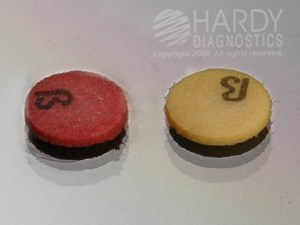 Figure: Nitrocefin test result (Left Positive), Right (Negative).
Test Results
- Left (H. influenzae): The orange/red color development was indicative as beta-lactamase positive.
- Right (M. catarrhalis): The yellow color development was indicative of beta-lactamase negative.
What the result means
The nitrocefin test exists to guide treatment, so reading it is really about what to do next.
A positive result (yellow to red). The isolate produces beta-lactamase. This predicts resistance to the penicillinase-labile penicillins, including penicillin, ampicillin, and amoxicillin, because the enzyme breaks the beta-lactam ring these drugs depend on. A positive result lets the laboratory predict this resistance 18 to 24 hours before a full susceptibility panel is available, which can change therapy the same day. It does not predict resistance to beta-lactamase-stable drugs or to beta-lactam plus inhibitor combinations, and it says nothing about resistance caused by other mechanisms.
A negative result (stays yellow). No beta-lactamase was detected. This does not mean the organism is fully susceptible to all beta-lactams. Resistance can arise through mechanisms the test cannot see, most importantly altered penicillin-binding proteins, which is the basis of methicillin resistance in staphylococci (MRSA). A negative nitrocefin test never rules out MRSA, because MRSA resistance is not caused by beta-lactamase.
The staphylococcal pitfall (important). Nitrocefin can give a false negative in staphylococci. Staphylococcal penicillinase is often inducible and produced at low levels, so a straight test on ordinary colonies can miss it. Two practical points follow. First, induce the enzyme before testing: use colonies taken from the zone edge around a penicillin or oxacillin disk, where enzyme production has been switched on. Second, current guidance treats the chromogenic test as unreliable for confirming staphylococcal penicillinase. For Staphylococcus aureus, the penicillin disk zone-edge test is preferred, and an induced nitrocefin test is used mainly for coagulase-negative staphylococci. In short, a negative nitrocefin result on a staphylococcus should not be trusted on its own to report penicillin susceptibility.
Where nitrocefin is not useful. The test is of little value for organisms such as the Enterobacteriaceae and Pseudomonas, which produce a diversity of beta-lactamases with different substrate ranges. For these organisms, susceptibility is determined by standard MIC or disk diffusion methods, not by nitrocefin. For how these results feed into resistance reporting, see the articles in the antimicrobial susceptibility testing section.
Reading tips and common errors
Read within the stated time. A positive is usually red within 1 to 2 minutes for strong producers. Weak producers may take longer, but a reaction appearing after about 10 minutes should be interpreted with caution, because very slow color change can come from background activity rather than true beta-lactamase.
Do not let the disk dry out. Water drives the color reaction. If the disk dries during the wait, rehydrate the reaction area with a small drop of water. Over-wetting is the opposite error, because excess water dilutes the reagent and can weaken a true positive.
Use fresh, well-isolated colonies. Mixed or old growth gives unreliable color. For staphylococci, use induced colonies from a penicillin or oxacillin disk zone edge, as above.
Protect nitrocefin from light. Nitrocefin degrades in light and turns pink to red on its own when degraded, which can be mistaken for a positive. Keep disks and solution wrapped and cold, and read against a clean background.
Other techniques
Rehydrate the nitrocefin as directed, and use this solution in the following ways:
- Direct Plate Method
Add one drop of the nitrocefin solution on to the surface of the colony. If the isolate is a high beta-lactamase producer then the colony and the surrounding area will quickly turn red. To detect a weak beta-lactamase producer the plate should then be incubated for 30 minutes before being reported as negative. - Slide Method
Add one drop of the nitrocefin solution on to a clean glass slide. Using a sterile loop, pick one colony from the plate and emulsify it into the nitrocefin drop. Report as positive if the color changes from yellow to red within 30 minutes (protect the slide from desiccation during the waiting period). - Broth Method
Add four drops of nitrocefin solution to 1ml of the grown culture. Report as positive if the color changes to red within 30 minutes. - Broken Cell Method
Sonicate 1ml of the culture in order to break open the cells. Add 4 drops of nitrocefin solution. Report as positive if the color changes to red within 30 minutes. - Paper Disc Spot Test
A Whatman No.1 filter paper disc (diameter 7cm) is placed in a petri dish and impregnated with nitrocefin solution (0-5ml). This impregnated paper is generally usable for one day, but should be kept away from light to avoid spontaneous degradation. An isolated colony is applied to the impregnated paper with a loop; a pink to red reaction developing within 15 minutes indicates beta-lactamase presence.
Resumen en español
La prueba de nitrocefina (también llamada prueba de betalactamasa, y en su forma comercial más común, el disco de Cefinase) detecta bacterias que producen la enzima betalactamasa. La nitrocefina es una cefalosporina cromogénica que cambia de amarillo a rojo cuando la betalactamasa rompe el anillo betalactámico. Se usa para analizar aislados de Neisseria gonorrhoeae, Haemophilus influenzae, Staphylococcus, Enterococcus y Moraxella catarrhalis, entre otros.
Un resultado positivo (cambio de amarillo a rojo) significa que el microorganismo produce betalactamasa, lo que predice resistencia a penicilinas como la penicilina, la ampicilina y la amoxicilina, a menudo un día antes que una prueba de sensibilidad completa. Un resultado negativo (permanece amarillo) no descarta toda resistencia, porque algunos mecanismos, como la proteína de unión a penicilina alterada del SARM (MRSA), no se detectan con esta prueba. En estafilococos, la prueba puede dar un falso negativo, por lo que conviene inducir la enzima usando colonias del borde de la zona alrededor de un disco de penicilina u oxacilina.
References
- Ghavami, A., et al. (2015). Assay for drug discovery: synthesis and testing of nitrocefin analogues for use as beta-lactamase substrates. Analytical Biochemistry, 486, 75–77.
- Uri, J. V. (1985). Detection of beta-lactamase activity with nitrocefin of multiple strains of various microbial genera. Acta Microbiologica Hungarica, 32(2), 133–145.
- Skov, R., et al. (2021). Evaluation of methods for detection of beta-lactamase production in MSSA. Journal of Antimicrobial Chemotherapy, 76(6), 1487–1494.
- Tille, P. M. (2022). Bailey and Scott's Diagnostic Microbiology (15th ed.). Elsevier.

Comments
No comments yet. Be the first to share your thoughts.
Leave a comment
All comments are reviewed before they appear.