
Mechanism of Action of Antifungal Drugs

On this page
Antifungal drugs are the agents that kill or stop fungal growth and are applied to treat or prevent fungal infections (mycoses). A proper antifungal drug selectively eliminates fungal pathogens from a host with minimal toxicity to the host.
The efficiency of antifungal drugs lagged due to the cellular structure of fungi. Antibiotics work well in bacteria because they are prokaryotes with many different structural and metabolic targets. Fungi are eukaryotes, so the toxic agents of fungi are also harmful to the host. In addition, the fungi grow slowly, and most are multicellular, which makes them difficult to quantify.
However, the mechanism of action of most antifungal drugs is targeting ergosterol, an essential component of the fungal cell membrane. Instead of ergosterol, the mammalian cell membrane possesses cholesterol. Advances have been made to develop new antifungal agents and to understand the existing ones.
Fungistatic agent: The agent that inhibits fungi’s growth and reproduction but does not necessarily kill them is called a fungistatic agent. The fungal growth resumes when such agent is removed from the environment.
Fungicidal agent: The agent that kills fungi is called a fungicide agent.
Why antifungal drug development lags so far behind antibacterial drugs
The article already notes that fungi being eukaryotic (like human cells) makes selective toxicity difficult — this single fact deserves to be understood as the central organizing principle of the entire field, not just a passing comment.
The numbers make this concrete: there are over 100 distinct classes of antibacterial antibiotics in clinical use, targeting dozens of structures unique to prokaryotic bacteria (peptidoglycan, 70S ribosomes, bacterial-specific enzymes). There are only five major classes of systemic antifungal drugs in widespread clinical use today — polyenes, azoles, echinocandins, allylamines, and antimetabolites. This stark difference exists because fungi, as eukaryotes, share the overwhelming majority of their cellular machinery with human cells — the same ribosomes (80S), similar DNA replication enzymes, similar protein synthesis pathways. Drugs that disrupt these shared structures are toxic to the patient as much as the pathogen.
This is precisely why ergosterol became the answer. Ergosterol is the fungal cell membrane's structural sterol — fungi's analog to cholesterol in human cell membranes. Although these two molecules are structurally similar (both are sterols), they are different enough that drugs can be designed to selectively target ergosterol with reduced (though rarely zero) effect on human cholesterol-containing membranes. This explains why ergosterol-targeting drugs (polyenes, azoles, allylamines) dominate antifungal therapy — they represent the best selective toxicity target eukaryotic fungal cells offer.
Chemical Classification and Mechanism of Action of Antifungal Drugs
Antifungals can be grouped into various classes based on their chemical composition and the site of action.
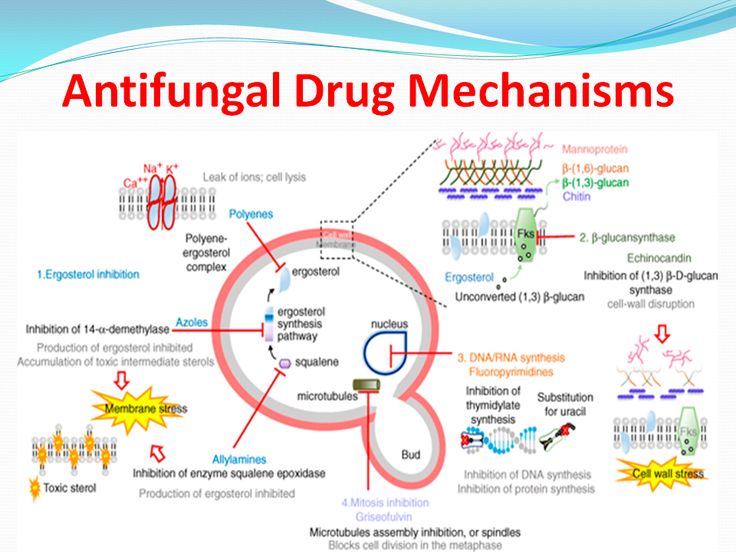 Figure: Figure source: Martinez, Lorena & Falson, Pierre. (2014). Multidrug resistance ATP-binding cassette membrane transporters as targets for improving oropharyngeal candidiasis treatment. Advances in Cellular and Molecular Otolaryngology. 2. 10.3402/acmo.v2.23955.
Antifungal Drug Classes at a Glance
| Class | Target | Mechanism | Fungistatic or fungicidal? | Spectrum | Key drugs |
|---|---|---|---|---|---|
| Polyenes | Ergosterol (binds directly) | Forms membrane micropores → leakage → cell death | Fungicidal | Broad — including molds, yeasts, dimorphic fungi | Amphotericin B, nystatin, natamycin |
| Triazoles | Lanosterol 14-α-demethylase (CYP51) | Inhibits ergosterol biosynthesis | Fungistatic (fungicidal against some molds at high dose) | Broad — yeasts, dermatophytes, many molds | Fluconazole, itraconazole, voriconazole, posaconazole, isavuconazole |
| Imidazoles | Same as triazoles (CYP51) | Same mechanism, mainly topical use | Fungistatic | Narrower — primarily topical/superficial use | Clotrimazole, ketoconazole, econazole, miconazole |
| Allylamines | Squalene epoxidase | Blocks an earlier step in ergosterol synthesis; squalene accumulation is itself toxic to the cell | Fungicidal (especially against dermatophytes) | Narrow — strongest against dermatophytes | Terbinafine, naftifine |
| Echinocandins | β-1,3-D-glucan synthase | Inhibits fungal cell wall glucan synthesis (NOT a membrane target) | Fungicidal against Candida; fungistatic against Aspergillus | Narrow-moderate — Candida, Aspergillus (NOT Cryptococcus, NOT Mucorales) | Caspofungin, micafungin, anidulafungin |
| Antimetabolites | Fungal DNA/RNA synthesis (via 5-FU conversion) | Disrupts nucleic acid and protein synthesis | Fungistatic | Narrow — used almost always in combination, never alone (rapid resistance otherwise) | 5-Flucytosine (5-FC) |
| Griseofulvin | Mitotic spindle (microtubules) | Interferes with fungal mitosis | Fungistatic | Narrow — dermatophytes only; ineffective against Candida | Griseofulvin |
Polyenes
These contain alternating conjugated double bonds that constitute a part of their macrolide ring structure. Polyenes are derived from Streptomyces species; these are broad-spectrum and fungicide drugs. These drugs act directly on the fungal cell membrane by interacting with ergosterol. Amphotericin, nystatin, and pimaricin are major drugs in this category.
- Amphotericin B combines and gets inserted within a cell membrane. It leads to the formation of micropore that causes the leakage of cellular components, and ultimately the cell dies. However, it is associated with numerous side effects. Adverse effects, like suppression of glomerular filtration, can be reduced, especially by administrating sodium chloride.
- Nystatin and pimaricin (natamycin) follow the exact mechanism of action as polyenes. Like polyenes, these are also toxic to the host, hence limited to topical use.
Azoles
Drugs of this group have five-membered organic rings that contain two or three nitrogen molecules (the imidazole and the triazoles, respectively). These are fungistatic and broad-spectrum drugs.
Drugs like fluconazole, itraconazole, posaconazole, and voriconazole belong to the triazoles, whereas clotrimazole, ketoconazole, econazole, and miconazole belong to the imidazole class.
Azoles inhibit cytochrome P450 – dependent enzymes (particularly C14-demethylase). These enzymes help in the biosynthesis of ergosterol. Hence this drug inhibits fungal cell growth.
Allylamine and Morpholine
Allylamines like naftifine and terbinafine inhibit ergosterol biosynthesis at the level of squalor epoxidase. These are the structural analog of squalene. The accumulation of unsaturated hydrocarbons reduces ergosterol concentration in the fungal cell membrane leading to cell death. The morpholine drug amorolfine inhibits the same pathway at a later step.
Antimetabolite
5-Fluorocytosine or flucytosine is the fluorine analog of cytosine. It is a narrow-spectrum drug and acts as an inhibitor of DNA and RNA synthesis via the intracytoplasmic conversion of 5-fluorocytosine to 5-fluorouracil. It is subsequently converted to 5-fluoro-deoxy uridylic acid monophosphate. This non-competitive inhibitor of thymidylate synthetase then interferes with fungal nucleic acid synthesis. Hence, metabolic activities incorporate these drugs into fungal DNA and RNA and disrupt nucleic acid and protein synthesis.
Griseofulvin
Heterocyclic benzofurans like griseofulvin also act against fungal infections, especially dermatophytes. Griseofulvin is the metabolic by-product of Penicillium griseofulvum. Such drugs are fungistatic and interfere with mitosis.
These are ineffective against Candida albicans and do not disturb normal gut bacterial flora.
Echinocandins
Echinocandins inhibit the synthesis of fungal cell wall polysaccharides- a new mode of action. It interferes with synthesizing the beta-1,3-D-glucan polymer in the fungal cell wall and results in the loss of rigidity leading the fungal cell disruption, cellular osmotic instability, and cell death. It is usually applied against Candida species.
From Mechanism to Prescription — Which Drug for Which Infection
Understanding mechanism is only useful if it changes what you actually prescribe. This section connects the chemistry above directly to clinical decision-making.
| Clinical scenario | First-line drug class | Why this class specifically |
|---|---|---|
| Invasive candidiasis/candidemia | Echinocandins | Fungicidal against Candida; favourable safety profile; first-line per most guidelines |
| Invasive aspergillosis | Triazoles (voriconazole) | Best CNS/tissue penetration among options effective against Aspergillus |
| Mucormycosis | Polyenes (liposomal amphotericin B) | Most triazoles have no reliable activity against Mucorales — this is a critical exception that trips up many learners |
| Cryptococcal meningitis | Polyenes + antimetabolite (amphotericin B + flucytosine), followed by triazole consolidation | Combination therapy reduces mortality compared to monotherapy; echinocandins do NOT work against Cryptococcus (lacks significant glucan-dependent wall structure in this context) |
| Dermatophyte (tinea) infections | Allylamines (terbinafine) or griseofulvin | Allylamines specifically concentrate in keratin; griseofulvin historically used but slower and requires longer courses |
| Oropharyngeal/vaginal candidiasis (uncomplicated) | Topical/oral azoles (fluconazole, clotrimazole) | Lower toxicity acceptable for localized, non-life-threatening infection |
| Severe, refractory, or azole-resistant Aspergillus | Liposomal amphotericin B or isavuconazole | Required when first-line triazole resistance is confirmed or strongly suspected |
The critical exception every student must memorise
Triazoles (including voriconazole, the first-line drug for Aspergillus) have unreliable activity against Mucorales — the fungi causing mucormycosis. This single fact is one of the most consequential prescribing distinctions in clinical mycology: misidentifying mucormycosis as aspergillosis and treating with voriconazole alone, rather than amphotericin B, is a recognised and preventable cause of treatment failure and death. Posaconazole and isavuconazole are notable exceptions among the triazoles with genuine activity against Mucorales, but amphotericin B remains first-line.
Others
Sordarins, a new class of antifungal drugs, inhibit fungal protein synthesis. Topical antifungals, like, ciclopirox, inhibit the transport of essential elements in the fungal cell; this disrupts DNA, RNA, and protein synthesis. These drugs are active against dermatophytes and Candida species.
Tolnaftate distorts hyphae and stunts mycelial growth in susceptible fungi.
Drawbacks of Using Antifungal Drugs
- Side Effects
Antifungal side effects vary depending on the drug type, strength/dose, and the type of pathogenic fungus. Allergy, skin reactions, liver damage, anaphylaxis, and nephrotoxicity are major side effects.
Due to the host toxicity, antifungal drugs are used in limit.
- Antifungal drug resistance
After the treatment of fungal diseases, some clear up within a few weeks, whereas some need months. Drug resistance may arise if the proper dose and period of drugs are not considered. Most antifungal drug resistance occurs because of the extended period or incomplete use of drugs or receiving too low doses. As a result, fungus no longer responds to treatment.
Mechanisms of antifungal drug resistance can be alteration in the drug target, alteration in sterol biosynthesis, reduction in intracellular concentration of target enzyme, and overexpression of the antifungal drug target.
Antifungal Resistance — A Growing Clinical Concern
The article already mentions general mechanisms of antifungal resistance (target alteration, sterol biosynthesis alteration, reduced intracellular concentration, target overexpression). One specific, increasingly important example deserves dedicated attention:
Environmental (agricultural) azole resistance in Aspergillus fumigatus is a distinct and growing concern. Azole-class agricultural fungicides — structurally similar to medical triazole antifungals — are widely used to protect crops. Since A. fumigatus is ubiquitous in soil and decaying vegetation, repeated environmental exposure to these fungicides selects for resistant strains entirely independent of any patient ever having received antifungal treatment. This means a patient can present with azole-resistant invasive aspergillosis on their very first exposure to the organism, fundamentally differing from the typical pattern where resistance develops after drug exposure within an individual patient.
This has direct prescribing implications: antifungal susceptibility testing is increasingly recommended for invasive Aspergillus isolates, particularly in regions with documented environmental resistance, and clinicians should not assume voriconazole will be effective by default in all cases.
→ Full discussion: Azole resistance in Aspergillus fumigatus
How to Learn and Remember Antifungal Drug Mechanisms
The calibration: mixed — theory (why so few drug classes exist) and practical (matching drug to organism)
One sentence that captures the entire clinical relevance
"Most antifungal drugs attack ergosterol because it's the best disguise fungi can't take off — but knowing which drug to reach for still depends on which organism and which site you're treating, since even the best disguise-breakers don't all work the same way."
Memory anchor for the membrane-targeting classes
Polyenes BIND ergosterol directly (like a key jamming a lock) → fungicidal, rapid, broad Azoles BLOCK ergosterol synthesis (cutting off the supply chain) → fungistatic, broad, but slower acting Allylamines block an EARLIER step in that same supply chain (squalene epoxidase) → the accumulating squalene itself becomes toxic — this is why allylamines can be fungicidal despite acting "upstream"
Key exam facts in one table
| Question | Answer |
|---|---|
| What is the fungal cell membrane's equivalent of cholesterol? | Ergosterol |
| Which drug class binds ergosterol directly (not synthesis inhibition)? | Polyenes (e.g. amphotericin B) |
| Which enzyme do azoles inhibit? | Lanosterol 14-α-demethylase (CYP51) |
| Which drug class targets the fungal cell wall, not the membrane? | Echinocandins (β-1,3-D-glucan synthase) |
| Why are echinocandins ineffective against Cryptococcus? | Cryptococcus wall structure/composition makes it intrinsically less reliant on this glucan synthesis target |
| Which drug class is first-line for invasive candidiasis? | Echinocandins |
| Which drug class is first-line for mucormycosis (NOT triazoles)? | Polyenes — liposomal amphotericin B |
| Why is griseofulvin ineffective against Candida? | It targets fungal mitotic spindle structure specific to dermatophyte biology; not effective against yeasts |
| What is flucytosine almost always combined with, and why? | Amphotericin B — flucytosine resistance develops very rapidly when used alone |
References
- Denver et al.(2011). Hugo and Russell’s Pharmaceutical Microbiology. 8th edition. A John Wiley & Sons, Ltd. Publication. Page no. 191-193.
- Dixon DM & Walsh TJ (1996). Antifungal Agents. In: Baron A, editor. Medical Microbiology. Galveston (TX): The University of Texas Medical Branch at Galveston.4th edition. Chapter 76. https://www.ncbi.nlm.nih.gov/books/NBK8263/
- Ghannoum MA & Rice LB(1999). Antifungal Agents: Mode of Action, Mechanisms of Resistance, and Correlation of These Mechanisms with Bacterial Resistance. Clin Microbiol Rev.DOI 10.1128/cmr.12.4.501 https://www.ncbi.nlm.nih.gov/pmc/articles/PMC88922/
- Neofytos et al.(2009). Pharmacology of infections. In Pharmacology and Therapeutics.https://www.sciencedirect.com/topics/pharmacology-toxicology-and-pharmaceutical-science/systemic-antifungal-agent
- Odds, F., Brown, A., & Gow, N. (2003). Antifungal agents: mechanisms of action. Trends In Microbiology, 11(6), 272-279. https://doi.org/10.1016/s0966-842x(03)00117-3
- Martinez-Rossi, N., Peres, N., & Rossi, A. (2008). Antifungal Resistance Mechanisms in Dermatophytes. Mycopathologia, 166(5-6), 369-383. https://doi.org/10.1007/s11046-008-9110-7
- Lass-Flörl, C. (2018). Triazole antifungal agents in invasive fungal infections: a comparative review. Drugs, 71(18), 2405–2419. https://doi.org/10.2165/11596540-000000000-00000
- Perlin, D. S. (2015). Echinocandin resistance in Candida. Clinical Infectious Diseases, 61(suppl 6), S612–S617. https://doi.org/10.1093/cid/civ791

Tankeshwar Acharya, MSc (Medical Microbiology)
Tankeshwar Acharya is an Assistant Professor in the Department of Microbiology at Patan Academy of Health Sciences (PAHS), Nepal, where he has been teaching and practicing clinical microbiology for over 14 years. He is the founder of Microbe Online, one of the leading free microbiology education resources on the web, covering bacteriology, mycology, parasitology, immunology, and clinical laboratory diagnostics written from direct experience in both the classroom and the diagnostic laboratory.
Comments
No comments yet. Be the first to share your thoughts.
Leave a comment
All comments are reviewed before they appear.