
Immunology MCQs: Antibodies and Immunoglobulins (With Answers and Explanations)
Twenty-four antibody MCQs with answers and explanations: immunoglobulin structure, the Fc region, the five classes (IgG, IgA, IgM, IgD, IgE), J-chain, opsonization, complement fixation, and the antibody response.

On this page
Twenty-four multiple choice questions with answers and explanations on antibodies (immunoglobulins): their structure, the five classes (IgG, IgA, IgM, IgD, and IgE), and their functions from opsonization and complement fixation to the antibody response. Write down your answers first, then check them against the key at the end.
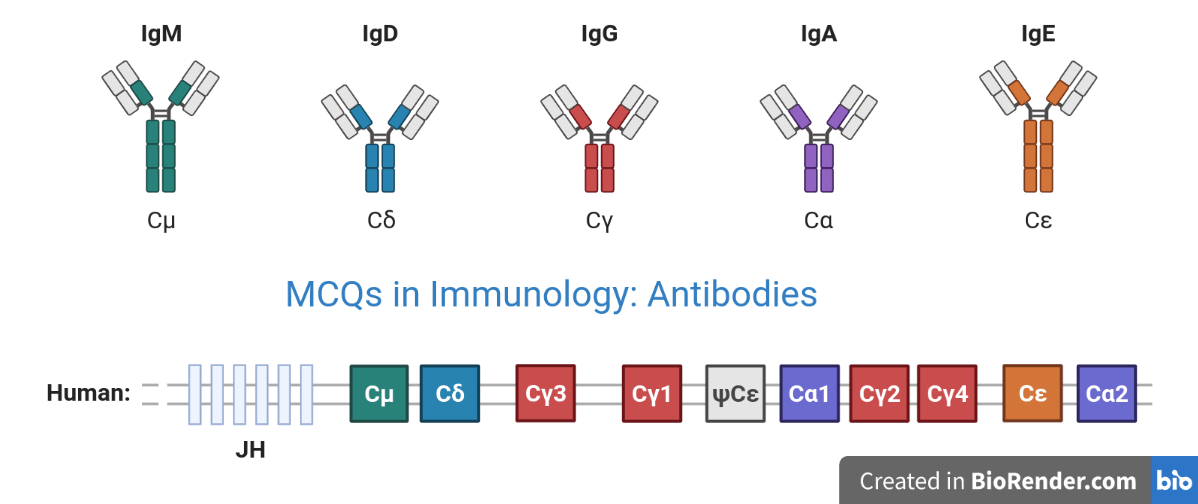
Antibody structure and general properties
1. An immunoglobulin is a:
a. Carbohydrate
b. Fatty acid
c. Glycoprotein
d. Protein
2. All of the following are true about antibodies except which one?
a. They are glycoproteins
b. They are molecules with a single, defined amino acid sequence
c. They fix complement
d. They occur on the surface of B lymphocytes
e. They can predominate in the primary immune response to antigen
3. Which of the following statements best characterizes an antibody?
a. An antibody contains high molecular weight RNA as its basic structure
b. An antibody is composed of protein and cannot be distinguished from the albumin fraction of serum proteins
c. An antibody is composed of four identical protein subunits, which can be made to dissociate by treatment with urea
d. An antibody contains protein as its major chemical component, and its synthesis may be elicited by administering a foreign protein or polysaccharide
e. An antibody contains mucopolysaccharides as its major chemical component
4. An epitope is:
a. A B cell
b. A hapten
c. An antibody
d. The antigenic determinant site
5. All of the following are true except:
a. An antigenic determinant is a paratope
b. An epitope is a small portion of a macromolecule
c. An IgG antibody is bivalent
d. The class of immunoglobulin is determined by its heavy chain
e. The variable region domains contain the antigen recognition site
6. The Fc region mediates all of the following except binding to:
a. Antigen
b. Complement (C1q)
c. Some phagocytic cells
d. Various cells of the immune system
7. The class (isotype) of an immunoglobulin is determined by the constant region found at the:
a. Amino terminus of the heavy chain
b. Amino terminus of the light chain
c. Carboxy terminus of the heavy chain
d. Carboxy terminus of the light chain
8. The immunoglobulin joining chain (J-chain) is:
a. Only produced by T cells
b. Only produced by neutrophils
c. Associated only with the multimeric forms of IgM and IgA
d. Associated with IgE for histamine release
e. Only produced by mast cells
The immunoglobulin classes
9. The descending order of the percentage of total immunoglobulin in serum is:
a. IgM > IgA > IgG > IgD > IgE
b. IgG > IgA > IgM > IgE > IgD
c. IgA > IgG > IgM > IgD > IgE
d. IgG > IgA > IgM > IgD > IgE
10. Which immunoglobulin is the most abundant in newborns?
a. IgA
b. IgM
c. IgG
d. IgD
11. Which immunoglobulin is produced early in the primary response to infection?
a. IgE
b. IgA
c. IgG
d. IgM
12. Which immunoglobulin has the highest avidity?
a. IgA
b. IgM
c. IgE
d. IgG
13. All of the following are true concerning IgM antibodies except which one?
a. They are glycoproteins
b. They fix complement
c. They mediate allergic reactions
d. They occur on the surface of lymphocytes
e. They predominate in the primary response to antigen
14. Which antibody is a prominent antigen receptor expressed on the surface of B cells?
a. IgG
b. IgA
c. IgM
d. IgE
15. The immunoglobulin found predominantly in secretions such as milk, saliva, and tears is:
a. IgD
b. IgE
c. IgG
d. IgA
16. All of the following are true concerning IgE molecules except which one?
a. They are involved in mediating antiparasitic immune responses
b. They are the least abundant immunoglobulin in the serum
c. They are the principal immunoglobulin class involved in allergic reactions
d. They can affect the release of histamine and other chemical mediators
e. They cross the placenta and fix complement
17. Which immunoglobulin is the primary host defense against parasitic infections?
a. Secretory IgA
b. IgG
c. IgM
d. IgE
18. Which IgG subclass is an important host defense against encapsulated bacteria (polysaccharide antigens)?
a. IgG1
b. IgG2
c. IgG3
d. IgG4
Antibody functions and applications
19. Which antibody directly participates in the opsonization of bacteria?
a. IgM
b. IgG
c. IgA
d. IgE
20. Complement fixation by the classical pathway is activated by:
a. IgM only
b. IgG only
c. Both IgM and IgG
d. All five classes of antibody
21. Which single antibody is the most effective at activating complement?
a. IgG1
b. IgG2
c. IgG3
d. IgM
22. Which of the following is useful to stimulate antibody production?
a. An adjuvant
b. A hapten
c. Antiserum
d. Purified antigen
e. Crude antigen
23. Which does not provide long-term immunity?
a. Artificially acquired active immunity
b. Artificially acquired passive immunity
c. Naturally acquired active immunity
d. None of the above
24. Compared to the secondary antibody response, the primary response:
a. Attains a higher IgG titer
b. Has a longer lag phase
c. Persists for a longer plateau period
d. Produces antibodies with a higher affinity for the antigen
Answer key
- c. Glycoprotein
- b. They are molecules with a single, defined amino acid sequence
- d. An antibody contains protein as its major chemical component, and its synthesis may be elicited by administering a foreign protein or polysaccharide
- d. The antigenic determinant site
- a. An antigenic determinant is a paratope
- a. Antigen
- c. Carboxy terminus of the heavy chain
- c. Associated only with the multimeric forms of IgM and IgA
- d. IgG > IgA > IgM > IgD > IgE
- c. IgG
- d. IgM
- b. IgM
- c. They mediate allergic reactions
- c. IgM
- d. IgA
- e. They cross the placenta and fix complement
- d. IgE
- b. IgG2
- b. IgG
- c. Both IgM and IgG
- d. IgM
- a. An adjuvant
- b. Artificially acquired passive immunity
- b. Has a longer lag phase
Why these are the answers
1. Glycoprotein. Immunoglobulins are glycoproteins: a protein framework of two heavy and two light chains held together by disulfide bonds, with carbohydrate groups attached mainly along the constant regions. They are proteins, but the most precise description is glycoprotein.
2. They are molecules with a single, defined amino acid sequence. This is false, so it is the exception. Antibodies are strikingly heterogeneous: through V(D)J recombination, somatic hypermutation, and class switching, the body makes an enormous, diverse (polyclonal) pool of antibodies with different variable-region sequences, not one uniform sequence. The other statements are true of antibodies as a group.
3. An antibody contains protein as its major chemical component, and its synthesis may be elicited by administering a foreign protein or polysaccharide. Antibodies are proteins (glycoproteins) produced in response to an antigen such as a foreign protein or polysaccharide. The other options are chemically wrong: antibodies are not built from RNA or mucopolysaccharide, and they are distinguishable from serum albumin.
4. The antigenic determinant site. An epitope (antigenic determinant) is the precise small region on an antigen that an antibody, B-cell receptor, or T-cell receptor recognizes and binds. It is the minimal structural unit that defines what a given antibody is specific for.
5. An antigenic determinant is a paratope. This is false, so it is the exception. An antigenic determinant is an epitope, the region on the antigen. The paratope is the matching antigen-binding site on the antibody. Epitope on the antigen, paratope on the antibody, is the lock-and-key pair. The other statements are true: an epitope is a small part of a macromolecule, IgG is bivalent, class is set by the heavy chain, and the variable domains hold the antigen recognition site.
6. Antigen. The Fc region is the stem of the antibody and does not bind antigen; antigen binding is done by the two Fab arms, which carry the variable regions. The Fc region instead binds C1q to activate complement and binds Fc receptors on immune cells such as phagocytes, so it mediates effector functions rather than antigen recognition.
7. Carboxy terminus of the heavy chain. The class (isotype) is defined by the heavy-chain constant region, which sits at the carboxy-terminal end of the heavy chain. The simple contrast to hold: the amino terminus is the variable region (which sets antigen specificity), and the carboxy terminus is the constant region (which sets the class and effector functions).
8. Associated only with the multimeric forms of IgM and IgA. The J (joining) chain is a small glycoprotein made by plasma cells that links and stabilizes polymeric immunoglobulins: it holds together the pentamer of IgM and the dimer of secretory IgA. It is not part of monomeric antibodies such as IgG or IgE, and it is not made by T cells, neutrophils, or mast cells.
9. IgG > IgA > IgM > IgD > IgE. In normal serum, roughly 80 percent is IgG, about 15 percent IgA, about 5 percent IgM, a small fraction IgD, and only a trace IgE. So IgG is the most abundant and IgE the least, giving the order IgG > IgA > IgM > IgD > IgE.
10. IgG. Newborns have high IgG because maternal IgG crosses the placenta during pregnancy, giving the infant passive protection in the first months of life. (Breast milk then supplies secretory IgA at mucosal surfaces.) IgG is the only class transferred across the placenta, which is why it dominates in the newborn.
11. IgM. IgM is the first antibody produced in the primary response to a new infection. Because it is made before class switching occurs, a rise in specific IgM indicates recent or current infection, while a later rise in IgG reflects the maturing or secondary response.
12. IgM. Avidity is the total binding strength of an antibody, combining all its binding sites. IgM circulates as a pentamer with ten antigen-binding sites, so even though each individual site may bind modestly, the combined avidity of IgM is the highest of all the classes.
13. They mediate allergic reactions. This is false for IgM, so it is the exception. IgM is a glycoprotein, it fixes complement very efficiently (its pentamer is the best complement activator), it appears on the B-cell surface as a receptor, and it dominates the primary response. Allergy (immediate, type I hypersensitivity) is mediated by IgE, not IgM.
14. IgM. Mature B cells display antibody on their surface as the B-cell receptor, and they express both IgM and IgD in this role, with membrane IgM being the prominent, characteristic antigen receptor. So IgM is the best answer for the surface antigen receptor on B cells.
15. IgA. Secretory IgA is the main antibody of mucosal surfaces and external secretions: it is abundant in colostrum, breast milk, saliva, tears, and mucus, where it provides local protection and gives breastfed infants passive immunity at the gut surface. It is secreted as a dimer joined by the J-chain and a secretory component.
16. They cross the placenta and fix complement. This is false for IgE, so it is the exception. IgG is the only class that crosses the human placenta, and IgE does not classically fix complement. The true IgE statements are that it is the least abundant serum immunoglobulin, mediates antiparasitic responses, and triggers histamine release in allergy.
17. IgE. IgE is the main antibody directed against parasitic infections, particularly helminths (worms) and some protozoa. It arms mast cells and eosinophils against parasites, the same mechanism that, turned against harmless environmental antigens, produces allergy.
18. IgG2. Among the IgG subclasses, IgG2 is the main responder to bacterial capsular polysaccharide antigens, so it is the key defense against encapsulated bacteria. This is why an isolated IgG2 subclass deficiency shows up as a weak response to polysaccharide-encapsulated organisms and their vaccines.
19. IgG. IgG is the main opsonizing antibody. It binds antigens on the bacterial surface through its Fab arms, leaving the Fc region exposed; phagocytes carry Fc-gamma receptors that grip that exposed Fc and engulf the coated bacterium. (C3b is the other major opsonin, from complement.)
20. Both IgM and IgG. The classical complement pathway is triggered by antibody bound to antigen, and only IgM and IgG can do this. IgA, IgD, and IgE do not activate the classical pathway, so it is specifically the IgM and IgG classes that fix complement this way.
21. IgM. Although both IgM and IgG activate complement, a single IgM molecule is by far the more effective, because its pentameric shape presents multiple binding sites that let one IgM molecule engage C1q and start the cascade. A single IgG, by contrast, cannot; several IgG molecules must sit close together on the surface before C1q is bound. So IgM is the most efficient complement activator.
22. An adjuvant. An adjuvant is a substance added to a vaccine to boost the immune response to the antigen, either by holding the antigen at the injection site for longer or by stimulating innate immune cells. A hapten cannot stimulate a response alone, and antiserum supplies preformed antibodies rather than stimulating the host to make them.
23. Artificially acquired passive immunity. Passive immunity means receiving ready-made antibodies (for example an immunoglobulin injection) rather than making your own. Because the recipient's immune system never activates and forms no memory cells, the protection is short-lived, fading as the transferred antibody is cleared. The active forms generate lasting memory.
24. Has a longer lag phase. The first time the immune system meets an antigen, it has no memory cells ready, so the primary response has a longer lag phase (often several days) while naive lymphocytes recognize the antigen, expand, and differentiate. The secondary response, drawing on memory cells, is faster, reaches higher titers, and produces higher-affinity antibody. So the longer lag belongs to the primary response.

Tankeshwar Acharya, MSc (Medical Microbiology)
Tankeshwar Acharya is an Assistant Professor in the Department of Microbiology at Patan Academy of Health Sciences (PAHS), Nepal, where he has been teaching and practicing clinical microbiology for over 14 years. He is the founder of Microbe Online, one of the leading free microbiology education resources on the web, covering bacteriology, mycology, parasitology, immunology, and clinical laboratory diagnostics written from direct experience in both the classroom and the diagnostic laboratory.
Comments
No comments yet. Be the first to share your thoughts.
Leave a comment
All comments are reviewed before they appear.