
Malonate Test: Principle, Procedure, and Results
The malonate test checks whether a bacterium can use sodium malonate as its sole carbon source, shown by a green-to-blue color change. Learn the principle, why malonate inhibits succinate dehydrogenase, the procedure, and how it differentiates Enterobacteriaceae.

On this page
Malonate is the molecule biochemistry textbooks reach for whenever they explain competitive inhibition, because it looks just enough like succinate to jam the enzyme that normally acts on it.
That same trick is put to work at the bench: a broth with sodium malonate as the only carbon source sorts the Enterobacteriaceae into those that can grow on it and those that cannot. One tube, a green-to-blue color change, and you have both a lesson in enzyme kinetics and a step toward naming the organism.
Malonate is an ionized form of malonic acid CH2(COOH)2, and its ester and salts. The medium for the malonate test contains sodium malonate.
Malonate is a reversible inhibitor of succinate dehydrogenase. Due to its structural similarity with succinate, it competitively inhibits the utilization of succinic acid by bacteria, shutting down the Krebs (tricarboxylic acid cycle) and the glyoxylate cycle. Malonate test is recommended to differentiate among the Enterobacteriaceae family especially species of Klebsiella and Salmonella.
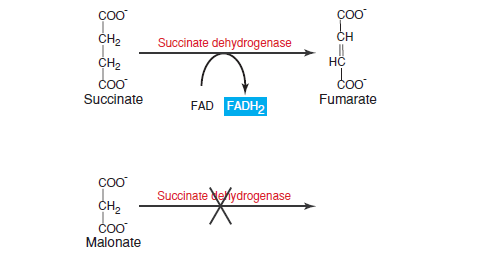 Figure: The attachment of malonate to the enzyme succinate dehydrogenase prevents the attachment of succinate and, thus, the conversion of succinate to fumarate.
Why malonate inhibits succinate dehydrogenase
Malonate is the classic textbook example of a competitive inhibitor, and understanding why explains how the test works.
In the Krebs (tricarboxylic acid) cycle, the enzyme succinate dehydrogenase normally converts succinate into fumarate. Succinate is a four-carbon dicarboxylic acid. Malonate is a three-carbon dicarboxylic acid with a very similar shape. Because the two molecules look so alike, malonate fits into the active site of succinate dehydrogenase and binds there, but the enzyme cannot act on it. While malonate occupies the active site, succinate cannot bind, so the conversion of succinate to fumarate is blocked.
This is competitive inhibition: the inhibitor (malonate) competes with the normal substrate (succinate) for the same active site. It is reversible, because more succinate can outcompete the malonate. This blockage shuts down the normal flow of the Krebs cycle and the linked glyoxylate cycle.
So how can any organism grow on malonate? The test does not measure the inhibition itself. It measures whether an organism can instead use malonate as a carbon source for growth. Organisms that possess the enzymes to take up and metabolize malonate can grow on it and give a positive result. Organisms that cannot use malonate as a carbon source simply fail to grow. The same molecule is therefore both a famous enzyme inhibitor and a usable nutrient, depending on the organism.
Principle
The malonate utilization test is a single substrate utilization test containing sodium malonate as a single carbon source. Apart from sodium malonate, this test medium also contains a trace amount of glucose to stimulate the growth of microorganisms. Organisms that can ferment sodium malonate and utilize it as a carbon source grow in this medium. The medium also contains inorganic ammonium salts as the sole source of nitrogen.
When an organism uses sodium malonate together with the ammonium salts in the medium, it produces alkaline end products such as sodium hydroxide and sodium bicarbonate. This raises the pH of the medium above about 7.6, and the bromothymol blue indicator turns from green to blue (blue is positive).
Malonate-negative organisms cannot use malonate for growth. They may instead ferment the trace of glucose in the medium, producing acid, so the tube stays green or turns slightly yellow (no color change or yellow is negative).
Materials Required
- Sterile inoculating loops or sticks
- Incubator
- Test Organism: Enterobacteriaceae as part of the identification to the species level.
- Medium: Malonate test medium
| Ingredients | Amount (Gram/Liter) |
|---|---|
| Yeast extract* | 1.0 g |
| Ammonium sulfate | 2.0 g |
| Dipotassium phosphate | 0.6 g |
| Monopotassium phosphate | 0.4 g |
| Sodium chloride | 2.0 g |
| Sodium malonate | 3.0 g |
| Glucose* | 0.25 g |
| Bromothymol blue | 0.025 g |
| Final pH: 6.7 |
Quality Control
Perform quality control on each new lot or media shipment before using it. Inspect broth for contamination before storage and use. Discard any blue tubes.
- Klebsiella pneumoniae ATCC 13883: Malonate positive (good growth, blue color)
- Escherichia coli ATCC 25922: malonate negative (no growth, green color)
Procedure
- Using a sterile loop or stick, pick a light inoculum from the center of a single well-isolated colony. Do not over-inoculate. The starting turbidity should be very low, less than a 0.5 Mc-Farland standard (no visible turbidity).
- Inoculate the malonate broth tube.
- Incubate aerobically at 35 to 37°C for up to 48 hours.
- Read the result. Do not read before 48 hours, because some positive reactions develop slowly. Observe the color of the broth against an uninoculated control tube.
Results
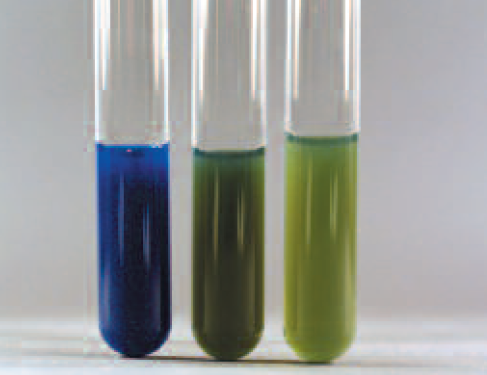 Figure: Malonate broth inoculated with Klebsiella aerogenes (+ve), Escherichia coli (-ve), and an uninoculated control (Left to Right)
Positive: the organism grows and the broth turns light blue to deep Prussian blue throughout. The organism uses malonate as a carbon source.
Negative: no color change (the broth stays green) or a change to yellow from glucose fermentation. The organism does not use malonate.
Reading tips. Some malonate-positive organisms produce only slight alkalinity, so a faint blue can be easy to miss. Always compare a doubtful tube with an uninoculated control, and read at a full 48 hours. Any definite trace of blue is positive.
Test Results
| Malonate Utilization Positive | Malonate Negative |
|---|---|
| Klebsiella pneumoniae | Klebsiella ozaenae |
| Citrobacter koseri | Citrobacter amalonaticus |
| Salmonella enterica subsp. arizonae | Shigella spp |
| Hafnia alvei | Escherichia coli |
| Bordetella trematum | Elizabethkingia anophelis |
What the malonate test differentiates
The malonate test is used as one step in identifying members of the Enterobacteriaceae. The useful applications are:
- Klebsiella: Klebsiella pneumoniae is positive, while Klebsiella ozaenae is negative, helping separate species within the genus.
- Salmonella: most Salmonella are negative, but Salmonella enterica subspecies arizonae (and diarizonae) are positive. A positive malonate result in a Salmonella-like isolate is a useful clue toward these subspecies.
- Citrobacter: Citrobacter koseri is positive, while Citrobacter amalonaticus is negative (the species name amalonaticus itself means it does not use malonate).
The test is always used with other biochemical tests, not on its own, because malonate reactions alone cannot identify an organism to species.
For separating Shigella from Escherichia coli, the acetate utilization test is the relevant one, not malonate. See the acetate utilization test article.
How to Remember
Malonate mimics succinate. They are look-alike dicarboxylic acids, so malonate slips into the succinate dehydrogenase active site. That is the textbook picture of competitive inhibition.
Blue is positive, and blue means basic. Growth on malonate produces alkali, the pH rises, and bromothymol blue turns from green to blue. Green or yellow is negative.
Amalonaticus says it in the name. Citrobacter amalonaticus is malonate-negative. The "a-malonate" prefix means "does not use malonate."
Arizonae is the odd Salmonella out. Most Salmonella are malonate-negative, but Salmonella arizonae is positive.
Read at 48 hours, against a control. Slow, faint positives are missed if read early or without an uninoculated tube for comparison.
Key exam facts
| Item | Fact |
|---|---|
| Tests for | Ability to use sodium malonate as the sole carbon source |
| Nitrogen source in medium | Inorganic ammonium salts (ammonium sulfate) |
| pH indicator | Bromothymol blue (green neutral, blue alkaline, yellow acid) |
| Positive result | Growth with green-to-blue color change |
| Negative result | No change (green) or yellow from glucose fermentation |
| Mechanism concept | Malonate is a competitive inhibitor of succinate dehydrogenase |
| Enzyme inhibited | Succinate dehydrogenase (succinate to fumarate, Krebs cycle) |
| Incubation | 35 to 37°C, read at 48 hours |
| QC positive | Klebsiella pneumoniae ATCC 13883 |
| QC negative | Escherichia coli ATCC 25922 |
| Key differentiations | Klebsiella species; Salmonella arizonae (+); Citrobacter koseri (+) vs amalonaticus (−) |
Where Students Get Confused
"Malonate inhibits the organism, so a positive test means no growth." No. The test does not measure enzyme inhibition. It measures whether the organism can use malonate as a carbon source for growth. Positive means growth (and blue color).
"Blue means acid." No. Blue is alkaline. Growth on malonate raises the pH, and bromothymol blue turns blue in alkaline conditions. Yellow is the acidic color.
"The malonate test separates Shigella from Escherichia coli." No. Both are malonate-negative, so malonate does not separate them. The acetate utilization test is used for the Shigella versus E. coli split.
"Competitive inhibition here is permanent." No. Competitive inhibition is reversible. Malonate competes with succinate for the same active site, and more succinate can displace it.
"Any blue tinge read early is positive." Read at a full 48 hours and compare with an uninoculated control. Some positives are only faintly alkaline, and reading too early causes both false negatives and misreadings.
References and further readings
- Leber, A. L. (Ed.). (2016). Clinical Microbiology Procedures Handbook (4th ed.). ASM Press. https://doi.org/10.1128/9781683670438.CMPH
- Leboffe, M. J., and Pierce, B. E. (2021). A Photographic Atlas for the Microbiology Laboratory (5th ed.). Morton Publishing.
Frequently Asked Questions
What does the malonate test detect?
What does the malonate test detect?
It detects whether a bacterium can use sodium malonate as its sole source of carbon for growth. Growth produces alkaline products that turn the indicator blue.
What does a positive malonate test look like?
What does a positive malonate test look like?
The organism grows and the broth turns from green to light blue or deep Prussian blue. Blue is positive.
What does a negative malonate test look like?
What does a negative malonate test look like?
No color change (the broth stays green), or a change to yellow from fermentation of the small amount of glucose in the medium.
Why does malonate inhibit succinate dehydrogenase?
Why does malonate inhibit succinate dehydrogenase?
Malonate has a shape very similar to succinate, the normal substrate of succinate dehydrogenase. It binds the enzyme's active site and blocks succinate from binding, which is the classic example of competitive (and reversible) inhibition.
What is the pH indicator in the malonate test?
What is the pH indicator in the malonate test?
Bromothymol blue. It is green at neutral pH, blue in alkaline conditions (positive), and yellow in acidic conditions.
Which organisms are malonate positive?
Which organisms are malonate positive?
Examples include Klebsiella pneumoniae, Salmonella enterica subspecies arizonae, Citrobacter koseri, and Enterobacter species.
What is the malonate test used to differentiate?
What is the malonate test used to differentiate?
It helps separate members of the Enterobacteriaceae, for example Klebsiella species from one another, Salmonella arizonae from most other Salmonella, and Citrobacter koseri from Citrobacter amalonaticus.

Tankeshwar Acharya, MSc (Medical Microbiology)
Tankeshwar Acharya is an Assistant Professor in the Department of Microbiology at Patan Academy of Health Sciences (PAHS), Nepal, where he has been teaching and practicing clinical microbiology for over 14 years. He is the founder of Microbe Online, one of the leading free microbiology education resources on the web, covering bacteriology, mycology, parasitology, immunology, and clinical laboratory diagnostics written from direct experience in both the classroom and the diagnostic laboratory.
Comments
No comments yet. Be the first to share your thoughts.
Leave a comment
All comments are reviewed before they appear.