
Magnetic Stirrer: Parts, Principle, Types, and Stir Bar Technique

On this page
A solution is set to stir overnight, and by morning the stir bar is not spinning smoothly but rattling and skipping erratically across the bottom of the flask, and the solute never fully dissolved. Nothing is broken. The stir bar has decoupled: the speed was pushed too high for the bar and vessel, and the bar lost sync with the magnet beneath it. This is the defining behavior of a magnetic stirrer, and understanding it, why the bar and the driving magnet must stay coupled, explains almost every stirring problem and every rule for choosing and using a stir bar.
The magnetic stirrer is an essential piece of laboratory equipment used for stirring or mixing in laboratory experiments by creating a rotating magnetic field. The rotating magnetic field is created with the help of a rotating magnet (i.e., stir bar) and a stationary magnet. It is also known as a magnetic mixer. Early magnetic stirring devices were patented in the first half of the twentieth century, with Arthur Rosinger's 1944 US patent among the most widely cited.
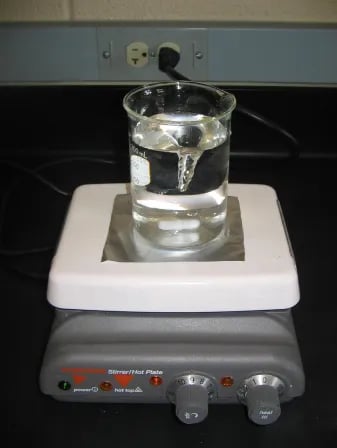 Figure: Magnetic stirrer Image
Major parts of magnetic stirrer
A magnetic stirrer has a few core components: a stir bar, a rotating driving magnet inside the unit, a motor, a speed control knob, and a flat top plate on which the vessel sits. A stir bar retriever is a useful accessory for removing the bar afterward. When a magnetic stirrer also includes a heating element, it becomes a hot plate stirrer, which can heat and mix at the same time. That combined device is covered in the hot plate article.
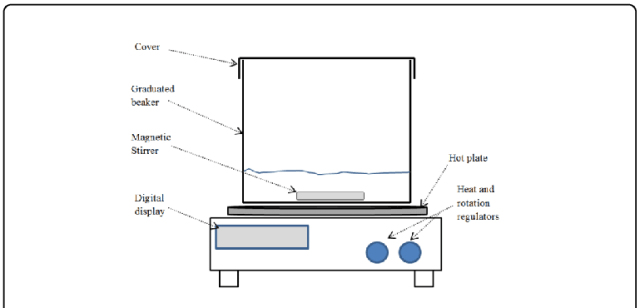 Figure: Parts of Magnetic stirrer Image source: DOI:10.4172/2150-3494
Stir bar
It is a magnetic bar placed in the container containing a solution used for the agitation of liquid mixture or solution. It is coated with nonreactive material (such as polytetrafluoroethylene (PTFE) or glass) that protects the magnet and prevents contamination of the liquid medium in which they are immersed for agitation. The shape of the stir bar varies (i.e., octagonal, circular, etc.) and depends on two factors; vessel shape and viscosity of the stirring medium. Similarly, the stir bar’s size also varies from a few millimeters to a few centimeters.
Driving magnet
A magnet mounted on a motor beneath the top plate. As the motor spins this magnet, its moving magnetic field pulls the stir bar around with it, so the bar spins inside the vessel. In most bench stirrers this is a rotating permanent magnet; some designs use a set of electromagnets switched in sequence to create the same rotating field.
Top plate
The flat surface, usually chemical-resistant, on which the vessel sits. On a pure magnetic stirrer it does not heat; it simply positions the vessel over the driving magnet.
Speed controlling knob
It helps to control the rotating speed (i.e., RPM) of the stir bar as per requirement.
Stir bar retriever
It is a separate magnet at the end of the long stick coated with inert material (i.e., PTFE). It helps in the removal of the stir bar from the vessel.
Principle
The magnetic stirrer is an important laboratory device that can be used over a wide temperature range and with any chemical agents, in an open or in closed system.
A magnetic stirrer works by magnetic coupling. A motor spins a magnet inside the unit, creating a rotating magnetic field at the top plate. A magnetic stir bar dropped into the vessel is pulled by this field and spins with it, and its spinning drives a circulating flow that mixes the solution. For this to work, the bar and the driving magnet must stay magnetically coupled, so the vessel is centered on the plate and the speed is raised gradually. If the speed is increased too fast or set too high for the bar and vessel, the bar loses sync with the magnet, a condition called decoupling, and it rattles instead of spinning. The stir bar is chosen to match the vessel size and the viscosity of the solution.
Types of magnetic stirrer
Based on the size, configuration, and applications; magnetic stirrers are of the following types;
Mini magnetic stirrer
- They are closed-packed and occupy less space in the laboratory.
- They are noiseless in operation with low vibration making them convenient to use.
- They also consist of a speed regulator that helps control the bar magnet’s speed (in RPM).
- They are resistant to corrosive and hazardous chemical agents in the lab.
Magnetic stirrer with timer
- A magnetic stirrer with a timer helps to close down the motor automatically after the set period runs out.
Heavy-duty magnetic stirrer
- They have a high mixing range and are long-lasting.
- Internally, it consists of an electronic management device that automatically controls the speed concerning the load.
- They are also highly unreactive to chemicals.
Battery-powered magnetic stirrer
- These portable magnetic stirrer work with batteries and are ideal to be used in fields, incubators, or anywhere without electricity.
Air-operated turbine magnetic stirrer
- It uses a low-pressure air supply to operate it.
- It is suited to mixing larger or hazardous volumes where an electric spark must be avoided.
- It abolishes the risk of sparkling from electrical sources.
- Ideal to stir solutions that produce hazardous vapors.
Choosing and Using a Stir Bar
Most stirring problems are really stir bar problems. Matching the bar to the job is the skill worth learning.
Match the bar length to the vessel. The bar should be roughly the diameter of the vessel bottom, not tiny in a large flask or crammed into a small one. A bar that is too short for the vessel spins weakly and mixes poorly; too long and it cannot turn freely.
Match the shape to the vessel. Octagonal and plain cylindrical bars suit flat-bottomed beakers and flasks. Bars with a pivot ring spin more smoothly. Egg-shaped or oval bars are made for round-bottomed flasks, where a straight bar would rock rather than spin.
Raise the speed gradually. Starting at high speed is the main cause of decoupling. Bring the speed up slowly until a gentle, stable vortex forms, then hold it there. A controlled vortex means good mixing; a violent one splashes and aerates.
Add the bar before heating (on a hot plate stirrer). Dropping a stir bar into an already hot or already thick solution gives poor, uneven mixing. Add it at the start.
Retrieve and clean the bar properly. Use a stir bar retriever, a magnet on a rod, to lift the bar out rather than pouring it out with the solution. Clean bars carefully, since a scratched or cracked PTFE coating can contaminate future solutions and eventually expose the magnet.
Where Mixing Goes Wrong
Decoupling (the bar rattles instead of spinning). The speed is too high for the bar and vessel, or the vessel is off-center. Lower the speed, re-center the vessel, and raise the speed slowly. A larger or heavier bar couples better at high speeds.
No vortex, weak mixing. The bar is too small for the vessel, the solution is too viscous, or the volume is too large. Use a longer bar, reduce the volume, or switch to a mechanical overhead stirrer for thick or high-volume mixtures.
Violent splashing and aeration. The speed is too high, forming a deep vortex that pulls in air. Reduce the speed until the vortex is gentle. Excess aeration can oxidize sensitive reagents.
Bar stuck or not moving at all. The vessel base is too thick, the bar is too far from the driving magnet, or the solution has already gelled around it. Use a thinner-based vessel and add the bar before the solution thickens.
Viscosity and volume limits. A magnetic stirrer cannot turn a bar through very viscous or dense suspensions, and it cannot mix very large volumes. These are hard limits of magnetic coupling, not settings to push, so reach for an overhead mechanical stirrer instead.
Coating breakdown at high temperature. On a hot plate stirrer run hot, the PTFE coating can degrade over time, roughening the bar and risking contamination. Inspect bars regularly and retire scratched ones.
Uses of magnetic stirrer
- Compared to other mechanical stirrers, magnetic stirrers are simple in architecture and also are easy to operate.
- It helps to mix solutions for several hours or even overnight.
- Stirring bars are smaller in size so are more easily cleaned and sterilized than other stirring devices.
- It allows stirring in a closed system (i.e., less contamination).
- Manual stirring is labor intense and time confusing process. Magnetic stirrer helps to save time for researchers.
- They are used in place of mechanical stirrers as they produce less noise and are comparatively more efficient.
- They occupy less space in the laboratory and are portable.
Limitations of magnetic stirrer
- The size of the stir bar needs to be changed from time to time, depending on the nature of the solution.
- Because of the limitation in the size of the stir bar, the device can only be used for small-scale experiments.
- It cannot be used to stir viscous or dense suspension or a high volume of liquid.
- It cannot be operated at extremely high temperatures because the outer covering of the stir bar might deteriorate
How to Remember
Coupling is everything. A magnetic stirrer is just a magnet chasing a magnet through the bottom of a vessel. As long as the stir bar stays coupled to the spinning magnet below, it mixes; the moment it loses that grip, it rattles. Every rule, center the vessel, size the bar to the vessel, raise the speed slowly, is really one rule: keep the bar coupled.
A gentle vortex is the target. Not flat (no mixing), not a violent whirlpool (splashing and air). The sweet spot is a small, steady vortex, and learning to read it is the whole craft of stirring.
Key Exam Facts in One Table
| Fact | Detail |
|---|---|
| Working principle | Magnetic coupling: a motor-driven magnet spins a stir bar in the vessel |
| Stir bar coating | PTFE (Teflon) or glass, inert to protect the magnet and the solution |
| Stir bar selection | Length to match vessel diameter; shape to match vessel bottom |
| Decoupling | Bar loses sync with the driving magnet when speed is too high or vessel off-center |
| Correct technique | Center the vessel, raise speed gradually to a gentle vortex |
| Hard limits | Cannot mix very viscous or very large-volume samples |
| Hot plate stirrer | Magnetic stirrer with a heating element; heats and mixes together |
| Air-turbine stirrer | Air-driven, spark-free, for hazardous or flammable environments |
| Stir bar retriever | Magnet on a rod used to remove the bar without pouring it out |
Where Students Get Confused
Magnetic stirrer vs. hot plate stirrer. A plain magnetic stirrer only mixes; it does not heat. A hot plate stirrer adds a heating element so it can heat and mix at once. If a task needs heat, you need the hot plate stirrer, covered in the hot plate article.
Magnetic stirrer vs. mechanical (overhead) stirrer. A magnetic stirrer drives a small bar by magnetic coupling and is limited to modest volumes and low viscosity. An overhead mechanical stirrer uses a motor-driven paddle and handles thick, dense, or large-volume mixtures. When a magnetic bar decouples or stalls, the mechanical stirrer is the answer.
Why the bar rattles. Students assume a rattling bar means a broken device. It almost always means decoupling from too much speed or an off-center vessel, not a fault.
The driving magnet is not stationary. A common misconception is that the magnet under the plate sits still. It spins (or its field rotates), and that motion is what turns the stir bar.
References
- Tille, P. M. (2022). Bailey & Scott's Diagnostic Microbiology (15th ed.). Elsevier.
- Cheesbrough, M. (2006). District Laboratory Practice in Tropical Countries, Part 2 (2nd ed.). Cambridge University Press.
- Reyes, F. (2016). Practical Laboratory Skills Handbook. Royal Society of Chemistry.
Frequently Asked Questions
How does a magnetic stirrer work?
How does a magnetic stirrer work?
A magnetic stirrer spins a magnet inside the unit, creating a rotating magnetic field. A magnetic stir bar placed in the vessel is pulled by this field and spins with it, driving a circulating flow that mixes the solution. The bar and the driving magnet must stay magnetically coupled for it to work.
Why does my stir bar rattle instead of spinning smoothly?
Why does my stir bar rattle instead of spinning smoothly?
This is called decoupling. It happens when the speed is set too high for the bar and vessel, or the vessel is not centered on the plate. Lower the speed, center the vessel, and raise the speed gradually. A larger or heavier bar couples better at higher speeds.
How do I choose the right stir bar?
How do I choose the right stir bar?
Match the bar length to the diameter of the vessel bottom, and match the shape to the vessel: octagonal or cylindrical bars for flat-bottomed beakers and flasks, egg-shaped bars for round-bottomed flasks. A bar too small for the vessel mixes weakly.
What is the difference between a magnetic stirrer and a hot plate stirrer?
What is the difference between a magnetic stirrer and a hot plate stirrer?
A magnetic stirrer only mixes. A hot plate stirrer combines a magnetic stirrer with a heating element, so it can heat and mix at the same time. For media and buffer preparation that needs both, the hot plate stirrer is used.
When should I use a mechanical stirrer instead?
When should I use a mechanical stirrer instead?
A magnetic stirrer cannot mix very viscous, dense, or large-volume solutions because the stir bar decouples or stalls. For those, an overhead mechanical stirrer with a motor-driven paddle is used instead.

Tankeshwar Acharya, MSc (Medical Microbiology)
Tankeshwar Acharya is an Assistant Professor in the Department of Microbiology at Patan Academy of Health Sciences (PAHS), Nepal, where he has been teaching and practicing clinical microbiology for over 14 years. He is the founder of Microbe Online, one of the leading free microbiology education resources on the web, covering bacteriology, mycology, parasitology, immunology, and clinical laboratory diagnostics written from direct experience in both the classroom and the diagnostic laboratory.
Comments
No comments yet. Be the first to share your thoughts.
Leave a comment
All comments are reviewed before they appear.