
Hemagglutination Inhibition Test: Principle, Procedure, Uses

On this page
Many viruses (such as influenza) carry a surface protein, hemagglutinin, that binds red blood cells and cross-links them into a lattice. This is hemagglutination, and it is the phenomenon the HAI test switches off. In a microtiter well, agglutinated cells settle as a diffuse irregular film, while unagglutinated cells roll down into a compact button. For hemagglutination as a general method, see agglutination test types.
Principle
Hemagglutination occurs when a hemagglutinating virus (measles is used in this example) is mixed with red blood cells (see image a). But, if the serum of a person infected with measles virus is mixed with RBC and measles virus, there won’t be any agglutination of RBC. This phenomenon is known as hemagglutination inhibition. This arises because antibodies present in the serum of that infected person react with the measles viruses and neutralize them (positive result); as the hemagglutinins are occupied, they can not bind and agglutinate RBCs.
If the patient’s serum does not contain antibodies against surface proteins of the test virus, there will be hemagglutination as surface molecules are free to hemagglutinate RBCs (negative result).
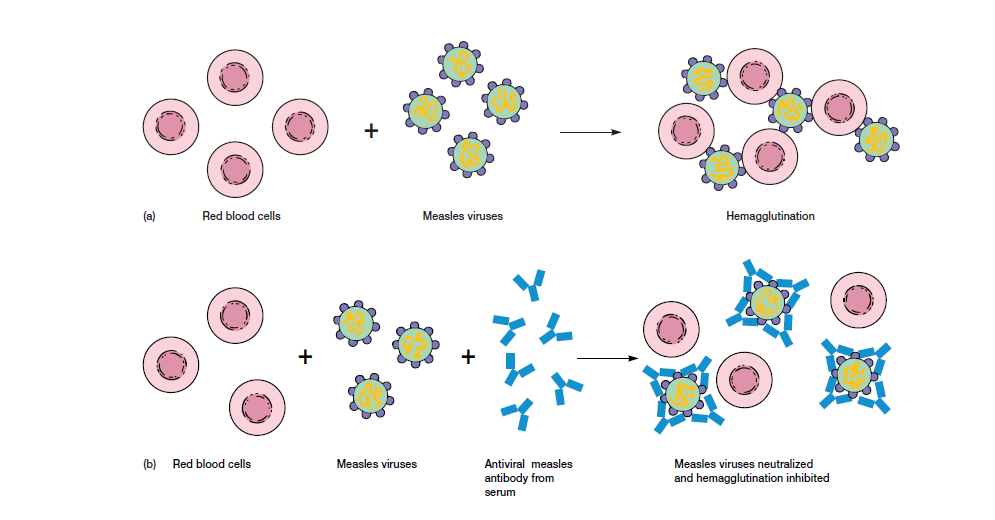 Figure: Hemagglutination and hemagglutination inhibition test
The basis of the HAI assay is that antibodies to that particular virus (for example; measles virus) will prevent the attachment of the virus to RBC. Therefore hemagglutination is inhibited when antibodies are present.
HAI Titer:The highest dilution of serum (Ab) that prevents hemagglutination is called the HAI titer of the serum.
- If the serum contains no antibodies that react with the measles virus, then hemagglutination will be observed in all wells.
- Likewise, if antibodies to the measles virus are present, hemagglutination will not be observed until the antibodies are sufficiently diluted.
The HAI test may be complicated by the presence of non-specific inhibitors of viral haemagglutination and naturally occurring agglutinins of the erythrocytes. Therefore, the sera should be treated before use or false positive or negative results may arise.
Materials and Reagents
- Red cells from an appropriate species (chicken, goose, guinea pig, trypsinized human O) collected in Alsever’s solution or heparin
- Diluent (e.g. bovine albumin veronal buffer) at appropriate pH
- Solutions to remove nonspecific hemagglutinins from serum
- Infected cultural fluid or standard antigen (e.g preparation of influenza virus) for serology
Procedure
- Obtain a preparation of virus (e.g. influenza viruses) with known HA titer or determine its HA titer
- Prepare two-fold dilutions of patient/test serum to be tested e.g. from 1:4 to 1:1024.
- Add a fixed amount of virus to every well of a 96-well plate, equivalent to 4 HA units (varies according to the virus), except for the serum control wells.
- Allow the plate to stand at room temperature for 60 minutes (time varies according to specific requirements).
- Add red blood cells (RBC) and incubate at 4°C for 30 minutes.
- Read the wells.
Results/interpretation
The highest dilution of serum (Ab) that prevents hemagglutination is called the HAI titer of the serum. A smooth or jagged shield of cells or an irregular button indicates agglutination. Observation of the movement of the button of red cells when the plate is tilted may help to clarify the endpoint.
In this example, an HAI titer of 1280 means, the greatest dilution of antibodies that still blocked hemagglutination from occurring was at 1280 dilution. At this dilution, the antibodies were still capable of recognizing and binding to the antigens on the virus.
Uses of Hemagglutination-Inhibition Test
- Hemagglutination inhibition test is widely used for the diagnosis of infection caused by orthomyxoviruses (influenza), paramyxoviruses (measles, mumps), mononucleosis, arboviruses-togaviruses (including rubella), flaviviruses, and bunyaviruses.
- The presence of the virus in infected cell cultures can be detected by hemagglutination; the identity of the virus or of antibodies in a patient’s serum can be determined by specific inhibition of that hemagglutination.
- Although influenza viruses can be detected by hemadsorption test, typing of the isolate is done most efficiently by hemagglutination inhibition (HAI).
Quality Control
- Known positive serum
- Known negative serum
- Serum and cells without antigen (to detect nonspecific agglutination)
- Back titration of hemagglutination activity of the antigen to confirm that 4 hemagglutinating units (HAU) of antigen were used
Where students get confused
No clumping is the positive result. This is the reverse of an ordinary agglutination test. In HAI, the patient's antibody blocks the virus from agglutinating the red cells, so a smooth button of un-agglutinated cells (no lattice) means antibody is present. Clumping means antibody is absent. Whenever a test has "inhibition" in its name, expect this inverted reading.
The HAI titer is the highest dilution that still inhibits. Because antibody is what blocks agglutination, you read the titer as the greatest serum dilution at which hemagglutination is still prevented. Beyond that dilution, there is too little antibody to block the virus, and clumping reappears.
Why sera are pretreated. Serum contains non-specific inhibitors of viral hemagglutination and naturally occurring agglutinins, both of which can mimic or mask antibody. Removing them before testing is what keeps the result specific, which is why the pretreatment step is not optional.
How to remember
Inhibition flips the sign. In a plain hemagglutination test, clumping is the positive signal. Add antibody and the virus can no longer clump the cells, so in HAI the button (no clumping) is positive and the film (clumping) is negative. The antibody's whole job is to stop the reaction, so its presence is read as the absence of clumping.
References
- Levinson, W. (2020). Review of Medical Microbiology and Immunology (16th ed.). McGraw-Hill.
- Sano, K., & Ogawa, H. (2014). Hemagglutination (inhibition) assay. Methods in Molecular Biology, 1200, 47–52.
- Tille, P. M. (2022). Bailey & Scott's Diagnostic Microbiology (15th ed.). Elsevier.
Frequently Asked Questions
Why is no clumping a positive HAI result?
What is the HAI titer?
Why must serum be pretreated before an HAI test?

Tankeshwar Acharya, MSc (Medical Microbiology)
Tankeshwar Acharya is an Assistant Professor in the Department of Microbiology at Patan Academy of Health Sciences (PAHS), Nepal, where he has been teaching and practicing clinical microbiology for over 14 years. He is the founder of Microbe Online, one of the leading free microbiology education resources on the web, covering bacteriology, mycology, parasitology, immunology, and clinical laboratory diagnostics written from direct experience in both the classroom and the diagnostic laboratory.
Comments
No comments yet. Be the first to share your thoughts.
Leave a comment
All comments are reviewed before they appear.