
Culture Media: PH Indicators, Color of Colonies
Culture Media: PH Indicators, Color of Colonies
Colony color or pigmentation is mostly exploited characteristics of bacteria which aids in the differentiation and identification of the isolates. Except when there is a growth of pigmented bacteria. The characteristics pigmentation observed in the culture media is because of the changes in the pH of the medium (i.e. development of the characteristics color based on the use of pH indicator).
pH indicators give characteristics color in different pH e.g., phenol red gives yellow color in acidic pH. So whenever fermenters grow in sugar-containing media, they produce acid and give yellow-colored colonies. For e.g. mannitol fermenter S. aureus in mannitol salt agar, sugar fermenter in XLD agar, etc. In this post, we are grouping some of the bacteriological media on the basis of pH indicator used.
pH indicators and their range
pH indicators used in different culture media
Bromothymol Blue pH range: 6.0 (yellow)- 8.0 (blue) | Phenol Red pH range: 6.8 (yellow)- 8.4 (red) | Neutral Red pH range: 6.8 (red)- 8 (yellow) |
Cystine Lactose Electrolyte Deficient Agar (CLED) | Mannitol Salt Agar | MacConkey Agar |
Thiosulfate Citrate Bile Salts Sucrose (TCBS) Agar | Triple Sugar Iron (TSI) Agar | Deoxycholate Citrate Agar (DCA) |
OF Medium | Urease Test Medium | Salmonella-Shigella Agar |
Simmons Citrate Agar | Xylose Lysine Deoxycholate Agar (XLD) |
|
pH indicator: Bromothymol blue
It is a color indicator that turns yellow at acidic pH. At a neutral pH, bromthymol blue is green. At pH 7.5 or above, bromthymol blue turns royal blue.
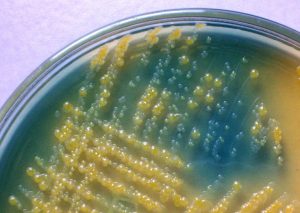 Figure: Lactose fermenting (Yellow colonies) and Lactose Non-fermenting colonies in CLED
- Cystine Lactose Electrolyte Deficient Agar (CLED): In CLED media, lactose fermenting colonies of Escherichia coli give pale yellow colonies whereas non-lactose fermenting colonies of Proteus, Salmonella, etc gives blue colored colony.
- Simmons Citrate Agar: Simmons citrate agar tests the ability of organisms to utilize citrate as a sole carbon source and ammonium dihydrogen phosphate as the sole source of nitrogen. Organisms that can utilize citrate as their sole carbon source also utilize ammonium dihydrogen phosphate creating an alkaline environment in the medium, turning the medium blue.
- Hugh and Leifsons Medium (OF Medium): OF medium (oxidative-fermentative test) is used to determine if gram-negative bacteria metabolize carbohydrates oxidatively (producing weak acid), by fermentation (producing mixed acid), or are nonsaccharolytic and therefore have no ability to use the carbohydrate in the media (no acid production). The high concentration of acid produced during fermentation will turn the bromthymol blue indicator from green to yellow in the presence or absence of oxygen.
- Thiosulfate Citrate bile salts sucrose (TCBS) agar is used for the selective isolation of Vibrio spp. TCBS has a very high pH (8.5 to 9.5) to suppress other intestinal flora. pH indicator bromothymol blue is used in this media, so if the organism utilizes the sucrose, it lowers the pH of the media and yellow-colored colonies are seen in TCBS.
pH indicator: Neutral Red
Red at pH 6.8 and below, yellow at pH 8 and above.
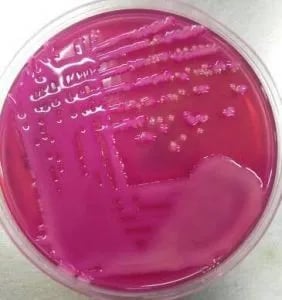 Figure: Mixed growth of mucoid Lactose fermenting colonies and NLF colonies in MacConkey Agar
- MacConkey Agar: It is a selective and differential medium. The pH indicator helps to differentiate between lactose fermenting and lactose non-fermenter. E coli and other lactose fermenting bacteria give pink-colored colonies in MacConkey agar. Whereas non-lactose fermenter gram-negative bacilli produce pale yellow colonies.
- Deoxycholate Citrate Agar (DCA): Lactose non-fermenter produces colorless colonies. Coliform bacteria if present form pink colonies.
- Salmonella-Shigella Agar: It is a selective media used to isolate Salmonella and Shigella. Lactose fermenter produces red-pigmented colonies. Whereas non-lactose fermenter (e.g., Salmonella) grows as translucent colonies (colorless) with or without black centers (neutral red does not have any role in black color formation, it’s because of action of sodium thiosulphate and ferric citrate which are also other constituents of SS Agar).
pH indicator: Methylene Blue and Eosin dyes
Eosin Methylene Blue (EMB) Agar: EMB agar is useful for the isolation and differentiation of lactose fermenting and non-lactose fermenting enteric bacilli.
Coliform bacteria: Purplish black colonies Non-coliform bacteria: Colorless colonies
Malachite green as pH indicator
Lowenstein Jensen Medium: Lowenstein Jensen medium is used to isolate Mycobacterium tuberculosis.
pH indicator: Phenol red
It is yellow at pH 6.8 and red at pH 8.4 and above.
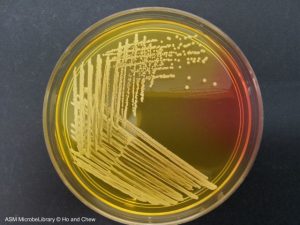 Figure: Yellow colonies of S. aureus in Mannitol Salt Agar (MSA).Image source: ASM
- Mannitol Salt Agar (MSA): Staphylococcus aureus grows in mannitol salt agar, ferments mannitol, and produces (acid) yellow colonies with yellow zones. Whereas most coagulase-negative staphylococci (CONS) and micrococci do not ferment mannitol and grow as small red colonies surrounded by red or purple zones.
- Triple Sugar Iron Agar (TSI) Test: TSI contains three sugar (glucose, sucrose, and lactose) along with an iron source. It helps in the identification of members of the family Enterobacteriaceae on the basis of their fermentative capability, gas production, and H2S gas production.
Lactose fermenters: yellow/yellow Non-lactose fermenter: red/yellow Non-fermenter: red/red
- Urea Agar base: Urease-producing organisms give pink-red color to the media as they utilize urea with the formation of ammonia the pH of the media changes to an alkaline condition.
- Xylose Lysine Deoxycholate (XLD) Agar: It is useful for the isolation and differentiation of Salmonella and Shigella spp which appear as pink-colored colonies (as they do not ferment carbohydrate). Whereas the other nonpathogenic gram-negative enteric bacilli which produce yellow colonies (as they ferment one or more of the sugars present in the media).
References
- Madigan Michael T, Bender, Kelly S, Buckley, Daniel H, Sattley, W. Matthew, & Stahl, David A. (2018). Brock Biology of Microorganisms (15th Edition). Pearson.
- Color Atlas and Textbook of Diagnostic Microbiology, Koneman, 5th edition

Tankeshwar Acharya, MSc (Medical Microbiology)
Tankeshwar Acharya is an Assistant Professor in the Department of Microbiology at Patan Academy of Health Sciences (PAHS), Nepal, where he has been teaching and practicing clinical microbiology for over 14 years. He is the founder of Microbe Online, one of the leading free microbiology education resources on the web, covering bacteriology, mycology, parasitology, immunology, and clinical laboratory diagnostics written from direct experience in both the classroom and the diagnostic laboratory.