
Bacillus anthracis: Anthrax Toxin, Clinical Forms, Diagnosis, Prevention
How anthrax toxin (protective antigen, lethal factor, edema factor) causes disease, the four clinical forms of anthrax, and how B. anthracis is diagnosed, treated, and prevented.

On this page
A wool sorter develops a small, painless, itchy bump on his forearm that looks like an insect bite. Over the next two days it blisters, then collapses into a black, dead-looking ulcer with a lot of swelling around it. It does not hurt, which is strange for a wound that looks this bad. He handles imported animal hides for a living. The painless black scab is the clue. A bacterium in the animal hides has entered a small break in his skin and is releasing a toxin that kills the local tissue and drives the swelling. This is cutaneous anthrax, caused by Bacillus anthracis.
Introduction
Bacillus anthracis is the most notorious member of the genus Bacillus and the cause of anthrax, a serious zoonotic disease. Anthrax is mainly a disease of wild and domestic herbivores, and humans are infected incidentally through contact with infected animals, animal products, or spores.
B. anthracis is also a leading potential agent of bioterrorism. It was involved in the 1979 Sverdlovsk outbreak and the 2001 US postal attacks. One idea organizes the whole topic: the disease is driven by two plasmid-encoded weapons, an antiphagocytic capsule and a three-part toxin. Take away either one and the organism is no longer fully virulent.
General properties
- Gram-positive, large rectangular rods arranged in chains
- Capsulated: B. anthracis has a polypeptide capsule made of poly-D-glutamate. This is unusual, because most other capsulated bacteria have a polysaccharide capsule. The capsule resists phagocytosis, which is why it is a key virulence factor, not just a structural feature. Capsulated bacilli often look square-ended, the boxcar appearance.
- Endospore forming: B. anthracis has non-bulging spores; that are elliptical and centrally located.
- Non-motile. This is a useful identification clue, because other members of the genus, including Bacillus cereus, are motile.
- Aerobes
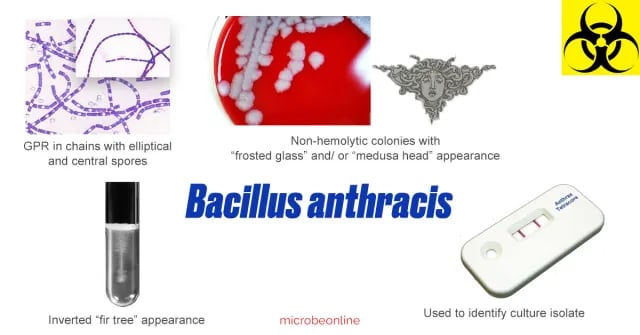 Figure: Bacillus anthracis important properties
B. anthracis holds a special place in the history of microbiology. Robert Koch first isolated it in pure culture and developed Koch's postulates using this organism, and Louis Pasteur prepared the first live attenuated bacterial vaccine against it.
Transmission
Both humans and animals acquire anthrax through spores, by three routes: inoculation through a break in the skin, inhalation, and ingestion. The route of entry decides the clinical form of anthrax. Spores are the dormant, highly resistant form and can survive in soil and in contaminated animal products such as hair, wool, and hides for decades. A key point for understanding the disease: infection is always started by the spore, which then germinates into the toxin-producing bacterium once inside the body.
Virulence factors of Bacillus anthracis
The full virulence of B. anthracis depends on two plasmids, and the organism needs both. The capsule is encoded on plasmid pXO2, and the anthrax toxin is encoded on plasmid pXO1. A strain that loses either plasmid is strongly attenuated. The live vaccine strains are made by removing one of them.
The capsule (pXO2)
What it is: a poly-D-glutamate polypeptide capsule.
Why it matters: the capsule resists phagocytosis. It lets the germinating bacteria survive and multiply in the early stages of infection, before the toxin does its work. Because the capsule is made of glutamate, not sugar, it is poorly immunogenic and the immune system does not clear it easily.
The anthrax toxin (pXO1)
The anthrax toxin is not one molecule but three separate proteins that only cause harm in combination. This is the single most important mechanism on the page.
- Protective antigen (PA): the delivery component. It binds to receptors on host cells and forms a pore that carries the other two factors into the cell. It does no damage by itself, but nothing gets in without it. (It is called "protective" because antibody against PA is protective, which is why PA is the target of the vaccine.)
- Edema factor (EF): an enzyme (an adenylate cyclase). Once PA delivers it into the cell, EF raises intracellular cAMP to abnormal levels. This disturbs water balance and causes the massive tissue edema seen in anthrax.
- Lethal factor (LF): an enzyme (a protease). Once inside the cell, LF cleaves proteins called MAPKK (mitogen-activated protein kinase kinases). This disrupts cell signaling, kills macrophages, triggers release of inflammatory mediators, and drives the shock and death seen in severe anthrax.
The three proteins combine into two functional toxins:
| Toxin | Components | Main effect |
|---|---|---|
| Edema toxin | PA + EF | Raises cAMP, causes edema |
| Lethal toxin | PA + LF | Cleaves MAPKK, causes cell death, shock, and death |
Putting it together: the spore enters the body and germinates. The capsule protects the growing bacteria from being eaten by phagocytes. Protective antigen then binds host cells and opens the door, letting edema factor and lethal factor inside. Edema factor produces the swelling. Lethal factor produces the tissue death, the shock, and, in severe disease, death. This is why the two plasmids matter so much: the capsule buys time, and the toxin does the damage.
This mechanism also explains two clinical clues. The eschar of cutaneous anthrax is relatively painless because the toxin, rather than a pus-forming inflammatory response, drives the lesion. And the striking edema is the direct signature of edema toxin.
Clinical presentations
Human anthrax has four clinical forms. The route of entry of the spore decides which form develops, and each form reflects the same toxin doing its work in a different tissue.
- Cutaneous anthrax: the most common form, about 95 to 99 percent of cases worldwide. Spores enter through small cuts or abrasions on exposed skin (hands, arms, neck, wrist, face). The lesion begins as a painless, itchy papule, becomes a blister, then breaks down into a black necrotic ulcer, the eschar, surrounded by marked edema. The painlessness and the heavy swelling are characteristic and reflect the toxin at work. The incubation period is usually 2 to 6 days.
- Oropharyngeal/gastrointestinal anthrax: In oropharyngeal anthrax, lesions are seen in buccal cavity, tongue, tonsils or posterior pharyngeal wall whereas lesions are mostly seen in ileum and cecum in gastrointestinal anthrax. Symptoms include sore throat, dysphagia, vomiting, mild diarrhea and fever. These may be mild, but can become severe, progressing to hematemesis, bloody diarrhea, and massive ascites. The incubation period ranges from 3 to 7 days.
- Inhalational (pulmonary) anthrax: the most dangerous form. Inhaled spores are carried to the mediastinal lymph nodes, where they germinate and release toxin. It often begins with a flu-like phase (fever, chills, malaise, non-productive cough, chest discomfort), then progresses suddenly to severe dyspnea, shock, and often death. A classic finding is a widened mediastinum on chest imaging, from hemorrhagic mediastinal lymphadenitis, not a typical pneumonia. Note that it is not primarily an airspace pneumonia, which is why "inhalational anthrax" is a better term than "pneumonia." The incubation period is usually a few days but can be longer because spores can lie dormant.
- Injectional anthrax: This is a new form of anthrax reported from injectional-drug users. Symptoms may be similar to those of cutaneous anthrax, but there may be infection deep under the skin or in the muscle where the drug was injected. Injection anthrax can spread throughout the body faster and be harder to recognize and treat.
One important safety point: despite its reputation as a bioweapon, anthrax does not spread from person to person, and B. anthracis is not highly contagious. Standard BSL-2 practices, equipment, and facilities are appropriate for routine diagnostic work, with extra precautions when spore-forming or aerosol-generating procedures are involved.
Laboratory diagnosis of Anthrax
Sample
Sample should be collected before starting antibiotic treatment. The choice of the sample depends on the type of anthrax and clinical presentations. Commonly used specimens are pus, sputum, blood, CSF, gastric aspirate, and feces.
To isolate Bacillus anthracis from environmental samples, heat or alcohol shock should be given before plating on culture media. The shock will allow only the spore-forming bacilli to survive, thus aiding as an enrichment technique.
Direct demonstration
- Gram staining: Reveals Gram-positive, large, rectangular rods. Spores are usually not seen in clinical specimens.
- McFadyean's reaction: the polypeptide capsule is demonstrated by staining with polychrome methylene blue for a short time. The capsule appears as an amorphous pink to purple material around the blue bacilli. This is used for the presumptive diagnosis of animal anthrax.
- Direct immunofluorescence test (direct-IF): It detects capsular and cell wall polypeptide antigens by using fluorescent-tagged monoclonal antibodies. It is used for confirmation of the diagnosis during bioterrorism outbreaks.
- Ascoli’s thermoprecipitation test: It is a ring precipitation test, done when the sample is received in putrid form and bacilli are likely to be non-viable. Tissue samples are grounded in saline, boiled and filtered. This antigenic extract is layered over anthrax antiserum on a narrow capillary tube. A ring of precipitate appears at the junction of two liquids within 5 minutes.
Culture
Bacillus anthracis is aerobic, non-fastidious, grows in ordinary media and has a wide temperature range (12-45°C) of growth. Sporulation is promoted at 25-30°C and in the presence of unfavorable conditions such as distilled water, 2% NaCl, oxalate, and oxygen.
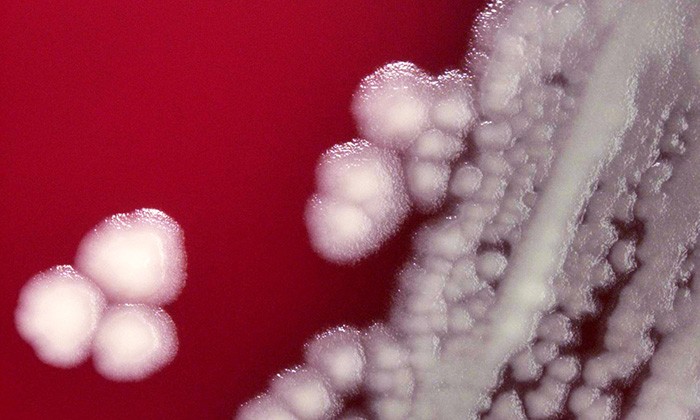 Figure: Bacillus anthracis colonies in Blood Agar at 10x magnification. Photo credit: Todd Parker/CDC.
Colony morphology of B. anthracis after 24 hours of incubation is as follows:
Blood agar
Bacillus anthracis produces dry wrinkled, non-hemolytic colonies with frosted glass appearance after overnight incubation on sheep blood agar. Occasionally the colonies may have fringed edges or put out curled protrusions (tailing). This is the so-called “Medusa head appearance” but is not encountered as frequently as textbooks often suggest, and varies from batch-to-batch of media.
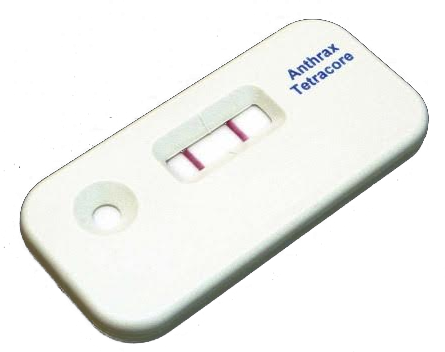 Figure: Identification of Bacillus anthracis colony
Non-hemolytic Bacillus colonies can be presumptively identified using ‘Red Line Alert Test‘, which is an immunochromatographic test for the detection of surface protein found in Bacillus anthracis vegetative cells.
Medusa head appearance: When colonies are viewed under a low power microscope, the edge of the colony which is composed of long interlacing chains of bacilli, appears as locks of matted hair.
Gelatin stab
Growth occurs as inverted fir tree appearance (due to liquefaction of gelatin which occurs maximum at the surface, and then slows down towards the bottom).
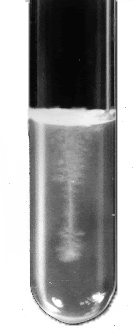 Figure: Inverted fir tree appearance
Selective and differential media
- String of pearls test (penicillin): on media with low-dose penicillin, B. anthracis cells swell into large spheres that line up in a chain, giving a string of pearls appearance under the microscope. This is a useful presumptive test, because B. cereus does not show this reaction
- PLET medium: It consists of polymyxin, lysozyme, EDTA and thallous acetate added in heart infusion agar. It has been devised to isolate B. anthracis from mixtures of other spore-bearing bacilli.
Gram staining of the culture smear, reveals bamboo stick appearance, i.e. a long chain of gram-positive bacilli with non-bulging spores (appear as empty space).
Serology
Antibodies appear in convalescent sera and can be detected by ELISA or indirect hemagglutination methods.
Molecular diagnosis
PCR with specific primers can be used for further confirmation.
Treatment of anthrax
The single most important principle is that anthrax must be treated early, before the toxin load becomes overwhelming. Once enough lethal toxin has been produced, antibiotics alone may not save the patient, because antibiotics kill the bacteria but do not neutralize toxin already released.
Antibiotics. B. anthracis is usually susceptible to penicillin, and penicillin has traditionally been a drug of choice for naturally acquired anthrax. However, for inhalational anthrax, exposure from a possible bioterrorism event, or serious systemic disease, a fluoroquinolone (ciprofloxacin) or doxycycline is preferred, because engineered or resistant strains cannot be excluded and these agents are recommended first-line in that setting. Severe systemic anthrax is treated with a combination of antibiotics.
Antitoxin. For severe systemic disease, antitoxin directed against protective antigen can be added to antibiotics, because neutralizing the toxin addresses the part of the disease that antibiotics cannot.
Post-exposure prophylaxis (PEP). After a known inhalational exposure (for example, a bioterrorism release), exposed people are given prophylactic antibiotics, because spores can remain dormant in the body and germinate late. Prophylaxis is combined with vaccination. This is a public-health decision made by health authorities, not a routine prescription.
Prevention of anthrax
Control in animals is the foundation: vaccinating livestock in endemic areas, and safe disposal (not opening or butchering) of animals that die suddenly, because opening the carcass exposes the vegetative bacteria to air and triggers heavy sporulation that contaminates the soil.
Occupational protection for people who handle wool, hides, hair, and bone products reduces cutaneous and inhalational risk.
Vaccine. An anthrax vaccine based on protective antigen is used for people at high occupational or military risk. PA is the target because antibody against PA blocks the delivery step of the toxin.
Spore handling. Because spores are extremely resistant, environmental decontamination requires sporicidal methods, and suspected material must be handled by trained personnel under the appropriate biosafety conditions.
How to Remember
| Device | The memory hook |
|---|---|
| Two plasmids, two weapons | pXO1 = the 1 toxin (three parts). pXO2 = the capsule (think "2" for the second defense). Need both for full virulence. |
| PA is the door, EF and LF walk in | Protective Antigen makes the Pore ("door"). Edema factor and lethal factor cannot enter without it. That is why the vaccine targets PA: block the door and neither factor gets in. |
| EF = Edema, cAMP up | Edema Factor is an adenylate cyclase. It raises cAMP, and the swelling follows. E for edema, E for enzyme that makes cAMP. |
| LF = Lethal, cuts signals | Lethal Factor cleaves MAPKK, killing cells and causing shock. L for lethal, L for the factor that actually kills. |
| Boxcar / bamboo stick | Square-ended rods in chains look like boxcars, and in culture the chains with clear spore gaps look like a jointed bamboo stick. |
| Painless black eschar | Cutaneous anthrax is a painless, black, swollen ulcer. Painless plus black plus edema = think anthrax, not an ordinary boil. |
| Non-motile, non-hemolytic | B. anthracis is non-motile and non-hemolytic. Its close relative B. cereus is motile and beta-hemolytic. This pair separates them. |
| Widened mediastinum | Inhalational anthrax gives a widened mediastinum, not a lobar pneumonia. The spores go to the mediastinal nodes. |
Key exam facts in one table
| Feature | Bacillus anthracis |
|---|---|
| Morphology | Gram-positive large rectangular rods in chains, boxcar/bamboo-stick appearance |
| Spores | Central, elliptical, non-bulging; not seen in clinical specimens, seen in culture |
| Motility | Non-motile (distinguishes from B. cereus) |
| Oxygen | Aerobe |
| Capsule | Polypeptide (poly-D-glutamate), antiphagocytic; encoded on pXO2 |
| Toxin plasmid | pXO1 (encodes PA, EF, LF) |
| Protective antigen (PA) | Binds receptor, forms pore, delivers EF and LF; vaccine target |
| Edema factor (EF) | Adenylate cyclase; raises cAMP; causes edema (edema toxin = PA + EF) |
| Lethal factor (LF) | Protease; cleaves MAPKK; causes cell death, shock (lethal toxin = PA + LF) |
| Blood agar | Dry, non-hemolytic, "frosted glass" colonies; Medusa head edges (variable) |
| Gelatin stab | Inverted fir tree |
| String of pearls | Positive with penicillin (negative in B. cereus) |
| McFadyean reaction | Capsule as pink/purple halo around blue bacilli (animal anthrax) |
| Selective medium | PLET |
| Main clinical forms | Cutaneous (95–99%), inhalational, gastrointestinal, injectional |
| Cutaneous sign | Painless black eschar with marked edema |
| Inhalational sign | Widened mediastinum (hemorrhagic mediastinal lymphadenitis) |
| Person-to-person spread | No; BSL-2 for routine diagnostics |
| Biothreat | CDC Category A agent |
| Historical note | Koch's postulates; Pasteur's first live attenuated bacterial vaccine |
Where Students Get Confused
| Confusion | The clarification |
|---|---|
| What does "protective antigen" protect? | It does not protect the host during infection. It is called protective because antibody against it is protective, which is why it is the vaccine target. On the organism's side it is the delivery component that forms the pore. |
| Which factor causes edema, which causes death? | Edema factor (EF) raises cAMP and causes swelling. Lethal factor (LF) cleaves MAPKK and causes cell death and shock. Both need PA to enter the cell. |
| B. anthracis vs. B. cereus | B. anthracis: non-motile, non-hemolytic, capsulated, string-of-pearls positive. B. cereus: motile, beta-hemolytic, no capsule. |
| Why is the eschar painless? | The lesion is driven by toxin, not by a pus-forming inflammatory response, so it is typically painless despite looking severe. Painlessness is a clue, not reassurance. |
| Is inhalational anthrax a pneumonia? | Not really. Spores travel to the mediastinal lymph nodes and cause hemorrhagic mediastinitis, seen as a widened mediastinum, rather than a typical airspace pneumonia. |
| Do you need both plasmids? | Yes, for full virulence. Losing pXO1 (toxin) or pXO2 (capsule) strongly attenuates the organism. Vaccine strains are made by removing one. |
| Is anthrax contagious person-to-person? | No. It spreads from spores in the environment or animal products, not between people. Routine lab work is BSL-2. |
| Why treat early and why add antitoxin? | Antibiotics kill the bacteria but not the toxin already released. Early treatment limits toxin production, and antitoxin neutralizes toxin in severe disease. |
References and further readings
- Tille, P. M. (2022). Bailey & Scott's Diagnostic Microbiology (15th ed.). Elsevier.
- Procop, G. W., & Koneman, E. W. (2017). Koneman's Color Atlas and Textbook of Diagnostic Microbiology (7th ed.). Wolters Kluwer.
- Carroll, K. C., Pfaller, M. A., et al. (2020). Murray's Medical Microbiology (9th ed.). Elsevier.
- World Health Organization. (2008). Anthrax in Humans and Animals (4th ed.). Geneva: WHO.
- Centers for Disease Control and Prevention. Anthrax: information for health professionals. CDC (current version).
Frequently Asked Questions
What are the three components of anthrax toxin and what does each do?
What are the three components of anthrax toxin and what does each do?
Protective antigen (PA) binds host cells and forms a pore that delivers the other two into the cell. Edema factor (EF) is an adenylate cyclase that raises cAMP and causes edema. Lethal factor (LF) is a protease that cleaves MAPKK signaling proteins, causing cell death and shock. PA plus EF is edema toxin; PA plus LF is lethal toxin.
Why is protective antigen called "protective" if it helps the toxin?
Why is protective antigen called "protective" if it helps the toxin?
The name refers to immunity, not to the host during infection. Antibodies against protective antigen protect a vaccinated person, because they block the delivery step of the toxin. On the organism's side, PA is actually the component that forms the pore and lets the harmful factors into the cell. That is also why PA is the target of the anthrax vaccine.
Why are both plasmids pXO1 and pXO2 important?
Why are both plasmids pXO1 and pXO2 important?
pXO1 carries the toxin genes and pXO2 carries the capsule genes. The organism needs both for full virulence: the capsule protects the bacteria from being eaten by phagocytes while they multiply, and the toxin then causes the tissue damage and shock. Removing either plasmid strongly weakens the organism, which is how some vaccine strains are made.
How is Bacillus anthracis distinguished from Bacillus cereus in the lab?
How is Bacillus anthracis distinguished from Bacillus cereus in the lab?
B. anthracis is non-motile, non-hemolytic, capsulated, and string-of-pearls positive with penicillin. B. cereus is motile, beta-hemolytic, and non-capsulated. These features reliably separate the two.
Why is the skin lesion of cutaneous anthrax painless?
Why is the skin lesion of cutaneous anthrax painless?
The lesion is caused mainly by the toxin rather than by a pus-forming inflammatory response, so it is typically painless even though it looks severe, forming a black eschar with marked surrounding swelling. The painlessness is a diagnostic clue.
Is inhalational anthrax the same as anthrax pneumonia?
Is inhalational anthrax the same as anthrax pneumonia?
Not exactly. Inhaled spores travel to the mediastinal lymph nodes and cause hemorrhagic mediastinitis, which shows as a widened mediastinum on chest imaging, rather than a typical airspace pneumonia. This is why it is called inhalational anthrax rather than anthrax pneumonia.
Is anthrax contagious from person to person?
Is anthrax contagious from person to person?
No. Anthrax is acquired from spores in soil, in contaminated animal products, or in a deliberate release, not by spread between people. Routine laboratory diagnosis is done under standard BSL-2 conditions.
Why must anthrax be treated as early as possible?
Why must anthrax be treated as early as possible?
Antibiotics kill the bacteria but do not neutralize toxin that has already been released. Early treatment limits how much toxin is produced. In severe systemic disease, antitoxin against protective antigen can be added to neutralize circulating toxin.

Tankeshwar Acharya, MSc (Medical Microbiology)
Tankeshwar Acharya is an Assistant Professor in the Department of Microbiology at Patan Academy of Health Sciences (PAHS), Nepal, where he has been teaching and practicing clinical microbiology for over 14 years. He is the founder of Microbe Online, one of the leading free microbiology education resources on the web, covering bacteriology, mycology, parasitology, immunology, and clinical laboratory diagnostics written from direct experience in both the classroom and the diagnostic laboratory.
Comments
No comments yet. Be the first to share your thoughts.
Leave a comment
All comments are reviewed before they appear.