
Zika Virus: Transmission, Pathogenesis, Symptoms, and Lab Diagnosis
Zika virus is a mosquito-borne flavivirus that can cause congenital Zika syndrome in pregnancy and Guillain-Barré syndrome in adults. Learn its transmission, pathogenesis, symptoms, and diagnosis.

On this page
For nearly 70 years, Zika virus was a medical footnote: a mild illness, discovered in a Ugandan forest, that caused a few days of fever and rash and little else. Then, in 2015, doctors in northeastern Brazil noticed something alarming. Babies were being born with unusually small heads, and the number was rising fast.
Within months, a virus that had barely troubled anyone became a global emergency. The reason was not that Zika had become more common. It was that, for the first time, its effect on the unborn child had become visible.
Zika virus (ZIKV) is a mosquito-borne virus first isolated from a monkey in the Zika forest of Uganda in 1947. For decades it caused only sporadic, mild illness in Africa and Asia and attracted little attention. That changed dramatically in 2015, when a large outbreak in Brazil was linked to a sharp rise in babies born with microcephaly (an abnormally small head). This link brought Zika worldwide attention and, in 2016, led the World Health Organization to declare it a Public Health Emergency of International Concern.
ZIKV is a flavivirus, a family that also includes dengue, yellow fever, Japanese encephalitis, and West Nile viruses. Like them, it has a single-stranded, positive-sense RNA genome and is enveloped. It is spread mainly by Aedes mosquitoes, the same mosquitoes that spread dengue and chikungunya. In humans and other primates the virus circulates, but the full details of its natural maintenance cycle in the wild are still not completely defined.
Transmission
Zika virus spreads to people in several ways. The main route is through the bite of an infected Aedes mosquito, mainly Aedes aegypti in tropical regions. These mosquitoes typically bite during the day, in the morning and late afternoon. This is the same mosquito that transmits dengue, chikungunya, and yellow fever.
Beyond the mosquito, three other routes are now well established and clinically important:
- Mother to fetus. A pregnant woman can pass Zika to her fetus during pregnancy. This is the route responsible for congenital Zika syndrome and is the reason Zika is so serious.
- Sexual transmission. Zika can be transmitted through sex, including from male to female, female to male, and between male partners. The virus can persist in semen for weeks to months after symptoms resolve, longer than in blood. This is a major difference from dengue and yellow fever, which do not spread sexually, and it shapes prevention advice for couples.
- Blood transfusion. Transmission through transfused blood is possible, though infrequent, so standard blood-safety measures apply.
Zika was long confined to Africa and Asia, causing only sporadic outbreaks. In May 2015, Brazil confirmed local transmission, and the virus spread rapidly across the Americas, eventually reaching more than 80 countries and territories. After the large 2015 to 2016 epidemic, transmission declined sharply as population immunity built up, and the WHO ended the emergency declaration in November 2016. Zika has not disappeared, however, and continues to circulate at lower levels in many tropical regions, remaining a risk for travelers and for pregnant women in affected areas.
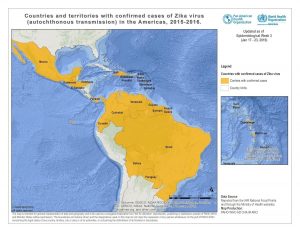 Figure: Spread of Zika across the Americas during the 2015 to 2016 epidemic.
Pathogenesis of Zika virus
Zika causes disease in two very different settings: a usually mild infection in the person who is bitten, and a potentially devastating infection of the developing fetus. The pathogenesis differs between the two.
In the infected person. After a mosquito bite, the virus first replicates in skin cells and nearby lymph nodes, then spreads through the blood (viremia) to other tissues. In most people the immune system controls the infection quickly, which is why symptoms are mild or absent. The virus is a flavivirus, so like dengue it targets several cell types, but it generally does not cause the severe plasma leakage seen in severe dengue.
In the fetus (congenital infection). The danger of Zika lies in its ability to cross the placenta and infect the fetus. The virus has a particular tropism for neural progenitor cells, the stem cells that build the fetal brain. By infecting and killing these cells, and disrupting their division, the virus interferes with brain growth. Because these cells are most active early in development, infection in the first trimester carries the greatest risk. The result can be reduced brain growth and the small head (microcephaly) that first drew attention to the virus, along with other brain and eye abnormalities.
In Guillain-Barré syndrome. In some adults, Zika triggers Guillain-Barré syndrome, a condition in which the immune system, activated by the infection, mistakenly attacks the body's own peripheral nerves. This is not the virus damaging nerves directly; it is an immune response gone wrong after the infection. It causes ascending muscle weakness that can become severe.
Signs and Symptoms
The incubation period is usually a few days, generally 3 to 14 days after the mosquito bite.
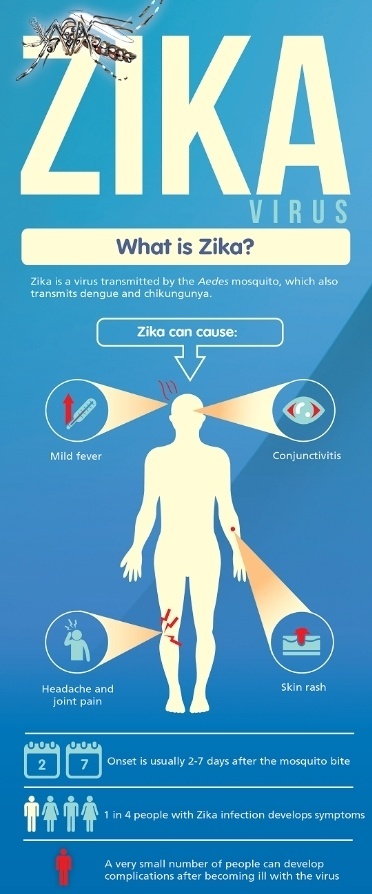 Figure: Zika virus signs and symptoms
Most infections cause no symptoms at all. Only about one in five to one in four infected people develops symptoms, and when symptoms do occur, the illness is usually mild. This is important, because a pregnant woman can be infected, and pass the virus to her fetus, without ever feeling ill.
When present, the symptoms resemble other arbovirus infections such as dengue and chikungunya: fever, an itchy rash, conjunctivitis (red eyes), muscle and joint pain, malaise, and headache. They usually last 2 to 7 days. Conjunctivitis is a useful clue, as it is more typical of Zika than of dengue.
Zika virus and pregnancy: congenital Zika syndrome
It is now established that Zika virus infection during pregnancy causes birth defects. This is no longer a matter of preliminary research; the causal link was confirmed by the WHO in 2016 after extensive study.
The most well-known result is microcephaly, an abnormally small head caused by poor brain growth. But microcephaly is only one part of a wider pattern now called congenital Zika syndrome, which can include:
- severe microcephaly with a partly collapsed skull,
- brain calcifications and other brain abnormalities on imaging,
- eye damage, including scarring and problems with the retina,
- limbs fixed in position (contractures),
- increased muscle tone restricting movement soon after birth.
The risk is greatest when infection occurs in the first trimester, when the fetal brain is developing most rapidly, though damage can follow infection later in pregnancy as well. Zika infection in pregnancy can also lead to pregnancy loss and stillbirth.
Because most infected women have no symptoms, a woman may not know she has been infected. This is why prevention (avoiding mosquito bites and considering the risk of sexual transmission) is central for pregnant women in or traveling to affected areas.
Zika virus and Guillain-Barré syndrome
In adults, the most important complication of Zika is Guillain-Barré syndrome (GBS). During the outbreaks in the Americas, countries with Zika epidemics saw a clear rise in GBS cases.
GBS is a condition in which the immune system, triggered by a recent infection, attacks the body's own peripheral nerves. It causes muscle weakness that usually begins in the legs and moves upward, and in severe cases it can affect the muscles used for breathing and require intensive care. Most people recover, though recovery can take weeks to months. The link between Zika and GBS is now well established and is one of the main reasons Zika is taken seriously even in adults who are not pregnant.
Diagnosis of Zika virus
In most people, diagnosis is based on clinical symptoms and epidemiological circumstances (such as Zika outbreak in the patient’s area or trips to areas where the virus is circulating).
Laboratory diagnosis depends on how long the patient has been ill, because the virus and the antibody response appear at different times.
- RT-PCR (nucleic acid detection): the preferred test early in the illness. It detects the virus itself in blood or urine. It is most useful in the first days after symptoms begin, while the virus is still present. Urine can stay positive slightly longer than blood. A positive PCR confirms the diagnosis.
- Virus isolation: the virus can be grown from blood, but this is slow and used mainly in reference or research laboratories, not for routine diagnosis.
- Serology (antibody detection): IgM antibodies appear about a week after infection and are useful once it is too late for PCR. The major problem is cross-reactivity: Zika antibodies cross-react with other flaviviruses such as dengue, West Nile, and yellow fever, which are common in the same regions and can cause false positives. A positive antibody test therefore often needs confirmation with a neutralization test (such as the PRNT) to be sure the antibodies are specific to Zika.
The cross-reactivity between Zika and dengue is a central diagnostic challenge, because the two circulate in the same places, are spread by the same mosquito, and cause similar illness. Distinguishing them matters, both for the pregnant patient and because severe dengue is managed differently.
Once local transmission is confirmed in an area, health authorities such as the Pan American Health Organization note that testing every case is no longer necessary, and laboratory work shifts to routine surveillance instead.
Treatment and prevention of Zika virus
There is no specific antiviral treatment for Zika. Care is supportive: rest, fluids, and medicine to relieve fever and pain. Because early Zika can be hard to tell apart from dengue, and because certain painkillers (NSAIDs such as aspirin and ibuprofen) can worsen bleeding in dengue, paracetamol (acetaminophen) is preferred until dengue has been ruled out.
There is currently no licensed Zika vaccine, though several candidates have progressed through early clinical trials. Developing one has been difficult partly because the epidemic waned before large efficacy trials could be completed.
Prevention therefore rests on avoiding infection:
- Avoid mosquito bites: use insect repellent, wear covering clothing, and use screens and bed nets. Because Aedes bites during the day, daytime protection matters.
- Reduce mosquito breeding: remove standing water around homes where Aedes mosquitoes breed.
- Prevent sexual transmission: couples in which one partner may have been exposed, especially when the woman is or may become pregnant, should use condoms or avoid sex for the period advised by health authorities, because the virus can persist in semen for months.
- Pregnancy precautions: pregnant women are advised to avoid travel to areas with Zika transmission where possible, and to take strict precautions against both mosquito bites and sexual exposure if they live in or must travel to such areas.
How to Remember
Same mosquito, different danger ("dengue's cousin with a cruel twist"): Zika rides the same Aedes mosquito as dengue, chikungunya, and yellow fever, and looks like a mild dengue. Its cruel twist is what it does in pregnancy. Remember Zika as "the arbovirus that attacks the unborn brain."
Why microcephaly ("the virus that eats the brain's builders"): Zika targets the neural progenitor cells that build the fetal brain. Kill the builders early (first trimester) and the brain cannot grow, hence the small head. The tropism explains the timing and the defect in one idea.
Two victims, two mechanisms: in the fetus, the virus directly damages brain-building cells. In the adult with GBS, the virus does not attack nerves directly; the immune response does. Direct damage in the baby, friendly-fire damage in the adult.
The routes beyond the bite ("blood, birth, and bed"): Zika spreads by mosquito, but also by blood, birth (mother to fetus), and bed (sex). The sexual route is what separates it from dengue and yellow fever.
Key exam facts
| Fact | Detail |
|---|---|
| Family | Flaviviridae (flavivirus) |
| Genome | Single-stranded, positive-sense RNA; enveloped |
| Relatives | Dengue, yellow fever, Japanese encephalitis, West Nile |
| Vector | Aedes mosquito (mainly Aedes aegypti), daytime biter |
| First isolated | Zika forest, Uganda, 1947 |
| Major outbreak | Brazil and the Americas, 2015 to 2016 |
| Emergency status | WHO PHEIC declared Feb 2016, lifted Nov 2016 |
| Transmission routes | Mosquito, mother to fetus, sexual, blood transfusion |
| Sexual route | Established; virus persists in semen for weeks to months |
| Symptomatic share | Only about 1 in 5 to 1 in 4 (most infections silent) |
| Typical symptoms | Fever, itchy rash, conjunctivitis, joint/muscle pain (mild, 2 to 7 days) |
| Congenital effect | Congenital Zika syndrome (microcephaly, brain calcifications, eye damage) |
| Highest fetal risk | First trimester |
| Fetal mechanism | Tropism for neural progenitor cells |
| Adult complication | Guillain-Barré syndrome (immune-mediated) |
| Preferred early test | RT-PCR (blood or urine) |
| Serology problem | Cross-reacts with dengue and other flaviviruses; confirm with PRNT |
| Treatment | Supportive only; paracetamol preferred until dengue excluded |
| Vaccine | None licensed; candidates in trials |
Where Students Get Confused
"Is Zika a serious disease or a mild one?" Both, depending on who is infected. In the person bitten, it is usually mild or symptomless. In a developing fetus, it can cause severe, permanent brain damage. The mildness in adults is exactly what makes it dangerous, because an infected pregnant woman may never know she was infected.
"How is Zika different from dengue if the same mosquito spreads both?" Same vector, same regions, similar mild illness, but three key differences: Zika crosses the placenta and damages the fetal brain, Zika spreads sexually, and Zika triggers Guillain-Barré syndrome. Dengue's danger is severe dengue with plasma leakage and shock, which Zika does not typically cause.
"Why is Zika serology so unreliable?" Because Zika antibodies cross-react with other flaviviruses, especially dengue, which circulates in the same areas. A positive antibody test may reflect past dengue, not Zika. This is why a confirmatory neutralization test (PRNT) is often needed, and why PCR is preferred early.
"Does Zika damage nerves directly in Guillain-Barré syndrome?" No. In GBS, the virus triggers the immune system, which then attacks the body's own peripheral nerves. The damage is immune-mediated, not the virus attacking nerves directly. This differs from the fetal brain, where the virus does infect and kill cells directly.
"Is there a vaccine for Zika?" Not yet. Several candidates have been tested in early trials, but none is licensed. Part of the difficulty is that the epidemic faded before large trials could prove efficacy. Prevention still depends on avoiding bites and sexual exposure.
"Only pregnant women need to worry about Zika, right?" No. Guillain-Barré syndrome can affect anyone, and although rare, it can be severe. Pregnancy is the highest-stakes situation, but Zika is not risk-free for others.
Frequently Asked Questions
What kind of virus is Zika?
What kind of virus is Zika?
Zika is a flavivirus, a single-stranded RNA virus in the same family as dengue, yellow fever, and West Nile. It is spread mainly by Aedes mosquitoes.
How is Zika virus transmitted?
How is Zika virus transmitted?
Mainly by the bite of an infected Aedes mosquito. It also spreads from a pregnant woman to her fetus, through sex, and rarely through blood transfusion.
Why is Zika dangerous in pregnancy?
Why is Zika dangerous in pregnancy?
The virus can cross the placenta and infect the developing fetal brain, targeting the cells that build the brain. This can cause microcephaly and other defects, together called congenital Zika syndrome. The risk is highest in the first trimester.
What are the symptoms of Zika?
What are the symptoms of Zika?
Most people have no symptoms. When present, symptoms are mild: fever, itchy rash, red eyes (conjunctivitis), and joint and muscle pain, lasting a few days.
How is Zika diagnosed?
How is Zika diagnosed?
By RT-PCR early in the illness (detecting the virus in blood or urine), and by antibody tests later. Antibody tests can cross-react with dengue, so a confirmatory neutralization test is sometimes needed.
Is there a treatment or vaccine for Zika?
Is there a treatment or vaccine for Zika?
There is no specific treatment; care is supportive. Paracetamol is preferred over ibuprofen or aspirin until dengue is ruled out. There is no licensed vaccine yet, though several are in development.
What is the link between Zika and Guillain-Barré syndrome?
What is the link between Zika and Guillain-Barré syndrome?
In some adults, Zika triggers Guillain-Barré syndrome, where the immune system attacks the body's own nerves, causing muscle weakness. It is a recognized complication in non-pregnant adults.
References
- World Health Organization. (2025). Zika virus [Fact sheet]. https://www.who.int/news-room/fact-sheets/detail/zika-virus
- Centers for Disease Control and Prevention. (2024). About Zika. https://www.cdc.gov/zika/
- Musso, D., & Gubler, D. J. (2016). Zika virus. Clinical Microbiology Reviews, 29(3), 487–524. https://doi.org/10.1128/CMR.00072-15
- Pierson, T. C., & Diamond, M. S. (2018). The emergence of Zika virus and its new clinical syndromes. Nature, 560(7720), 573–581. https://doi.org/10.1038/s41586-018-0446-y
- Counotte, M. J., et al. (2019). Zika virus infection as a cause of congenital brain abnormalities and Guillain-Barré syndrome: A living systematic review. PLOS Medicine / F1000Research. https://doi.org/10.12688/f1000research.19918.1

Tankeshwar Acharya, MSc (Medical Microbiology)
Tankeshwar Acharya is an Assistant Professor in the Department of Microbiology at Patan Academy of Health Sciences (PAHS), Nepal, where he has been teaching and practicing clinical microbiology for over 14 years. He is the founder of Microbe Online, one of the leading free microbiology education resources on the web, covering bacteriology, mycology, parasitology, immunology, and clinical laboratory diagnostics written from direct experience in both the classroom and the diagnostic laboratory.
Comments
No comments yet. Be the first to share your thoughts.
Leave a comment
All comments are reviewed before they appear.