
Transport Media Used in Microbiology Lab
Which transport medium to reach for depending on the suspected organism, why there's no single universal choice, and links to the full mechanism of each.
One morning, three specimens, three different tubes.
A single morning's specimen log at a district hospital laboratory might include a stool sample from a suspected cholera case, a throat swab from a suspected diphtheria patient, and a genital swab for suspected gonorrhea, none of them processable on-site, all three headed to a central reference laboratory. Grabbing the wrong transport tube for any one of them doesn't just produce a slightly worse sample. It can mean the organism is dead on arrival, and a true infection comes back reported as a false negative.
There is no single, universal transport medium. The right choice depends entirely on which organism is actually suspected, and this article is a map of exactly which one to reach for, and why, with links to the full mechanism of each.
Transport media are buffered solutions containing salts and, in some cases, carbohydrates or peptones, but deliberately excluding growth factors, designed to preserve the viability of an organism during transport without allowing it to multiply. The goal is to keep a specimen as close to its original state as possible between collection and processing.
This is the single most important conceptual distinction in this topic: a transport medium is not a growth medium. Its entire design goal is to hold organisms in a stable, non-multiplying, non-dying state, the opposite job of a culture medium, which is built specifically to support active growth.
Which Transport Medium for Which Organism
The useful question is not "which medium do I have?" but "what am I afraid might die in transit?" The choice always starts with the suspected organism's fragility. A robust organism tolerates a wide range of conditions, while a fastidious one such as Neisseria gonorrhoeae or Vibrio cholerae demands exactly the right buffer, atmosphere, and timing. There is no generic swab medium that is correct for everything.
| Suspected organism / specimen | Recommended medium |
|---|---|
| Routine bacteriology (throat, wound, ear, eye) | Amies with or without charcoal, or a liquid-based system such as eSwab |
| Salmonella, Shigella, Campylobacter (stool) | Cary and Blair medium |
| Vibrio cholerae (stool) | Cary and Blair medium (WHO-preferred); alkaline peptone water only as a backup if Cary-Blair is unavailable and subculture is possible within 6 hours |
| N. gonorrhoeae, H. influenzae, N. meningitidis, H. ducreyi (swabs) | Amies medium with charcoal |
| Mycoplasma, Ureaplasma (swabs) | Amies medium without charcoal |
| Bacillary dysentery, historical (stool) | Sach's buffered glycerol saline |
| Anaerobic bacteria | Anaerobic transport medium (pre-reduced, with reducing agent and redox indicator) |
| Viral pathogens (respiratory, ocular, tissue swabs) | Viral Transport Medium (VTM) |
Note: Full mechanism, composition, and handling rules for Cary-Blair and Amies are covered in their own dedicated articles, linked above; the sections below stay intentionally brief.
Common Transport Media
Cary and Blair Medium. A semi-solid, white-colored transport medium for feces that may contain Salmonella, Shigella, Vibrio, or Campylobacter.
Amies medium. See the full Amies Transport Medium article for the complete composition, the charcoal vs. charcoal-free distinction, and handling rules.
Stuart's medium. Still in use for throat, wound, and skin swabs, and historically the standard for gonococcal specimens. Amies medium was later developed specifically to improve on Stuart's design, removing a buffering component (glycerophosphate) that could accidentally serve as a carbon source for some organisms, letting them multiply during transport. See the Amies article linked above for the full explanation.
Venkatraman Ramakrishnan (VR) medium. Historically used to transport feces from suspected cholera patients; no longer in use, replaced by Cary-Blair medium.
Alkaline Peptone Water (APW). Primarily an enrichment medium rather than a pure transport medium. Its high pH (8.6) actively favors Vibrio while suppressing competing enteric flora, so the target organism increases during the holding period rather than merely surviving. This is why the window is short: beyond about 6 hours, competing organisms begin to adapt and the enrichment advantage is lost. Use Alkaline Peptone Water (APW) for suspected cholera only when Cary-Blair is unavailable and subculture can be performed within that window.
Sach's buffered glycerol saline. Used to transport feces from patients suspected of bacillary dysentery,now largely superseded by Cary-Blair.
Viral Transport Medium (VTM)
Requires a Dacron or nylon flocked swab on a plastic shaft. Cotton, calcium alginate, and wooden-shafted swabs all compromise viral recovery or inhibit PCR, and wooden shafts risk splinter injury during nasopharyngeal collection. See the full VTM article for sample types and handling, and Types of Swabs in Microbiology for swab material selection across all specimen types.
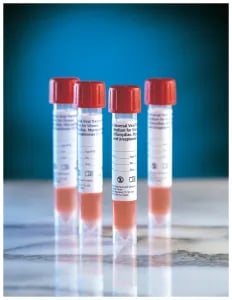 Anaerobic Transport Medium (ATM). A mineral salt-base semi-solid medium with reducing agents (sodium thioglycollate, cysteine), designed to maintain anaerobic organism viability without significant multiplication. Resazurin may be added as a redox indicator, turning pink if the medium is exposed to oxygen.
Thioglycollate broth is often confused with anaerobic transport medium because both contain sodium thioglycollate as a reducing agent, but it is an enrichment and growth medium, designed to support multiplication rather than prevent it.
General Handling and Timing
Transport promptly. The 24 and 48 hour figures quoted for various media are validated maxima under controlled conditions, not working targets. Recovery of fastidious organisms declines steadily with time in any medium.
Refrigerate, with two important exceptions. Most bacterial specimens in transport medium hold better at 2 to 8°C. But specimens for Neisseria gonorrhoeae and Neisseria meningitidis are cold-sensitive and should be held at room temperature, and anaerobic specimens should not be refrigerated because oxygen dissolves more readily as temperature falls.
Never freeze bacterial specimens. Freezing kills most vegetative bacteria. Freezing applies only to viral specimens held for longer periods, and then only at -70°C or below. For routine transport, viral specimens go at 2 to 8°C. A -20°C freezer damages viral specimens and should not be used.
Do not use expired or dried media. Buffering capacity and reducing agents degrade over time. A semi-solid medium that has dried at the surface or changed color has lost the properties it was selected for.
Key exam facts in one table
| Fact | Detail |
|---|---|
| Core principle | Preserves organism viability without allowing multiplication; not a growth medium |
| Contains | Buffers and salts, sometimes small amounts of peptone or carbohydrate; no enrichment sufficient to support multiplication |
| Classified by physical state | Semi-solid or liquid |
| Classified by utility | Bacterial or viral transport media |
| Cholera specimen, preferred | Cary-Blair medium (WHO-recommended) |
| Cholera specimen, backup only | Alkaline peptone water (inferior to Cary-Blair; only if subculture within 6 hours) |
| Fastidious swab pathogens | Amies with charcoal |
| Mycoplasma/Ureaplasma | Amies without charcoal |
| Obsolete medium | VR medium (replaced by Cary-Blair) |
Where Students Get Confused
- Treating transport media as growth media. The whole design goal is the opposite: hold the organism steady without letting it multiply, unlike a culture medium built to support active growth.
- Assuming alkaline peptone water is just as good as Cary-Blair for cholera. It's a backup only, used specifically when Cary-Blair is unavailable and subculture can happen quickly.
- Assuming Amies and Stuart's medium are functionally identical. Amies specifically fixed a design flaw in Stuart's medium (glycerophosphate acting as an unintended carbon source); they aren't interchangeable in principle, even though they serve similar specimen types.
- Citing VR medium as current practice. It shows up in older references and textbooks but has been replaced by Cary-Blair medium.
How to Remember
Ask what might die in transit. The organizing question for the whole topic. Medium selection follows from the suspected organism's fragility, not from what tube happens to be on the shelf.
A waiting room, not a dining hall. A transport medium keeps organisms alive without feeding them. Anything that fed the pathogen would feed its faster-growing neighbors even better, and the specimen arriving would misrepresent the one collected. The poverty is deliberate.
Amies fixed Stuart's carbon leak. Stuart's used glycerophosphate as buffer, which some organisms could metabolize. Amies swapped it for inorganic phosphate and added charcoal to adsorb toxic fatty acids. One change closed a loophole, the other added protection.
Charcoal is a sponge for poisons. Wherever charcoal appears, its job is mopping up fatty acids and metabolic products that would otherwise kill delicate pathogens. That is why Amies with charcoal is the choice for Neisseria.
Cold for most, warm for Neisseria, never frozen for bacteria. The three-part storage rule. Refrigerate bacterial specimens generally, keep gonococcal and meningococcal specimens at room temperature, and reserve freezing for viral specimens at -70°C only.
References
- Tille PM. Bailey & Scott's Diagnostic Microbiology. 15th ed. St. Louis: Elsevier; 2022.
- Leber AL, editor. Clinical Microbiology Procedures Handbook. 4th ed. Washington, DC: ASM Press; 2016.
- World Health Organization. Laboratory Methods for the Diagnosis of Epidemic Dysentery and Cholera. Geneva: WHO. [verify current edition]
- Johnson FB. Transport of viral specimens. Clin Microbiol Rev. 1990;3(2):120–131.
- McLeod SD, Kumar A, Cevallos V, Srinivasan M, Whitcher JP. Reliability of transport medium in the laboratory evaluation of corneal ulcers. Am J Ophthalmol. 2005;140(6):1027–1031.
Frequently Asked Questions
Why do transport media contain no nutrients?
Can bacterial transport medium (Amies or Stuart's) be used for viral specimens?
Which transport medium should be used for a stool specimen when Vibrio cholerae is suspected?
How is a transport medium different from a culture medium?
Is thioglycollate broth a transport medium?
How long can a specimen stay in transport medium?

Tankeshwar Acharya, MSc (Medical Microbiology)
Tankeshwar Acharya is an Assistant Professor in the Department of Microbiology at Patan Academy of Health Sciences (PAHS), Nepal, where he has been teaching and practicing clinical microbiology for over 14 years. He is the founder of Microbe Online, one of the leading free microbiology education resources on the web, covering bacteriology, mycology, parasitology, immunology, and clinical laboratory diagnostics written from direct experience in both the classroom and the diagnostic laboratory.