
Trans-Isolate (T-I) Medium: Inoculation, Transport, and the Rules
Why three of the most feared meningitis pathogens die within hours outside the CSF, and the one venting decision that's easy to reverse by mistake when a sample has to travel.
The sample that has to outlast the trip
A rural hospital performs a lumbar puncture on a child with suspected bacterial meningitis. The nearest laboratory equipped to culture and test susceptibility on the sample is hours away. Neisseria meningitidis, Streptococcus pneumoniae, and Haemophilus influenzae, the three organisms responsible for the overwhelming majority of bacterial meningitis cases, are all notoriously fragile once outside the protected environment of CSF. A delay of even a few hours in a dry, unsupported specimen can mean the difference between confirming the exact pathogen and its susceptibility pattern, information that matters for both individual treatment and outbreak surveillance, and a falsely negative culture that leaves the diagnosis unconfirmed.
Trans-Isolate (T-I) medium exists specifically to close that gap. Its biphasic design, a solid charcoal-and-starch slant paired with a buffered liquid broth, keeps all three of these fastidious organisms alive for as long as a week if needed, buying exactly the time a specimen needs to reach wherever it's going. This is why the World Health Organization distributes T-I media directly to national reference laboratories for meningitis surveillance in settings where immediate processing isn't realistic, this medium's entire reason for existing is bridging that specific, high-stakes gap.
Tran-isolate (T-I) Medium Overview
Tran-isolate (T-I) is a biphasic medium used to inoculate and transport CSF samples of patients suspected of having bacterial meningitis. If the CSF cannot be transported to a microbiology laboratory immediately (within 1 hour from the time of collection) for culture, a T-I medium is used.
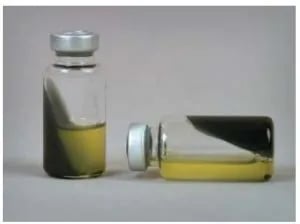 Figure: Fig. Trans Isolate (T-I) Medium
T-I medium consists of a solid phase (a slant containing activated charcoal, soluble starch, and agar) and a liquid phase (soybean-casein digest-gelatin broth buffered at pH 7.2 with MOPS buffer). It supports the growth and survival of N. meningitidis, S. pneumoniae, and H. influenzae, and in stock culture form supports growth for at least three months. National Reference Laboratories can procure T-I media directly from the WHO.
Quality Control
Upon receipt, visually inspect all media for signs of contamination and physical defects. Examination of contamination includes turbid liquid, color change, or growth of bacteria or mold on the slant. Material defects include cracked glass, broken seal, leaking, reduced volume, or absent liquid phase. If you see any of the above signs, discard the T-I bottle.
After visual inspection, store all eligible T-I media at 4°C.
Sterility Testing
- Incubate one T-I bottle vented and one non-vented for 48 hours at 37°C.
- Using a sterile syringe, withdraw 50 μL of the liquid phase of T-I and plate it onto a chocolate agar plate.
- Incubate the plate at 37°C with 5% CO2 for 48 hours. Any growth on the media is indicative of contamination.
Growth Promotion
- Using sterile technique, inoculate one T-I bottle with 100 μL of an inoculum containing 103 CFU/ml for each of the following pathogens: N. meningitidis, H. influenzae, and S. pneumoniae.
- Incubate the plate at 37°C with 5% CO2 for 48 hours.
- Observe for growth of bacterial colonies.
T-I Inoculation
Remove T-I bottles from the refrigerator at least 30 minutes before inoculating them with the CSF sample and allow them to warm at room temperature.
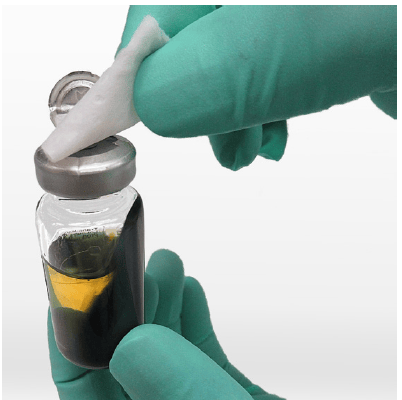 Figure: Disinfecting the rubber stopper of the T-I bottle(Source: US Centers for Disease Control and Prevention)
- Lift the small metal cap on top of the T-I bottle using sterile forceps. (Do not completely remove the aluminum cover).
- Wipe the rubber stopper with a 70% alcohol swab (do not use povidone-iodine as it may be carried into the medium by the passing needle, thus inhibiting the growth of bacteria.)
- Aseptically inoculate 0.5-1.0 ml of the CSF into the T-I medium using a 21G (0.88 mm) sterile syringe through the rubber stopper of the lid.
- Invert the T-I bottle several times and incubate the inoculated T-I medium at 35-37°C with ~5% CO2 (or in a candle jar) overnight or until transport is possible.
- Label the T-I bottle clearly with the patient’s date and name. Include identification number and other necessary information.
Transport of T-I media
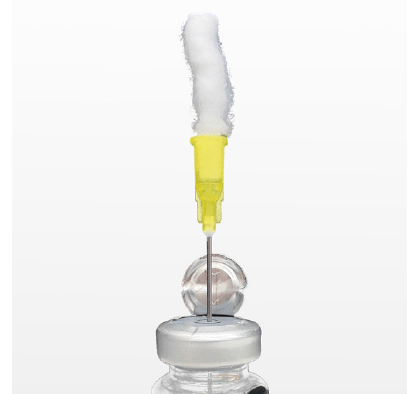 Figure: Ventilating T-I media with cotton plugged needle(Source: US Centers for Disease Control and Prevention)
- If T-I media cannot be shipped within 24 hours, ventilate with cotton plugged needle inserted through the rubber stopper without touching the media and incubate at 37°C. Before transporting the T-I media, remove the venting needle and disinfect the rubber stopper. Then transport in triple packaging following guidance for transport of infectious biological material. Transport T-I media at ambient temperature. If the T-I medium can be transported to a microbiology laboratory on the same day of inoculation, do not vent the T-I bottle until it arrives in the receiving laboratory.
- While shipping the sample to a national or reference laboratory, include a case report along with T-I media.
- Upon arrival, wipe the rubber stopper with 70% alcohol, insert a venting needle into the T-I bottle, incubate at 35-37°C with ~5% CO2 (or in a candle-jar), and observe daily for turbidity in the liquid phase for up to 7 days.
- Before subculture, remove the venting needle and wipe the rubber stopper with 70% alcohol.
- Use a sterile needle and syringe to transfer 50-100 µl of the liquid portion of the T-I medium onto both a blood agar plate (BAP) and chocolate agar (CAP) for primary culture.
- Approximately 50-100 µl is used to streak each plate. To streak two plates, draw approximately 100-200 µl with the syringe at one time to minimize the possibility of contaminating the T-I medium.
- Streak the BAP and CAP for isolation, incubate the plates at 35-37°C with ~5% CO2 (or in a candle jar), and examine the plates daily for up to 72 hours.
- If no growth is observed, subculture the T-I medium again on day 4 and day 7.
- Dispose of all inoculated T-I media in the same manner as infectious bacterial cultures.
Isolates should always be inspected for purity of growth by looking at colony morphology before any testing is performed. Cultures should be re-streaked if contamination is seen to ensure purity before testing.
Venting or Not?
The decision to vent or not vent depends entirely on how long the sample will take to reach the lab:
- Same-day transport: Do not vent the bottle. Leave it sealed until it arrives at the receiving laboratory.
- Transport delayed beyond 24 hours: Do vent, using a cotton-plugged needle inserted through the rubber stopper without touching the medium, and incubate at 37°C until shipping.
Getting this backwards, venting a bottle that was going to arrive the same day, or failing to vent one that's going to sit for days, isn't a cosmetic error. It's exactly the kind of small procedural reversal that can compromise a sample that otherwise had every chance of surviving the trip intact.
Anchor for the venting rule: "vent for the long haul, seal for the sprint." A same-day trip stays sealed until it arrives. A multi-day trip gets vented so trapped gas doesn't become a problem long before the sample ever reaches the lab.
A second easy-to-miss detail: disinfect the rubber stopper with a 70% alcohol swab only, never povidone-iodine. A needle passing through iodine-treated rubber can carry trace amounts into the medium, quietly inhibiting the growth of the very organisms the medium exists to preserve. Alcohol, reached for by default in most other clinical contexts as "the milder option," is specifically the correct and required choice here, not an alternative.
Key exam facts in one table
| Fact | Detail |
|---|---|
| Purpose | Inoculation and transport of CSF when immediate (within 1 hour) processing isn't possible |
| Design | Biphasic: solid slant (charcoal, starch, agar) + liquid broth (soybean-casein digest-gelatin, MOPS buffer, pH 7.2) |
| Organisms supported | Neisseria meningitidis, Streptococcus pneumoniae, Haemophilus influenzae |
| Stock culture shelf life | At least 3 months |
| Source for national reference labs | WHO |
| Same-day transport | Do not vent until arrival |
| Transport delayed >24 hours | Vent with a cotton-plugged needle |
| Stopper disinfection | 70% alcohol only; never povidone-iodine (risk of carrying inhibitory iodine into the medium) |
| Subculture schedule after arrival | Blood agar + chocolate agar, examine daily up to 72 hours; if no growth, re-subculture on day 4 and day 7 |
Where Students Get Confused
- Applying the venting rule backwards. Same-day transport means sealed; a delay beyond 24 hours means vented. Reversing this can genuinely compromise the sample.
- Assuming any antiseptic works for stopper disinfection. Povidone-iodine specifically risks inhibiting the target organisms if carried into the medium by the needle; only alcohol is correct here.
- Assuming a single failed subculture attempt means the sample is negative. The protocol specifically calls for re-subculturing on day 4 and day 7 before ruling out growth.
- Not appreciating why this specific trio of organisms drives the whole design. N. meningitidis, S. pneumoniae, and H. influenzae aren't an arbitrary panel, they're the three organisms responsible for the overwhelming majority of bacterial meningitis, and all three are notoriously fragile outside CSF, which is exactly the problem this medium is built to solve.
References
- Ajello, G. W., Feeley, J. C., Hayes, P. S., Reingold, A. L., Bolan, G., Broome, C. V., & Phillips, C. J. (1984). Trans-isolate medium: a new medium for primary culturing and transport of Neisseria meningitidis, Streptococcus pneumoniae, and Haemophilus influenzae. Journal of clinical microbiology, 20(1), 55–58. https://doi.org/10.1128/jcm.20.1.55-58.1984
- Wasas, A. D., Huebner, R. E., & Klugman, K. P. (1999). Use of Dorset egg medium for maintenance and transport of Neisseria meningitidis and Haemophilus influenzae type b. Journal of clinical microbiology, 37(6), 2045–2046. https://doi.org/10.1128/JCM.37.6.2045-2046.1999
Frequently Asked Questions
What is Trans-Isolate (T-I) medium used for?
What organisms does T-I medium support?
When should a T-I bottle be vented versus left sealed?
Why should povidone-iodine never be used to disinfect the T-I bottle's stopper?
What happens if no growth is seen after the first subculture?

Tankeshwar Acharya, MSc (Medical Microbiology)
Tankeshwar Acharya is an Assistant Professor in the Department of Microbiology at Patan Academy of Health Sciences (PAHS), Nepal, where he has been teaching and practicing clinical microbiology for over 14 years. He is the founder of Microbe Online, one of the leading free microbiology education resources on the web, covering bacteriology, mycology, parasitology, immunology, and clinical laboratory diagnostics written from direct experience in both the classroom and the diagnostic laboratory.