
The Wobble Hypothesis: Importance and Examples
Understand wobble base pairing at the third codon position, how one tRNA recognizes multiple codons, and why the rule matters for translation efficiency.

On this page
Here is a puzzle. The genetic code has 61 codons that stand for amino acids. If each codon needed its own matching tRNA molecule, a cell would need 61 different tRNAs. Yet most cells manage with only about 40. How can 40 tRNAs read 61 codons correctly?
The answer is the wobble hypothesis. Proposed by Francis Crick in 1966, it says that the pairing between a codon and a tRNA anticodon is strict for the first two positions but slightly flexible at the third. This small flexibility, or "wobble," lets one tRNA read several codons that differ only in their third base. That single idea explains why the genetic code has spare codons, why a cell needs fewer tRNAs than codons, and why many DNA mutations cause no harm at all. This article explains the wobble rules, works through clear examples, and shows why the concept matters well beyond the exam.
To understand wobble, start with two facts about the genetic code.
- First, codons. A codon is a set of three nucleotides in messenger RNA (mRNA) that stands for one amino acid. There are 64 possible codons. Three of them are stop signals, leaving 61 codons that specify amino acids.
- Second, degeneracy. There are only 20 amino acids but 61 coding codons, so most amino acids are represented by more than one codon. This "more codons than amino acids" feature is called degeneracy, and the extra codons almost always differ only in their third base. For example, GGU, GGC, GGA, and GGG all code for glycine, and they share the first two bases.
Wobble is the mechanism that lets a cell take advantage of this. Because the codons for one amino acid usually differ only at the third position, a single tRNA that can be flexible about that third position can read all of them.
The wobble hypothesis or wobble theory, proposed by Francis Crick in 1966, suggests that the third base of a codon can sometimes be flexible or “wobble.” The wobbling or flexibility allows for non-standard base pairing between the mRNA codon and the tRNA (t RNA) anticodon during translation.
The first two nucleotides of the codon typically adhere to strict base-pairing rules. Still, the third position may tolerate mismatches, allowing for variations such as G-U (guanine-uracil) pairing or other non-standard interactions.
This hypothesis helps explain how a relatively limited number of tRNA molecules can recognize and bind to multiple codons for the same amino acid, facilitating efficient and accurate protein synthesis. Experimental evidence has supported the wobble hypothesis, a fundamental concept in understanding the genetic code and translation machinery.
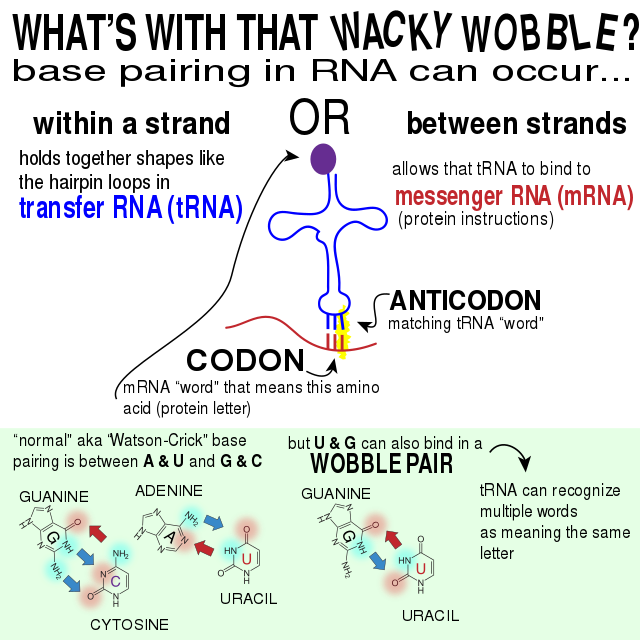 Figure: Infographic explaining wobble base pairing in RNA
Codon and anticodon: which end pairs with which
A tRNA carries a three-base anticodon that pairs with the mRNA codon. The two line up in opposite directions (antiparallel), like two strips of tape laid head-to-tail. This direction detail is the key to wobble, so it is worth stating plainly.
The codon is read 5′ to 3′. The first codon base (5′ end) pairs with the third anticodon base (3′ end). The third codon base (3′ end), which is the wobble position, pairs with the first anticodon base (5′ end).
So the "wobble" happens between the third base of the codon and the first base of the anticodon (its 5′ end). The first two codon positions still follow strict Watson-Crick pairing (A with U, G with C), which is what keeps translation accurate. Only the third position is allowed to be flexible.
The wobble base-pairing rules
Crick worked out which flexible pairings are allowed at the wobble position. The rules describe what the first anticodon base (the wobble base) can pair with at the third codon position:
| Wobble base (5′ of anticodon) | Can pair with (3′ of codon) |
|---|---|
| U | A or G |
| G | U or C |
| I (inosine) | U, C, or A |
| A | U only |
| C | G only |
Two of these do the real work. A G in the wobble position can read codons ending in U or C. And inosine (I), a modified base found in some tRNA anticodons, is the most flexible of all: it can read codons ending in U, C, or A, which lets a single tRNA cover three codons at once. A and C in the wobble position offer no flexibility; they pair only with their standard partner.
This is why fewer tRNAs are needed than codons. Each tRNA whose wobble base is G or I can cover two or three codons instead of one.
Key Points
Crick's wobble hypothesis states that the base at the 5′ end of the anticodon is held less rigidly than the other two bases. This lets it form hydrogen bonds with more than one kind of base at the 3′ (third) position of the codon. The wobble hypothesis outlines several key points:
- Degeneracy of the Genetic Code: The genetic code degenerates, meaning multiple codons can code for the same amino acid. For example, six codons, UUA, UUG, CUU, CUC, CUA, and CUG, code the amino acid leucine.
- Flexibility in Codon-Anticodon Interactions: The wobble hypothesis suggests that the base pairing between the mRNA codon’s third nucleotide and the tRNA anticodon’s corresponding nucleotide is flexible. Instead, it allows for some flexibility or “wobble” in the pairing.
- Non-Standard Base Pairing: The third position of the codon-anticodon interaction can tolerate non-standard base pairs, such as G-U (guanine-uracil) pairing. A guanine at the wobble position of the anticodon can pair with either U or C at the third position of the codon, so one tRNA reads both codons.
Importance of Wobble Hypothesis
The wobble hypothesis is essential in molecular biology for several reasons:
- Efficient Translation: The wobble hypothesis explains how fewer tRNA molecules can recognize multiple codons coding for the same amino acid. This reduces the number of tRNA species required for protein synthesis, streamlining the translation process and making it more efficient.
- Silent mutations. Because the third codon base is the flexible one, a mutation that changes only the third base often still codes for the same amino acid. For example, if GGU (glycine) mutates to GGC, it is still glycine. These are called silent mutations, and they are a direct consequence of degeneracy and wobble. This is a major reason many DNA mutations have no effect on the protein, which matters in genetics, evolution, and the study of disease.
- Evolutionary Conservation: The wobble hypothesis is evolutionarily conserved across species, indicating its fundamental importance in translation. This conservation suggests that the wobble base pairing mechanism provides an evolutionary advantage by allowing for greater adaptability and efficiency in protein synthesis.
- Understanding Genetic Code Variability: The wobble hypothesis helps us understand the variability in the genetic code, where multiple codons can code for the same amino acid. This variability provides flexibility and redundancy in the genetic code. This allows for robustness and adaptability in the face of genetic mutations and environmental changes.
- Biotechnological Applications: Understanding the wobble hypothesis is crucial in biotechnology and genetic engineering applications. For example, it informs the design of synthetic genes and optimization of codon usage to enhance protein expression in heterologous expression systems.
Overall, the wobble hypothesis plays a fundamental role in understanding protein synthesis and the genetic code, with implications for various aspects of molecular biology, genetics, and biotechnology.
Examples of Wobble Hypothesis
In the examples below, the anticodon is written 5′ to 3′, so the first base listed is the wobble base.
Phenylalanine. The codons UUU and UUC both code for phenylalanine. A tRNA with the anticodon GAA (5′ to 3′) reads both. The wobble base G at the 5′ end pairs with either U or C at the third codon position, so one tRNA covers both codons.
Isoleucine. The codons AUU, AUC, and AUA all code for isoleucine. A tRNA whose anticodon begins with inosine (I) at the 5′ end reads all three, because inosine can pair with U, C, or A. This is the clearest example of one tRNA reading three codons through wobble.
Serine (a special case). Serine is coded by six codons: UCU, UCC, UCA, UCG, plus AGU and AGC. Wobble lets one tRNA cover a group such as UCU and UCC (again through a G or inosine wobble base), but wobble alone does not join every serine codon. Some, like the AGU/AGC pair, are read by a separate tRNA. This shows an important limit: wobble reduces the number of tRNAs needed, but it does not shrink it all the way down to one tRNA per amino acid.
Limitation of Wobble Hypothesis
While the wobble hypothesis provides a valuable framework for understanding how the genetic code is flexible and the efficiency of translation, it also has some limitations and considerations:
- Context-dependence: The wobble hypothesis primarily applies to the standard codon-anticodon interactions during translation. However, non-standard base pairing beyond the wobble hypothesis may occur in certain contexts or under specific conditions. For example, modified nucleotides in tRNA or mRNA can influence base pairing interactions in ways that go beyond traditional wobble pairing rules.
- Accuracy and Specificity: While wobble base pairing can contribute to the recognition of multiple codons by a single tRNA molecule, it may also lead to potential errors during translation. The flexibility in the third position of the codon-anticodon interaction could allow non-standard base pairs to form. This can potentially lead to misinterpretation of the genetic code and errors in protein synthesis.
- Influence of Structural Constraints: The wobble hypothesis primarily focuses on the base pairing interactions between codons and anticodons. However, other factors such as tRNA structure, modifications, and interactions with the ribosome also influence the accuracy and efficiency of translation. These factors may impose additional constraints or considerations beyond the wobble hypothesis.
- Evolutionary Variability: While the wobble hypothesis explains a general trend in codon-anticodon recognition, there can be variations in wobble base pairing preferences across species or even within different tissues or cellular conditions. Evolutionary pressures, genetic variations, and differences in tRNA modifications can influence the extent and specificity of wobble interactions.
- Complexity of Codon Usage: The relationship between codon usage bias, tRNA abundance, and wobble interactions is complex and can vary between organisms and genes. While wobble base pairing contributes to codon redundancy and efficient translation, other factors such as codon optimality, mRNA secondary structure, and ribosome kinetics influence translation efficiency and protein expression levels.
How to Remember
What "wobble" names. The word describes the third base of the codon, the one allowed to wobble. First two bases: strict. Third base: wobbly. "Two strict, one loose" is the whole hypothesis in three words.
Which end of the anticodon does the wobbling. The wobble base is the 5′ base of the anticodon, because it pairs with the 3′ (third) base of the codon. They are antiparallel, so the wobble happens at the two "inner facing" ends: 3′ of codon meets 5′ of anticodon. A self-check: "codon three, anticodon one."
The two flexible bases that matter. Only two wobble bases give real flexibility: G (reads U or C) and I, inosine (reads U, C, or A). Remember "G reads two, I reads three." Inosine is the champion because it covers three codons with one tRNA.
Why mutations often do nothing. Because the wobbly base is the third one, changing it usually keeps the same amino acid. "Third base changes, amino acid stays" is the reason silent mutations exist.
Key exam facts
| Fact | Detail |
|---|---|
| Proposed by | Francis Crick, 1966 |
| What it explains | Degeneracy of the genetic code; why fewer tRNAs than codons |
| Coding codons | 61 (64 minus 3 stop codons) |
| Approx. tRNAs needed | About 40, thanks to wobble |
| Strict positions | First and second codon bases (Watson-Crick) |
| Flexible position | Third codon base (the wobble position) |
| Wobble base location | 5′ end (first base) of the anticodon |
| G wobble base reads | U or C |
| Inosine (I) wobble base reads | U, C, or A |
| Key consequence | Silent mutations at the third codon base |
Where Students Get Confused
The wobble is at the third codon base, not the first. The first two codon positions pair strictly. Only the third position is flexible. Students sometimes think the whole codon is loose; it is not, and that strictness is what keeps translation accurate.
Which end of the anticodon wobbles. The wobble base is the base at the 5′ end of the anticodon, because codon and anticodon are antiparallel. The third base of the codon (its 3′ end) faces the first base of the anticodon (its 5′ end). Writing the anticodon in the wrong direction is the most common source of wrong answers, so always note which end is 5′.
Inosine is not one of the four standard bases. Inosine (I) is a modified base found in some tRNA anticodons. It is not present in mRNA codons. Its special value is its flexibility: it can pair with U, C, or A at the wobble position.
Wobble reduces tRNA number but not to one per amino acid. Wobble lets one tRNA read two or three related codons, but amino acids with six codons (like serine or leucine) still need more than one tRNA. Wobble makes translation efficient; it does not make it one-tRNA-per-amino-acid.
Degeneracy and wobble are related but not the same. Degeneracy is the feature of the code: more than one codon per amino acid. Wobble is the mechanism at the tRNA level that lets a cell read those extra codons without needing an extra tRNA for each. One describes the code, the other explains how it is read.
Frequently Asked Questions
What is the wobble hypothesis in simple terms?
What is the wobble hypothesis in simple terms?
It is the idea, proposed by Francis Crick in 1966, that the pairing between an mRNA codon and a tRNA anticodon is strict at the first two positions but flexible at the third. This flexibility lets one tRNA recognize several codons that differ only in their third base.
Why is it called "wobble"?
Why is it called "wobble"?
Because the third base of the codon is allowed to "wobble," meaning it can pair in a slightly non-standard way with the anticodon. The first two positions do not wobble; they follow strict base-pairing rules.
What are the wobble base-pairing rules?
What are the wobble base-pairing rules?
At the wobble position (the 5′ base of the anticodon): U can pair with A or G, G can pair with U or C, and inosine (I) can pair with U, C, or A. A and C at this position pair only with their standard partner.
Why does the wobble hypothesis matter?
Why does the wobble hypothesis matter?
It explains how a cell can read all 61 coding codons with only about 40 tRNAs, which makes translation efficient. It also explains why many mutations in the third codon base are silent and do not change the protein.
What is the role of inosine in wobble?
What is the role of inosine in wobble?
Inosine is a modified base found in some tRNA anticodons. At the wobble position it can pair with U, C, or A, so a single tRNA carrying inosine can read three different codons. It is the most flexible wobble base.
How does the wobble hypothesis reduce the number of tRNAs needed?
How does the wobble hypothesis reduce the number of tRNAs needed?
Because the codons for one amino acid usually differ only at the third base, a tRNA that is flexible at that position can read two or three of them. This means the cell does not need a separate tRNA for every codon, so around 40 tRNAs can read all 61 coding codons.
What is the difference between degeneracy and wobble?
What is the difference between degeneracy and wobble?
Degeneracy is a property of the genetic code: more than one codon can code for the same amino acid. Wobble is the mechanism that lets a single tRNA read those multiple codons, by allowing flexible pairing at the third codon position.
References
- Crick FH. Codon-anticodon pairing: the wobble hypothesis. J Mol Biol. 1966;19(2):548-555. https://doi.org/10.1016/s0022-2836(66)80022-0
- Watson JD, Baker TA, Bell SP, Gann A, Levine M, Losick R. Molecular Biology of the Gene. 7th ed. Pearson; 2013.
- Nelson DL, Cox MM. Lehninger Principles of Biochemistry. 8th ed. W.H. Freeman; 2021.
- Alberts B, Heald R, Johnson A, et al. Molecular Biology of the Cell. 7th ed. W.W. Norton; 2022.

Tankeshwar Acharya, MSc (Medical Microbiology)
Tankeshwar Acharya is an Assistant Professor in the Department of Microbiology at Patan Academy of Health Sciences (PAHS), Nepal, where he has been teaching and practicing clinical microbiology for over 14 years. He is the founder of Microbe Online, one of the leading free microbiology education resources on the web, covering bacteriology, mycology, parasitology, immunology, and clinical laboratory diagnostics written from direct experience in both the classroom and the diagnostic laboratory.
Comments
No comments yet. Be the first to share your thoughts.
Leave a comment
All comments are reviewed before they appear.