

A previously healthy young person develops a sudden high fever, a widespread sunburn-like rash, plummeting blood pressure, and within hours is in shock with failing organs. The trigger can be as ordinary as a retained tampon or an infected wound.
The cause is not the bacteria spreading through the body. It is a single toxin that hijacks the immune system and turns it against itself, forcing a huge fraction of the body's T cells to fire at once. That toxin is a superantigen, and understanding how it works explains one of the most dramatic emergencies in infectious disease.
Superantigens are intact microbial proteins, usually bacterial or viral toxins, that can activate a large fraction of the body's T cells at once, on the order of up to 20 percent. The word "intact" is central: unlike ordinary antigens, superantigens are not broken down into peptides and processed by antigen-presenting cells. They act as whole molecules, binding directly to the outside of the T-cell receptor and to MHC class II.
This mass activation is not a targeted, useful immune response. It is a dysregulated one, and the flood of cytokines it releases can cause life-threatening illness and death.
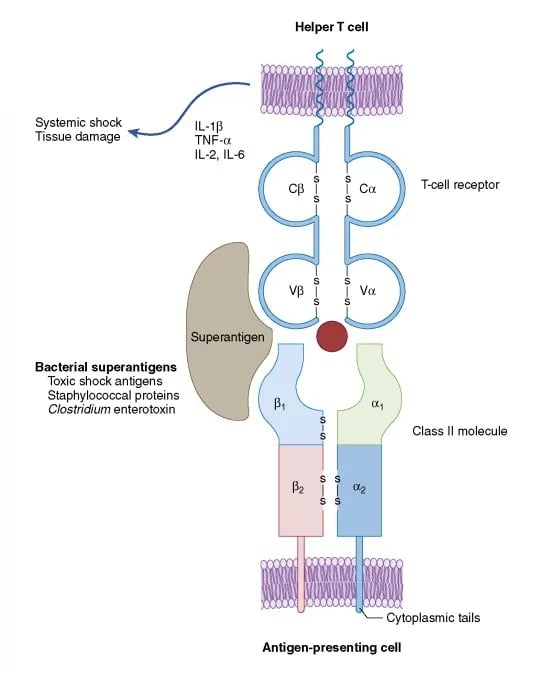 Figure: Superantigen interaction with TCR-MHC-II(Source)
Superantigens bind simultaneously to the Vβ domain of a T-cell receptor and the α chain of a class II MHC molecule. Cross linkage of a T-cell receptor and class II MHC molecule produces an activating signal that induces T-cell activation and proliferation.
Superantigens bind simultaneously to the Vβ domain of a T-cell receptor and the class II MHC molecule. This cross-linking produces an activating signal that drives T-cell activation and proliferation. Because many different T cells share the same Vβ domain, a single superantigen activates large numbers of T cells with different specificities.
Superantigens activate a large fraction of the T-cell population, commonly cited as up to 20 percent, with reported ranges from about 5 to 25 percent depending on the specific toxin. Compare this with a conventional antigen, which activates only about 1 in 10⁴ to 1 in 10⁶ T cells. The difference is enormous: a normal response recruits a tiny, specific subset of T cells, while a superantigen recruits a huge, indiscriminate slice of the entire repertoire. See more: How MHC works and how APCs or target cells present peptides through MHC.
That mass activation forces the overproduction of T-helper cytokines, particularly TNF-alpha, IL-1, and IL-6. This sudden, systemic flood is often called a cytokine storm, and it is what drives the fever, capillary leak, falling blood pressure, multi-organ failure, and death seen in severe cases.
Why one toxin activates so many T cells
The scale of a superantigen response follows logically from where it binds. Walking through it makes the whole topic click.
A normal T-cell receptor recognizes a specific peptide sitting inside the groove of an MHC molecule. Only a T cell whose receptor matches that exact peptide is activated, which is why a conventional response is small and specific.
A superantigen ignores the groove entirely. It clamps the MHC class II molecule and the T-cell receptor together from the outside, binding the conserved Vβ region of the receptor's beta chain rather than the variable peptide-binding site. Because it grips a region that is shared across many different T cells, the specificity of the individual receptor no longer matters.
The consequence: every T cell that carries the right Vβ family gets cross-linked and activated, regardless of what antigen it was actually built to recognize. Since a single Vβ family is shared by a large percentage of all T cells, one toxin activates a massive number of them simultaneously.
There is a second shortcut. Normal T-cell activation needs two signals: the receptor engagement plus a separate co-stimulatory signal (B7 on the APC binding CD28 on the T cell). Superantigens can drive activation without the normal co-stimulatory requirement, removing a safety check that would otherwise limit the response. How the normal two-signal system works is covered in a separate article on T lymphocyte activation.
Put simply: superantigens win by binding the wrong place (outside the groove) on a shared part (Vβ) while bypassing a safety check (co-stimulation). That is the whole mechanism, and every clinical consequence flows from it.
Superantigens are of two kinds.
- Exogenous superantigens are soluble proteins secreted by bacteria, such as Staphylococcus aureus TSST-1 and the Streptococcus pyogenes pyrogenic exotoxins.
- Endogenous superantigens are cell-membrane proteins encoded by certain viruses that infect mammalian cells, such as mouse mammary tumor virus and Epstein-Barr virus.
Examples of Bacterial Superantigens and their roles
- Staphylococcal enterotoxins: Food poisoning
- Staphylococcal toxic shock toxin (TSST-1): Toxic shock syndrome
- Staphylococcal exfoliating toxins: Scalded skin syndrome
- Streptococcal pyrogenic exotoxins (exotoxin A and exotoxin B): Shock
Conventional antigen Vs. Superantigen
Some of the key features of conventional antigen and superantigen is summarized in the table below:
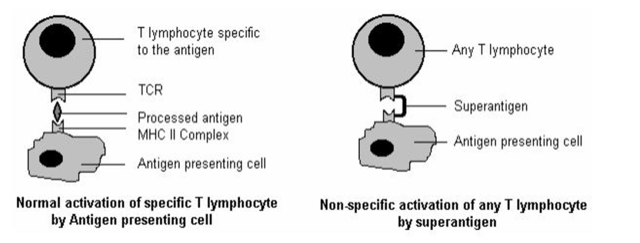 Difference between conventional antigen and superantigen
| Properties | Conventional Antigen | Superantigen |
|---|---|---|
| Nature | Antigens are foreign substances (primarily proteins and polysaccharide) or altered self-proteins that induces a specific immune response. | Superantigens are intact microbial proteins (toxins) that activate a large fraction of T cells without being processed. |
| Antigen Processing and Presentation | Conventional protein antigens are processed by antigen-presenting cells, and a peptide is presented to a matching CD4 T cell via MHC-II-peptide:TCR | Superantigens are not processed intracellularly, instead, they bind class II MHC molecules as intact macromolecules and bind outside of the peptide-antigen binding groove. |
| Binding with T cells | Classical antigens bind to the highly variable peptide groove of the T-cell receptor. | Superantigen binds/interact with the more conserved Vβ region of T cell receptor. All T cells that express that particular Vβ region are subject to activation regardless of antigen specificity. |
| Need of costimulatory signal | Successful T cell activation by conventional antigen requires multiple signals. Presentation of MHC-II-peptide-TCR is not enough to stimulate T cells. It requires co-stimulatory signal provided by an interaction between members of the B7 family (either CD80 or CD86) on APCs and CD28 on T cells. | Superantigens can activate T lymphocytes in the absence of costimulatory molecules. |
| T Cell Activation | Conventional peptide antigens activate only a tiny fraction of the T-cell population, about 1 in 10⁴ to 10⁶ T cells. | Superantigens activate a large fraction, up to about 20% (range ~5–25%), of the T-cell repertoire. |
How to remember
"Super = Skips processing, Sticks outside the groove, Stimulates by Vβ." The three S's capture the mechanism: no processing, binds outside the peptide groove, activates by the shared Vβ region.
The numbers, as a contrast pair: conventional antigen activates about 1 in a million T cells; a superantigen activates up to 1 in 5. That is the single most memorable fact on the page, roughly a million-fold difference in scale.
Cytokine storm trio: "TNF-1-6." TNF-alpha, IL-1, IL-6 are the headline cytokines. The storm, not the bacteria spreading, is what makes the patient critically ill.
The clinical four (bacterial superantigen diseases): toxic shock (TSST-1), food poisoning (enterotoxins), scalded skin (exfoliative toxins), and streptococcal shock (Spe A/B). Same trick, different toxin and target.
Key exam facts
| Fact | Detail |
|---|---|
| What a superantigen is | An intact microbial protein (toxin), not a processed peptide |
| Processing | None; acts as a whole molecule |
| Binds MHC class II | Outside the peptide groove |
| Binds TCR at | The conserved Vβ region of the beta chain |
| Co-stimulation | Not required (bypasses the normal second signal) |
| T cells activated | Up to ~20% (range ~5–25%) |
| Conventional antigen activates | ~1 in 10⁴ to 10⁶ T cells |
| Key cytokines | TNF-alpha, IL-1, IL-6 (cytokine storm) |
| Main bacterial sources | Staphylococcus aureus, Streptococcus pyogenes |
| TSST-1 causes | Toxic shock syndrome |
| Staph enterotoxins cause | Food poisoning |
| Exfoliative toxins cause | Scalded skin syndrome |
| Strep pyrogenic exotoxins cause | Streptococcal toxic shock / scarlet fever |
Where students get confused
"Superantigens are super-strong normal antigens." No. The name is misleading. They do not trigger a stronger version of the normal response; they trigger a completely different, non-specific one. A normal antigen activates the few T cells that match it. A superantigen activates a huge fraction regardless of match.
"Superantigens are processed and presented like other antigens." No, and this is the defining feature. They are not processed at all. They bind MHC class II intact, on the outside surface, not as a peptide in the groove.
"They bind the specific peptide-binding part of the TCR." No. They bind the conserved Vβ region, which is shared by many T cells. That is exactly why so many T cells respond.
"The bacteria spreading through the body causes the shock." Not directly. The toxin can cause life-threatening shock even from a localized infection, because the damage comes from the body's own cytokine storm, not from bacteria in the bloodstream.
"Superantigen disease is autoimmunity." No. It is a toxin-driven overactivation of T cells causing a cytokine storm. The immune system is being hijacked, not mistaking self for non-self.
References and further reading
- Punt J, Stranford SA, Jones PP, Owen JA. Kuby Immunology. 8th ed. W.H. Freeman; 2019.
- Moza B, Buonpane RA, Zhu P, et al. Structural basis of T-cell specificity and activation by the bacterial superantigen TSST-1. EMBO J. 2007;26(4):1187–1197. https://doi.org/10.1038/sj.emboj.7601531
- Abbas AK, Lichtman AH, Pillai S. Cellular and Molecular Immunology. 10th ed. Elsevier; 2022.

Comments
No comments yet. Be the first to share your thoughts.
Leave a comment
All comments are reviewed before they appear.