
Antigen-Presenting Cells: Professional and Non-Professional APCs
What antigen-presenting cells are, the three professional APCs (dendritic cells, macrophages, B cells), how they differ from non-professional APCs, and what makes a cell "professional." For micro and health-science students.

On this page
A T cell is powerful but nearly blind. It cannot see a whole pathogen, and it cannot respond to a free-floating protein. It can only act when another cell catches the antigen, breaks it into pieces, and holds one piece up on a special display molecule for the T cell to inspect. The cells that do this job are the antigen-presenting cells.
Some are specialists, built for this task and able to switch on a naive T cell from scratch. Others do it only part-time, when the situation demands. Understanding which cells present antigen, and what separates the specialists from the part-timers, explains how the adaptive immune response gets started in the first place.
What is an antigen-presenting cell?
An antigen-presenting cell (APC) is any cell that displays a fragment of antigen on an MHC molecule so that a T cell can recognize it. Because T cells cannot recognize free antigen, this display step is the gateway to the entire adaptive immune response. No presentation, no T-cell response.
There is a broad sense and a narrow sense of the term, and keeping them apart avoids most confusion.
In the broad sense, almost every cell in the body is an antigen-presenting cell, because nearly all nucleated cells carry MHC class I and constantly display fragments of their own internal proteins for inspection by CD8 T cells. This is how a virus-infected cell reveals itself.
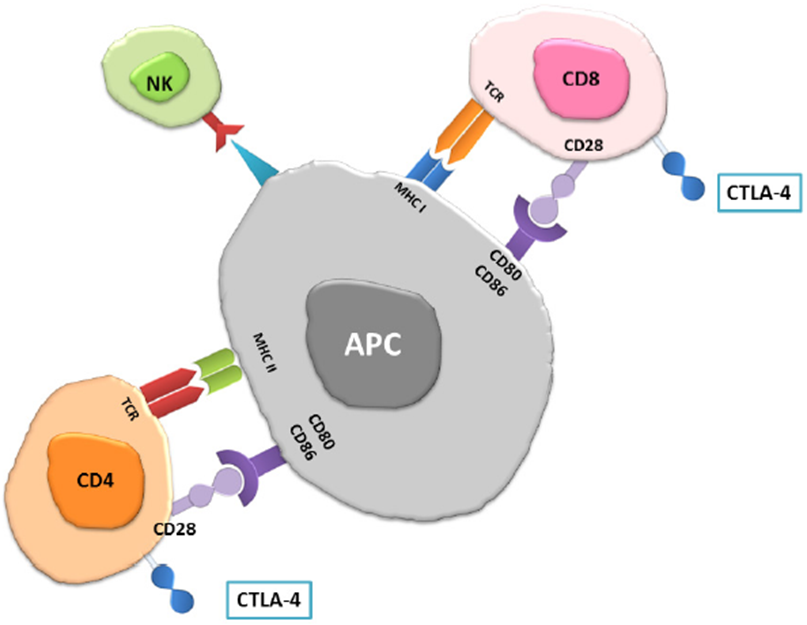 Figure: Antigen-presenting cell (APC) presenting antigen to CD8, CD4 and NK Cells.
In the narrow sense, and the one usually meant by "APC," an antigen-presenting cell is a cell that takes up antigen from outside, processes it, and displays it on MHC class II to CD4 helper T cells. Only certain cells can do this. When immunologists say "APC," they almost always mean this narrower group.
How antigens are processed and loaded onto MHC molecules is covered in a separate article on MHC molecules. This article focuses on the cells themselves.
Professional vs non-professional APCs
The cells that present on MHC class II fall into two groups, and the dividing line is simple and worth memorizing.
Professional APCs express MHC class II all the time (constitutively) and also carry the co-stimulatory molecules needed to fully activate a T cell. Because they have both signals ready, they can switch on a naive T cell that has never seen its antigen before. There are three professional APCs: dendritic cells, macrophages, and B cells.
Non-professional APCs (also called amateur or atypical APCs) do not normally express MHC class II. They can be induced to express it temporarily, usually by inflammatory signals such as the cytokine interferon-gamma, and can then present antigen in a limited way. They generally cannot prime a naive T cell on their own. Examples include fibroblasts, epithelial cells, endothelial cells, and glial cells.
The single distinguishing question is: does the cell express MHC class II all the time and provide co-stimulation? If yes, it is professional. If it only presents when inflamed, and cannot fully activate a naive T cell, it is non-professional.
The three professional APCs
Dendritic cells
Dendritic cells are the most important professional APCs and the most effective at activating naive T cells. They sit in tissues that contact the outside world, such as skin and mucosa, where they capture antigen. They then migrate to the lymph nodes and present it to T cells. Because they are the best at starting a response from scratch, they are the main bridge between innate and adaptive immunity. Their detailed role is introduced in the article on cells of the immune system.
Macrophages
Macrophages are phagocytes first and presenters second. They engulf and destroy pathogens, then display fragments on MHC class II to helper T cells. A helper T cell that recognizes the fragment can, in turn, activate the macrophage further, making it a better killer. So the macrophage and the helper T cell strengthen each other.
B cells
B cells present antigen in a targeted way. Using their B-cell receptor, they capture the specific antigen they recognize, internalize it, and present it on MHC class II to a helper T cell. This is the step that lets a helper T cell provide help back to the B cell, which the B cell needs to make high-quality antibody. This two-way exchange is covered in the article on humoral immunity.
A useful way to see the three
Each professional APC captures antigen differently, and this shapes its role:
Dendritic cells sample broadly from the environment and are built to alert naive T cells. Macrophages capture what they phagocytose and use presentation to get help killing it. B cells capture one specific antigen through their receptor and use presentation to get help making antibody against it.
Same display molecule (MHC class II), three different reasons to use it.
Cross-presentation: the exception worth knowing
There is one important exception to the tidy rule that MHC class I shows inside antigens and MHC class II shows outside antigens. Some dendritic cells can take antigen captured from outside the cell and present it on MHC class I to CD8 T cells. This is called cross-presentation.
It matters because it is how the immune system activates killer (CD8) T cells against a virus that does not directly infect the dendritic cell itself. Without cross-presentation, a killer T-cell response could only be triggered by a cell the virus had actually infected. Cross-presentation lets a dendritic cell raise the alarm about an infection happening in other cells. This is largely a specialty of dendritic cells.
How to remember
APC's job in one line: catch, chop, and show. The APC catches the antigen, chops it into fragments, and shows a fragment on an MHC molecule to a T cell.
The three professionals: "DMB." Dendritic cells, Macrophages, B cells. Dendritic cells are the leaders (best at priming naive T cells).
Professional = MHC II all the time + co-stimulation. The dividing line is constitutive MHC class II plus the ability to fully activate a naive T cell. Non-professional cells only present when inflamed and cannot prime naive T cells.
Why each professional presents: Dendritic cell to alert, macrophage to get help killing, B cell to get help making antibody. Same tool, three motives.
Cross-presentation = dendritic cells breaking the rule. They show outside antigen on MHC class I to activate killer T cells against infections happening elsewhere.
Key exam facts in one table
| Fact | Detail |
|---|---|
| APC (narrow sense) | Presents outside antigen on MHC class II to CD4 T cells |
| Three professional APCs | Dendritic cells, macrophages, B cells |
| Most effective APC | Dendritic cell (best at priming naive T cells) |
| Professional means | Constitutive MHC class II + co-stimulation |
| Non-professional APCs | Fibroblasts, epithelial, endothelial, glial cells |
| Non-professional trigger | Express MHC II only when induced (e.g. IFN-gamma) |
| Can prime naive T cells | Professional APCs only |
| Macrophage presentation | Get help to kill what it engulfed |
| B cell presentation | Get help to make antibody |
| Cross-presentation | Outside antigen shown on MHC class I to CD8 T cells |
| Cross-presentation done by | Mainly dendritic cells |
Where students get confused
"All nucleated cells are APCs, so the term does not mean much." It is true that nearly all cells present on MHC class I, but the term "APC" almost always means the narrower group that presents on MHC class II to helper T cells. When someone says "APC," assume they mean dendritic cells, macrophages, or B cells unless told otherwise.
"There are three APCs total." No, there are three professional APCs. Many other cells (fibroblasts, epithelial cells) can present as non-professional APCs when induced. And in the broadest sense, all nucleated cells present on MHC class I.
"Any APC can activate a naive T cell." No. Only professional APCs can prime a naive T cell, because they provide both antigen on MHC class II and the co-stimulatory second signal. Non-professional APCs lack full co-stimulation and cannot do this.
"Cross-presentation means MHC class II showing inside antigen." No, it is the reverse. Cross-presentation is outside (exogenous) antigen being shown on MHC class I to CD8 T cells. It is the exception to the usual rule, and mainly a dendritic cell ability.
"B cells present random antigens like macrophages do." No. A B cell presents the specific antigen its receptor captured, not just anything it engulfs. This specificity is exactly why B-cell presentation leads to help for making antibody against that antigen.
References
- Abbas AK, Lichtman AH, Pillai S. Cellular and Molecular Immunology. 10th ed. Elsevier; 2022.
- Punt J, Stranford SA, Jones PP, Owen JA. Kuby Immunology. 8th ed. W.H. Freeman; 2019.
- Kambayashi T, Laufer TM. Atypical MHC class II-expressing antigen-presenting cells: can anything replace a dendritic cell? Nat Rev Immunol. 2014;14(11):719–730. https://doi.org/10.1038/nri3754

Tankeshwar Acharya, MSc (Medical Microbiology)
Tankeshwar Acharya is an Assistant Professor in the Department of Microbiology at Patan Academy of Health Sciences (PAHS), Nepal, where he has been teaching and practicing clinical microbiology for over 14 years. He is the founder of Microbe Online, one of the leading free microbiology education resources on the web, covering bacteriology, mycology, parasitology, immunology, and clinical laboratory diagnostics written from direct experience in both the classroom and the diagnostic laboratory.
Comments
No comments yet. Be the first to share your thoughts.
Leave a comment
All comments are reviewed before they appear.