
Sterilization and Disinfection Methods
The framework hospitals actually use to decide how sterile a device needs to be, sterilization vs. disinfection vs. decontamination explained clearly, the Spaulding Classification, and the full mechanism of every method linked below.
The device that was cleaned, just not enough
Endoscopes present a genuinely difficult reprocessing problem: they're expensive, reusable, contain long narrow internal channels that are hard to fully access, and they contact mucous membranes deep inside the body during almost every procedure. In the mid-2010s, a series of real, well-documented U.S. healthcare-associated infection investigations traced clusters of carbapenem-resistant Enterobacteriaceae (CRE) infections back to inadequately reprocessed duodenoscopes, despite staff having followed a cleaning protocol.
The failure wasn't carelessness. It was that a device contacting mucous membranes needs to reach a specific, defined level of microbial killing, high-level disinfection at minimum, and the combination of the device's complex internal geometry and the cleaning protocol in use didn't reliably achieve that level inside every channel, every time. A blood pressure cuff, which only ever touches intact skin, can be safely reused after a much lower level of cleaning. An endoscope cannot. Treating the two as if they belonged in the same category, even informally, is exactly the kind of gap that leads to outbreaks like this one.
The framework that exists specifically to prevent this confusion, deciding exactly how sterile a given device needs to be, based on what part of the body it will actually touch, is called the Spaulding Classification, and it's the organizing idea behind everything in this article.
Sterilization is the process of killing or removing all microorganisms, including highly resistant bacterial endospores. Depending on the material, sterilization can be achieved by moist heat (autoclave), dry heat (hot air oven), ethylene oxide gas, or filtration.
However, sterilization is not always attainable or practical, for example, in fresh produce processing. In those cases, rapid microbial growth is limited instead by decontamination and disinfection.
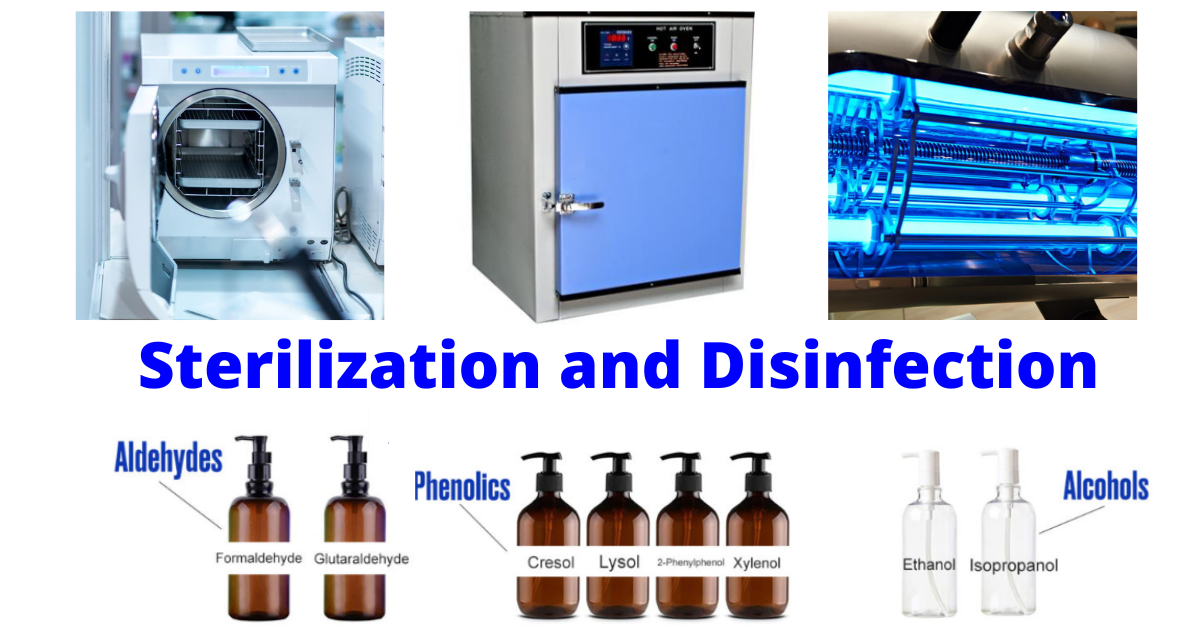 Figure: Methods of sterilization and disinfection
Disinfection is the killing of pathogenic organisms, but not necessarily all microorganisms. Pathogenic bacteria are destroyed during disinfection, but some microorganisms, including bacterial endospores, may remain viable. Disinfectant choice depends on the intended use, inanimate objects versus skin surfaces. Common disinfectants include phenol-containing compounds, quaternary ammonium compounds, alcohol, chlorine, and iodine.
Decontamination is the removal of pathogenic microorganisms from inanimate objects or surfaces so that items are safe to handle or dispose of, the least rigorous of the three terms. Simply wiping a table after a meal, for example, removes contaminating microorganisms and their potential nutrients, without claiming to kill anything specific.
The Spaulding Classification
Deciding which of these three processes a given item actually needs isn't guesswork. The Spaulding Classification, developed by Earle Spaulding and adopted by the CDC, sorts medical devices into three categories based on the infection risk of how they're used, not on how the device looks or feels:
| Category | Definition | Required processing |
|---|---|---|
| Critical | Enters normally sterile tissue, the vascular system, or blood flow | Sterilization (all microbial life, including endospores, must be destroyed) — e.g., surgical instruments, cardiac catheters, implants, needles |
| Semicritical | Contacts mucous membranes or non-intact skin, without penetrating sterile tissue | High-level disinfection at minimum — e.g., endoscopes, respiratory therapy equipment |
| Noncritical | Contacts only intact skin | Low- to intermediate-level disinfection — e.g., blood pressure cuffs, stethoscopes |
This is exactly the framework the duodenoscope outbreaks above ran into: a semicritical device needs high-level disinfection every single time, in every channel, and any gap between that requirement and what actually happens during reprocessing becomes a real infection risk.
Factors Affecting Sterilization and Disinfection Success
Several factors determine whether a given sterilization or disinfection method actually succeeds: the microbial load and amount of organic material present, the type of organism involved (bacterial spores are far more resistant than most vegetative bacteria or enveloped viruses), the concentration and exposure time of the germicide, the physical nature of the surface, and temperature and pH.
For the full breakdown of each factor, plus the complete hierarchy of microbial resistance, see Disinfection: Methods and Uses.
Sterilization Methods
Physical Agents of Sterilization
Heat, radiation, and filtration are the most commonly used physical sterilization methods, with heat being the most widely used overall.
Incineration. Treating infectious waste by burning it to ash at 870–980°C. Incineration is the most complete method available for destroying pathogenic microorganisms, bacterial endospores, and even prions, though toxic air emissions and heavy metals in the resulting ash have limited its broader use.
Moist heat sterilization. Using autoclaves, moist heat (saturated steam under pressure) sterilizes bio-hazardous waste and heat-stable objects, the fastest and simplest physical sterilization method available. The two common sterilization parameters are 121°C for 15 minutes and 132°C for 5 minutes. Read the full mechanism, including boiling, tyndallization, and pasteurization, in Moist Heat Sterilization, or the full autoclave procedure and parts in Autoclave Sterilization.
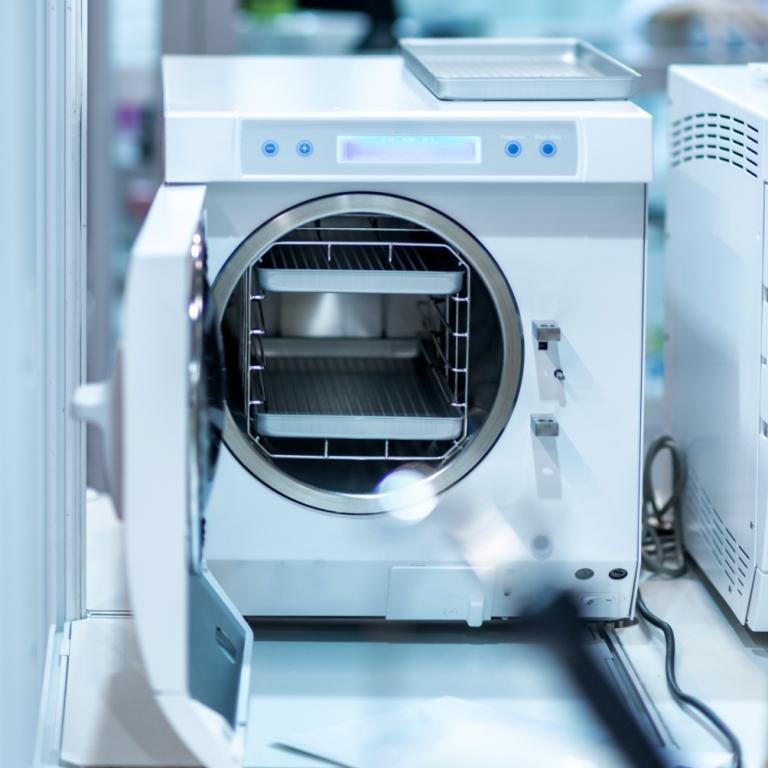 Image: Medical Autoclave
Dry heat sterilization. Requires longer exposure (1.5–3 hours) and higher temperatures (160–180°C) than moist heat, used for glassware, oils, petrolatum, and powders. Read more in Dry-Heat Sterilization, or about the equipment itself in Hot Air Oven: Parts, Types, and Uses.
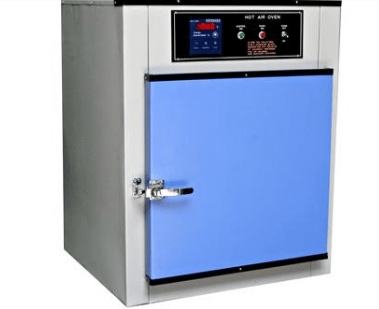 Source: Autoclave
Radiation. Ionizing radiation generates reactive species (electrons, hydroxyl and hydride radicals) that damage DNA, lipids, and protein, killing the irradiated cell. The FDA has approved radiation for sterilizing surgical supplies, disposable labware, drugs, and tissue grafts; the WHO has approved it for decontaminating foods susceptible to microbial contamination, such as fresh produce, meat, poultry, and spices. Read the full mechanism, including non-ionizing UV disinfection, in Radiation Sterilization.
Filtration. Passing an aqueous liquid through the tiny pores of a membrane filter traps microorganisms present in the liquid, rendering it sterile, without killing anything. High-efficiency particulate air (HEPA) filters serve the equivalent role for air filtration.
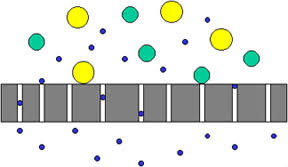 Read the full mechanism, including what filtration doesn't remove, in Filtration Sterilization.
Chemical Agents of Sterilization
Chemicals used to destroy all forms of life, including spores, are called chemical sterilants or biocides. Ethylene oxide and hydrogen peroxide are common examples. The same chemicals, used at lower concentration or for shorter contact time, function as disinfectants instead. Ethylene oxide (EtO) is the most common chemical sterilant for heat-sensitive objects; vapor-phase hydrogen peroxide is used to sterilize HEPA filters in biological safety cabinets and both metal and nonmetal medical instruments.
Disinfection Methods
Physical Methods of Disinfection
Boiling and pasteurization. Boiling at 100°C kills most vegetative bacteria and non-sporing organisms but does not reliably kill bacterial endospores, making it a disinfection method, not a sterilization one. Pasteurization uses controlled heat to reduce pathogens (including those causing tuberculosis, brucellosis, and typhoid) without sterilizing the product.
For the full comparison of boiling, tyndallization, pasteurization, and true steam sterilization, see Moist Heat Sterilization.
Non-ionizing radiation (UV). UV rays are long-wavelength, low-energy radiation that can damage microbial DNA directly, but they don't penetrate solid, opaque, or light-absorbing surfaces. This is why UV disinfection is limited to directly exposed surfaces, such as the work surface of a biological safety cabinet after use.
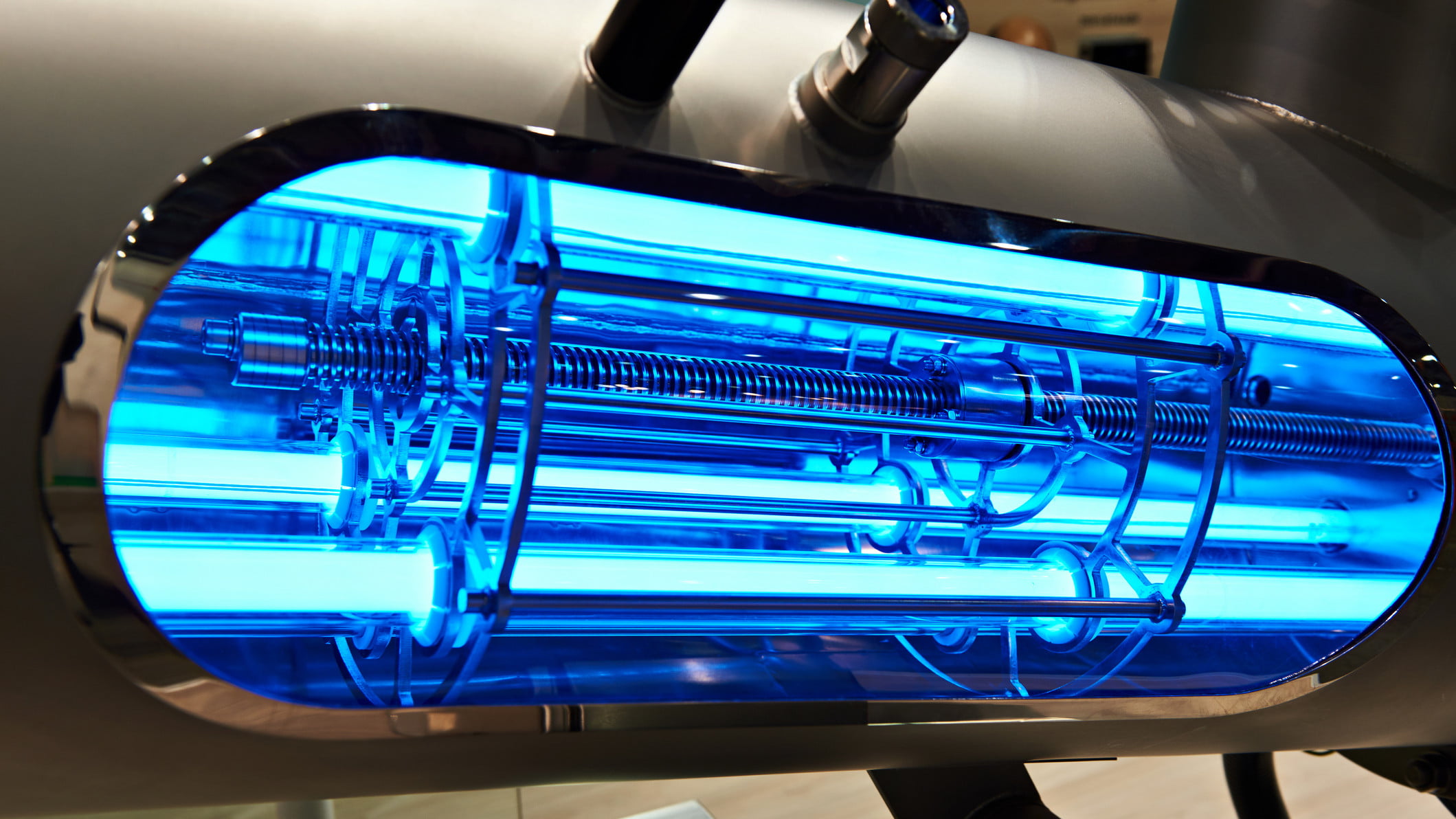 Image: Use of UV Light for Sterilization
For the full mechanism, including how UV was used during the COVID-19 pandemic, see Radiation Sterilization.
Chemical Methods of Disinfection and Levels of Disinfection
Chemical disinfectants are classified by how much they can kill: low-level disinfectants handle most vegetative bacteria and some fungi/viruses; intermediate-level disinfectants add mycobacteria; high-level disinfectants kill everything except large numbers of bacterial spores. Common chemical disinfectants include alcohols, phenolics, aldehydes, halogens (chlorine and chlorine compounds), hydrogen peroxide, peracetic acid, and quaternary ammonium compounds. Bleach (sodium hypochlorite) is commonly used to disinfect food-preparation surfaces.
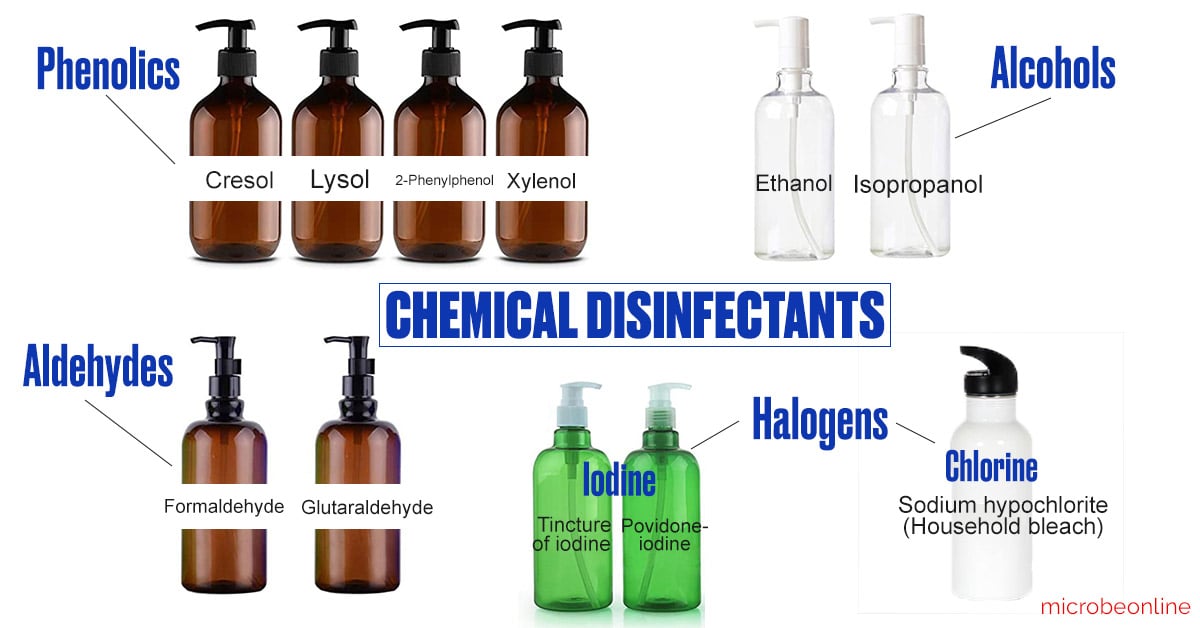 Image source: Chemical disinfectants
For the full activity-level table, the hierarchy of microbial resistance, and why some disinfectants can't be relied on against spore-forming pathogens, see Disinfection: Methods and Uses.
Antiseptics
Antiseptics are disinfectants formulated for use on living tissue, such as skin or mucous membranes, rather than inanimate objects. They matter for personal laboratory safety and for preparing patients before invasive procedures such as blood draws or surgery.
Iodine compounds (tincture-iodine or povidone-iodine) are widely used antiseptics. A combination of 70% ethyl alcohol followed by an iodophor is the most common approach to skin disinfection before drawing blood cultures or performing surgery.
Clinical Use
Sterilization and disinfection are basic components of hospital infection control. According to the CDC, more than 99,000 deaths occur each year in the United States alone due to hospital-acquired infections, making the correct application of the framework above a matter of real clinical consequence, not just an exam topic.
Devices intended to enter normally sterile sites (surgical instruments, cardiac catheters, implants, needles) should be sterilized by steam, plasma, or ethylene oxide, per the Critical category above. Devices contacting only intact skin (blood pressure cuffs, stethoscopes) are decontaminated with an intermediate- or low-level disinfectant, per the Noncritical category.
Commonly used disinfection or sterilization methods and their clinical use:
| Clinical Use | Commonly Used Disinfection or Sterilization Method |
|---|---|
| Surgical hand disinfection | Chlorhexidine |
| Surgical site skin preparation | Iodophor |
| Skin preparation for venipuncture or immunization | 70% ethanol |
| Disinfect skin before blood culture or vascular catheter insertion | Tincture of iodine followed by 70% ethanol, or iodophor, or chlorhexidine |
| Cleanse wounds | Thimerosal, chlorhexidine, hydrogen peroxide |
| Cleanse burn wounds | Silver sulfadiazine |
| Clean up blood spill from a hepatitis B/C patient | Hypochlorite (bleach) |
| Sterilize heat-sensitive materials (endoscopes, respiratory equipment) | Ethylene oxide or glutaraldehyde |
| Sterilize heat-resistant materials (surgical gowns, drapes) | Autoclave |
| Sterilize intravenous solutions | Filtration |
| Disinfect operating theatre air (when not in use) | Ultraviolet light |
| Disinfect operating room floor | Benzalkonium chloride (Lysol) |
| Disinfect stethoscope | 70% ethanol or isopropyl alcohol |
| Preserve vaccines | Thimerosal |
How to Remember
The "risk elevator" analogy for the Spaulding Classification. Picture medical devices riding an elevator with three floors, based on how deep into the body they go. Ground floor: intact skin only (noncritical), a quick clean is enough. Middle floor: mucous membranes (semicritical), the device needs high-level disinfection before it's allowed back on. Top floor: sterile tissue or bloodstream (critical), nothing short of full sterilization is acceptable. The higher the floor, the less room there is for anything to survive.
Anchor for sterilization vs. disinfection vs. decontamination: sterilization means zero survivors, no exceptions, spores included. Disinfection means the dangerous ones are dead, but spores might still be there. Decontamination is the lowest bar of all: just "safe enough to handle," with no specific claim about what's still alive.
Anchor for the hook: the duodenoscope outbreaks happened because a semicritical device needs high-level disinfection reliably, every channel, every time, and a complex device's geometry made that harder to guarantee than a simple blood pressure cuff ever would be. The Spaulding Classification exists precisely so that "how sterile does this need to be" is never left to judgment call.
Key exam facts in one table
| Fact | Detail |
|---|---|
| Sterilization | Kills/removes all microorganisms, including endospores |
| Disinfection | Kills pathogenic organisms; spores may survive |
| Decontamination | Makes an item safe to handle; the least rigorous of the three terms |
| Spaulding Classification: Critical | Enters sterile tissue/bloodstream → requires sterilization |
| Spaulding Classification: Semicritical | Contacts mucous membranes → requires high-level disinfection |
| Spaulding Classification: Noncritical | Contacts intact skin only → requires low/intermediate-level disinfection |
| Levels of chemical disinfection | Low → intermediate → high, based on which organisms each level kills |
| Physical sterilization methods | Moist heat, dry heat, radiation, filtration, incineration |
| Chemical sterilants | Ethylene oxide, hydrogen peroxide (at sterilant concentration) |
| CDC statistic | >99,000 annual U.S. deaths from hospital-acquired infections |
| Real-world consequence of misclassification | Duodenoscope-linked CRE outbreaks from inadequate high-level disinfection |
Where Students Get Confused
- Confusing high-level disinfection with sterilization. High-level disinfection kills everything except large numbers of bacterial spores. Only sterilization guarantees zero survivors, spores included. This distinction is exactly what separates the Critical and Semicritical Spaulding categories.
- Using "decontamination" and "disinfection" interchangeably. Decontamination is the broadest, least rigorous term, "safe to handle", with no specific claim about which organisms are dead. Disinfection specifically means pathogens are killed, even if some other organisms (including spores) survive.
- Assuming Spaulding classification depends on a device's physical properties. It depends entirely on what tissue the device contacts in use, not on whether it's rigid, flexible, disposable, or reusable.
- Assuming any hospital-grade method works for any device. A method appropriate for a noncritical item (like a stethoscope) is not automatically adequate for a semicritical or critical one, exactly the gap that caused real duodenoscope-related outbreaks.
References
- Forbes, B. A., Sahm, D. F., & Weissfeld, A. S. Bailey & Scott's Diagnostic Microbiology (11th ed.).
- Review of Medical Microbiology and Immunology (13th ed.). Lange Medical Books.
- Mohapatra, S. (2017). Sterilization and Disinfection. In Essentials of Neuroanesthesia (pp. 929–944). https://doi.org/10.1016/B978-0-12-805299-0.00059-2
- Madigan, M., Martinko, J., Stahl, D., & Clark, D. (2018). Brock Biology of Microorganisms (15th ed.). Pearson Education.
- Centers for Disease Control and Prevention. (2008). Guideline for Disinfection and Sterilization in Healthcare Facilities. https://www.cdc.gov/hicpac/pdf/guidelines/Disinfection_Nov_2008.pdf
Frequently Asked Questions
What is the difference between sterilization, disinfection, and decontamination?
What is the Spaulding Classification?
What processing does a critical medical device require?
What processing does a semicritical device like an endoscope require?
What are the levels of chemical disinfection?
Why did duodenoscope reprocessing failures cause real hospital outbreaks?
How many deaths occur annually from hospital-acquired infections in the U.S.?
What are the main physical methods of sterilization?
What is the difference between sterilization and disinfection?
Which microorganisms are most resistant to disinfectants?
Why is glutaraldehyde used for endoscope disinfection?
What concentration of bleach is used for different purposes?
What is the difference between an antiseptic and a disinfectant?
Why can't ethylene oxide be used for all medical devices?
Why is 70% alcohol more effective than 100% alcohol as a disinfectant?

Tankeshwar Acharya, MSc (Medical Microbiology)
Tankeshwar Acharya is an Assistant Professor in the Department of Microbiology at Patan Academy of Health Sciences (PAHS), Nepal, where he has been teaching and practicing clinical microbiology for over 14 years. He is the founder of Microbe Online, one of the leading free microbiology education resources on the web, covering bacteriology, mycology, parasitology, immunology, and clinical laboratory diagnostics written from direct experience in both the classroom and the diagnostic laboratory.