
Satellitism Test: How to Read It and Why Haemophilus Grows Only Near Staphylococcus
How the satellitism test presumptively identifies Haemophilus influenzae, how to read satellite colonies, why hemolytic species fail to satellite, and what confirms the result.

On this page
Haemophilus influenzae needs both X factor (hemin) and V factor (NAD) to grow, and plain blood agar supplies neither in usable form. Hemin stays locked inside intact red cells, and the NAD that is present is destroyed by NADase enzymes released from the red cells. This is why H. influenzae fails to grow on an ordinary blood agar plate. A neighboring Staphylococcus aureus streak changes that locally, which is the whole basis of the satellitism test.
Staphylococcus aureus secretes NAD (V factor) as a metabolic byproduct, and the lysis of red cells around its growth frees hemin (X factor). Both factors diffuse only a short distance, so Haemophilus grows as tiny colonies clustered right next to the S. aureus streak and nowhere else on the plate. This is the phenomenon called satellitism.
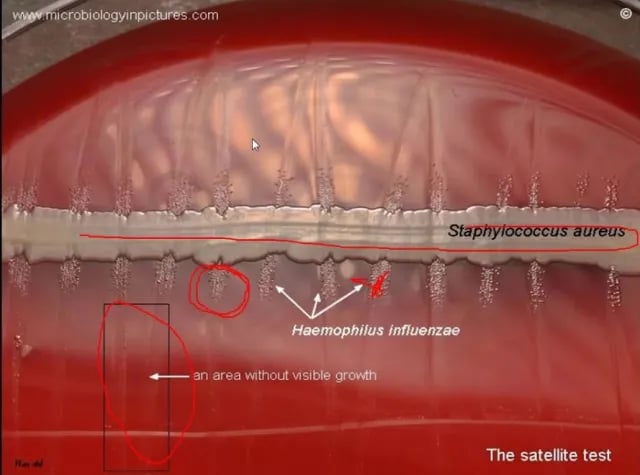 Figure: Satellitism test for the identification of Haemophilus influenzae(Image source: microbiologypictures.com)
Why does Haemophilus need X and V Factor?
Haemophilus uses X factor (hemin) to build respiratory enzymes and V factor (NAD) as a redox electron carrier. Which species needs which factor, and how to test it directly, is covered in the X and V factor test.
Quality Control
- Demonstrate satelliting on each new lot of blood agar using Staphylococcus aureus ATCC 25923 as the V factor source and Haemophilus influenzae ATCC 10211 as the test strain.
- Periodically verify that the stock strains have not become contaminated.
Procedure of Satellitism test
- Mix a loopful of suspected colonies of Haemophilus colonies in about 2 ml of sterile physiological saline (or sterile peptone water). Make sure none of the chocolate agar media is transferred.
- Using a sterile swab, inoculate the organism suspension onto two plates: (a) a plate of nutrient agar or tryptic soy agar, and (b) a plate of blood agar.
- Streak a pure culture of S. aureus across each of the inoculated plates
- Incubate both plates in a carbon dioxide-enriched atmosphere at 35 to 37°C for 18-24 hours.
- Examine the culture plates for growth and satellite colonies
Observation and interpretations
A positive result for a tiny Gram-negative rod or coccobacilli indicates the organism is in the genus Haemophilus.
The suspected colonies can be presumptively identified as Haemophilus influenzae if:
- Growth is seen in the blood agar but not in the nutrient agar (or tryptic soy agar) plate
- The colonies near the column of S. aureus growth are larger than those furthest from it
- If satellite colonies are present on both blood and nutrient agar plates, then the organism is probably a Haemophilus species that requires only factor V, such as H. parainfluenzae (the colonies of S. aureus supply v factors)
- Some organisms grow only on chocolate agar and will not grow on blood agar even with a Staphylococcus streak. These include Francisella tularensis, some Methylobacterium, and Haemophilus ducreyi.
- Haemophilus haemolyticus and H. parahaemolyticus may not demonstrate the satellite phenomenon, since they are hemolytic.
Note: Very occasionally, satellitism is shown by strains of Neisseria, Streptococcus species, and diphtheroids.
Interesting Fact: Haemophilus influenzae is the first free-living organism to have its genome (complete genetic code) sequenced.
Where Students Get Confused
1. Satellitism is a presumptive screen, not a confirmed ID. A positive satellitism test tells you the organism needs factors supplied by S. aureus. It does not by itself prove H. influenzae. Confirm with the X and V factor disk test (and the porphyrin test for X dependence) before reporting a species.
2. Hemolytic species can fool the test. H. haemolyticus and H. parahaemolyticus lyse red cells themselves, so they release their own NAD and may grow across the whole blood agar plate instead of satelliting cleanly. A strain that grows without hugging the S. aureus streak has not "failed" the test. It may be a hemolytic Haemophilus, which then looks like H. influenzae on other tests too. Separate them by hemolysis on horse blood agar.
3. The two-plate comparison is the point, and students skip it. You inoculate both a blood agar plate and a nutrient (or tryptic soy) agar plate. Growth on blood agar near S. aureus but no growth on nutrient agar points to H. influenzae (needs both X and V). Satellite growth on both plates points to a V-only species such as H. parainfluenzae, because S. aureus supplies V and the basal medium already carries trace X. Reading only the blood agar plate throws away half the information.
4. Carryover of chocolate agar ruins the result. If you transfer chocolate agar along with your inoculum, you seed the plate with free hemin and NAD, and the organism grows everywhere instead of satelliting. Make a clean saline suspension and carry no medium across.
How to Remember
Satellites orbit a star. The tiny Haemophilus colonies are the satellites, and the S. aureus streak is the star they orbit. They survive only close to it, because that is where the factors are. No star nearby, no growth.
Staph gives V, lysis gives X. S. aureus supplies NAD (V factor). The red-cell lysis around it frees hemin (X factor). One factor is donated, one is spilled.
Key exam facts in one table
| Fact | What to remember |
|---|---|
| What it tests | Presumptive identification of Haemophilus, especially H. influenzae, by growth-factor dependence. |
| Factor source | S. aureus streak: secretes NAD (V); nearby red-cell lysis frees hemin (X). |
| Positive result | Tiny colonies satelliting close to the S. aureus streak on blood agar; no growth on nutrient agar. |
| Points to H. influenzae | Growth near streak on blood agar, none on nutrient agar (needs both X and V). |
| Points to H. parainfluenzae | Satellites on both blood and nutrient agar (needs V only). |
| Common false pattern | H. haemolyticus / H. parahaemolyticus are hemolytic, may grow without satelliting. |
| Confirmatory step | X and V factor disk test; porphyrin (ALA) test for X dependence. |
| Classic trivia | H. influenzae was the first free-living organism to have its genome fully sequenced. |
References and further readings
- Leber A. L. (Ed.). (2016). Clinical Microbiology Procedures Handbook (4th ed.). ASM Press.
- Procop G. W. et al. (2017). Koneman's Color Atlas and Textbook of Diagnostic Microbiology (7th ed.). Wolters Kluwer.
- Tille P. M. (2022). Bailey & Scott's Diagnostic Microbiology (15th ed.). Elsevier.
- Musher DM. Haemophilus Species. In: Baron S, editor. Medical Microbiology. 4th edition. Galveston (TX): University of Texas Medical Branch at Galveston; 1996. Chapter 30. Available from: https://www.ncbi.nlm.nih.gov/books/NBK8458/
Frequently Asked Questions
What does a positive satellitism test mean?
It means the organism grows only next to a Staphylococcus aureus streak on blood agar, because the Staphylococcus supplies growth factors (NAD, and hemin from lysed red cells) that the organism cannot get from blood agar alone. It is a presumptive pointer to Haemophilus influenzae, confirmed by the X and V factor test.
Why does Haemophilus influenzae grow only around the Staphylococcus streak?
Why does Haemophilus influenzae grow only around the Staphylococcus streak?
S. aureus secretes NAD (V factor) and the lysis of red cells around it frees hemin (X factor). Both diffuse only a short distance, so H. influenzae, which needs both, can grow only in that narrow zone.
Does a positive satellitism test confirm Haemophilus influenzae?
Does a positive satellitism test confirm Haemophilus influenzae?
No. It is presumptive. H. haemolyticus can give a similar picture, and other species satellite too. Confirm with the X and V factor disk test and, for X dependence, the porphyrin test.
Why do we inoculate both blood agar and nutrient agar?
The comparison distinguishes species. Growth near the streak on blood agar but none on nutrient agar means the organism needs both X and V (H. influenzae). Satellite growth on both plates means it needs V only (H. parainfluenzae).
Which organisms will not satellite even with Staphylococcus?
Which organisms will not satellite even with Staphylococcus?
Organisms that grow only on chocolate agar, such as Francisella tularensis, some Methylobacterium, and Haemophilus ducreyi, do not grow on blood agar even with a Staphylococcus streak.

Tankeshwar Acharya, MSc (Medical Microbiology)
Tankeshwar Acharya is an Assistant Professor in the Department of Microbiology at Patan Academy of Health Sciences (PAHS), Nepal, where he has been teaching and practicing clinical microbiology for over 14 years. He is the founder of Microbe Online, one of the leading free microbiology education resources on the web, covering bacteriology, mycology, parasitology, immunology, and clinical laboratory diagnostics written from direct experience in both the classroom and the diagnostic laboratory.
Comments
No comments yet. Be the first to share your thoughts.
Leave a comment
All comments are reviewed before they appear.