
Spontaneous Generation Experiments MCQs: Redi, Schulze, Schwann, Pasteur, Tyndall
Ten MCQs on the experiments that disproved spontaneous generation, from Redi and Schulze to Schröder and von Dusch, Schwann, Pasteur, and Tyndall. With answer key and explanations.

On this page
1. Which of the following bacteria was not discovered by Robert Koch?
a) Bacillus anthracis
b) Mycobacterium tuberculosis
c) Salmonella Typhi
d) Vibrio cholerae
2. Which of the following scientist first described the usefulness of Azotobacter as a free-living nitrogen-fixing bacteria?
a) H. Hellriegel
b) H. Wilfarth
c) Martinus Willem Beijerinck
d) Sergei Winogradsky
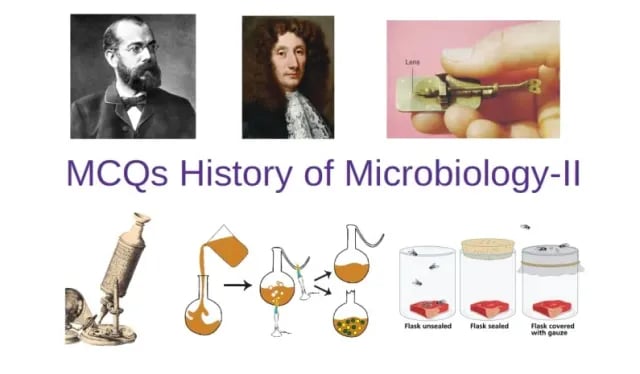 Figure: History of Microbiology II
3. Which of the following scientist first showed a mutually beneficial relationship between bacteria and leguminous plants?
a) H. Hellriegel and H. Wilfarth
b) Nocard and Roux
c) Sergei Winogradsky and Martinus Willem Beijerinck
d) Welch and Nuttall
4. All of the following scientists got Nobel Prize for their contribution to the field of Microbiology except
a) Antonie van Leeuwenhoek
b) Elie Metchnikoff
c) Paul Ehrlich
d) Robert Koch
5. All of the following scientists supported the idea of “spontaneous generation” of animals except:
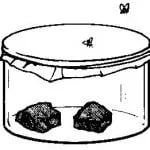 Figure: This Experiment proved maggots came from flies
a) Aristotle
b) Francesco Redi
c) John Needham
d) Felix Archimede Pouchet
6. Which of the following scientist tried to disprove the spontaneous generation theory by passing air through cotton into flasks containing heated broth?
a) Franz Schulze
b) H. Schroder and T. Von Dusch
c) Lazaro Spallanzani
d) Theodor Schwann
7. Which of the following scientist tried to disprove spontaneous generation theory by passing air into his flasks through red hot tubes?
a) Franz Schulze
b) H. Schroder and T. Von Dusch
c) Lazaro Spallanzani
d) Theodor Schwann
8. Which of the following scientist tried to disprove Spontaneous generation theory by using simple goose-necked flasks?
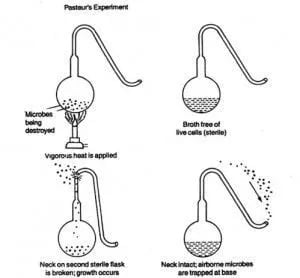 Figure: Swan necked experiment to disprove the theory of spontaneous generation
a) Franz Schulze
b) H. Schroder and T. Von Dusch
c) Louis Pasteur
d) Theodor Schwann
9. Which of the following scientist tried to disprove the spontaneous generation theory by passing air through strong acid solutions into boiled infusions?
a) Franz Schulze
b) H. Schroder and T. Von Dusch
c) Louis Pasteur
d) Theodor Schwann
10. Which of the following scientist carried out an experiment in a specially designed box to prove dust carried the germs?
a) H. Schroder and T. Von Dusch
b) John Tyndall
c) Lazaro Spallanzani
d) Louis Pasteur
History of Microbiology: Answer Key
- c (Salmonella Typhi)
- c (Martinus Willem Beijerinck)
- a (H. Hellriegel and H. Wilfarth)
- a (Antonie van Leeuwenhoek)
- b (Francesco Redi)
- b (H. Schröder and T. von Dusch)
- d (Theodor Schwann)
- c (Louis Pasteur)
- a (Franz Schulze)
- b (John Tyndall)
For the earlier questions in this series (Black Death, Leeuwenhoek, Koch's postulates, Pasteur's swan-neck flask), see MCQs in History of Microbiology (Part I).
Why these are the answers
- Salmonella Typhi. Koch discovered the agents of anthrax (1876), tuberculosis (1882), and cholera (1883). The typhoid bacillus was isolated in 1884 by Georg Gaffky, working in Koch's own laboratory, which is why it is the odd one out here. The distractors are all genuine Koch discoveries; only Typhi belongs to his colleague.
- Martinus Willem Beijerinck. He described Azotobacter, a free-living (non-symbiotic) nitrogen-fixing soil bacterium. Keep this separate from question 3: free-living nitrogen fixation is Beijerinck and Winogradsky territory; symbiotic, root-nodule nitrogen fixation is a different discovery with different names.
- H. Hellriegel and H. Wilfarth. Their classic 1888 experiments showed that legumes fix atmospheric nitrogen through their root nodules, establishing the mutually beneficial plant-bacteria relationship the question asks about. Option c is the designed trap: Beijerinck did belong to this story, but his role was to isolate and name the responsible bacteria (the rhizobia, 1888), not to discover the symbiosis; and Winogradsky does not belong here at all. Winogradsky's fame is free-living soil bacteria, chemolithotrophy, and sulfur and nitrifying organisms, which is why he is called the Father of Soil Microbiology. Pairing him with legume symbiosis is the common mistake.
- Antoni van Leeuwenhoek. He never received a Nobel Prize, and could not have: he died in 1723, and the prizes began in 1901. The other three are Nobel laureates. Robert Koch won in 1905; Elie Metchnikoff (cellular immunity, phagocytes) and Paul Ehrlich (antibody, humoral immunity) shared the 1908 prize, representing the two halves of the immunity debate of their era.
- Francesco Redi. The question asks who did NOT support spontaneous generation. Redi's covered-jar experiment (1668) showed maggots came from fly eggs, not from decaying meat itself. Aristotle, Needham, and Pouchet all defended spontaneous generation; Pouchet was Pasteur's direct opponent in the 1860s debate.
- H. Schröder and T. von Dusch. Distinguishing apparatus: a plug of cotton wool. In 1854 they filtered incoming air through cotton, which trapped airborne microbes, and the broth stayed sterile. This showed the germs travel in air, not that air itself generates life.
- Theodor Schwann. Distinguishing apparatus: a red-hot tube. He passed air through heated glass to kill anything it carried before it reached the broth. Same conclusion, different method of sterilizing the incoming air.
- Louis Pasteur. Distinguishing apparatus: the swan (goose) neck. Air reached the broth freely, but the S-bend trapped falling dust and microbes. The famous result: the broth stayed clear until the flask was tilted so the liquid touched the trapped material. This closed the debate that Redi had opened two centuries earlier.
- Franz Schulze. Distinguishing apparatus: strong acid (or KOH). He passed incoming air through concentrated potassium hydroxide or sulfuric acid to destroy any organisms before the air met the boiled infusion.
- John Tyndall. Distinguishing apparatus: a dust-free box. He showed that air rendered optically clear (free of floating dust) grew nothing, proving dust carries the germs. This work led him to fractional sterilization, still called Tyndallization, which destroys heat-resistant endospores by repeated cycles of heating and incubation.

Tankeshwar Acharya, MSc (Medical Microbiology)
Tankeshwar Acharya is an Assistant Professor in the Department of Microbiology at Patan Academy of Health Sciences (PAHS), Nepal, where he has been teaching and practicing clinical microbiology for over 14 years. He is the founder of Microbe Online, one of the leading free microbiology education resources on the web, covering bacteriology, mycology, parasitology, immunology, and clinical laboratory diagnostics written from direct experience in both the classroom and the diagnostic laboratory.
Comments
No comments yet. Be the first to share your thoughts.
Leave a comment
All comments are reviewed before they appear.