
Virology MCQs: Hepatitis Viruses (With Answers and Explanations)
Ten hepatitis virology MCQs with answers and explanations: HBV and HCV structure, hepatitis D as a defective virus, HBIG, cell culture, and laboratory diagnosis (HBsAg, IgM anti-HAV, RIBA).

On this page
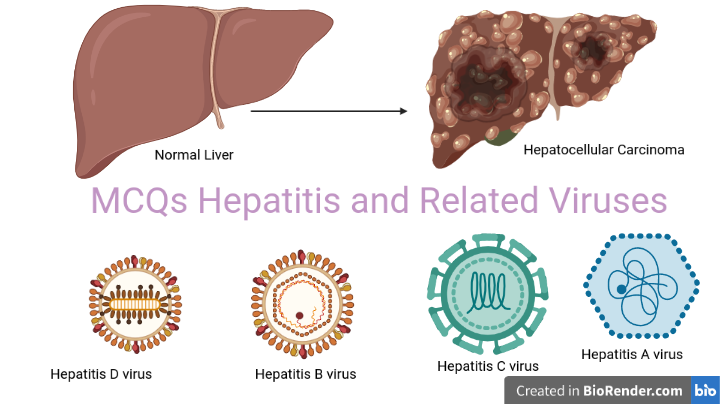
Ten multiple choice questions on the hepatitis viruses, covering their structure, replication, laboratory diagnosis, and prevention, with a full answer key and explanations at the end. Some of these can be solved by eliminating the wrong options even when the right answer is not obvious; a few are deliberately tricky. Write down your answers first, then check them against the key.
 1. Which viruses produce a DNA genome by reverse transcription, using RNA as the template, and carry that DNA genome in the infectious particle?
a. Hepadnaviruses
b. Retroviruses
c. Influenza viruses
d. SARS viruses
2. Which virus was formerly classified as enterovirus 72?
a. Hepatitis A
b. Hepatitis E
c. Polio
d. Rota
3. Which of the following is a defective virus?
a. Influenza
b. SARS
c. Marburg
d. Hepatitis D
4. Which of the following statements about the hepatitis viruses is not correct?
a. Chronic carriage of HBV is much higher than the rate of chronic carriage of HCV
b. Hepatitis D virus has only one serotype because HBsAg has only one serotype
c. Hepatitis E virus does not have a prolonged carrier stage
d. A person immunized against HBV will not be infected by hepatitis D virus
5. Which of the following statements regarding hepatitis B immune globulin (HBIG) is not correct?
a. HBIG contains a high titer of anti-HBs (HBsAb)
b. HBIG is prepared from the sera of patients who have recovered from hepatitis B
c. HBIG is used to provide immediate, passive protection to individuals
d. HBIG is not recommended for a newborn whose mother is HBsAg positive, because the baby's blood already contains HBsAb
6. Which of the following statements about culturing hepatitis viruses is correct?a. Hepatitis A virus was successfully grown in cell culture decades before hepatitis C virus
b. Hepatitis B virus is routinely cultured on enriched artificial media for diagnosis
c. No hepatitis virus has ever been propagated in cell culture
d. Cell culture is the standard laboratory method for diagnosing hepatitis C infection
7. Which of the following statements regarding the laboratory diagnosis of hepatitis viruses is misleading?
a. Recombinant immunoblot assay (RIBA) is one of the confirmatory tests used to diagnose HCV infection
b. The most important laboratory test for detecting early HBV infection is the immunoassay for HBsAg
c. The detection of IgG antibody in the patient's serum is the most important test for presumptive diagnosis of acute HAV infection
d. The diagnosis of HDV infection can be made by detecting delta antigen
8. Which one of the following statements regarding hepatitis B virus (HBV) is most accurate?
a. The most reliable indicator that a person can transmit HBV is the presence of HBsAg in the blood
b. HBV has a circular, partially double-stranded DNA genome and a DNA polymerase in the virion
c. Antibody to HBcAg (core antigen) induced by HBV infection protects against reinfection by the same strain
d. A person in the "window period" can be diagnosed as HBV-infected because HBsAg is present
9. Which one of the following statements regarding hepatitis C virus (HCV) is most accurate?
a. Chronic infection with HCV predisposes to hepatocellular carcinoma
b. HCV is a defective virus that requires concurrent HBV infection in order to replicate
c. Chronic infection with HCV occurs less frequently than chronic infection with HBV
d. Proper sewage disposal has significantly decreased the incidence of hepatitis C
10. Which one of the following statements regarding hepatitis D virus (HDV) is most accurate?
a. Alpha interferon can eradicate the latent state established by HDV
b. Immunization against hepatitis B virus (HBV) will reduce the incidence of hepatitis caused by HDV
c. HDV has DNA as its genome and an RNA-dependent DNA polymerase in the virion
d. Laboratory diagnosis of HDV infection is made by growing HDV in cells coinfected with HBV
Answer key
- a. Hepadnaviruses
- a. Hepatitis A
- d. Hepatitis D
- a. Chronic carriage of HBV is much higher than the rate of chronic carriage of HCV
- b. HBIG is prepared from the sera of patients who have recovered from hepatitis B
- a. Hepatitis A virus was successfully grown in cell culture decades before hepatitis C virus
- c. The detection of IgG antibody is the most important test for presumptive diagnosis of acute HAV infection
- b. HBV has a circular, partially double-stranded DNA genome and a DNA polymerase in the virion
- a. Chronic infection with HCV predisposes to hepatocellular carcinoma
- b. Immunization against HBV will reduce the incidence of hepatitis caused by HDV
Why these are the answers
1. Hepadnaviruses. Both hepadnaviruses (hepatitis B) and retroviruses use reverse transcription, so this pair is the trap. The distinction is what sits in the infectious particle. Hepadnaviruses reverse-transcribe their pregenomic RNA into DNA before the virion leaves the cell, so the particle carries a DNA genome; this is why HBV was first classified as a DNA virus. Retroviruses do the opposite: they carry an RNA genome in the virion and reverse-transcribe it into DNA only after entering the next cell. So the virus that produces and packages a DNA genome by reverse transcription is the hepadnavirus.
2. Hepatitis A. Hepatitis A virus was formerly classified as enterovirus 72, within the family Picornaviridae, reflecting its small, non-enveloped, positive-sense RNA structure and fecal-oral spread. It has since been reclassified into its own genus, Hepatovirus, but the enterovirus 72 designation is the historical label this question points to.
3. Hepatitis D. Hepatitis D virus (the delta agent) is a defective virus: it cannot replicate on its own because it depends on hepatitis B virus to supply the HBsAg envelope it needs to form infectious particles. This is why HDV infection occurs only in people who are also infected with HBV, either as a coinfection or a superinfection, and it is the central fact behind several of the questions here.
4. Chronic carriage of HBV is much higher than the rate of chronic carriage of HCV. This is the incorrect statement, so it is the answer. In fact the reverse is true: a much larger proportion of HCV infections become chronic (roughly a majority of adults infected) than HBV infections in immunocompetent adults (a small minority). The other statements are correct: HDV has a single serotype because it depends on the single-serotype HBsAg, hepatitis E does not establish a chronic carrier state in immunocompetent people, and immunity to HBV also protects against HDV because HDV cannot infect without HBV.
5. HBIG is prepared from the sera of patients who have recovered from hepatitis B. This statement is not correct, so it is the answer. HBIG is prepared from pooled plasma selected for a high titer of anti-HBs, not specifically from recovered hepatitis B patients. The other statements are accurate: HBIG contains a high titer of anti-HBs, it provides immediate passive protection, and it is used (together with vaccine) precisely in situations such as a newborn of an HBsAg-positive mother. Note that option d, as originally worded, describes withholding HBIG from such a newborn, which is the opposite of correct practice; a baby born to an HBsAg-positive mother should receive both HBIG and vaccine promptly. Only one option can be the single "not correct" answer the stem asks for, and the preparation claim in b is the clean factual error.
6. Hepatitis A virus was successfully grown in cell culture decades before hepatitis C virus. Hepatitis A was adapted to cell culture in the late 1970s, though it grows slowly and often without a visible cytopathic effect. Hepatitis C resisted culture for far longer and was only propagated efficiently in 2005, with the JFH-1 isolate in Huh7 cells, so HAV preceded HCV by about 25 years. The other statements are wrong: HBV cannot be grown on artificial (cell-free) media, and neither HBV nor HCV is diagnosed by culture; diagnosis relies on serology and nucleic acid tests.
7. The detection of IgG antibody is the most important test for presumptive diagnosis of acute HAV infection. This is misleading, so it is the answer. Acute hepatitis A is diagnosed by IgM anti-HAV, which marks recent or current infection; IgG anti-HAV indicates past infection or immunity, not acute disease. The other statements are accurate: RIBA has been used as a confirmatory HCV antibody test, HBsAg immunoassay is the key marker of early HBV infection, and detecting delta antigen (or anti-HDV) diagnoses HDV.
8. HBV has a circular, partially double-stranded DNA genome and a DNA polymerase in the virion. This is the accurate statement. HBV's genome is a small, circular, partially double-stranded DNA, and the virion carries its own polymerase (with reverse transcriptase activity). The distractors contain classic errors: the best marker of active transmissibility is HBeAg (not simply HBsAg), anti-HBc alone is not protective (anti-HBs is the protective, neutralizing antibody), and during the window period HBsAg has become undetectable, so a person in that period cannot be diagnosed by HBsAg (anti-HBc IgM is the useful marker then).
9. Chronic infection with HCV predisposes to hepatocellular carcinoma. This is accurate: long-standing HCV infection leads to chronic hepatitis and cirrhosis, which substantially raises the risk of hepatocellular carcinoma. The distractors are wrong: the defective, HBV-dependent virus is HDV, not HCV; HCV becomes chronic far more often than HBV, not less; and HCV is bloodborne, so sewage disposal (which affects the fecal-oral viruses HAV and HEV) has little effect on its incidence.
10. Immunization against HBV will reduce the incidence of hepatitis caused by HDV. This is accurate and is the most important practical fact about HDV. Because HDV is defective and cannot replicate without the HBsAg envelope supplied by HBV, preventing HBV infection with the HBV vaccine also prevents HDV. The distractors are wrong: HDV has an RNA genome (not DNA) and does not establish a latent state that interferon eradicates, and HDV is diagnosed serologically (delta antigen, anti-HDV) or molecularly, not by culture.

Tankeshwar Acharya, MSc (Medical Microbiology)
Tankeshwar Acharya is an Assistant Professor in the Department of Microbiology at Patan Academy of Health Sciences (PAHS), Nepal, where he has been teaching and practicing clinical microbiology for over 14 years. He is the founder of Microbe Online, one of the leading free microbiology education resources on the web, covering bacteriology, mycology, parasitology, immunology, and clinical laboratory diagnostics written from direct experience in both the classroom and the diagnostic laboratory.
Comments
No comments yet. Be the first to share your thoughts.
Leave a comment
All comments are reviewed before they appear.