Laboratory diagnosis of intestinal parasitic infections can be done by detecting and identifying the parasites or their particular stages (ova/egg, cyst, larva, or trophozoite) in the stool specimen.
Stool sample collection
Stool specimens should be collected in a wide-mouthed, clean, leak-proof container. The sample should be collected after the onset of symptoms and ideally before the initiation of the antiparasitic therapy. First-morning sample is preferable. The amount of stool and the frequency of stool specimen submission differ according to the suspected disease. Generally, collections of three stool specimens are sufficient to make a diagnosis of most intestinal parasitic infections but for some diseases like giardiasis or amoebiasis, a total of six specimens are preferable.
Transport of stool specimen
Liquid & semi-formed stool specimens should be examined within 30 minutes of collection to visualize the motility of trophozoites (if giardiasis/amoebiasis is suspected). Further delay in an examination may disintegrate the trophozoites. Formed stools may be examined up to 24 hours after passage.
Intestinal
Parasites found in Faeces
| Name of the Parasite | Protozoa or Helminth | Disease |
|---|---|---|
| Entamoeba histolytica | Protozoa | Amoebiasis & ameobic liver abscess |
| Giardia lamblia | Protozoa | Giardiasis |
| Cryptosporidium parvum | Protozoa | Cryptosporidiosis |
| Cystoisospora belli (Previously known as Isospora belli) | Protozoa | Cystoisosporiasis |
| Cyclospora cayetanensis | Protozoa | Cyclosporiasis |
| Balantidium coli | Protozoa | Balantidiasis |
| Taenia solium (pork tapeworm) | Helminth | Taeniasis & cysticercosis |
| Taenia saginata (beef tapeworm) | Helminth | Taeniasis |
| Hymenolepis nana (dwarf tapeworm ) | Helminth | Hymenolepiasis |
| Schistosoma mansoni, S. haematobium, S. japonicum | Helminth | Schistosomiasis |
| Fasciola hepatica ( the common liver fluke) or (the sheep liver fluke). | Helminth | Fascioliasis |
| Ascaris lumbricoides (large roundworm) | Helminth | Ascariasis |
| Ancylostoma duodenale (Old world hookworm) | Helminth | Hookworm infection |
| Necatar americanus (New World hookworm) | Helminth | Necatoriasis (hookworm infestations) |
| Enterobius vermicularis (Pinworm) | Helminth | Enterobiasis |
| Trichuris trichiura (Whip worm) | Helminth | Trichuriasis (whipworm infection) |
Preservation of the stool specimen
Preservatives (like formalin and polyvinyl alcohol) are used to fix stool specimens permanently. Preservatives kill the parasites, so the characteristics motility of the trophozoites cannot be seen. Preservatives help preserve morphological forms (cyst, ova, and larvae) of parasites while being sent to reference laboratories for analysis and lower the risk of infections to the laboratory technicians.
Laboratory detection methods for Intestinal Parasitic Infections
Macroscopic examination
The stool sample is first examined macroscopically for its consistency (formed, semi-formed, or liquid), color, odor, and presence of blood or mucus. Adult intestinal helminths may be seen in stool specimens, e.g.,Ascaris lumbricoides and Enterobius vermicularisor segment (proglottids) of tapeworms.
Blood and mucus in stool may be due to amoebic dysentery or invasive infections such as balantidiasis, schistosomiasis, or severe infections with Trichuris trichiura. In giardiasis, the stool specimen may be fat-colored and frothy.
Microscopic Examination
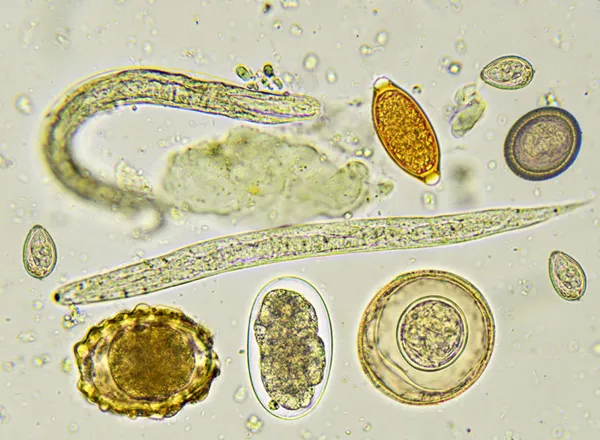
Direct wet mount (saline or iodine) of stool specimens is routinely done in diagnostic laboratories to detect and identify agents of intestinal parasitic infections.
Microscopic examination of the stool is done to detect and identify the cyst and trophozoites of protozoan parasites. In the case of helminthic infestations, eggs (ova), larvae, or segments of helminths can be seen.
Stool specimens can be concentrated by various flotation/sedimentation techniques to increase the detection rate (sensitivity). Smear from the concentrated sediment sample or permanent stained smear (e.g., Iron-hematoxylin stain, trichrome stain, modified acid-fast stain) are diagnostic tools depending on the suspected infections.
Culture Methods
Unlike Bacteriology, culture methods are rarely used as a diagnostic tool in parasitology. Culture methods are available for some of the protozoan parasites such as*; Entamoeba histolytica, Balantidium coli,* and helminths e.g. Harada-Mori culture for recovering larvae of nematodes such as hookworms, Strongyloides stercoralis.
Serology
When routine ova and parasite Exam (O & P exam) fails to identify the agents responsible for suspected parasitic infections or when an invasive parasitic infection is suspected, serological tests are used to make a diagnosis. Serological tests are available for the diagnosis of amoebiasis, giardiasis, cysticercosis, schistosomiasis, strongyloidiasis, and toxoplasmosis. Direct fluorescent antibody (DFA) assay, enzyme immunoassay (EIA) and rapid immunochromatographic cartridge assays are commonly used serological techniques.
Molecular Assay
Molecular assays (e.g. nucleic acid amplification tests such as PCR, and DNA probes) are reliable but expensive diagnostic tools that can be used for the diagnosis of intestinal parasitic infections. So far, molecular assays are not the preferred method of diagnosis for stool parasites.
References and Further Reading