
MCQs in History of Microbiology (Part I)
Eight history of microbiology MCQs with answers and explanations: spontaneous generation, Koch, Pasteur, Leeuwenhoek, and the scientists who built the field. With answer key.

On this page
MCQ History of Microbiology One: The epidemic that infected Europe, Middle East, and North Africa and killed tens of millions of people were known as the Black Death.The disease was caused by
a) Anthrax
b) Breathing of foul air
d) Smallpox
e) Swine flu
MCQ History of Microbiology Two: The event that triggered the development and establishment of microbiology as a science is the
a) Development of microscope
b) Germ theory of disease
c) Spontaneous generation
d) Use of disinfectants
e) Vaccinations
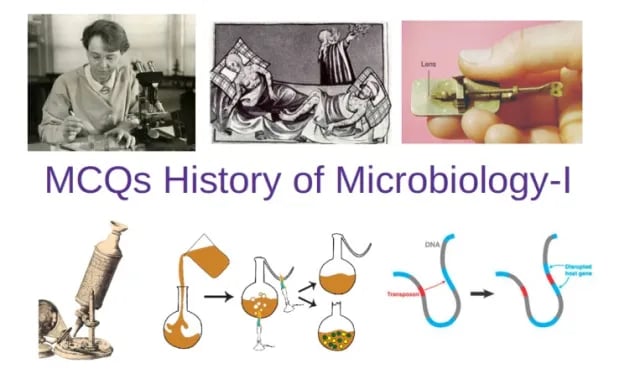 MCQ History of Microbiology Three: Which of the following pioneers of Microbiology is credited with the discovery of microorganisms using high-quality magnifying lenses (early microscopes)?
a) Anton Van Leeuwenhoek
b) Louis Pasteur
c) Robert Hooke
d) Robert Koch
e) Semmelweis
MCQ History of Microbiology four: Which scientists’ first disproved spontaneous generation by showing that maggots only appear on decaying meat that has been exposed to flies?
a) Francesco Redi
b) Joseph Lister
c) Louis Pasteur
d) Robert Hooke
e) Robert Koch
MCQ History of Microbiology Five: The purpose of swan-necked flasks that Louis Pasteur designed to disprove spontaneous generation is to:
a) Allow the multiplication of microbes in the broth
b) Implicate the role of flies in the development of maggots on rotting meat
c) Pasteurize the meat broth
d) Sterilize the broth by boiling inside the sealed flask
e) Trap the microbes and prevent them from reaching the broth
MCQ History of Microbiology Six: The double-helical structure of DNA was described in 1953 by:
a) Edward Tatum
b) Elie Metchnikoff
c) James Watson and Francis Crick
d) Oswald Avery, Maclyn McCarty, and Colin MacLeod
e) Paul Ehrlich
MCQ History of Microbiology Seven: Match the following scientists with their contribution:
I. Elie Metchnikoff | 1 Discovery of Transposons (jumping genes) |
II. Martinus Beijerinck | 2 Discovery of Arsphenamine (salvarsan) against syphilis |
III. Barbara McClintock | 3. Cellular immunity (phagocytes) |
IV. Paul Enrlich | 4. Discovered viruses (called Contagium vivum fluidum) in a filtrate |
a. I-4, II-3, III-2, IV-1
b. I-3, II-4, III-1, IV-2
c. I-3, II-1, III-2, IV-4
d. I-4, II-3, III-1, IV-2
MCQ History of Microbiology Eight: Match the following scientists with their contribution:
I. Sergey N. Winogradsky | 1 Established germ theory of disease |
II. Louis Pasteur | 2 Vaccination for Small pox |
III. Joseph Lister | 3. Discovered nitrogen fixing bacteria in soil |
IV. Edward Jenner | 4. Developed aseptic techniques |
a. I-3, II-1, III-4, IV-2
b. I-3, II-4, III-1, IV-2
c. I-4, II-1, III-2, IV-3
d. I-4, II-1, III-3, IV-2
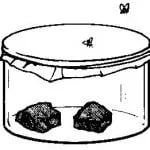 Figure: Redi’s experiment; proved maggots came from flies
Answer keys
1. c) Bubonic plague
2. a) Development of the microscope
3. a) Antoni van Leeuwenhoek
4. a) Francesco Redi
5. e) Trap the microbes and prevent them from reaching the broth
6. c) James Watson and Francis Crick
7. b. (I-3, II-4, III-1, IV-2)
8. a. (I-3, II-1, III-4, IV-2)
Why these are the answers
1. Bubonic plague. The Black Death (1347 onward) was caused by Yersinia pestis, spread by fleas from infected rodents. "Breathing of foul air" is the miasma theory, the prevailing (wrong) explanation of the time, which is exactly why it is offered here: people believed disease came from bad air long before they accepted that a living organism caused it.
2. Development of the microscope. Before Leeuwenhoek's lenses (1670s), microorganisms could not be seen at all, so no scientific study of them was possible. Germ theory is tempting, and it is what turned microbiology into a mature science, but it came roughly two centuries later and depended on the microscope existing first. The microscope made the field possible; germ theory made it powerful.
3. Antoni van Leeuwenhoek. Using single-lens microscopes he ground himself (reaching roughly 270x), he was the first to see and describe bacteria and protozoa, which he called "animalcules." Robert Hooke, a strong distractor, described cells in cork and drew fungi, but did not observe bacteria.
4. Francesco Redi. Redi (1668) covered some jars of meat and left others open. Maggots appeared only where flies could reach the meat. This was an early, targeted blow against spontaneous generation for visible organisms. Note the trap in the wording: Redi disproved it for maggots; Pasteur, two centuries later, closed the argument for microorganisms.
5. Trap the microbes and prevent them from reaching the broth. This is the key idea of the whole experiment. Pasteur boiled broth in a flask with a long S-shaped (swan) neck. Air still reached the broth freely, but airborne microbes and dust settled in the bend and never got through. The broth stayed sterile. Tilt the flask so the broth touched the trapped material, and it spoiled. This design defeated the usual objection that boiling had simply "damaged the air." It was not the boiling that kept it sterile (distractor d); boiling started every version. The bend is what made the point.
6. James Watson and Francis Crick. They described the double-helical structure of DNA in 1953, building on Rosalind Franklin's X-ray diffraction images. Watch the distractors: Avery, MacLeod, and McCarty (1944) showed that DNA, not protein, is the transforming material, that is, that DNA carries heredity, but they did not work out its structure.
7 and 8. These match scientists to contributions. The pairs students most often miss are Beijerinck (coined the concept of the virus, Contagium vivum fluidum, from tobacco mosaic filtrates), Winogradsky (nitrogen-fixing and sulfur bacteria, the founder of environmental microbiology), and Metchnikoff (cellular immunity through phagocytes, which is why he shares a Nobel with Ehrlich, who represented the antibody/humoral side). Ehrlich's own entry, Salvarsan/arsphenamine against syphilis, was the first true targeted antimicrobial, his "magic bullet."
Some of the scientists and their discoveries
The scientists in these questions built microbiology over roughly three centuries. This table gathers them in one place so you can see who did what.
| Investigator | Nationality | Contribution |
|---|---|---|
| Robert Hooke | English | First drawings of microorganisms (fungal structures); coined the term "cell" |
| Antoni van Leeuwenhoek | Dutch | Discovery of bacteria |
| Edward Jenner | English | Vaccination (smallpox) |
| Louis Pasteur | French | Principle of immunization (rabies vaccine), mechanism of fermentation, the defeat of spontaneous generation |
| Joseph Lister | English | Antiseptic surgery |
| Ferdinand Cohn | German | Discovery of endospores |
| Robert Koch | German | Koch’s postulates, the discovery of agents causing tuberculosis and cholera, pure culture microbiology |
| Sergei Winogradsky | Russian | Chemolithotrophy and chemoautotrophy, nitrogen fixation, and discovery of sulfur bacteria |
| Martinus Beijerinck | Dutch | Enrichment culture technique, the concept of the virus, and the discovery of many metabolic groups of bacteria. |
Ready for more? Continue with MCQs in History of Microbiology (Part II).

Tankeshwar Acharya, MSc (Medical Microbiology)
Tankeshwar Acharya is an Assistant Professor in the Department of Microbiology at Patan Academy of Health Sciences (PAHS), Nepal, where he has been teaching and practicing clinical microbiology for over 14 years. He is the founder of Microbe Online, one of the leading free microbiology education resources on the web, covering bacteriology, mycology, parasitology, immunology, and clinical laboratory diagnostics written from direct experience in both the classroom and the diagnostic laboratory.
Comments
No comments yet. Be the first to share your thoughts.
Leave a comment
All comments are reviewed before they appear.